
A debt management plan (DMP) has a specific meaning in U.S. consumer guidance: it is a counselor-managed repayment arrangement, not a catch-all label for every debt payoff strategy. You make one payment to the credit counseling organization, which then pays participating creditors; the counselor may be able to lower your overall monthly payment, interest charges, or fees, but a DMP does not erase what you owe. The Consumer Financial Protection Bureau explains how credit counseling and DMPs differ from debt settlement, consolidation, and credit repair.
Start with one question: after essentials, can you cover every required minimum payment? If not, prioritize creditor hardship options and nonprofit credit counseling before optimizing payoff order. If you can, decide whether you want to keep payments self-directed, compare a formal DMP, or test new credit only when the all-in cost is lower. The guide and selector below walk through those forks; debt settlement is a separate, higher-risk route.
As an Amazon Associate, I earn from qualifying purchases.
Table of Contents
- Compare Your Debt Payoff Paths
- DMP vs. DIY Payoff, Consolidation, and Settlement
- How to Vet a Credit Counseling Agency
- Understanding Your Debt Landscape
- Build the Numbers Before You Choose a Plan
- See Your Debts, Spending, and Goals Together
- Choose Your Payoff Strategy
- Debt Consolidation Strategies
- Negotiating with Creditors
- Budgeting for Debt Freedom
- Credit During a DMP or Debt Payoff Plan
- Debt Relief, Taxes, and Special Cases
- Common Debt Management Pitfalls
- Technology Tools for Debt Management
- Your DIY Debt Payoff Action Plan
- Long-Term Financial Health and Debt-Free Strategies
- Frequently Asked Questions
- Choose the Debt Path You Can Actually Finish
Compare Your Debt Payoff Paths
DMP vs. DIY Payoff, Consolidation, and Settlement
These options solve different problems, so do not choose only by the promise of “one payment.” Compare who receives your payment, whether you are taking on new credit, whether principal is expected to be repaid in full, and what happens if the plan fails.
| Path | What changes | When it may fit | Main trade-off |
|---|---|---|---|
| Debt management plan (DMP) | A credit counseling organization coordinates payments to participating creditors; creditor concessions may reduce rates or fees. | You can repay the principal but need structure, concessions, or one counselor-managed payment. | Fees may apply, not every debt is eligible, and enrolled credit-card accounts may be closed. |
| DIY avalanche or snowball | You keep paying creditors directly and direct extra money to one balance at a time. | Your minimums are current and your budget has reliable room for extra payments. | You do not receive counselor-negotiated concessions, and progress depends on consistent cash flow. |
| Consolidation or balance transfer | New credit replaces or combines existing balances. | You qualify for terms that reduce total cost and can avoid rebuilding balances. | Approval, fees, promotional deadlines, and post-promo rates can erase the benefit. |
| Debt settlement | You or a company try to settle a debt for less than the full balance. | Usually a higher-risk hardship path after safer repayment options have been evaluated. | Missed payments, fees, collection activity, credit damage, and possible tax consequences can make the outcome worse. |
How to Vet a Credit Counseling Agency Before You Enroll
If you are comparing debt management plan companies online, start by separating nonprofit credit-counseling organizations from debt-settlement firms; they solve different problems and use different payment models. If a DMP looks plausible, evaluate the counseling organization before you evaluate the pitch. Nonprofit status is a useful starting signal, but it is not a guarantee that services are free, affordable, or legitimate. The CFPB’s credit-counseling guidance says a reputable organization should review your broader financial situation rather than push a DMP as the only answer.
- Ask what services they offer. Look for budget counseling and education, not just plan enrollment.
- Get the full cost in writing. Ask about setup and monthly fees, when they are charged, and what happens if you cannot afford them.
- Check counselor qualifications. Ask about training, certification or accreditation and whether the organization is licensed where required.
- Read the agreement before paying. Put the payment amount, included debts, fees, estimated term, and verbal promises in writing.
- Confirm creditor participation. The FTC recommends checking with your creditors to verify that they accepted the proposed plan and the concessions described to you.
Understanding Your Debt Landscape
Which Debts Fit a DMP?
For a formal debt management plan, the first question is not which balance should be “lowest priority.” It is which accounts a counseling agency and your creditors will actually include, and which obligations must stay outside the plan.
Unsecured consumer debt: Credit cards are common DMP accounts. Other unsecured debts may or may not be eligible depending on the creditor and counseling agency, so confirm each account rather than assuming it will be included. The NFCC’s overview of debt-relief options describes DMPs as mainly addressing unsecured debt such as credit cards.
Secured debt: Mortgages, auto loans, and home-equity debt are tied to collateral and are generally handled outside a consumer DMP. Keep essential secured payments in the budget; missing them can put the home or vehicle at risk.
Tax and other priority debt: Government debts follow separate rules and should not be treated like ordinary credit-card balances. If you owe federal taxes you cannot pay in full, review the IRS’s current payment-plan options rather than assuming a consumer DMP will cover them.
The True Cost of Debt
Suppose Michael has $15,000 at a fixed 22% APR, makes no new charges, pays no extra fees, and sends $300 a month. At that payment, the result is about 137 months and $41,034 in total payments. Raising the payment to $550 a month changes the result to about 39 months and $20,985 total. The lesson is not that everyone should pay $550; it is that the payment amount and APR change the answer dramatically.
Build the Numbers Before You Choose a Plan
Step 1: Complete Debt Assessment
Create a comprehensive inventory including:
- Creditor name and contact information
- Current balance
- Minimum monthly payment
- Interest rate (APR)
- Payment due date
- Account status (current, past due, collections)
Use this inventory to total your balances, minimum payments, and due dates. Then compare required debt payments with the cash you actually have available after essential expenses; that tells you whether a DIY plan is workable or whether you need hardship help or credit counseling.
Step 2: Find Your Reliable Monthly Payment Room
Use the income you can reasonably expect to receive, then subtract essential spending and every required debt minimum. Reserve a realistic cash buffer for irregular expenses instead of assigning every remaining dollar to debt. What is left is the ceiling for extra DIY payments—or the payment you can compare with a written DMP proposal.
If income varies, use a conservative month rather than your best month. A plan that only works when income is unusually high is not a reliable plan.
Step 3: Stress-Test the Plan
Before you commit to a payoff route, ask:
- Can you make the payment after essentials and required minimums?
- Can you absorb a plausible surprise without immediately borrowing again?
- Does the payment still work in a weaker income month?
- If you are comparing a DMP, does the written proposal list participating accounts, fees, the monthly payment, and the estimated term?
If the answer is no, reduce the DIY extra-payment target or go back to hardship options and credit counseling before locking in the plan.
If a shortfall is mainly a timing mismatch rather than a recurring budget deficit, a cash-flow app may be worth evaluating carefully. Check fees, repayment timing, and eligibility first; our Brigit app review walks through that trade-off in detail.
Before you choose avalanche, snowball, consolidation, or a DMP, put the numbers you just gathered in one place so you can compare each path against the same cash-flow picture.
See Your Debts, Spending, and Goals Together
The Frugal Harpy 30-Minute Money Reset includes a five-sheet editable workbook whose SNAPSHOT totals income, spending, up to 8 debts, and up to 8 goals, plus an 8-page guide.
Confirm to get the workbook and frugal money tips. Unsubscribe anytime.
Something went wrong. Please check your email address and try again.
Choose Your Payoff Strategy
The Debt Avalanche Method
Avalanche: Sort debts by APR and attack the top rate first. Among simple DIY payoff orders, this generally minimizes interest when payment amounts and terms are otherwise unchanged. Keep every other account at its required payment and move the extra payment up the list each time you clear one balance.
The Debt Snowball Method
Snowball: Start with the smallest balance. If visible wins help you stay motivated, this makes progress easier to see; then roll the freed payment into the next balance.
Track it with the snowball vs. avalanche Excel spreadsheet. See also: free debt payoff tracker (printable).
When to Override Avalanche or Snowball Order
A strict highest-APR or smallest-balance order is a useful default, not a rule that overrides an urgent deadline or consequence. Pause the normal DIY order when another account needs attention first—for example, an introductory rate is about to expire, a secured payment protects an essential home or vehicle, or a creditor has offered a hardship window that changes the immediate decision.
Keep required payments and essential obligations current where possible, resolve the time-sensitive issue, then return extra payments to the avalanche or snowball order you chose.
Quick pick: Match the method to the job you need it to do.
- Avalanche: Highest rate first → usually the lowest interest cost among DIY payoff orders.
- Snowball: Smallest balance first → faster visible wins.
- Consolidation or 0% transfer: Potentially simpler or cheaper only when you qualify and the all-in fee-and-rate math beats your current debts.
- Formal DMP: A counselor-managed repayment arrangement when you need structure or creditor concessions rather than a new loan.
Debt Consolidation Strategies
Consolidation can simplify payments, but it is not automatically cheaper and it does not fix a recurring cash-flow deficit. The CFPB recommends comparing the full cost and addressing why the debt accumulated. Lenders may also use debt-to-income ratio (DTI), but the CFPB notes that DTI limits vary by lender and loan product. If a loan is still worth testing, check typical lender requirements in what credit score you need for a consolidation loan.
See also:
Personal Loan Consolidation
A fixed-rate personal loan can replace several revolving balances with one payment, but the offer only helps when its APR, origination fees, term, and monthly payment beat your current path. Use a simple loan amortization calculator to test the payment and payoff time before you apply.
Many online lenders and marketplaces target borrowers in a crunch. Before you commit to any high-cost or last-resort option, review detailed breakdowns like our Explore Credit loan review and our HonestLoans.net review so you understand the true costs and risks.
Balance Transfer Credit Cards
A 0% or low-interest balance-transfer offer can help if the transfer fee is reasonable and you can clear the balance before the promotional rate expires. The CFPB explains that introductory balance-transfer rates are temporary; check the actual offer for its transfer fee, post-promotion APR, and deadline. See the best no-fee balance transfer cards for the comparison framework.
See also: top balance transfer cards for a 600 score.
Example: $10,000 at 0% for 18 months means ~$556/mo to clear it in time—set the transfer payment on payday so you don’t miss the window.
Home Equity Options
Using a HELOC or home-equity loan to pay unsecured debt raises the stakes because the new debt is secured by your home. The CFPB warns that failure to repay can put the home at risk, and closing costs may also reduce the apparent savings.
Treat home equity as a separate, high-consequence decision—not a default debt-payoff shortcut. Compare the full cost, payment stability, and downside before converting unsecured balances into debt secured by your home.
Negotiating with Creditors
Timing and Approach
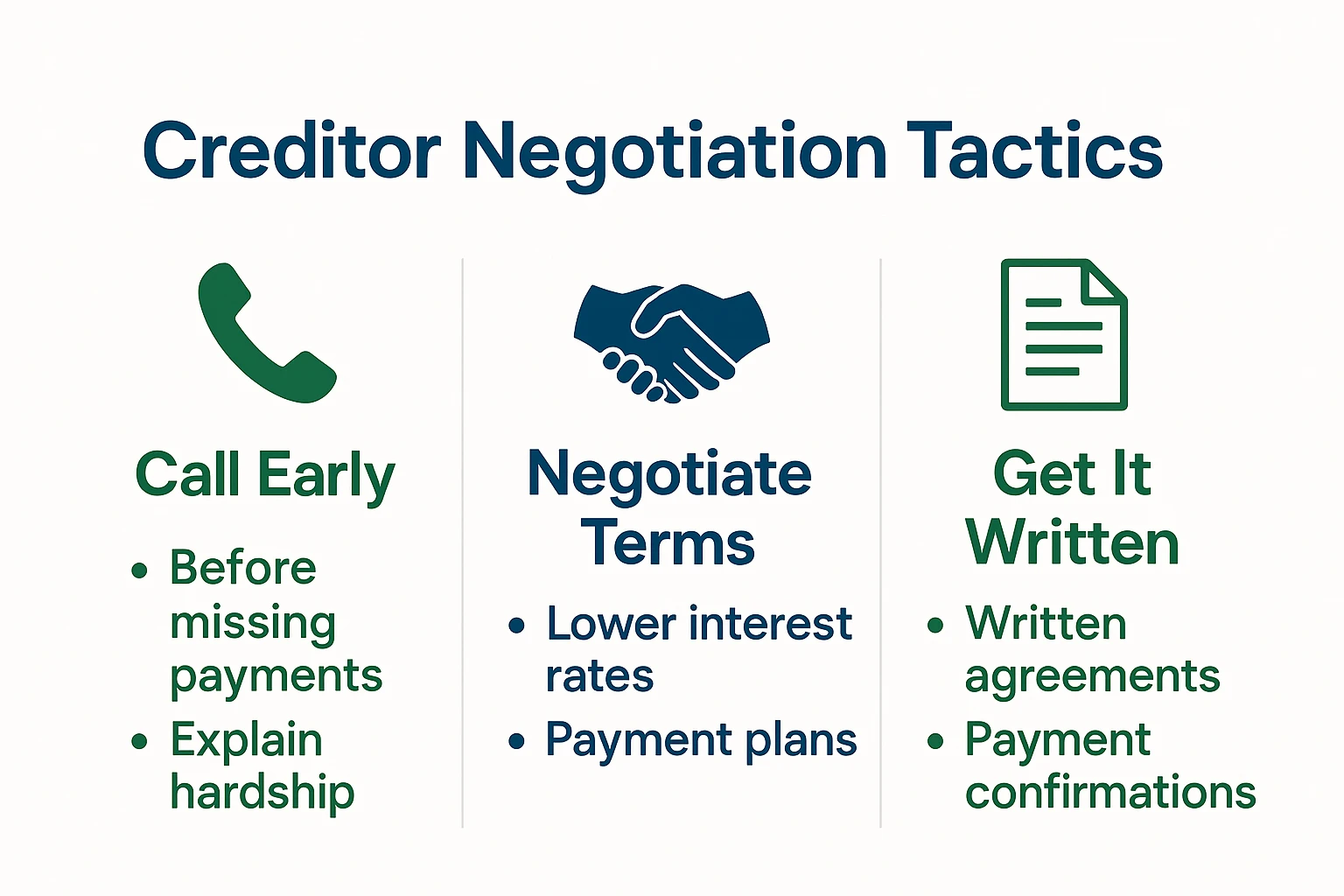
If you think you may miss a payment, contact the creditor before the due date when possible and explain what you can afford. For an ordinary medical-bill hardship request, ask whether a payment plan or financial-assistance option is available. If you are already negotiating a medical-debt settlement, use this medical debt settlement letter template. Jot down the date, the person’s name, and what you agreed to.
Common Negotiation Outcomes
- Interest or fee concessions: A creditor may reduce a rate or waive certain fees.
- Payment plan modifications: A creditor may change the monthly payment, due date, or repayment schedule.
- Hardship programs: Temporary payment or rate relief may be available when you explain what changed and what you can afford.
- Settlement: Paying less than the full balance is a different, higher-risk path from a DMP. It can affect credit and collections, and canceled debt may be taxable unless an exception applies; see the IRS guidance on canceled debt.
Documentation and Follow-Through
Get agreements in writing. Keep records of dates, representatives, and terms (new payments, rates, fee waivers, settlements).
Budgeting for Debt Freedom
Build a Payoff Budget You Can Sustain
Cover essentials and required minimums first, then choose an extra-payment amount you can repeat without relying on new debt. If the budget only works by skipping essentials or immediately borrowing again, the plan needs a hardship or counseling path—not a more aggressive percentage target.
Zero-Based Budgeting as a Planning Option
If detailed planning helps you stay consistent, assign every dollar a job before the month starts: income → essentials → debt payments → savings and other plan-aligned priorities.
If you prefer seeing the whole month on paper, there’s a dedicated option below.
Clever Fox Budget Planner — dedicated bill, expense, savings, and debt-planning sections.
Skip it if a spreadsheet or printable tracker already gives you enough structure.
Emergency Fund Considerations
Keep enough cash to absorb the next plausible surprise—such as an insurance deductible, car repair, prescription, or income gap—without immediately reaching for a card. The right starter buffer depends on your household risks; once the immediate cushion is in place, decide how to split new surplus between savings and extra debt payments.
Credit During a DMP or Debt Payoff Plan
Judge the Plan by Affordability First
A DMP is not a promise of a particular credit-score outcome. Enrolled credit-card accounts may be closed or restricted, while your payment history and balances continue to change as you repay debt. Judge the plan first by whether you can make the agreed payments without new borrowing; treat score movement as a secondary result, not the only measure of success.
If you want context for your current number, our guide on what is a good credit score explains common score ranges and what lenders typically look for.
Protect Your Credit While You Repay
Prioritize on-time payments and steadily lower revolving balances. Avoid opening new accounts only to chase a score change, and do not close an older card solely because its balance reached zero; fees, spending behavior, account age, and utilization can all affect the decision.
Check Errors Before Paying for Credit Repair
Review your credit reports for errors and dispute inaccurate information directly with the credit reporting company and the company that supplied it. The CFPB explains the free dispute process. It also notes that accurate negative information generally cannot be removed simply because it is unfavorable.
If you are still considering paid credit-repair help after checking what you can dispute yourself, read our honest Legal Harbor credit repair review so you understand how these services work, what they can and can’t do, and when a DIY approach may be enough.
Debt Relief, Taxes, and Special Cases
Tax Implications of Debt Relief
A standard DMP generally focuses on repaying what you owe rather than forgiving principal. Settlement or other cancellation is different: the IRS says canceled debt is generally taxable unless an exception or exclusion applies. Review IRS Topic 431 and consider qualified tax help if cancellation is part of your plan.
Federal Student Loan Forgiveness
If you work in government or for a qualifying nonprofit, review current Public Service Loan Forgiveness (PSLF) rules before deciding how extra student-loan payments fit into the rest of your debt plan. A potentially qualifying federal loan may need a different payoff decision from ordinary consumer debt.
Business Debt Considerations
Keep business and personal obligations separate in your debt inventory, and flag any personal guarantees or collateral. If deductibility, entity liability, or asset-protection questions affect the plan, get qualified tax or legal guidance rather than treating business debt like ordinary consumer debt.
Common Debt Management Pitfalls
Emotional Spending Triggers
If stress, social pressure, celebrations, or boredom tend to trigger spending for you, name the pattern in advance and choose a lower-cost response before the next trigger arrives.
The Debt Transfer Trap
Consolidation can backfire if old cards are used again. If paid-off cards tempt you to rebuild balances, remove them from wallets or autofill, freeze them in the issuer app when available, or consider closing an account only after weighing fees, account age, and utilization.
Perfectionism Paralysis
Do not wait for the “perfect” plan. Start with a workable version, track what breaks, and adjust the payment amount or method without abandoning the whole plan.
Technology Tools for Debt Management
Choose a Tracking System You Will Maintain
- Debt payoff app: Useful when you want balances, payoff order, and progress in one place.
- Spreadsheet or printable tracker: Better when you want full control and do not want to connect financial accounts.
- Creditor portals and alerts: Useful for due dates, minimum-payment changes, and autopay confirmation.
- Monthly debt check-in: A simple calendar reminder can be enough if your plan only needs a balance update and one extra-payment decision.
For app options, see our debt payoff tracker app roundup. Prefer calculators? Try the auto loan payoff calculator and the student loan payoff calculator.
Your DIY Debt Payoff Action Plan
If you chose a counselor-managed DMP, the counseling organization should give you the payment amount, participating accounts, fees, and estimated term in writing. If you chose a DIY payoff path, use this 30-day sequence to turn the numbers into a routine.

30-Day Quick Start: How to Get Out of Debt
Start with four steps you can sustain:
- Week 1: Complete your debt inventory and tally the totals.
- Week 2: Choose avalanche or snowball (use the debt snowball vs. avalanche comparison guide).
- Week 3: Contact creditors to negotiate or request hardship options.
- Week 4: Implement automation and tracking tools (see the printable tracker).
Need a boost? Read 10 debt payoff success stories.
90-Day Momentum Building
- Month 1: Build routines and a starter emergency fund.
- Month 2: Refine the budget and cut nonessentials that do not support your priorities.
- Month 3: Evaluate progress and adjust the payment plan.
Periodic Plan Review
- Progress toward payoff goals
- Income or essential-expense changes
- New options such as refinancing, balance-transfer offers, or hardship programs
- Credit-profile changes that affect your options
- Alignment with long-term goals
Long-Term Financial Health and Debt-Free Strategies
Building Wealth After Debt Freedom
- Strengthen your cash buffer: Build an emergency fund around job stability, household needs, and likely out-of-pocket shocks.
- Revisit retirement contributions: Include any employer match you can reasonably capture, then increase contributions as the budget allows.
- Choose a simple long-term investing plan: Match the account and investment mix to your time horizon, risk tolerance, and tax situation.
- Review protection and planning: Insurance, beneficiaries, taxes, and estate documents become more important as assets grow.
Preventing Future Debt Cycles
Automate savings, use a deliberate cooling-off period for discretionary purchases, review the plan regularly, and refill the emergency fund after use.
Frequently Asked Questions
Choose the Debt Path You Can Actually Finish
If your minimums are current and your budget has reliable room for extra payments, choose a DIY method and automate the routine parts. If the numbers do not work, or you want one counselor-managed payment with possible creditor concessions, a nonprofit credit counselor can tell you whether a formal DMP fits. If you are considering consolidation, compare the full cost before taking on new credit; if you are considering settlement, understand that it is a different and riskier process.
The useful debt-free strategies are the ones that match your cash flow and reduce the chance that you will need to borrow again next month. Make the next decision concrete: finish the debt inventory, calculate what you can reliably pay, and choose the path that still works after essentials and a realistic cash buffer are covered.
This guide is educational and not individualized financial, legal, or tax advice. For help evaluating a debt management plan, consider a nonprofit credit counselor; for legal or tax consequences, use an appropriately qualified professional.

