
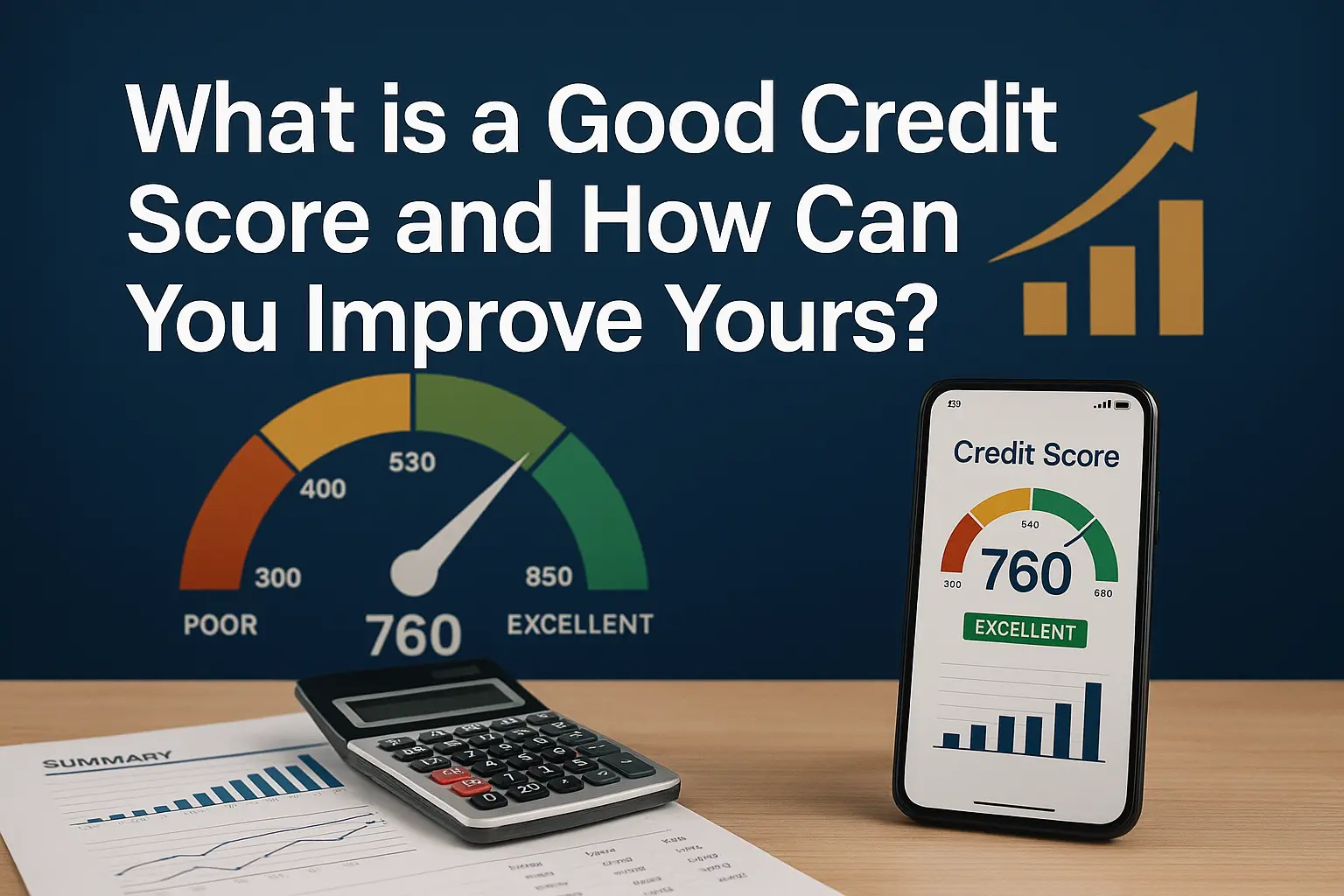
If you’re asking what is a good credit score, FICO’s standard ranges put 670–739 in the Good range, 740–799 in Very Good, and 800–850 in Exceptional. That number matters, but it is not an approval guarantee: lenders may use different score versions and also consider factors such as income, debt, and the product you are applying for.
Start with the range table, then use the short priority check to decide whether you should verify your reports, reduce card balances, rebuild, prepare for a loan, or simply protect what is already working.
This post contains affiliate links. If you buy through our links, we may earn a commission at no extra cost to you. Learn more.
Table of Contents
- Credit Score Ranges: What Counts as Good?
- Find Your Credit Score Priority
- The Five Factors in a FICO Score
- How to Check Your Credit Score Safely
- How to Improve Your Credit Score
- How Long Credit Score Improvement Can Take
- What Lenders Look For Beyond the Score
- Common Credit Score Myths
- Credit Mistakes to Avoid
- Building Credit From Scratch or Rebuilding
- Frequently Asked Questions
- What to Do Next
Credit Score Ranges: What Counts as Good?
The answer depends on the scoring model and the lender’s own standards. You can have multiple credit scores because models, bureau data, loan type, and calculation date can differ. For an official overview of how reports and scores work, see the CFPB credit score guide.
FICO Score Ranges
FICO says its scores are used by 90% of top lenders. Standard FICO scores generally run from 300 to 850; the ranges below follow FICO’s published categories:
| Score Range | FICO Rating | General Interpretation |
|---|---|---|
| 800–850 | Exceptional | Well above the average range and generally viewed as very low credit risk. |
| 740–799 | Very Good | Above the average range and generally associated with strong creditworthiness. |
| 670–739 | Good | Near or above the average range; many lenders consider this good credit. |
| 580–669 | Fair | Below the average range; approval and pricing depend heavily on the lender and product. |
| 300–579 | Poor | Well below the average range and generally associated with higher credit risk. |
VantageScore Ranges
VantageScore also uses a 300–850 scale for widely used models, but its tier labels do not match FICO’s. For VantageScore 4.0, the published tiers are:
- 781–850: Superprime
- 661–780: Prime
- 601–660: Near prime
- 300–600: Subprime / not prime
The bottom line: On FICO’s standard scale, 670–739 is Good. A lender can still use a different scoring model, version, cutoff, or set of underwriting criteria, so treat the range as context rather than an approval guarantee.
Find Your Credit Score Priority
Answer up to three quick questions to choose a practical starting point. This is a planning guide, not a prediction of how many points your score will change.
Step 1 of 3
Whatever priority the tool gives you, the next section explains the scoring factors behind that recommendation so you can see which habits matter most.
The Five Factors in a FICO Score
To improve your credit, it helps to understand what FICO actually measures. FICO groups report data into five broad categories; the percentages below describe their importance for the general population, but FICO notes that the weight can vary by credit profile.
1. Payment History (35% of Your Score)
This is the largest FICO category. Late payments can hurt, but there is no universal point loss: the effect depends on factors such as how recent, severe, and frequent the late history is and what else is in your credit file.
Payment history can include credit cards and installment loans such as auto, mortgage, and personal loans. The important point is consistency: a generic point-loss estimate cannot tell you what a late payment would do to your particular score.
2. Credit Utilization (30% of Your Score)
This measures how much revolving credit you’re using compared with your available limits. Lower utilization is generally better, but 30% is not a scoring cliff. FICO says the effect varies by profile, so use 30% as a common rule of thumb rather than a magic threshold.
FICO considers revolving balances in more than one way, including how much of your available credit you are using overall and on individual accounts. A heavily used card can therefore matter even when your total utilization looks lower.
3. Length of Credit History (15% of Your Score)
FICO considers how long your credit accounts have been established, including the age of your oldest and newest accounts, the average age of accounts, and how long particular account types have been used. Time can help a file mature, but do not keep a costly or unsuitable account open solely for age.
4. Credit Mix (10% of Your Score)
FICO also considers your experience with different account types, such as revolving credit and installment loans. You do not need every type of credit, and opening a loan or card solely to create “mix” can add cost or unnecessary new-credit activity.
5. New Credit Inquiries (10% of Your Score)
Hard inquiries can affect your score, but the impact varies; FICO says one additional inquiry costs fewer than five points for most people. For mortgage, auto, and student-loan rate shopping, FICO groups qualifying inquiries made within a 14- to 45-day window, depending on the score version.
How to Check Your Credit Score Safely
Checking your own credit report does not hurt your score. The more useful distinction is between a credit report, which shows the underlying account information, and a credit score, which is calculated from credit-report data using a particular scoring model.
Free and Safe Options
1. AnnualCreditReport.com
- Free weekly online credit reports are available from Equifax, Experian, and TransUnion through AnnualCreditReport.com
- The reports show credit-file details; they do not necessarily include a credit score
- Requesting your own reports does not hurt your credit score
2. Banks and Credit Card Issuers
- Some banks and card issuers provide customers with a free credit score
- The score may use FICO, VantageScore, or another model, so check which model you are viewing
- Viewing a score provided for your own education does not create a hard credit application
3. Credit Monitoring Services
- Some banks and standalone services include credit monitoring or score tracking
- Confirm which scoring model and credit bureau the service uses before comparing it with a lender’s score
- Alerts can help you notice newly reported changes or unfamiliar activity
Why Your Credit Scores Can Be Different
Don’t panic if you see different scores from different sources. You can have many different credit scores because:
- Different scoring models (FICO vs. VantageScore)
- Different versions of each model
- Scores calculated on different dates
- Different credit bureaus may have different information
Compare like with like. Track the same score model, bureau, and source over time when possible instead of treating unlike scores as interchangeable.
If your reports show possible errors, start with the free dispute process. The CFPB provides sample dispute letters for both the credit reporting company and the business that furnished the information. If you consider paid credit-repair help later, compare exactly what the company will do with what you can do yourself at no cost.
How to Improve Your Credit Score
Credit improvement starts with the information already in your reports: keep payments on time, reduce revolving balances when they are high, correct genuine reporting errors, and add new credit only when it serves a real purpose. No single action guarantees a particular point increase or timeline.
Start With the Basics That Affect Your File
Pay every account on time. Payment history is the largest FICO category. If you are already behind, contact the creditor and focus first on a payment arrangement you can actually maintain rather than chasing a score shortcut.
Lower revolving balances. Paying down credit-card debt can lower reported utilization after the issuer reports the new balance. There is no magic 30% cliff, so prioritize expensive balances and cards using a large share of their limits instead of aiming for one universal percentage.
If debt is driving those balances, use a debt management plan to organize the bigger picture. If you are deciding which balance to attack first, compare the debt snowball vs avalanche methods.
Check and dispute report errors. Review each bureau report for accounts that are not yours, incorrect status or payment history, wrong balances or limits, and duplicate debts. You can dispute inaccurate or incomplete information yourself with the credit reporting company and the business that furnished it.
Build Positive History When Your File Is Thin
If you have little credit history or are rebuilding, compare the cost and reporting rules before opening anything new. The goal is a manageable account that reports useful payment history—not another product simply for the sake of having more accounts.
- Authorized-user status: may add a reported account to your file when the issuer reports authorized users, but the scoring effect depends on the account and scoring model.
- Secured credit card: can provide revolving history when the issuer reports to the nationwide credit bureaus; compare the deposit, fees, credit limit, and any path to an unsecured card.
- Credit-builder loan: can create installment-payment history while funds are held according to the lender’s terms; compare fees, reporting, and what happens if a payment is late.
Brigit — worth comparing if your file is thin or you’re rebuilding
One credit-building feature inside a budgeting app. Before signing up, review the current plan details and verify what, if anything, is reported to the credit bureaus so you can compare it with a secured card or credit-builder loan.
See Brigit credit-building options
Prefer to research the app first? Read our Brigit app review, then compare it with the steps you can take on your own.
Use Credit Strategically
- Credit-limit increases: can lower utilization when balances stay the same, but ask whether the request requires a hard inquiry and do not treat a higher limit as extra spending room.
- Statement timing: many issuers report the statement balance. If you want a lower balance reported before an application, check your issuer’s reporting pattern and consider paying down the card before the statement closes.
- New applications: apply only when the account serves a real goal. For mortgage, auto, or student-loan rate shopping, comparable inquiries can receive special FICO treatment when they fall within the applicable shopping window.
If You Are Behind on Accounts
Ask the creditor or collector what payment plans or settlement options are available, and get any agreement in writing before you pay. Payment does not guarantee that accurate negative history will disappear from your credit reports. Dispute information only when it is inaccurate, incomplete, duplicated, or not yours.
If you are trying to organize several balances at once, a debt payoff tracker can help you map the plan. Before applying for consolidation, check how credit scores can affect a debt consolidation loan and compare the total cost, not just the monthly payment.
How Long Credit Score Improvement Can Take
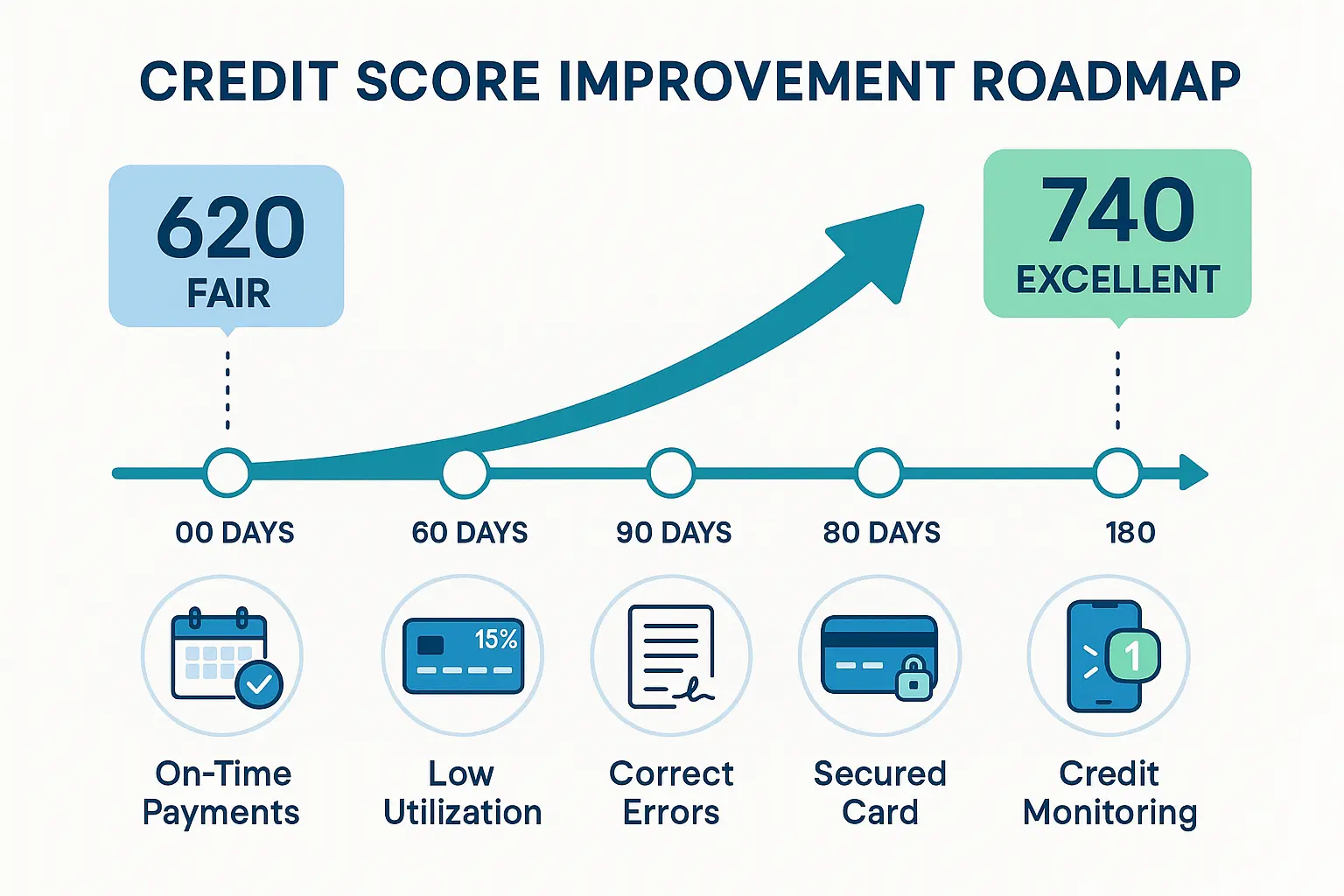
There is no universal credit-score recovery calendar. Your score can change when the information in your credit reports changes, but the size and timing of that change depend on the scoring model and the rest of your credit file. FICO describes improvement as a gradual process and notes that some people may begin to notice small changes within roughly three to six months.
Changes That May Show Up Sooner
- Lower reported card balances: can affect utilization after the issuer reports the new balance
- Corrected report errors: can affect a score after the credit report is updated
- New inquiries or accounts: can also change a score, sometimes in the opposite direction
Changes That Usually Need More History
- On-time payment history: becomes more meaningful as you build a longer record of paying as agreed
- Rebuilding after delinquencies: generally takes sustained positive history rather than one quick action
- Credit age: improves only as accounts and your overall file get older
What Time Does—and Does Not—Fix
- Most negative account information can generally remain on a credit report for up to seven years
- Bankruptcy information can remain for up to ten years
- Accurate negative information cannot be removed early simply because it hurts your score; inaccurate or incomplete information can be disputed
What Lenders Look For Beyond the Score
A credit score is one input in a lending decision, not the whole decision. Depending on the product, a lender may also review your income, required debt payments, available cash, down payment, recent applications, and the amount and terms you want to borrow.
Debt, Income, and Cash Reserves
- Debt-to-income ratio: compares required monthly debt payments with income; acceptable levels vary by program and underwriting method.
- Income and documentation: lenders may verify the amount, source, and stability of income using records appropriate to the loan and how you earn money.
- Down payment and assets: cash available for the transaction and reserves can affect both eligibility and pricing, especially for mortgages.
Mortgage, Auto Loan, and Credit Card Requirements
Mortgages. Credit rules vary by mortgage program, lender, and underwriting method. FHA has its own minimum-score and down-payment framework, while Fannie Mae’s Desktop Underwriter no longer uses a fixed minimum third-party credit score for its credit-risk decision. Debts, income, reserves, down payment, property details, and loan purpose can all matter. Our homeowner’s guide to mortgages explains the broader process.
Auto loans and credit cards. Lenders and card issuers set their own underwriting standards. A stronger credit profile can improve your options, but income, existing debt, recent applications, loan amount, term, down payment, vehicle, and other product-specific factors may also affect the offer.
If you’re preparing for a loan or card, step back from the score for a moment and look at the rest of your money picture before deciding what to do next.
Put Your Money Picture on One Screen
Enter your income, spending, up to 8 debts and 8 goals; the Snapshot sheet totals everything automatically.
Confirm to get the workbook and frugal money tips. Unsubscribe anytime.
Something went wrong. Please check your email address and try again.
Common Credit Score Myths
“Checking my own credit hurts my score.” It does not. Reviewing your own report or an educational score is not the same as applying for new credit.
“I need to carry a balance and pay interest to build credit.” You do not. Card issuers can report a statement balance even when you pay the statement in full by the due date; carrying debt from month to month is not required to generate credit history.
“Closing an old card immediately erases its age from my FICO score.” Not necessarily. FICO can continue to consider a closed account while it remains on your credit report. The more immediate scoring issue is often the loss of available revolving credit, which can raise utilization if you still have balances.
“A credit-repair company can remove accurate negative information.” It cannot legally erase accurate, current negative information simply because it hurts your score. Most negative information can generally remain for up to seven years, while bankruptcy information can remain for up to ten.
“There is one credit score everyone sees.” There are many score models and versions, and the underlying bureau data can differ. Compare like with like when tracking progress, and expect a lender’s score to differ from a score shown in a consumer app.
Credit Mistakes to Avoid
Most credit-score setbacks come from a few repeatable problems. Watch for these before chasing optimization tactics:
- Missing payments: late fees can happen quickly, and an account that reaches the reporting threshold can add a serious negative mark.
- Running cards close to their limits: high reported revolving balances can weigh on FICO scores even when every payment is on time.
- Applying for credit you do not need: new hard inquiries and accounts can add short-term scoring pressure without solving a real financial problem.
- Closing a card without checking the trade-offs: losing available credit can raise utilization; keep or close an account based on cost, usefulness, and the effect on your overall file.
- Ignoring your reports: errors, unfamiliar accounts, or identity-theft signs are easier to address when you catch them early.
- Paying for impossible promises: no credit-repair company can legally erase accurate negative information just because it is damaging your score.
Building Credit From Scratch or Rebuilding
The same core rules still apply when your file is thin or damaged: use only accounts you can afford, pay as agreed, keep revolving balances manageable, and check that the account actually reports to the credit bureaus you expect.
Young Adults and Students
You do not need several accounts to start a credit file. If you need a card, compare student or secured options for fees, reporting, and eligibility. Becoming an authorized user on a well-managed account may also add reported history, but the effect depends on the issuer, the account, and the scoring model.
If you already have a student loan, paying it as agreed contributes payment history. Do not take on a loan solely to create “credit mix.”
Newcomers to the U.S.
A limited U.S. credit file can make approval less predictable, so check each issuer’s identification, income, and credit-history requirements before applying. Secured cards or credit-building products can be options when their fees, eligibility rules, and credit-bureau reporting fit your situation.
Avoid opening several accounts at once simply to build a file faster. One manageable reported account plus consistent payments is easier to control than a stack of new obligations.
Rebuilding After Financial Difficulty
Start with affordability: keep current accounts current, address past-due balances with terms you can maintain, and verify that your reports accurately reflect the accounts. A secured card or credit-builder product may be useful later if you need new positive history and can comfortably handle the cost.
After bankruptcy or foreclosure, mortgage waiting periods and eligibility vary by program, event, and lender. Check the current rules for the specific loan before timing an application around a generic online cutoff.
Frequently Asked Questions
What to Do Next
On FICO’s standard scale, a Good credit score starts at 670—but the more useful question is what is driving your current score and what your next financial goal actually requires. Start with accurate credit reports, on-time payments, and lower revolving balances before adding new accounts or chasing a particular number.
A practical next step: check all three reports, identify the one or two issues that matter most in your file, and work those consistently. If you are preparing for a mortgage, auto loan, or credit card, verify that product’s current requirements before applying. Credit improvement is usually gradual, and no legitimate service can promise a specific point gain on a fixed schedule.
This article provides general credit education, not individualized lending or credit-repair advice. Scoring models and lender requirements vary, so verify current requirements with the lender or relevant credit reporting company before applying or paying for credit-repair help.

