

Tax software can start at $0 and still end with fees through state-return charges, optional support, or refund-processing services. If you want to avoid tax filing fees, check three things before you file: whether the service supports your forms, what federal and state filing will cost, and which optional services you are adding. For the 2026 filing season, most people are filing their 2025 federal income tax return, and several legitimate filing paths can still cost $0.
The cheapest route depends on your AGI, forms, state return, and how much guidance you need. If your 2025 AGI was $89,000 or less, check IRS Free File first; otherwise compare software by supported forms and total state cost. Use the checker below to narrow the path. Rentals, K-1s, business ownership, major investment activity, or IRS notices? Jump to when paying a tax pro may be worth it.
This post contains affiliate links. If you use a service through our links, we may earn a commission at no extra cost to you. Learn more.
Table of Contents
- Tax Filing Fee Route Checker
- 5 Free or Low-Cost Tax Filing Options for 2026
- Where Tax Filing Fees Come From
- Using IRS Free File to Avoid Fees
- Free Tax Software Options
- Watch for Hidden Tax Filing Charges
- Open-Source Tax Software
- When It’s Worth Paying a Tax Pro
- Frequently Asked Questions
- Your Lowest-Fee Filing Plan
- Put the Rest of Your Money Picture on One Screen
Five low- or no-cost filing paths at a glance
- IRS Free File — Guided software for 2025 returns if your AGI is $89,000 or less; each partner can apply additional eligibility rules.
- Free File Fillable Forms — Any AGI; DIY federal filing.
- Cash App Taxes — Currently advertises $0 federal and state filing, including many 1099, investment, and self-employment situations.
- FreeTaxUSA — Federal filing is currently $0; state returns are currently $15.99 each.
- MilTax — Free federal filing and up to five state returns for eligible service members, family members, survivors, and recent veterans.
In the sections below, we break these paths down in plain language so you can match one to your situation in just a few minutes.
Not sure which route deserves your attention first? The checker below uses your return complexity, AGI range, and current filing choice to point you to the most relevant section.
Tax Filing Fee Route Checker
Answer three quick questions to see which filing path is worth checking first. This is a planning check, not a guarantee of eligibility or final price.
5 Free or Low-Cost Tax Filing Options for 2026
1) IRS Free File Guided Tax
Partner offers for eligible filers; step-by-step assistance.
- Check: Access via the IRS link so the offer applies.
- Best for: AGI of $89,000 or less for 2025 returns, subject to each IRS Free File partner’s eligibility rules.
2) IRS Free File — Fillable Forms
Electronic versions of IRS forms; no income cap.
- Check: No software guidance; you fill forms yourself.
- Best for: Experienced filers comfortable with IRS instructions.
3) Cash App Taxes
Cash App currently advertises $0 federal and state filing and supports W-2s, 1099 income, investments, self-employment, and other common situations.
- Check: Check supported forms before you start.
- Best for: Filers looking for free state tax filing as well as federal filing, provided their situation is supported by the service.
4) FreeTaxUSA (Free Edition)
Federal filing is currently $0; a state return is currently $15.99.
- Check: Federal filing is $0 and a state return is $15.99; if you choose to pay filing fees from your refund, FreeTaxUSA currently lists an additional $24.99 fee.
- Best for: Filers comfortable paying a small state-filing fee or using another option for their state return.
5) MilTax for Military-Connected Filers
Military OneSource provides free MilTax preparation software and expert support for eligible members of the military community.
- Check: Eligibility includes active-duty service members, eligible family members, survivors, and recent veterans up to 365 days after separation or retirement.
- Best for: Eligible military-connected filers who want free federal filing and up to five state returns, with military-specific tax support.
How to Choose Between These Options
If you want the shortest decision rule, use the factor most likely to change your final cost or filing difficulty:
- 2025 AGI of $89,000 or less: Check IRS Free File Guided Tax first, then confirm the partner’s form, age, state, and other eligibility rules.
- Military-connected: Check MilTax before paying for commercial software; eligible users can file a federal return and up to five state returns free.
- Self-employment or investment forms: Compare Cash App Taxes and FreeTaxUSA by supported forms and total state cost before entering your return.
- Prefer a local, open-source workflow: Consider OpenTaxSolver only if its current release includes every form you need and you are comfortable with a more hands-on process.
- Already deep into TurboTax: Weigh the time required to switch against the fee you would avoid. If you stay, use a payment method that does not add the optional Refund Processing Service when that is your goal.
Where Tax Filing Fees Come From
Many filing charges are optional or provider-specific. The useful question is not whether a service advertises “free,” but what your return will cost after state filing, form eligibility, support, and payment-method choices are included.
Think in one all-in total: federal filing + state filing + any product tier your forms require + optional support or payment-method fees.
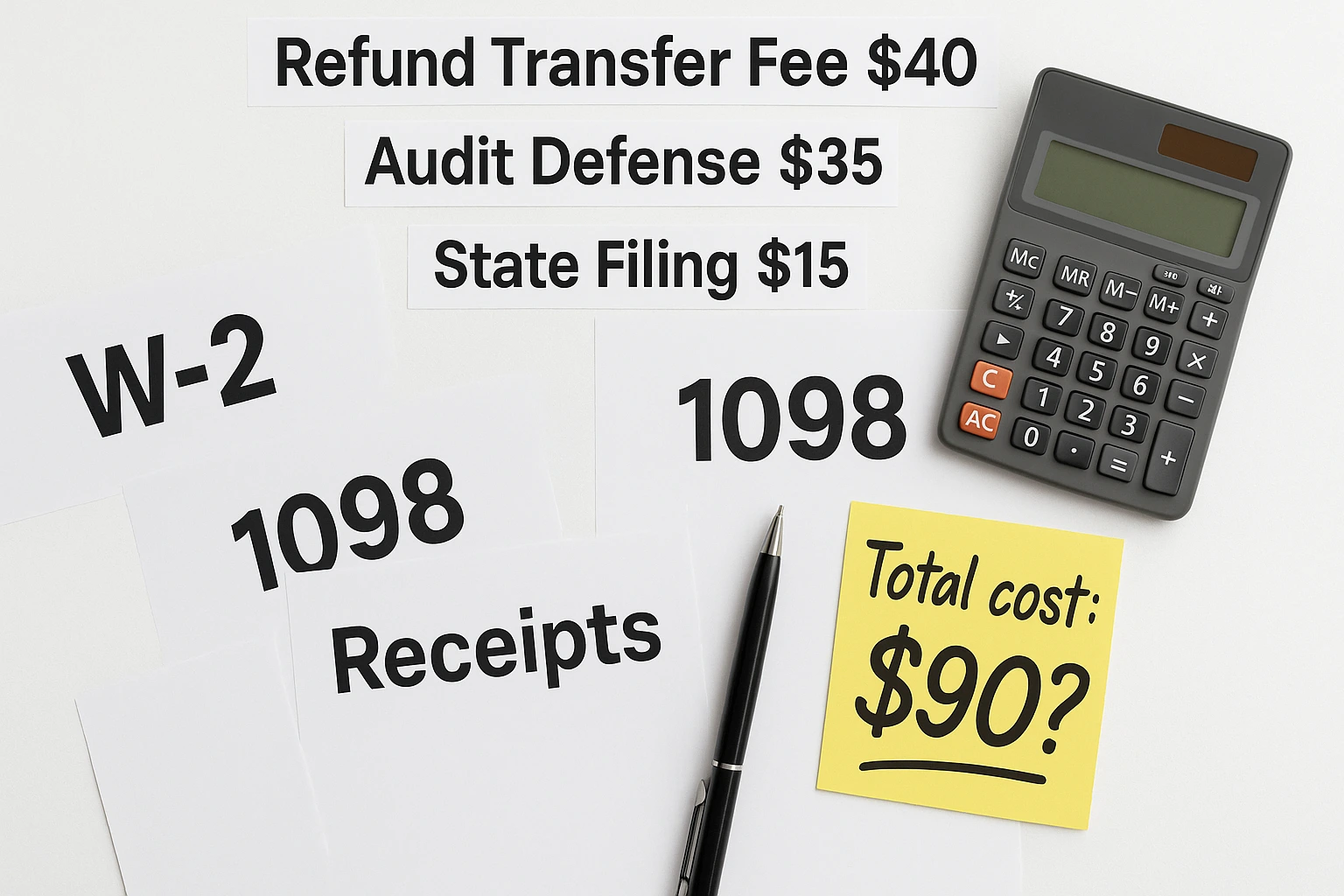
Types of Fees That Increase Tax Costs
- Software or product-tier fees: Some providers reserve particular forms, features, or support levels for paid products.
- State filing fees: A $0 federal return does not always include a $0 state return.
- Optional support or audit products: Expert help and added protection can carry a separate charge.
- Refund-processing fees: Some providers charge when preparation fees are deducted from your refund instead of paid another way.
Before you start a return, check three things on the provider’s current site: federal price, state price, and whether your forms are included.
Using IRS Free File to Avoid Fees
The IRS Free File program, a partnership with tax software companies, is one of the easiest ways to file for free if you qualify. For 2025 returns filed in 2026, IRS Free File Guided Tax is available to taxpayers with adjusted gross income (AGI) of $89,000 or less. Each participating provider can also set additional eligibility rules, such as age or state residency.
Used IRS Direct File last year? The Direct File pilot is not available for the 2026 filing season. The Taxpayer Advocate Service’s 2026 filing-season guidance instead points taxpayers to current filing resources such as IRS Free File.
Who Qualifies for the Free File Program?
Eligibility depends on your adjusted gross income (AGI). For 2025 returns filed in 2026, the program-wide AGI ceiling for Guided Tax is $89,000. That does not mean every partner will accept every filer below the ceiling: provider rules can also depend on age, state, military status, and the forms you need. Confirm the current match on the official IRS Free File page before you file.
If this is your first time doing your own return, our beginner’s guide to filing taxes walks through the basics before you choose software.
Steps to Access the Program
- Start from IRS.gov Free File so you enter a participating offer through the IRS program.
- Browse participating providers’ offers.
- Choose a provider that matches your AGI and filing needs.
- Access the software via the IRS link to ensure it’s free.
- File your federal return following the software’s guide.
Tax rules and income limits can change; always confirm the latest details on IRS.gov or with a tax professional before you file.
IRS Free File Options
| Feature | Free File Guided Tax Software | Free File Fillable Forms |
|---|---|---|
| Software Guidance | Yes | No |
| AGI Requirement | Yes ($89,000 or less for 2025 returns) | No |
| State Returns | Varies by provider | No |
| Best For | Eligible filers who want guided preparation | Experienced filers |
| Quick Eligibility | AGI ≤ $89,000; confirm partner eligibility and state availability | Any AGI; federal only; DIY |
Free In-Person Tax Help (VITA and TCE)
IRS-sponsored Volunteer Income Tax Assistance (VITA) sites generally offer free basic return preparation to people making $69,000 or less, people with disabilities, and limited-English-speaking taxpayers. Tax Counseling for the Elderly (TCE) focuses especially on people age 60 and older and retirement-related tax questions. Availability and the returns a site can prepare vary by location.
Use the IRS VITA/TCE locator guidance to check eligibility, nearby sites, and what documents to bring.
Free Tax Software Options
If you do not qualify for IRS Free File Guided Tax, other providers may still offer a $0 federal return, a $0 federal-and-state return, or a low-cost state filing option. The important part is matching the provider to your forms and checking the full price before you invest time entering your tax data.
Before you create an account: pick one option below and check its current eligibility, supported forms, and state-return price.
Limits of Free Plans
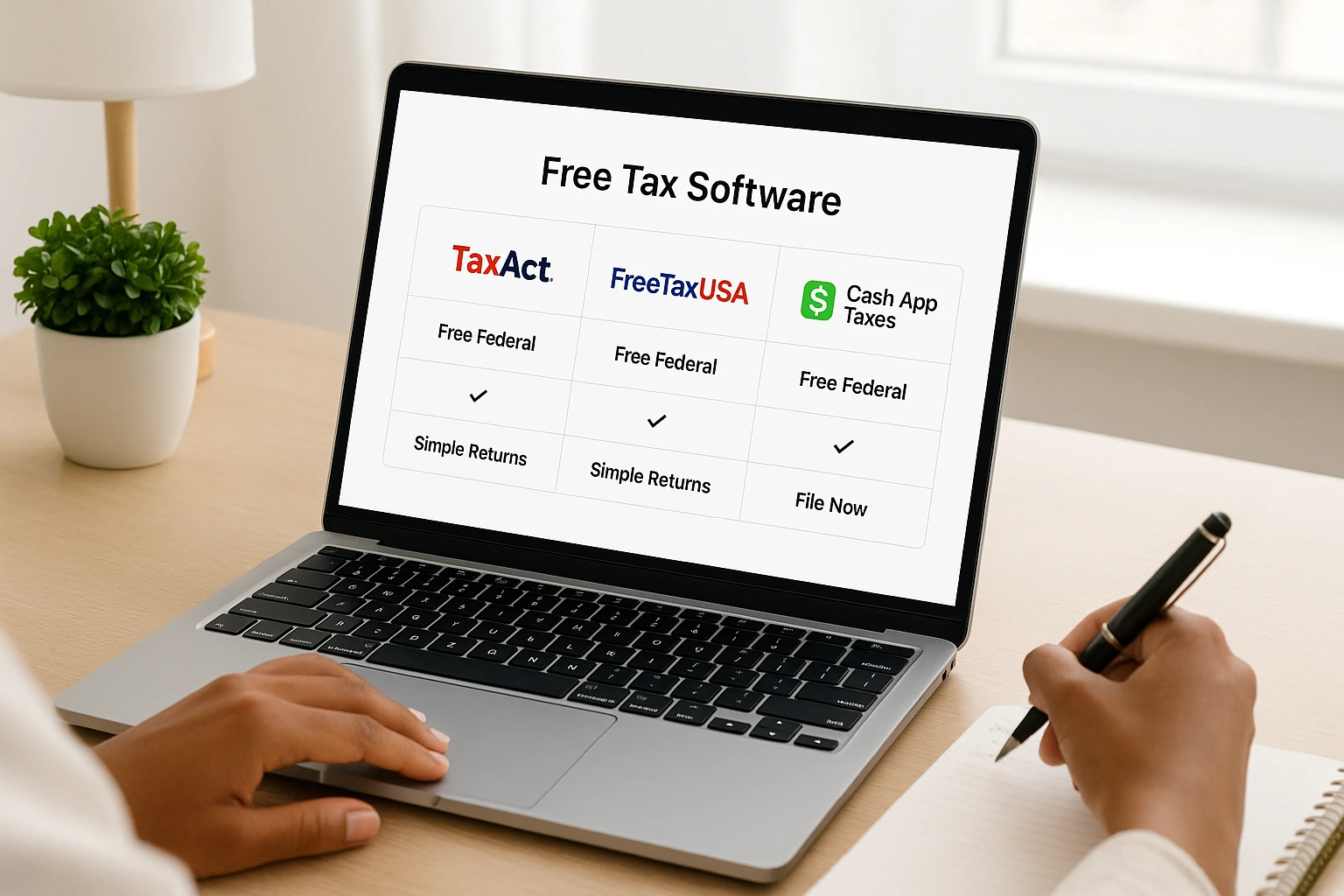
“Free” does not mean the same thing at every provider. TaxAct limits its Free Edition to qualifying simple returns, while Cash App Taxes currently advertises $0 filing across a much wider range of situations. FreeTaxUSA keeps federal filing free but charges for state returns. Check the forms and price that apply to your return before entering all your data.
Current Free or Low-Cost Tax Software Options
- Cash App Taxes: Currently advertises $0 federal and state filing, including W-2s, 1099s, investments, and self-employment.
- FreeTaxUSA: Current listed pricing is $0 for a federal return and $15.99 for each state return.
- TaxAct Free: Free federal filing for qualifying simple Form 1040 returns; eligibility limits apply.
Watch for Hidden Tax Filing Charges
Extra charges can appear when a return no longer qualifies for a free tier, when you add support or audit products, when you file a state return with a provider that charges for it, or when you choose a paid refund-processing option. Review the final price and what triggered it before you file.
Four Checks Before Checkout
- Free-tier eligibility: Confirm that your income, forms, deductions, and credits still fit the provider’s free option.
- State filing: Check the price for every state return you need, not just the federal return.
- Optional services: Decide separately whether you want expert help, audit products, or other add-ons.
- Pay-with-refund fees: If you have filing charges deducted from your refund instead of paying upfront, check for another fee. FreeTaxUSA currently lists $24.99 for its pay-with-refund option, while TurboTax currently lists a $40 Refund Processing Service fee for eligible customers using that payment method.
Before you file, pause on the final price screen and confirm which charges are required for your return, which are optional, and whether the way you pay creates another fee.
Avoiding the TurboTax Refund Fee
The TurboTax refund fee discussed here is TurboTax’s Refund Processing Service fee. TurboTax currently lists it at $40 when an eligible customer chooses to have TurboTax preparation fees deducted from a federal or state refund. If you do not want that service fee, choose another available way to pay your TurboTax fees instead. Check TurboTax’s current terms and pricing before filing because prices and conditions can change.
Open-Source Tax Software
For tech-comfortable filers, open-source software can provide a no-cost local workflow, but it requires more hands-on setup and closer attention to forms and instructions than mainstream guided software.
Benefits
- No tax-software filing fee
- Source code is available
- Local desktop workflow
Challenges
- Less polished UX
- Community-based support
- Some setup required
A Current Open-Source Option
OpenTaxSolver: The project has a current 2025-tax-year release for Windows, macOS, Linux, and Chromebooks, with federal Form 1040 support plus selected schedules, forms, and state programs. Check the current OpenTaxSolver release page for the exact forms included before relying on it for your return.
When It’s Worth Paying a Tax Pro Instead of Filing Free
Free filing is not automatically the best fit for every return. When the tax issues are unusually complex, the forms are unclear, or an IRS notice is already involved, it can be worth comparing professional help with the DIY options.
- Very complex returns: Multiple rentals, K-1s, business ownership, or major investment activity.
- Big life changes: Divorce, large inheritance, selling a business, or big stock sales.
- IRS notices or past filing issues: Professional help may be useful when you need help understanding a notice, correcting prior filings, or deciding what to do next.
- Time or confidence is the constraint: Compare the preparer’s scope and fee when you are not confident you can complete the return accurately on your own.
If these situations sound familiar, compare the scope and price of professional help before you commit:
Prefer to research the online option first? Our Tax Expert Now review explains how the service works so you can decide whether paid help fits your situation.
Frequently Asked Questions
Your Lowest-Fee Filing Plan
- Start with the no-cost route you may qualify for. If your 2025 AGI was $89,000 or less, check IRS Free File Guided Tax and the partner’s eligibility rules first.
- Compare the all-in price before entering your return. Check federal filing, state filing, the forms your return requires, and any optional support or payment-method fee.
- Review the final price before you file. Remove optional services you do not want. If the forms or an IRS notice are beyond what you are comfortable handling, compare professional help before submitting the return.
If you want a starting point, rerun the Tax Filing Fee Route Checker and follow its first recommended section. Once this year’s return is handled, our retirement account guide can help with the longer-term 401(k), IRA, and Roth IRA decisions that affect future tax planning.
You’ve already checked what filing your return may cost. Before you move on, put the rest of your money picture in one place too.
Put the Rest of Your Money Picture on One Screen
Track income, spending, up to 8 debts, and up to 8 goals; the SNAPSHOT sheet totals the key numbers automatically.
Confirm to get the workbook and frugal money tips. Unsubscribe anytime.
Something went wrong. Please check your email address and try again.
This guide is for general information and education only and does not constitute tax, legal, or financial advice. Tax eligibility, filing requirements, and fees depend on your facts and can change. Confirm current IRS and provider rules for your return, and consider a qualified tax professional when you need advice about your specific situation.

