
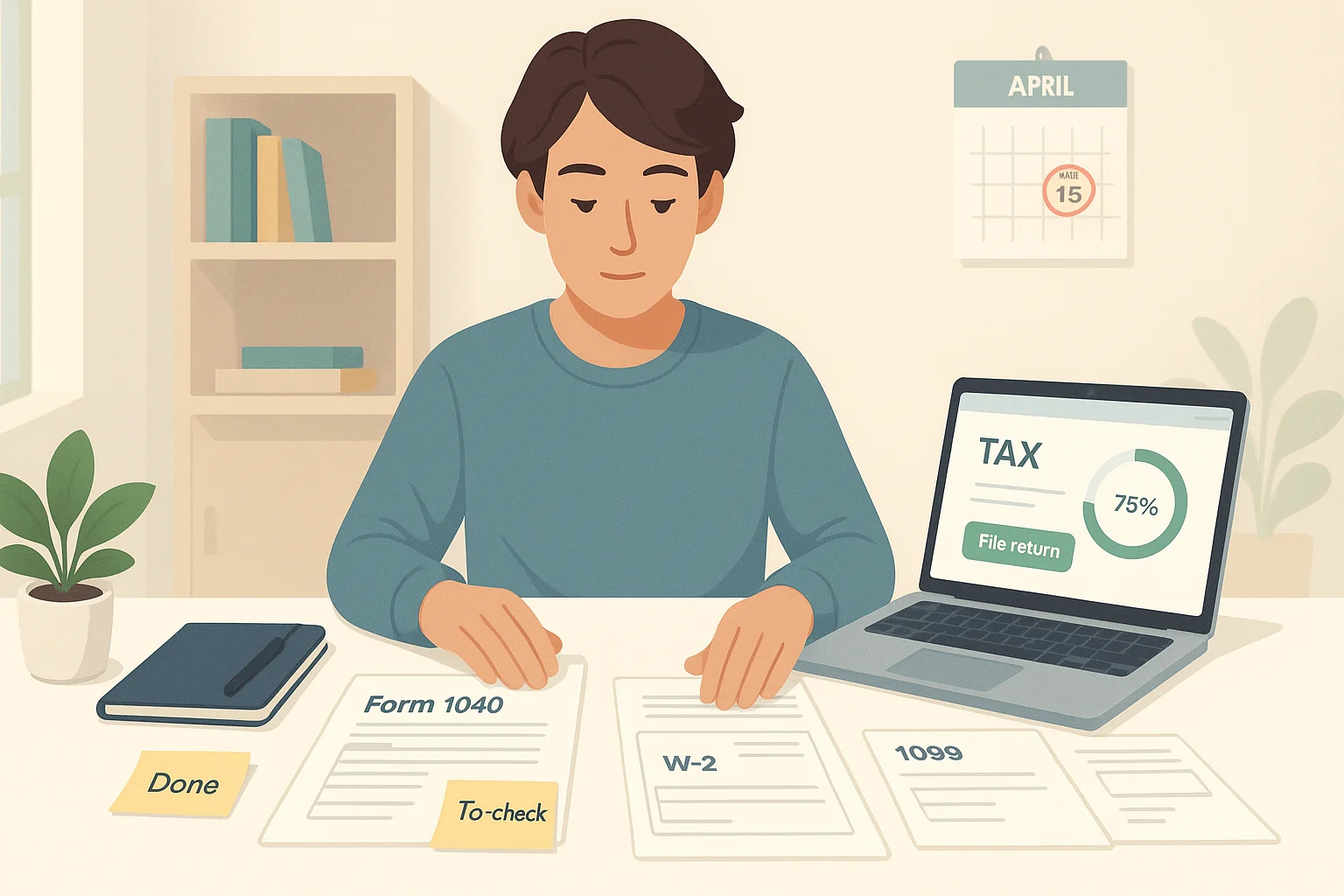
The hardest part of filing taxes for the first time is often not the math—it’s knowing what applies to you, which forms matter, and what to do next. This beginner’s guide to filing taxes turns those decisions into a clear sequence: confirm whether you need to file, gather your documents, choose a filing method, review the return, and handle any refund or balance due.
This guide focuses on U.S. federal individual income tax basics. State rules and more complex situations can add extra steps, so use the linked IRS guidance whenever a rule depends on your circumstances.
Open tax checklistThis post contains affiliate links. If you buy through our links, we may earn a commission at no extra cost to you. Learn more.
Table of Contents
- Key Takeaways
- Do I Need to File a Tax Return?
- Understanding Tax Basics for First-Time Filers
- Essential Tax Documents You Need Before You File
- Quick Tax Filing Readiness Checklist
- Standard Deduction vs. Itemizing
- Choose How You’ll File Your Taxes
- How to File Taxes for the First Time: Step by Step
- Important Deadlines and Extensions
- Refunds and Payments
- Free Money Reset Workbook
- Record Keeping for Tax Season
- Common Mistakes to Avoid
- Frequently Asked Questions
- Your Next Steps for Filing Taxes
Key Takeaways
- Gather the forms and records you expect before starting your tax return so you can enter income and supporting information from the source documents.
- Choose a filing method that fits your return—straightforward returns may fit a free or guided option, while more complex returns can justify professional help.
- Check your filing status, deductions, and credits so you claim what you qualify for without relying on guesses or assumptions.
- Check the deadline that applies to your return; for 2025 federal returns, the regular deadline was April 15, 2026, while a timely extension generally gives calendar-year filers until October 15, 2026, to file—not to pay.
- Keep tax records for the period that applies to them; many records are kept for at least three years, while some situations require longer.
Do I Need to File a Tax Return?
Before you touch a form, answer the threshold question: do you need to file a tax return? The answer can depend on income, filing status, age, dependency status, self-employment, and other filing triggers.
If you only worked part time or picked up a few side-gig payments, don’t guess from the size of the paycheck. Add up the relevant income and check the filing rules that apply to your situation.
For tax year 2025, the filing threshold depends on your filing status, age, dependency status, and other circumstances. For taxpayers who were under 65 at the end of 2025, the IRS lists these general gross-income thresholds:
| Filing Status | Generally file if 2025 gross income is at least |
|---|---|
| Single | $15,750 |
| Married Filing Jointly | $31,500 if both spouses were under 65 |
| Married Filing Separately | $5 |
| Head of Household | $23,625 |
These are general thresholds, not a complete filing test. Different rules can apply if you are 65 or older, can be claimed as a dependent, or have another filing requirement. Even below the usual threshold, filing may still help you recover federal income tax that was withheld or claim a refundable credit.
If a parent or someone else may claim you as a dependent, check that before you file. You can be claimed as a dependent and still need to file your own return, but dependents can have different filing requirements and some tax benefits depend on who qualifies to claim whom. This comes up often for students and young adults, so use the IRS dependent rules rather than assuming that being claimed means you should not file.
Use the IRS’s current filing-requirement guide or its interactive filing tool to check your own situation instead of relying on the table alone.
If you earned money from self-employment or side gigs, you generally have a filing requirement when your net earnings from self-employment are $400 or more, even if your total income is below the amounts in the table.
Action: Write down your total income for the year, including any side-gig earnings, then use the IRS “Do I Need to File?” tool to confirm whether you should file a return.
Understanding Tax Basics for First-Time Filers
If you’re filing taxes for the first time, a few core concepts make everything much less confusing. Once you understand how your filing status, income, deductions, and credits fit together, the forms start to feel a lot more manageable.
Tax Year vs. Filing Season 📅
The tax year is the year the income belongs to; the filing season is when you prepare and submit that return. The 2026 filing season covers 2025 federal individual income tax returns, and the regular deadline for most calendar-year filers was April 15, 2026.
Key Tax Concepts Every Beginner Should Know
Filing Status determines your tax rates and standard deduction amount:
- Single: Unmarried individuals.
- Married Filing Jointly: Married couples filing one joint return.
- Married Filing Separately: Married couples filing individual returns.
- Head of Household: Unmarried with qualifying dependents.
- Qualifying Surviving Spouse: A special status for some recently widowed taxpayers who meet the IRS requirements.
Income you may need to report can include:
- Wages and salaries.
- Tips and bonuses.
- Self-employment income.
- Interest and dividends.
- Unemployment compensation.
- Rental income.
Tax Credits vs. Deductions:
- Credits reduce your tax bill dollar-for-dollar.
- Deductions reduce your taxable income.
If a 401(k), traditional IRA, or Roth IRA is part of your financial picture, our retirement accounts and taxes guide explains how contributions and withdrawals can affect your taxes.
Most individuals report their income and claim deductions and credits on Form 1040, the main federal income tax form. If you use tax software, it fills out Form 1040 for you in the background, so you rarely have to touch the form itself.
Think about a typical year: maybe you have a full-time paycheck, a little interest from savings, and some extra income from driving for a rideshare app. All of those pieces show up somewhere on your tax return, and understanding the categories makes them much less scary.
Essential Tax Documents You Need Before You File
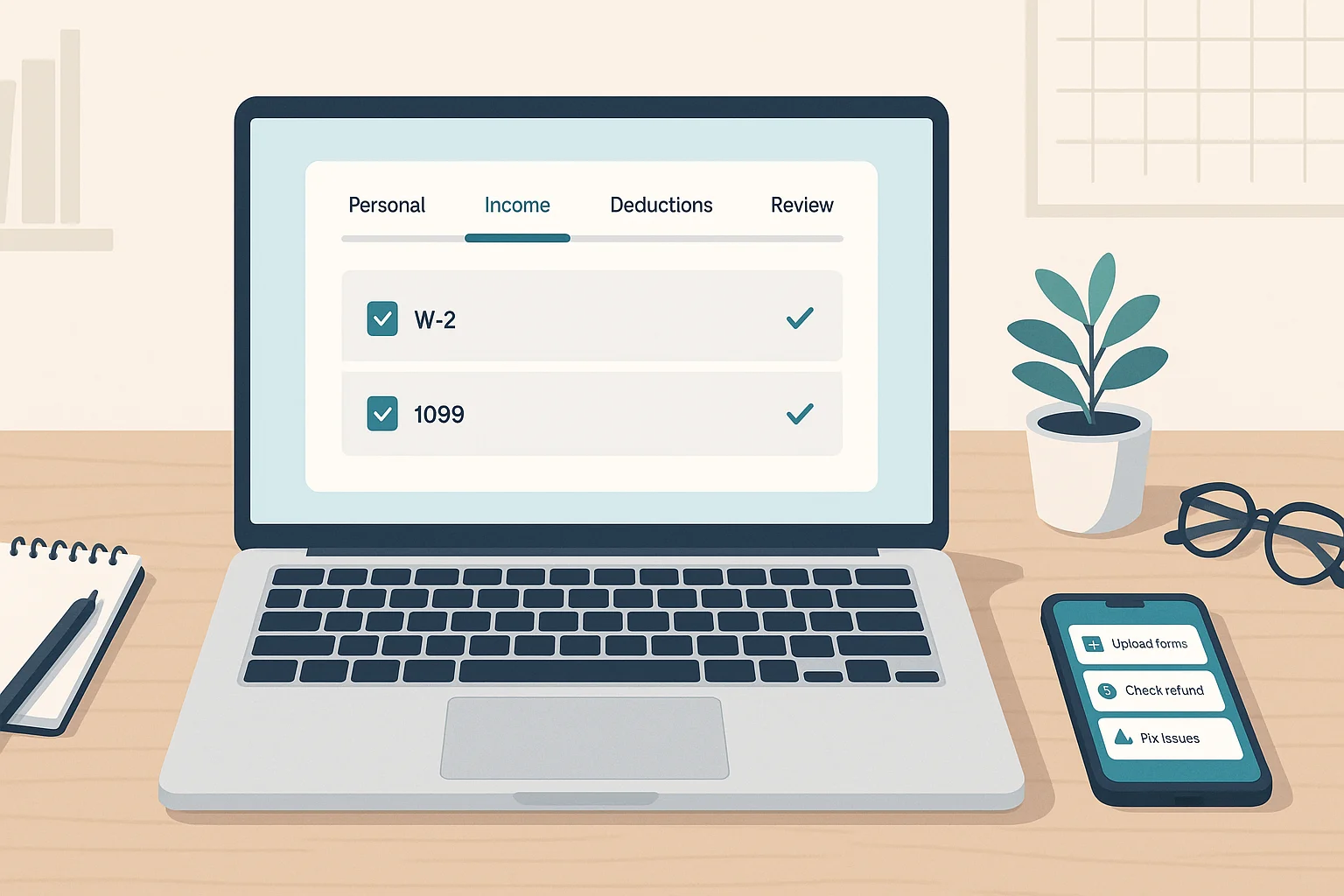
Gather the forms that report your income first, then add the records needed for any deductions or credits you plan to claim. Starting with one complete document set makes the filing interview much easier to follow.
Personal Information to Have Ready
Before you enter income forms, collect the identifying details your return may need:
- Your Social Security number or ITIN, plus the number for anyone else included on the return.
- Bank routing and account numbers if you plan to use direct deposit or pay electronically.
- Your IRS Identity Protection PIN (IP PIN), if the IRS issued one to you.
Employment Documents 💼
Form W-2: Received from employers showing:
- Annual wages.
- Federal and state taxes withheld.
- Social Security and Medicare taxes.
- Retirement plan contributions.
Form 1099: Various types for different income sources:
- 1099-NEC: Non-employee compensation (freelance work).
- 1099-INT: Interest income from banks.
- 1099-DIV: Dividend income from investments.
- 1099-G: Government payments (unemployment, state tax refunds).
Additional Important Documents
| Document Type | What It Shows | Who Needs It |
|---|---|---|
| 1098-E | Student loan interest paid | Borrowers who paid student loan interest and may qualify for the deduction |
| 1098-T | Tuition payments | Taxpayers evaluating education credits for an eligible student |
| 1095-A | Marketplace health coverage and premium tax credit information | People who enrolled in coverage through the Health Insurance Marketplace |
| Receipts for deductions | Charitable donations, medical expenses | Those who might itemize |
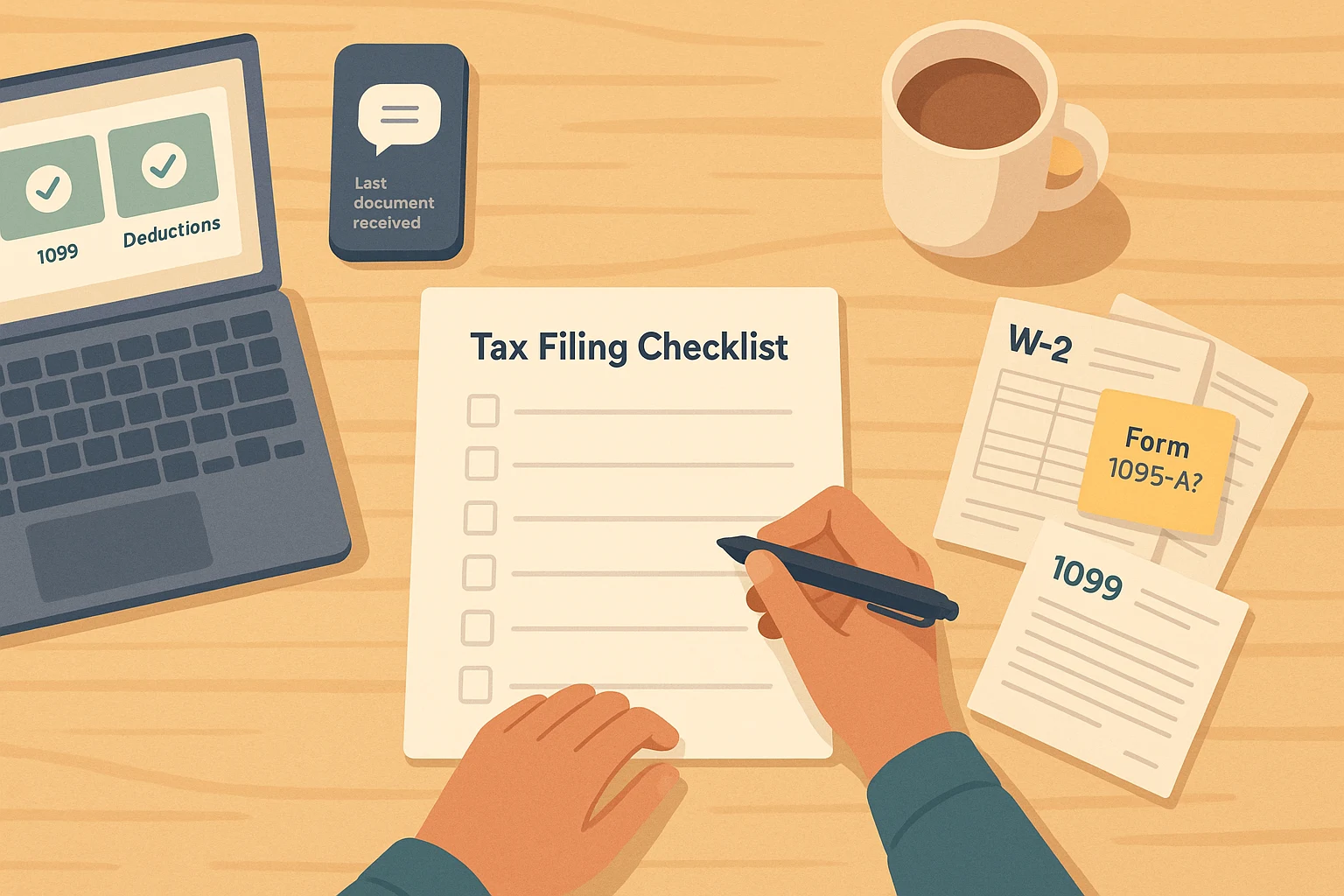
If you expect Form 1095-A, wait until you have it before filing because it is used to reconcile or claim the premium tax credit. You generally do not need to wait for Forms 1095-B or 1095-C, and those forms are not attached to your federal return. See the IRS health coverage information-form guidance for the current rules.
Digital Document Organization Tips
- Create a dedicated tax folder on your computer or cloud storage.
- Scan physical documents for digital backup.
- Use consistent naming conventions (for example, “2025_W2_CompanyName” for a 2025 form).
- Download year-end tax forms from financial institutions when they become available.
Action: Create a folder for the tax year you’re filing—such as “2025 Taxes” for a 2025 return—and move every W-2, 1099, and tax-related email or PDF into it before you start.
Quick Tax Filing Readiness Checklist
Check off the steps you already have covered. The result will point you to the first gap worth fixing before you file.
0/5 key steps in place
Start with the first unchecked step.
Work down the list in order; this checklist is a planning aid, not a confirmation that your return is complete or correct.
Once the checklist shows what is missing, use the linked section as your next step; then come back and check it off before moving on.
Standard Deduction vs. Itemizing
The standard deduction is a fixed amount that reduces taxable income. Itemizing means listing specific deductible expenses instead. You don’t need to decide from memory—compare the allowed deductions that apply to you with the standard deduction for your filing status.
2025 Standard Deduction Amounts
- Single: $15,750.
- Married Filing Jointly: $31,500.
- Married Filing Separately: $15,750.
- Head of Household: $23,625.
These are the 2025 base standard deduction amounts. Your deduction can differ if special rules apply, so confirm the amount your filing software or preparer uses against current IRS guidance.
When to Consider Itemizing
Compare the two methods before you choose. Common itemized deductions include:
State and Local Taxes (SALT): For 2025, the federal itemized deduction for state and local taxes is generally limited to a combined $40,000 ($20,000 if married filing separately), with a phase-down at higher modified adjusted gross incomes.
- State income taxes.
- Local property taxes.
- Sales taxes (if higher than income taxes).
Mortgage Interest: Qualified home-acquisition debt limits depend on when the debt was incurred. For debt incurred after December 15, 2017, the general limit is $750,000 ($375,000 if married filing separately); older qualifying debt can have higher limits.
If you own a home and think you might itemize, our detailed mortgage interest tax deduction rules guide walks through what qualifies and how the limits work.
Charitable Contributions: Cash and non-cash donations.
Medical Expenses: Exceeding 7.5% of adjusted gross income.
The choice depends on the deductions you are allowed to claim and the total that applies to your return. Compare the actual numbers rather than assuming that renting, owning a home, or living in a high-tax state automatically decides the answer.
💡 Pro Tip: Keep the records for deductions you might claim even if you expect to use the standard deduction. Once all your numbers are in one place, you can compare the options without trying to remember expenses later.
Choose How You’ll File Your Taxes
Your best filing route depends on how complicated the return is, how much guidance you want, and what you’re willing to pay for help. Start with the lightest option that can handle your situation accurately.
Free Filing Options 🆓
IRS Free File: For the 2026 filing season, taxpayers with 2025 adjusted gross income of $89,000 or less can use guided partner software for a federal return at no cost, subject to each partner’s eligibility rules. Some partners also offer free state filing. For a deeper walkthrough, see our guide on how to file your taxes for free and the current IRS Free File options.
Free File Fillable Forms: Available without the guided-software income limit. They are electronic versions of IRS paper forms, so they work best for people who are comfortable preparing a return with IRS instructions.
DIY Tax Software 💻
Paid tax software can provide step-by-step interviews, electronic filing, error checks, and refund-status tools. Features and prices vary by provider and by the forms or assistance your return requires, so check current pricing before you start rather than assuming the advertised entry price covers your situation.
A straightforward W-2 return may be a good fit for a free or guided filing option. As the return adds business income, rental activity, complex investments, multiple tax questions, or IRS correspondence, weigh whether more hands-on help would reduce uncertainty.
Professional Tax Preparers 👨💼
Consider whether professional help is worth the cost when the return includes issues such as:
- Business or rental income.
- Significant life changes that affect filing status or dependents.
- Complex investment transactions or income from multiple states.
- An IRS notice, a prior unresolved tax issue, or a question you cannot answer confidently from reliable guidance.
If you’re weighing paid online help, our Tax Expert Now review explains what that service offers so you can compare it with software or a local preparer before deciding.
How to File Taxes for the First Time: Step by Step
Once you have chosen a filing method, the core workflow is straightforward: identify yourself, enter the income from your forms, add the deductions and credits that apply, then review the return before you submit it.
Step 1: Start the Return and Confirm Personal Information
- Full legal name (as it appears on your Social Security card).
- Social Security number.
- Date of birth.
- Current address.
- Bank account information if you plan to use direct deposit.
Step 2: Enter Your Income
Use each income form as the source instead of typing from memory.
From W-2 Forms:
- Box 1: Wages, tips, other compensation.
- Box 2: Federal income tax withheld.
- Boxes 3 & 5: Social Security and Medicare wages.
From 1099 Forms:
- Enter each form in the section that matches that type of income.
- Double-check the payer and amount against the form before moving on.
Step 3: Add Deductions and Credits
Your filing method should ask questions about deductions and credits that may apply. Common examples include:
- Earned Income Tax Credit (EITC): For eligible workers with earned income; eligibility depends on income, filing status, qualifying children, and other IRS rules.
- American Opportunity Tax Credit: For eligible students and qualifying higher-education expenses; enrollment, income, dependency, and other rules apply.
- Child Tax Credit: For eligible taxpayers with qualifying children; age, dependency, residency, identification, and income rules apply.
Step 4: Review, Sign, and Submit
Final Checklist ✅:
- Verify all names and Social Security numbers.
- Confirm bank account information if you are using direct deposit.
- Compare income, deductions, and credits with the source documents you entered.
- Resolve any warnings or incomplete fields your filing method identifies.
- Make sure the return is signed and successfully submitted.
If you e-file, watch for the acceptance or rejection notice after submission. If the return is rejected, correct the listed error and resubmit rather than assuming the filing is finished.
Before you submit, use the Common Mistakes to Avoid section as one final cross-check.
Important Deadlines and Extensions
Keep the filing deadline and the payment deadline separate in your mind: an extension can give you more time to file paperwork without automatically giving you more time to pay.
2026 Federal Filing Dates 📅
- April 15, 2026: Regular deadline for most calendar-year taxpayers to file a 2025 federal individual return and pay tax due.
- October 15, 2026: General filing deadline for most calendar-year taxpayers who requested a valid extension by the April deadline.
As of August 2026, the regular April filing deadline has passed. If you timely requested an extension, the extra time generally applies to filing the return, not paying the tax. Disaster relief, living abroad, military service, or a fiscal tax year can change the date that applies to you, so confirm your deadline with the IRS current filing-date guidance.
If You Missed the April 15 Deadline
If you were required to file and did not file by April 15, 2026—and you did not have a valid extension—the IRS says to file as soon as possible. If you owe tax, file and pay as much as you can to help limit additional penalties and interest; payment options may be available if you cannot pay in full. If the IRS owes you a refund, there is no failure-to-file penalty for filing after the deadline, but you still need to file to claim it. See the IRS late-filing guidance.
State Tax Deadlines
State filing and payment deadlines can differ from the federal schedule. Instead of relying on a generic state list, confirm your date directly with your state tax authority; the IRS maintains a directory of state government tax websites.
How to Request an Extension
For most individual calendar-year filers, a timely federal extension gives until October 15 to file. The IRS allows several methods, including Form 4868 and certain electronic extension options.
⚠️ Important: An extension to file is not an extension to pay. For 2025 returns, tax was generally due April 15, 2026, even when the filing deadline was extended. See the IRS extension guidance, and review our tips on avoiding the IRS underpayment penalty if your income tends to fluctuate.
When one-on-one tax help may be worth it
If you’re staring at an IRS notice, missed a filing deadline, or still have a deduction question you can’t resolve, you can ask a tax professional online about what to check next.
Refunds and Payments
After you submit the return, the next step depends on whether you expect money back or still owe a balance. Set up the path you’ll use before you file so you’re not making payment or banking decisions at the last screen.
Direct Deposit vs. Paper Check 💰
Direct Deposit Benefits:
- Electronic filing with direct deposit is generally the fastest route; the IRS says it issues more than nine out of ten refunds in less than 21 days, though some returns take longer.
- More secure.
- No risk of lost mail.
- Can split refund between accounts.
If you’re counting on your refund to cover upcoming bills or build an emergency fund, using direct deposit and double-checking your routing and account numbers can help the money land where it needs to go as quickly as possible.
Refund Tracking
The IRS “Where’s My Refund?” service updates once a day. For a current-year return, refund status is generally available about 24 hours after e-filing or about four weeks after filing a paper return.
If You Owe Money
Payment Options:
- Direct debit from a bank account.
- Credit or debit card (fees apply).
- Installment agreement for amounts you can’t pay immediately.
- Offer in compromise for certain financial hardship situations.
Before using retirement savings to cover a tax bill, review the 401(k) withdrawal rules and penalty exceptions so you understand the potential tax cost before taking money out.
Action: Before you file, decide how you’ll handle a possible balance due—set a simple payment plan in your budget or look into IRS payment options so there are no surprises.
Once you know whether you expect a refund or still owe a balance, that’s a useful moment to zoom out from taxes and look at the rest of your finances.
Put Income, Spending, Debts, and Goals on One Screen
The editable workbook holds up to eight debts and eight goals, and the SNAPSHOT sheet totals everything automatically.
Confirm to get the workbook and frugal money tips. Unsubscribe anytime.
Something went wrong. Please check your email address and try again.
Record Keeping for Tax Season
What to Keep and for How Long 📁
The IRS record-retention period depends on why the record matters. A useful beginner rule is to keep the return and supporting documents until the applicable IRS period has expired—not to assume every tax document has the same deadline.
- Many ordinary income-tax records: generally at least 3 years.
- Worthless-security or bad-debt loss records: generally 7 years.
- Property and investment basis records: keep them as long as they are needed to establish basis, including after a sale when the tax period for that return is still open.
- Special situations: some circumstances require 6 years or indefinite retention.
For the exact period that applies to a record, use the IRS recordkeeping guidance.
Organization Tips
Physical Documents:
- Use labeled file folders by tax year.
- Store paper records in a secure place protected from loss or damage.
- Make copies of important documents.
Digital Storage:
- Scan documents to PDF.
- Use cloud storage with backup.
- Organize by year and category.
- Password-protect sensitive files.
Future you will be grateful when a mortgage application, financial aid form, or new job asks for last year’s return and you can pull it up in seconds instead of digging through old shoeboxes.
Action: Set a calendar reminder to archive your tax documents into a clearly labeled folder as soon as you finish filing each year.
Common Mistakes to Avoid
Use your final review to compare the return against the source documents, not just to scan for red warning icons. Names, identification numbers, income amounts, bank details, and filing status deserve a deliberate second look.
Math and Data Entry Errors 🔢
It’s easy to rush through the last few screens late at night and mistype a Social Security number or bank account detail. Slow down and let your software’s built-in review run, then fix anything it flags before you hit submit.
- Compare the return with your source documents before submitting, especially names, identification numbers, bank details, and income amounts.
Missing Income Sources
Don’t forget:
- Side-gig, platform, and freelance income.
- Interest from savings accounts.
- Unemployment compensation.
- Digital asset transactions.
- Cash tips.
Filing Status Mistakes
- Use only a filing status you qualify for; if more than one may apply, compare the result before filing.
- Check how marriage, separation, and household support affect your filing status.
- Review the head of household requirements before selecting that status.
Missing an income form or choosing a filing status without checking the requirements can create extra correction work later. A careful cross-check before submission is usually simpler than untangling the same issue after filing.
Frequently Asked Questions
Start with the income forms you expect, such as W-2s and relevant 1099s. Then gather the records needed for deductions or credits you plan to claim, plus Form 1095-A if you had Marketplace coverage. Keep your identification details and bank information handy if you plan to use direct deposit.
Watch for missing income forms, mistyped identification or bank numbers, and a filing status chosen without checking the requirements. Also review the credits your filing method asks about instead of assuming you do or do not qualify. A source-document cross-check before submission can catch several of these problems.
A straightforward return may fit IRS Free File or guided tax software, especially when your income forms and filing situation are easy to identify. If the return includes business or rental income, complex investments, an IRS notice, or questions you cannot resolve confidently, consider whether a qualified preparer is worth the added help.
Possibly. Filing your own return does not automatically stop a parent or someone else from claiming you if the IRS dependency tests are met. Dependents can also have their own filing requirements, so start with Do I Need to File a Tax Return? and the linked IRS rules before filing.
Your Next Steps for Filing Taxes
Filing taxes gets easier when you treat it as a sequence instead of one giant task: confirm whether you need to file, gather the forms you expect, choose a filing method, enter the return carefully, and review it against your source documents before you submit.
If you are not sure what comes next, return to the tax filing readiness checklist and fix the first unchecked step. Verify any deadline or rule that depends on your circumstances with the IRS or another qualified source rather than guessing.
This beginner’s guide to filing taxes is for general education only and does not provide personalized tax, legal, or financial advice. Individual situations and results will always vary, especially if you have business income, investments, or other complexities. For guidance tailored to your circumstances, consult a qualified tax professional or other trusted advisor.

