

The house price gets attention, but the mortgage terms determine what the home costs you month after month. This mortgage guide helps you compare a loan, manage one you already have, decide when extra payments make sense, and judge a refinance without treating any single strategy as right for everyone.
If you’re shopping, start with pre-approval, loan types, and closing costs. If you already own, jump to payoff, refinancing, equity, or credit. Compare each decision by what it changes in your total cost, cash flow, or risk. That keeps the guide practical instead of turning it into a list of mortgage “hacks.”
This post contains affiliate links. If you buy through our links, we may earn a commission at no extra cost to you. Learn more.
Table of Contents
- Key Takeaways
- Getting Your Mortgage: Pre-Approval to Closing
- Understanding Mortgages: Key Fundamentals
- Mortgage Types: Rate Choices and Government-Backed Programs
- Fixed vs. Adjustable Rates: How to Choose
- Smart Mortgage Payoff Strategies
- Get the 30-Minute Money Reset Before You Pay Extra
- Mortgage Refinancing: Break-Even, Costs, and Options
- Home Equity: Borrowing Options and Risks
- Credit Impact and Mortgage Management
- Common Mortgage Mistakes to Avoid
- Advanced Mortgage Decisions: Rates, Points, and Investment Properties
- Planning Your Mortgage Future
- Frequently Asked Questions
- Conclusion: Your Mortgage Management Action Plan
Key Takeaways
Keep these five decision rules in mind as you move through the guide:
- Pre-approval is not your spending limit: A lender may approve more than comfortably fits your household budget, so set your own ceiling from the payment, cash to close, reserves, and other goals you still need to fund.
- Loan structure changes risk: A fixed rate buys payment predictability; an ARM accepts future rate-reset risk in exchange for any initial rate or payment advantage the actual offer provides.
- Extra principal is a trade-off: Paying principal sooner can reduce interest and payoff time, but that cash is no longer available for emergencies, higher-cost debt, or other goals.
- Refinancing is a break-even decision: Compare upfront costs, the new term, monthly payment, and how long you expect to keep the loan—not the headline rate alone.
- Home equity is not free cash: A HELOC, home equity loan, or cash-out refinance turns equity into debt secured by your home.
Getting Your Mortgage: Pre-Approval to Closing
Pre-approval answers what a lender may be willing to lend; your household budget answers what you can comfortably carry. Those are not the same number. Use pre-approval as a financing screen, then set your own price range from the payment, cash-to-close, reserves, and other goals your budget still has to support.
Lenders commonly review your debt-to-income (DTI) ratio, credit history, income, assets, and down payment. Stronger overall finances can improve eligibility and pricing, but the exact effect varies by lender and loan program. If your numbers are tight, paying down high-cost debt, avoiding unnecessary new credit, and preserving a cash cushion can strengthen the application without forcing you to spend every available dollar at closing.
Closing costs are another major piece that buyers often underestimate. Freddie Mac says buyers should typically be prepared for roughly 2%–5% of the purchase price in closing fees, although the actual total varies by location, lender, loan, and transaction. You might be able to negotiate seller credits or choose a lender-credit option with a higher rate in exchange for lower upfront costs, but you’ll still want cash available for moving, small repairs, and your first few months of homeownership.
Once your offer is accepted and underwriting wraps up, you’ll review a final Closing Disclosure that shows your rate, projected payment, closing costs, and cash to close. The CFPB recommends comparing it with your most recent Loan Estimate and asking the lender to explain material changes before you sign. Careful review here can prevent expensive surprises and make sure the loan still matches what you agreed to.
Before closing, set aside 30 minutes to compare your most recent Loan Estimate with the Closing Disclosure line by line and ask about any change you cannot explain.
Understanding Mortgages: Key Fundamentals
What Every Homeowner Should Know About Their Loan
A mortgage is a loan secured by your home, and the amount you pay each month can include more than principal and interest. Understanding the pieces makes it easier to compare offers and see what an extra payment, escrow change, or refinance actually changes.
If the terms lenders use—like principal, escrow, and PMI—have ever made you feel like you missed a class in school, you’re not alone; the goal here is to slow things down and translate those moving parts into plain language.
Key mortgage components include:
- Principal: The loan balance you are repaying
- Interest: The cost of borrowing money
- Taxes: Property taxes, often collected through an escrow account
- Insurance: Homeowners insurance and, when required, mortgage insurance
Understanding these elements is a big part of truly understanding mortgages and helps homeowners make strategic decisions about payments, refinancing, and long-term financial planning. For more official guidance and definitions, you can also review the Consumer Financial Protection Bureau’s mortgage resources.
The Anatomy of Mortgage Payments
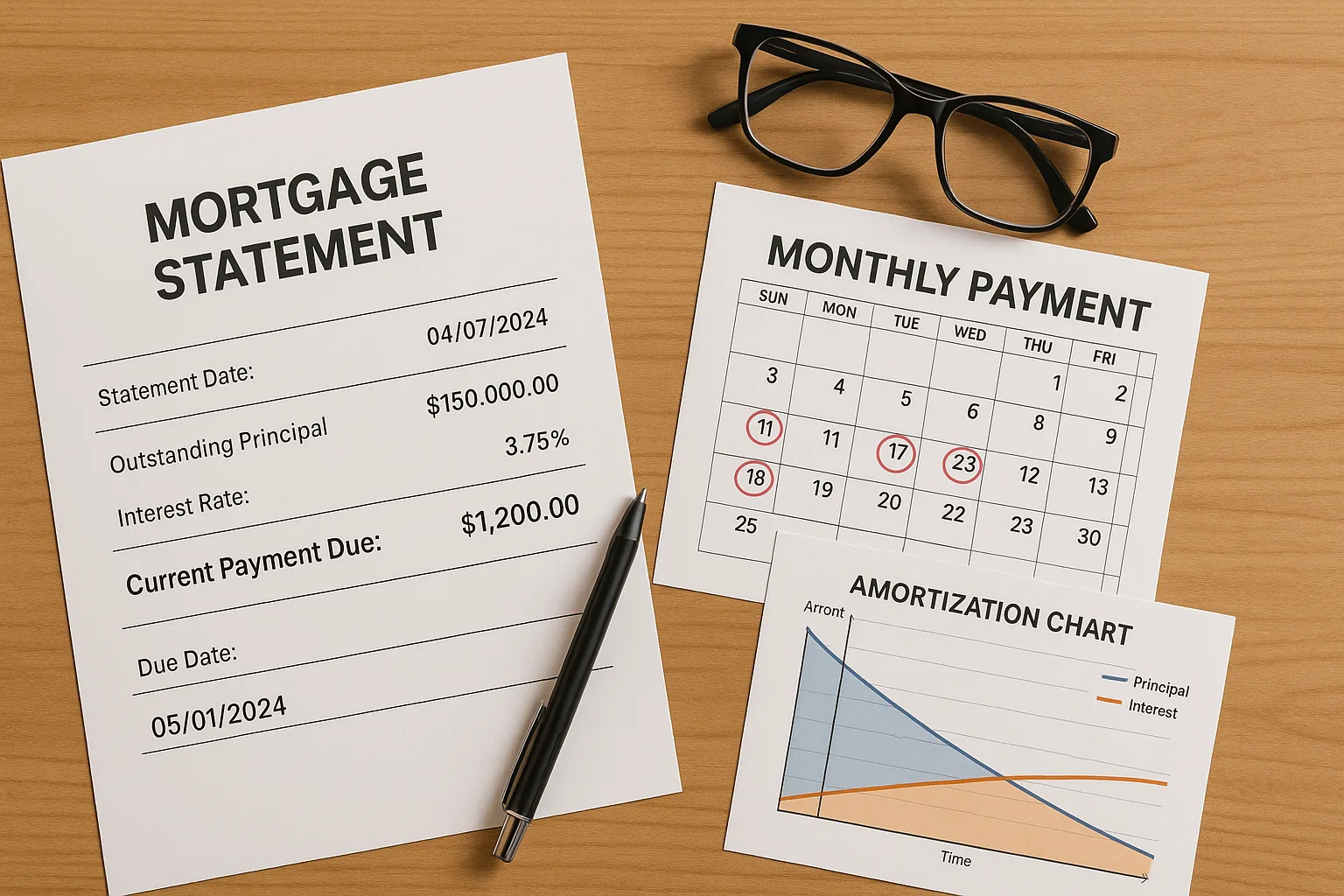
The principal-and-interest portion of a mortgage payment is divided through a process called amortization. Early in the loan term, more of that principal-and-interest payment goes toward interest; over time, more goes toward principal. Your total amount due can also include escrowed property taxes, homeowners insurance, and mortgage insurance, so it may change even when the loan’s principal-and-interest payment is fixed.
For principal and interest only, on a $300,000 30-year loan at 6.5% interest:
- Month 1: about $1,896 payment ($271 principal, $1,625 interest)
- Month 180: about $1,896 payment ($713 principal, $1,183 interest)
- Month 360: about $1,896 payment ($1,886 principal, $10 interest)
Because extra principal reduces the balance sooner, the same extra payment generally has more time to reduce interest when you make it earlier in the loan. If you want to plug in your own numbers, try our free mortgage payoff calculator with extra payments to see how payment changes affect your payoff date and interest.
Mortgage Types: Rate Choices and Government-Backed Programs
Start by separating two decisions that lenders often present together: how the interest rate behaves, and which loan program you qualify for. A familiar loan label is not a reason to choose it; compare the payment, total cost, adjustment risk, insurance or guarantee fees, and eligibility rules.
Fixed-Rate Mortgages: Predictable Principal and Interest
Fixed-rate mortgages maintain the same interest rate throughout the loan term, so the scheduled principal-and-interest payment does not change because market rates move. Taxes, insurance, mortgage insurance, or escrow adjustments can still change the total amount you pay each month. If you value predictable loan payments and protection from future rate resets, a fixed-rate mortgage can be easier to plan around.
Common fixed-rate terms:
- 30-year mortgages: Lower required principal-and-interest payments, with more years for interest to accrue
- 15-year mortgages: Higher required payments, with a faster payoff and less time for interest to accrue
- 20-year mortgages: A middle term that shortens repayment versus 30 years while requiring less each month than a comparable 15-year loan
May fit: borrowers who place a high value on predictable principal-and-interest payments and do not want future market-rate changes built into the loan.
Adjustable-Rate Mortgages (ARMs): Understand the Reset Risk
Adjustable-rate mortgages (ARMs) may start with a lower rate than a comparable fixed-rate loan, but the rate can adjust later according to the loan’s index, margin, adjustment schedule, and caps. These loans typically feature an introductory fixed-rate period followed by periodic adjustments.
ARM labels describe an initial fixed period and a later adjustment schedule. For example, a 5/1 ARM is fixed for five years and then adjusts once per year; other loans may use different fixed periods or adjustment intervals. Check the Loan Estimate and the loan’s caps rather than assuming every ARM follows the same pattern.
May fit: borrowers who can afford the payment if the rate adjusts upward and whose time horizon makes the initial fixed period genuinely useful. Do not make the plan depend on being able to refinance later.
Government-Backed Loans: FHA, VA, and USDA
Government-backed programs can reduce some barriers for qualified borrowers, but each program has its own eligibility and cost rules:
- FHA loans: down payments can be as low as 3.5% for borrowers who meet FHA and lender requirements, with mortgage insurance and other program costs to consider.
- VA-backed purchase loans: many eligible borrowers can buy with no down payment when the sales price does not exceed the appraised value, subject to lender underwriting and VA eligibility.
- USDA guaranteed loans: qualified borrowers can finance eligible homes in eligible rural areas with no money down.
Do not assume a government-backed loan is automatically the cheapest option. Compare the rate, mortgage insurance or guarantee fees, closing costs, property rules, and total cost against conventional alternatives you qualify for.
Fixed vs. Adjustable Rates: How to Choose
The fixed-versus-adjustable choice is really a trade between certainty now and rate risk later. Compare the actual offers in front of you, then stress-test the ARM payment before treating a lower starting rate as a benefit.
What a Fixed Rate Protects You From
A fixed rate mainly buys predictability: the note rate and scheduled principal-and-interest payment do not reset when market rates move. It does not automatically have the worse starting price, so compare actual offers. Its main trade-off is that a future market-rate decline will not lower your note rate unless you refinance or otherwise replace the loan.
When an ARM Is Worth Comparing
An ARM can trade a lower initial rate or payment for future adjustment risk. It is worth comparing when you understand the index, margin, caps, and adjustment schedule, can afford a higher payment if rates rise, and the initial fixed period is useful for your actual time horizon. A shorter expected ownership period may reduce exposure to later resets, but do not rely on a future sale, refinance, or income increase as the only way the loan stays affordable.
Rate Comparison Strategy
When evaluating mortgage options, compare:
| Factor | Fixed-Rate | Adjustable-Rate |
|---|---|---|
| Initial Rate | Depends on the offer | May be lower initially |
| Payment Stability | Principal & interest stays fixed | Can change after adjustments |
| Rate Risk | No rate-reset risk | Borrower bears adjustment risk within caps |
| When it may fit | When payment certainty matters | When the initial-period benefit outweighs reset risk and you can absorb higher payments |
For your top two offers, put the rate, APR, term, initial payment, maximum adjustment terms, and cash to close on one page. That makes the price of certainty—and the cost of taking rate risk—much easier to see.
Smart Mortgage Payoff Strategies
Paying a mortgage off faster can reduce interest, but extra principal competes with emergency savings, higher-cost debt, retirement contributions, and other goals. The right payoff pace is one your cash flow can sustain without creating a more expensive problem elsewhere.
The Power of Extra Principal Payments
Extra principal reduces the balance sooner, which can shorten the payoff period and reduce interest. The effect depends on your rate, remaining term, timing, and the amount you add.
Example: On a $250,000 30-year loan at 6% interest, using principal and interest only:
- Standard payment: about $1,499/month, about $539,595 total paid
- Extra $100/month: about $1,599/month, about $488,023 total paid
- Savings: about $51,572 and roughly 4.5 years off the loan term
Biweekly Payment Strategy
Switching from monthly to biweekly payments (half your monthly payment every two weeks) results in 26 payments annually—equivalent to 13 monthly payments instead of 12.
What a true biweekly schedule can do:
- Creates the equivalent of one extra monthly payment each year
- Can shorten the payoff period and reduce interest if the servicer applies the payments as intended
- May align with biweekly paychecks, but you should confirm the servicer’s posting rules and any program fees first
To see the real impact on your own loan, our biweekly mortgage payments guide walks through example savings and shows how much interest you can really save.
If You Have More Than One Mortgage
If you own more than one financed property, do not assume the highest stated rate is automatically the only loan worth targeting. Compare each mortgage’s rate, remaining term, prepayment terms, required reserves, property cash flow, and the value of keeping cash available. When the loans are otherwise comparable, directing extra principal toward the higher-cost mortgage will generally reduce interest faster, but liquidity and property-specific risks can change the decision.
Before Sending a Windfall to Principal
A tax refund, bonus, gift, or other windfall does not have to be an all-or-nothing mortgage payment. Before sending extra cash to principal, ask:
- Do I have enough liquid cash? Preserve a cushion for income disruptions, insurance deductibles, repairs, and other near-term needs.
- Do I carry more expensive debt? Compare the borrowing cost and risk before prioritizing a lower-cost mortgage.
- Does my loan restrict or complicate prepayment? Check your loan documents and servicer instructions before making a large extra payment.
- What matters more right now—lower debt or flexibility? Extra principal reduces the balance, but you generally cannot pull that cash back out without selling, refinancing, or borrowing against the home.
Once those questions are clear, decide how much—if any—of the windfall belongs on the mortgage. For more payoff scenarios, see our early mortgage payoff calculator.
If you want to test the payoff idea without committing to a big change, run the loan with an extra $25 or $50—then check what that cash is competing with across the rest of your finances before you commit it to principal.
Get the 30-Minute Money Reset Before You Pay Extra
See income, spending, up to 8 debts, and up to 8 goals together in the editable workbook.
Confirm to get the workbook and frugal money tips. Unsubscribe anytime.
Something went wrong. Please check your email address and try again.
Mortgage Refinancing: Break-Even, Costs, and Options
A lower advertised rate is not the same as a better refinance. The decision depends on what the new loan changes after you include closing costs, the new term, monthly payment, and how long you expect to keep the loan.
When Refinancing Makes Financial Sense
Refinancing replaces your current mortgage with a new loan, potentially offering better terms, lower payments, or access to home equity. Consider refinancing when:

- A new Loan Estimate shows a meaningful improvement after you account for closing costs, term length, and how long you expect to keep the loan
- Your credit profile improves enough to qualify for materially better pricing or terms
- Your equity position changes enough to alter mortgage-insurance or loan-structure options
- Your cash-flow goals change and a different term better fits the payment you can safely carry
- You have a specific cash-out purpose and have compared the cost and risk of turning that need into debt secured by your home
In some cases, you might even qualify to refinance without a new appraisal; our guide on refinancing your mortgage without an appraisal explains when that’s possible and what to expect.
Types of Refinancing Options
Rate-and-Term Refinancing: Changes interest rate or loan term without accessing equity.
- Potentially lower monthly payments
- Potentially lower total interest when the rate, term, and costs work in your favor
- A shorter term when faster payoff fits your cash flow
Cash-Out Refinancing: Replaces your current mortgage with a larger loan and returns part of the new balance as cash.
Home repairs and debt consolidation are common reasons borrowers use cash-out refinancing, but the use of the money does not make the new mortgage automatically worthwhile. CFPB research notes that replacing non-mortgage debt with mortgage debt can increase foreclosure risk, because the home now secures that borrowing. Compare the new mortgage with keeping your existing loan, check whether the new term raises total cost, and make sure the plan actually reduces the problem rather than simply moving it onto the house.
Cash-In Refinancing: Brings money to closing to reduce loan balance.
- Can improve loan-to-value and mortgage-insurance options, depending on program rules
- May qualify for better pricing or terms
- Can reduce the amount financed and monthly payment
If you’re also weighing a lump-sum recast instead of a full refi, our comparison of mortgage recast vs. refinance breaks down which option fits different situations.
Refinancing Cost-Benefit Analysis
Start with the break-even point, then compare the old and new loans over the time you realistically expect to keep the mortgage:
Break-even months = eligible upfront refinance costs ÷ estimated monthly savings
Then compare total interest, remaining term, points or lender credits, and any costs rolled into the new balance.
There is no universal “1% lower rate” or “2–3 year break-even” rule that makes a refinance automatically worthwhile. Compare the Loan Estimates and choose a time horizon that matches how long you expect to keep the new loan. You can also use our mortgage refinance break-even calculator to run the basic break-even math.
Refinance Cost & Break-Even Check
Enter your current loan and a refinance quote. You’ll see the principal-and-interest change, simple break-even point, and how the entered terms compare if both loans are held to payoff.
Current loan
Refinance scenario
Your refinance comparison
Current P&I—
Proposed P&I—
Monthly change—
Payment break-even—
Enter your current loan and refinance terms to compare them.
Planning estimate only. Compare the APR, points or lender credits, cash to close, and total loan costs on real Loan Estimates before deciding.
The Refinancing Process Timeline
- Shop and compare: Request comparable Loan Estimates from multiple lenders
- Apply and document: Submit income, asset, insurance, and property information the lender requests
- Underwriting and valuation: The lender reviews the file and may require an appraisal or another valuation method
- Final review: Check the Closing Disclosure against the deal you expected
- Closing and funding: Sign only after questions and material discrepancies are resolved
Processing time varies by lender, loan type, appraisal needs, documentation issues, and market volume, so use your lender’s current estimate rather than planning around a fixed number of weeks.
Before requesting quotes, gather your latest mortgage statement and a realistic estimate of your home’s value. Then compare written offers on the same goal and time horizon so a lower payment is not hiding a longer or more expensive loan.
Home Equity: Borrowing Options and Risks
Home equity is an asset, but borrowing against it creates debt secured by your home. Start with the purpose, amount, repayment plan, and downside if your income changes; only then compare a HELOC, home equity loan, or cash-out refinance.
Understanding Home Equity Accumulation
Home equity represents the difference between your home’s current market value and outstanding mortgage balance. Equity grows through:
- Principal payments reducing loan balance
- Property appreciation increasing home value
- Home improvements that may add value, although the increase is not guaranteed to equal what you spend
- Market conditions that can raise or lower local home values
Home Equity Line of Credit (HELOC)
HELOCs provide flexible access to home equity through a revolving line of credit secured by your home. The CFPB notes that HELOCs usually have variable rates, so the payment can change even when you do not borrow more.
HELOC Features:
- Usually a variable rate, although some plans allow fixed-rate options for part of the balance
- A draw period followed by a repayment period; the exact lengths vary by plan
- Some plans allow interest-only payments during part of the draw period, while others require principal repayment
- A lender-set credit limit based on factors such as home value, existing liens, credit, income, and program rules
Potential uses: expenses that arrive in stages or require flexible borrowing. Using a HELOC as an emergency fund still means taking secured debt, so keep the repayment risk in view.
Home Equity Loans: A Lump-Sum Alternative
A home equity loan provides the amount you borrow as a lump sum. Rates are often fixed, but the CFPB notes that home equity loans may have fixed or adjustable rates, so check the actual offer rather than assuming the payment structure.
Home Equity Loan Features:
- Lump-sum funding at closing
- A fixed or adjustable rate depending on the product
- A set repayment term defined by the lender and loan agreement
- Pricing that may be lower than unsecured debt because your home secures the loan, but puts the home at risk if you cannot repay
Potential uses: a defined one-time expense when a fixed repayment structure is useful. Compare the secured-loan risk with unsecured alternatives before moving other debt onto your home.
Equity Access Comparison
| Feature | HELOC | Home Equity Loan | Cash-Out Refi |
|---|---|---|---|
| Rate Type | Variable | Often fixed; can vary | Fixed or adjustable |
| Access | As needed | Lump sum | Lump sum |
| Payments | Vary with balance and plan terms; some plans allow interest-only payments during part of the draw period | Scheduled payments follow the loan terms | Replaces the first mortgage; payment depends on the new loan terms |
| Closing Costs | Often lower, but varies | Varies by lender and loan | Can be substantial |
A rough equity estimate is useful for screening options, but a lender will use its own valuation and underwriting. Treat online home-value estimates as a starting point, not spendable cash.
Credit Impact and Mortgage Management
A mortgage can affect your credit profile, but the exact score movement is personal and scoring-model dependent. Focus on what you can control: accurate reports, on-time payments, manageable balances, and avoiding unnecessary new debt around a mortgage application.
How Mortgages Affect Credit Scores
Mortgage payment history and balances can affect credit scores, but no single mortgage action produces a fixed point change. FICO groups its general scoring factors into five categories, and it also notes that their importance can vary by person:
- Payment history (35%): Paying as agreed supports a positive payment record; late payments can hurt.
- Amounts owed (30%): Revolving utilization is one part of this category, while mortgage and other installment balances are evaluated differently.
- Length of credit history (15%): The age of accounts can matter, but the effect depends on the rest of your file.
- New credit (10%): New accounts and inquiries can affect scores.
- Credit mix (10%): Mortgages are one type of installment credit, but you do not need every account type to have a strong score.
Protecting Your Credit During Homeownership
- Make payments on time: Set up automatic payments to avoid late fees and credit damage.
- Monitor credit reports: Check for errors that could affect future refinancing rates.
- Be deliberate with older accounts: Don’t close an account solely to chase a score; weigh fees, fraud risk, and whether you still need it.
- Avoid unnecessary credit changes: New debt or account changes right before or during a mortgage process can complicate underwriting.
Credit Score Improvement Strategies
If you want to strengthen your credit profile before a mortgage application or refinance:
- Reduce revolving balances when practical; lower utilization can help, but there is no universal 30% cutoff that guarantees a score result
- Dispute genuine credit report errors and keep records of the correction process
- Avoid unnecessary new credit right before and during mortgage shopping
- Keep useful older accounts deliberately rather than opening or closing accounts only for score manipulation
- Don’t take on debt just to change your credit mix; FICO says you do not need one of every account type
If your credit report contains genuine errors, you can dispute them yourself for free. If you want help organizing that process, a credit-repair service may offer guidance, but it cannot legally remove accurate, current negative information. The FTC explains these limits and your dispute rights.
A stronger credit profile can affect mortgage pricing, but there is no universal “X points equals Y rate reduction” formula. The CFPB says mortgage shopping within a 45-day window is generally treated as a single inquiry for scoring purposes, so comparing multiple real Loan Estimates can be more useful than guessing what a particular score change should save.
Before your next mortgage application or refinance, review your credit reports and document any genuine errors early enough to dispute them before underwriting.
Common Mortgage Mistakes to Avoid
The expensive mortgage mistakes are usually not exotic. They come from rushing, comparing unlike offers, optimizing one number while ignoring total cost, or using cash so aggressively that the rest of the household becomes fragile.
Refinancing Pitfalls
Mistake 1: Refinancing too frequently and repeatedly paying closing costs.
Solution: Use the break-even calculation and compare total loan costs instead of relying on a fixed rate-drop threshold.
Mistake 2: Extending loan terms repeatedly and increasing total interest.
Solution: Consider shorter terms or maintain your current payoff timeline.
Mistake 3: Treating cash-out refinancing like low-risk spending money.
Solution: Use home equity only when the purpose justifies the cost and the added risk of securing that debt with your home.
Payment Strategy Errors
Mistake 4: Sending every extra dollar to the mortgage while carrying much higher-cost debt.
Solution: Compare the cost and risk of each debt before choosing where extra cash goes. High-interest revolving debt often deserves priority, but keep required mortgage payments current and preserve enough liquidity for near-term needs.
Mistake 5: Depleting emergency savings for extra mortgage payments.
Solution: Keep a cash cushion that fits your income stability, insurance coverage, household risks, and near-term expenses before making aggressive extra payments.
Mistake 6: Assuming mortgage interest is deductible for you.
Solution: The deduction depends on itemizing and other IRS rules, so verify your own eligibility before letting a tax assumption drive a borrowing or payoff decision.
Credit and Documentation Issues
Mistake 7: Making major financial changes during a mortgage process without telling the lender.
Solution: Avoid unnecessary new debt or large financed purchases, and promptly tell your lender about material income or employment changes.
Mistake 8: Failing to shop multiple lenders on comparable terms.
Solution: Request Loan Estimates from at least three lenders and compare the same loan type, rate-lock assumptions, points or credits, and total loan costs.
Advanced Mortgage Decisions: Rates, Points, and Investment Properties
Rate headlines are useful context, not a mortgage strategy. Start with the loan you actually have, the alternatives you can actually qualify for, and the downside if your assumptions are wrong; that keeps advanced tactics tied to your own cash flow instead of the news cycle.
Interest Rate Environment Navigation
Mortgage rates can change week to week, so a durable strategy starts with your own loan terms rather than a calendar-year forecast. Compare your current rate, remaining term, break-even horizon, and realistic alternatives, then check the latest Freddie Mac Primary Mortgage Market Survey for broad market context before you shop. Homeowners with unusually low existing rates may value preserving them, while borrowers with higher-cost loans may have more reason to compare refinance or restructuring options.
- If current offers are worse than your existing loan: Protect the value of a favorable fixed rate unless another goal justifies a change.
- If a new offer improves your real numbers: Compare APR, points or credits, upfront costs, term length, and the break-even horizon instead of reacting to headlines alone.
- If rates are moving quickly: Ask lenders how long a quoted rate or lock is valid and compare written Loan Estimates on equivalent terms.
Using Discount Points Wisely
When you take out a new mortgage or refinance, your lender may offer discount points—upfront fees that lower your interest rate. Paying points can make sense if you plan to keep the loan long enough to break even on the cost, so it’s worth running the numbers with a calculator and comparing them to guidance from a trusted housing agency or financial planner before you commit.
Investment Property Considerations
For homeowners with multiple properties:
- Cross-collateralization: Some financing structures tie multiple properties to the same debt, which can complicate a sale or default; understand exactly which assets secure which loan.
- Refinancing: Compare each property’s rate, term, costs, reserves, and cash flow rather than assuming the whole portfolio should move together.
- Tax treatment: Investment-property interest and expense rules can differ from a primary residence, so coordinate significant moves with a tax professional.
- Cash-flow reserves: Leave room for vacancies, repairs, insurance, taxes, and rate changes where applicable.
If you’re curious about turning a duplex into a live-in investment, our guide on house hacking a duplex with tips from Reddit shows how other homeowners reduce their housing costs.
Advanced strategies are worth considering only when the downside is as clear as the upside. Write down the failure case—higher payment, longer debt, tied-up property, tax complexity—before you commit to the strategy.
Planning Your Mortgage Future
Your mortgage plan should change when your time horizon, income, retirement date, household needs, or housing goals change—not simply because a headline says rates moved. Use those future constraints to decide whether liquidity, lower required payments, faster payoff, or flexibility matters most.
Long-Term Wealth Building
A mortgage can affect wealth building through equity, leverage, liquidity, and tax treatment:
- Equity buildup: Principal payments reduce what you owe, while changes in home value can increase or decrease your equity.
- Leverage: Borrowing lets you control a larger asset with less cash up front, which can magnify both gains and losses.
- Potential tax deduction: Some homeowners who itemize and meet the rules can deduct qualified mortgage interest; IRS Publication 936 explains the limits and eligibility.
- Fixed-rate inflation effect: The principal-and-interest payment stays nominally fixed, although taxes, insurance, maintenance, and other ownership costs can still rise.
If your main goal is to own your home free and clear sooner, our home loan repayment calculator with extra payments shows how different payoff schedules change your timeline and interest costs.
Retirement Planning Integration
Consider mortgage payoff timing with retirement goals:
- Pre-retirement payoff: Can reduce required monthly spending before employment income falls.
- Keep the mortgage: May preserve liquidity for other priorities, but you continue paying interest and carrying the loan’s risks.
- Partial paydown: Can balance lower housing debt with keeping some cash available.
A useful planning target is not necessarily “mortgage-free as soon as possible.” Pick the housing cost and debt level you want by a meaningful life milestone, then work backward from the cash flow required to get there.
Frequently Asked Questions
Conclusion: Your Mortgage Management Action Plan
A good mortgage plan is less about finding one clever trick and more about keeping three things visible: what you owe, what the loan costs, and what a change would do to your cash flow and risk.
- Know your baseline: Write down your balance, rate, years remaining, principal-and-interest payment, and any mortgage insurance.
- Name the goal: Decide whether you are trying to lower required payments, reduce total interest, pay off sooner, preserve liquidity, or access equity.
- Compare the right numbers: For payoff decisions, test the effect of extra principal. For refinancing, include upfront costs and the new term instead of comparing rates alone.
- Keep secured debt in perspective: A HELOC, home equity loan, or cash-out refinance may solve a real need, but it also puts the home behind the debt.
- Revisit the plan when your life changes: A move, income change, retirement milestone, major repair, or new loan offer can justify another review.
If you do one thing this week, pull up your latest mortgage statement and record the balance, rate, and years remaining. Those three numbers are enough to make the payoff and refinance sections of this guide immediately more useful.
This mortgage guide is for general education only and isn’t personal financial, tax, or legal advice. Your situation and results may look very different from the examples here, so always check big decisions with a qualified financial professional or housing counselor who understands your full picture.

