

If you searched for “house hacking duplex Reddit,” you probably want the problems a listing sheet will not show you. Reddit can be a useful question generator, but it should not be your underwriting.
House hacking a duplex can lower your housing cost, but you are buying a home and taking on a small rental business at the same time. The deal has to survive vacancies, repairs, financing rules, legal-use questions, and the fact that you become a live-in landlord. This guide turns recurring owner-occupant questions into a deal-screening process, checks time-sensitive points against current official sources, and gives you an estimator to test a real listing. Use our mortgage guide alongside lender quotes when you are ready to compare financing.
This post contains affiliate links. If you use a service through one of them, we may earn a commission at no extra cost to you. Learn more.
Table of Contents
- Before You Buy: Five Go/No-Go Checks
- What Reddit Threads Can—and Can’t—Tell You About Duplex House Hacking
- Run the Numbers Conservatively
- Financing an Owner-Occupied Duplex
- Insurance and Cash Reserves
- Living Next Door: Screening, Laws, and Boundaries
- Choose the Rental Setup and Neighborhood Together
- Tax Basics for an Owner-Occupied Duplex
- Deal Breakers and Warning Signs
- Exit Strategy and Scaling
- If You Buy: Build a Simple Landlord System
- Frequently Asked Questions
- Your Next Step: Test One Real Duplex
Before You Buy: Five Go/No-Go Checks
A duplex is worth deeper research when you can answer these five questions with evidence rather than optimism:
- Do the numbers survive a bad month? The payment still feels manageable after a vacancy, a repair, or a lower-than-hoped-for rent.
- Do you have a financing path? A lender has explained the cash to close, monthly payment, mortgage insurance, reserve requirements, and how rental income will be treated.
- Can the property legally operate the way you plan? The second unit, rental use, occupancy, and any planned alterations match local rules.
- Can you live next to the tenant relationship? Privacy, noise, parking, shared space, maintenance access, and communication boundaries are workable for you.
- Do you have an exit that does not depend on perfect appreciation? You know what would make you keep, sell, refinance, or move on.
If two or more answers are still unknown, treat them as your research list before you fall in love with a listing.
What Reddit Threads Can—and Can’t—Tell You About Duplex House Hacking
A duplex house hack is simple in concept: you live in one unit and rent the other. The useful part of Reddit is not a universal formula; it is seeing where that simple idea becomes difficult in real properties and real landlord relationships.
Carry These Reddit Questions Into Your Own Deal
The threads reviewed for this update repeatedly center on three practical questions:
- Do the numbers work beyond the listing pitch? A first-property duplex discussion begins with the buyer asking what to calculate before deciding whether the property is a good investment.
- Can you live next to the tenant relationship? A duplex house-hacking experience thread spends much of its attention on privacy, boundaries, leases, layout, and the reality of managing people who live next door.
- Can you actually occupy the property as planned? A fully occupied duplex discussion shows how existing tenancies can complicate an owner-occupancy plan before financing and local tenant rules are even resolved.
That is the right role for Reddit here: it can reveal questions and failure modes, but it does not establish current lending, fair-housing, tax, insurance, or local landlord rules. Those claims need the lender, government authority, insurer, or qualified professional that controls the decision.
Run the Numbers Conservatively
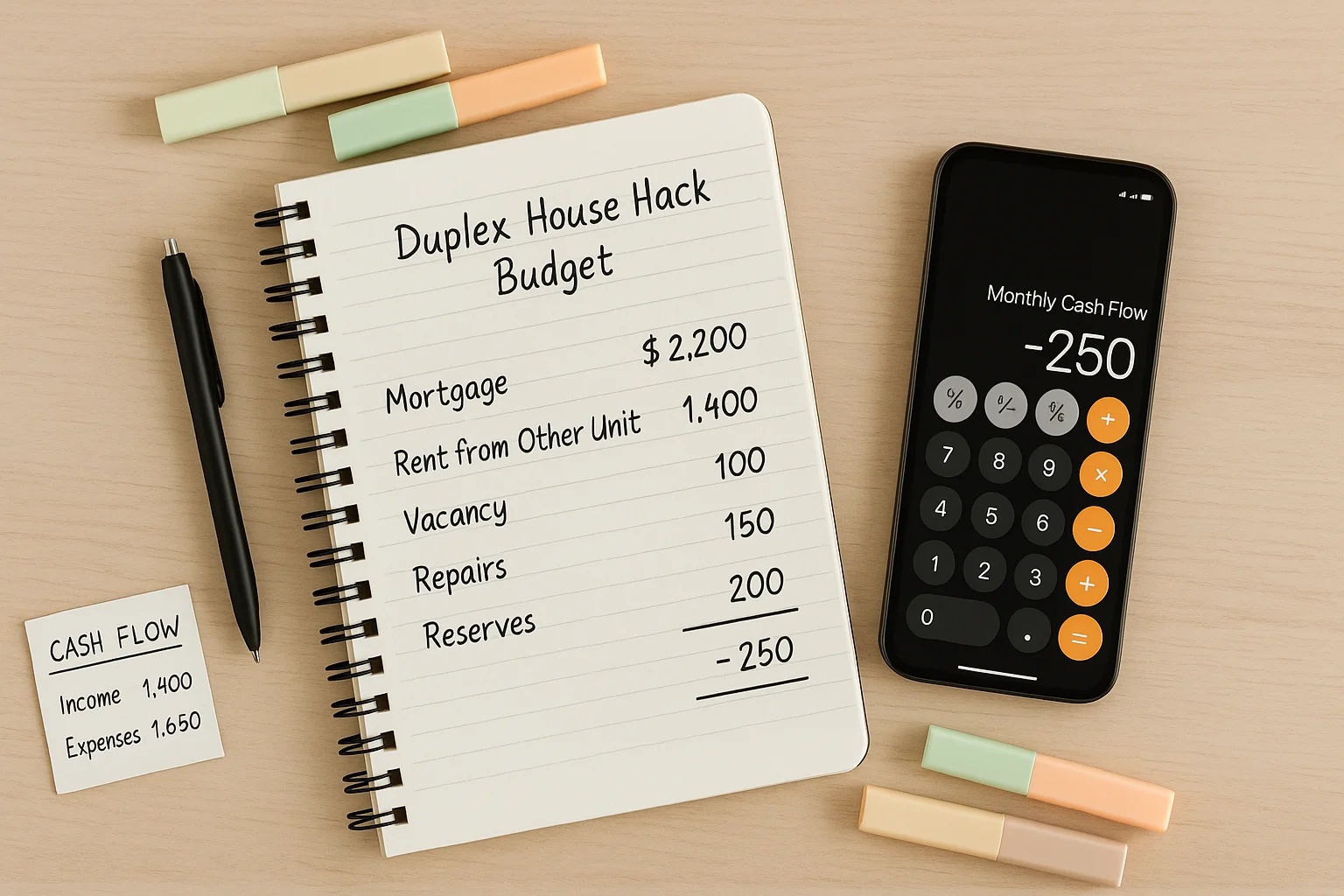
The estimator above answers the first useful question: after a reserve for vacancy and repairs, how much of your monthly PITI might the other unit offset? The next step is to replace every shortcut with property-specific numbers.
Use Shortcuts Only as a First Screen
The 50% rule is a rough investor screen that assumes half of gross rent may be consumed by operating expenses before debt service. It is not an underwriting rule or a forecast, and it is especially blunt for an owner-occupied duplex. If a listing looks promising under a shortcut, rebuild the estimate from actual taxes, insurance, owner-paid utilities, repair history, major-component condition, and local vacancy evidence.
Model the Costs That Do Not Show Up in Advertised Rent
| Cost to model | What to verify | Why it matters |
|---|---|---|
| Vacancy and turnover | Local vacancy, expected lease length, cleaning, and make-ready costs | Rent can stop between tenants while ownership costs continue. |
| Routine maintenance | Plumbing, appliances, finishes, exterior, and shared systems | Small repairs arrive irregularly, so the budget needs room even in quiet months. |
| Major replacements | Roof, HVAC, water heaters, electrical, sewer, and other expensive components | A positive monthly estimate can disappear when a large component fails. |
| Owner-paid services | Utilities, lawn or snow service, HOA dues, pest control, bookkeeping, and management if used | The lease determines which recurring costs remain yours. |
Stress-test the deal by lowering the rent assumption, adding a vacancy period, and including one major repair. If it works only when every assumption is favorable, the margin for error is thin.
Illustrative Calculator Example
Suppose a lender quote puts total monthly PITI and any required mortgage insurance at $2,900, and recent comparable rentals support $1,850 for the other unit. With a 20% vacancy-and-repair reserve, the estimator applies $1,480 of effective rent and leaves about $1,420 of monthly housing cost before utilities, capital expenses, HOA dues, management costs, local taxes or fees, and other owner-paid items.
This is a math example, not a benchmark or loan quote. Replace every input with the numbers for the property you are actually considering.
Financing an Owner-Occupied Duplex
FHA Owner-Occupied Financing
FHA financing comes up often in house-hacking discussions because HUD says eligible borrowers may put as little as 3.5% down on one- to four-unit properties. FHA eligibility, mortgage insurance, appraisal/property requirements, loan limits, occupancy rules, and the amount of rental income a lender may use still depend on the current program rules and your application.
- Low-down-payment route: FHA can be a practical option when upfront cash is the main constraint.
- Rental income is not the same as cash-flow rent: lender qualifying rules determine how documented or appraised rent may be counted, so do not assume the other unit’s full advertised rent offsets your mortgage dollar for dollar.
- Owner occupancy matters: this article is about a principal-residence house hack, not an investment-property FHA workaround.
Check HUD’s current FHA loan overview and the current FHA Single Family Housing Policy Handbook, then have an FHA-approved lender apply the rules to the exact property.
Conventional Owner-Occupied Loans
Conventional financing can also support an owner-occupied duplex. Fannie Mae’s August 2026 standard Desktop Underwriter eligibility matrix shows a maximum 95% LTV for eligible two- to four-unit principal-residence purchases, which can translate to as little as 5% down in qualifying cases. That is a program ceiling, not a promise that every borrower or property will qualify.
- Compare the total cash to close, rate, mortgage-insurance cost, reserves, and monthly payment rather than choosing a loan solely by its down-payment percentage.
- Ask how each lender will document and count rent from the other unit.
- Confirm property-condition, appraisal, occupancy, and reserve requirements for the exact loan product.
See Fannie Mae’s current Eligibility Matrix, then request side-by-side FHA and conventional estimates from lenders that regularly finance two-unit owner-occupied properties.
For general budgeting, financing, or cash-flow questions, you can chat with a finance expert on JustAnswer.
Insurance and Cash Reserves
Insurance Questions for an Owner-Occupied Duplex
Insurance needs depend on the property, how the units are occupied, what the policy covers, and who is responsible for particular losses. Instead of assuming a standard landlord package, ask the insurer to confirm in writing:
- Building coverage: how the dwelling limit is calculated and what exclusions or deductibles apply.
- Liability: the liability limit and whether the rental exposure changes the recommended coverage.
- Loss of rents: whether, when, and for how long covered rental income can be reimbursed after an insured loss.
- Umbrella eligibility: whether additional liability coverage is available and what underlying limits it requires.
Policy forms and exclusions vary, so use the insurer’s actual policy documents—not a generic checklist—as the final authority.
Build a Reserve Around the Property’s Real Risks
There is no universal cash-reserve number that fits every duplex. Size your reserve around the insurance deductible, the age and condition of expensive components, expected vacancy and turnover, owner-paid utilities, and how much of the payment you could cover from non-rental income.
A useful stress test is to ask whether you could handle a vacancy and one major repair at the same time without using high-cost debt. Any lender reserve requirement is separate from the additional cushion you choose for your own risk tolerance.
If you need more room in your budget to build that cushion, our frugal living guide covers practical ways to reduce recurring spending.
If that reserve would compete with other debts or goals, look at those trade-offs together before you commit more cash to the property.
Check Your Money Picture Before You Stretch for a Duplex
Use the editable workbook to put income, spending, up to 8 debts, and up to 8 goals on one screen; the SNAPSHOT sheet totals everything automatically.
Confirm to get the workbook and frugal money tips. Unsubscribe anytime.
Something went wrong. Please check your email address and try again.
Living Next Door: Screening, Laws, and Boundaries
Owner-occupancy makes tenant decisions feel personal, but the operating system should stay professional. The goal is not to find someone whose lifestyle resembles yours; it is to use lawful written criteria, confirm the property can be rented as intended, and make the shared-property boundaries clear before move-in.
Use Written, Objective Screening Criteria
- Ability to pay: choose a lawful, documentable income standard and acceptable forms of verification before applications arrive.
- Rental history: use the same reference questions and look-back period for applicants in the same pool.
- Credit, eviction, or background information: use only criteria permitted where the property is located and apply them consistently.
- Application completeness: define which identity, consent, and screening documents are required for everyone.

Federal fair-housing law prohibits housing discrimination based on race, color, national origin, religion, sex, familial status, and disability; state and local protections can go further. Avoid subjective filters such as social-media impressions or “lifestyle compatibility” tests, and check the rules that govern screening fees, credit reports, eviction records, criminal-history information, required notices, and application handling in your jurisdiction.
Review HUD’s current Fair Housing Act overview and current state/local rules before you advertise or deny an applicant on a contested criterion.
Verify the Property Can Be Rented as Intended
A listing that looks like a duplex is not proof that both units are a legal, conforming use. Before closing, verify the records and rules with the authorities that actually enforce them.
- Legal use and zoning: confirm the property is recognized for the two-unit use you plan.
- Rental licensing and inspections: check whether the city, county, or state requires registration, licenses, inspections, or recurring certificates.
- Safety and occupancy: verify egress, smoke/CO requirements, occupancy limits, and any rules affecting shared or separately metered utilities.
- Planned work: confirm permits and code requirements before relying on a new kitchen, bath, electrical upgrade, wall change, or unit conversion.
Set Boundaries Before Move-In
Decide how the property will work before a routine issue becomes a neighbor dispute:
- Private and shared space: entrances, yard areas, storage, laundry, mail, and parking should be unambiguous.
- Maintenance: give tenants one written route for routine requests and a separate definition of emergencies.
- Communication: keep ordinary landlord communication professional rather than relying on hallway conversations.
- Access: follow the lease and local notice rules rather than treating proximity as permission to enter.
Living nearby can make every problem feel urgent. A written process gives both sides more privacy and makes it easier to separate being a neighbor from acting as the landlord.
Reduce Shared-Wall Friction
Noise is partly a building problem and partly an expectations problem. Before spending on a major soundproofing project, identify whether the issue is impact noise, air leakage, doors, plumbing, or sound passing through a wall or ceiling assembly.
| Upgrade | Complexity | Verify first |
|---|---|---|
| Door seals and weather stripping | Low | Where sound is leaking and whether required ventilation or egress is affected. |
| Rugs or soft finishes | Low | Whether impact noise is the main problem. |
| Acoustic sealant or targeted wall work | Medium | The actual wall/ceiling assembly and penetrations. |
| Insulation or wall reconstruction | High | Contractor scope, fire separation, code, permits, and multiple quotes. |
Choose the Rental Setup and Neighborhood Together
The rental format and the location are one decision: a room-by-room plan that works near a university may be a poor fit elsewhere, while a whole-unit lease can be easier to manage but leaves you with a full vacancy when that tenant moves out.
Whole-Unit vs. Room-by-Room
| Decision | Whole-unit lease | Room-by-room |
|---|---|---|
| Management | Usually one lease and one tenant household. | Multiple agreements and more coordination. |
| Vacancy | A turnover can remove all rent from that unit. | One vacancy may leave other rooms occupied. |
| Income potential | Simpler; compare one-unit market rent. | May produce higher gross rent in some markets, but management and turnover can also rise. |
| Privacy | Clearer household boundary. | More tenant interaction and shared-space issues. |
| Rules to verify | Lease, licensing, occupancy, and insurance still matter. | Check whether room rentals trigger additional occupancy, use, licensing, or insurance requirements. |
Check Rentability and Daily-Life Fit
Use recent comparable rentals with similar size, condition, amenities, and location, then check the parts of the neighborhood that affect both demand and your own experience living there.
- Rental evidence: asking rents are useful, but recent leased comparables, time on market, and turnover tell you more than one optimistic listing.
- Demand drivers: employment, schools or universities, transit, hospitals, and other durable destinations can affect who wants to rent nearby.
- Property-specific carrying costs: taxes, insurance, utilities, parking, and local rental rules can change the economics block by block.
- Your daily life: visit at different times to evaluate noise, parking, commute, shared outdoor space, and whether you would actually want to live there.
Do not use assumptions about who “belongs” in a neighborhood or the type of tenant you expect. Underwrite the property from objective market and property data.
Tax Basics for an Owner-Occupied Duplex
Rental Tax Basics for a Duplex You Also Live In
Tax treatment is not the same as for a property that is 100% rental use. IRS Publication 527 says that when you rent part of a property and use another part personally, you must allocate shared expenses between rental and personal use using a reasonable method.
- Depreciation: under the IRS general depreciation system, residential rental buildings and structural components are generally depreciated over 27.5 years. Only the depreciable rental portion is relevant; land is not depreciated.
- Shared costs: mortgage interest, real estate taxes, insurance, utilities, and other whole-property expenses may need to be split between the rental and personal portions.
- Rental expenses: qualifying costs can include maintenance, utilities, insurance, depreciation, and other expenses described by current IRS guidance.
- Home-office claims are separate: merely managing a rental from home does not automatically create a home-office deduction; separate IRS requirements apply.
See IRS Publication 527, IRS Topic 415, and the separate IRS home-office rules for the current federal framework.
Record-Keeping Essentials
Keep records that let you separate rental income and rental expenses from personal spending. That can include rent received, security-deposit records, mortgage-interest and property-tax statements, insurance, utilities you pay, repair invoices, and professional fees.
A dedicated property account can simplify bookkeeping, but it does not decide the tax treatment by itself. Keep the underlying invoices, statements, and allocation method your tax preparer needs.
Professional Consultation
Tax allocation, depreciation basis, passive-activity rules, a later sale, and local landlord law can become more consequential than the basic bookkeeping. Use an appropriately qualified tax or legal professional when those issues affect a purchase or filing decision.
Deal Breakers and Warning Signs
Most house-hack problems are visible before closing if you know what would make the plan fragile. Slow down when:
- The deal works only at the highest advertised rent.
- You would have little cash left after closing despite an older roof, HVAC system, sewer line, or other major risk.
- The second unit’s legal status is unclear or the rent depends on an unpermitted conversion.
- The screening plan depends on subjective personal fit rather than lawful written criteria.
- You have not thought through privacy, parking, noise, maintenance access, or emergency communication.
- The exit requires appreciation or a future refinance instead of working under more conservative scenarios.
One warning sign does not automatically kill a property, but unresolved legal use, financing, insurance, or affordability questions should be solved before you treat the listing as a viable deal.
Exit Strategy and Scaling
Common Exit Paths
- Move and keep the duplex: rent both units if the property, financing, insurance, and local rules support the new use.
- Sell: compare the likely net proceeds after transaction costs and taxes with the value of keeping the property.
- Refinance: use a new loan only when the appraisal, equity, occupancy status, and lender requirements make sense.
- Section 1031 exchange: a properly structured exchange may defer recognition of gain when qualifying business or investment real property is exchanged for like-kind business or investment real property. Personal-use property does not qualify merely because it is real estate; review current IRS guidance before planning around it.
Choose a Holding Period From the Deal, Not a Rule of Thumb
There is no universal five-year holding rule for a duplex house hack. Compare transaction costs, financing, likely repairs, tax consequences, rent and resale scenarios, and your expected move date. A short hold can be expensive even when the property appreciated, while a longer hold can be a poor choice if the property no longer fits your finances or life.
If your plan depends on paying the loan down aggressively, our mortgage payoff guide can help you model extra payments separately from the rental decision.
Scaling Beyond the First Duplex
If this becomes the start of longer-term duplex investing, do not build the second-property plan from projected equity alone. First track the duplex’s actual cash flow, repair load, reserve needs, tenant turnover, and management time long enough to know whether the model is working as expected.
- Keep liquidity: a down payment on the next property should not drain the reserve protecting the first one.
- Re-underwrite every refinance: seasoning, appraisal, LTV, debt-to-income, and occupancy rules vary by lender and product.
- Scale systems before doors: bookkeeping, maintenance contacts, lease processes, and tenant communication become more important as the portfolio grows.
If You Buy: Build a Simple Landlord System
Keep the Operating System Simple
- Rent collection: use a documented payment method that fits the lease and local rules.
- Maintenance requests: keep one written channel such as a tenant portal or dedicated email.
- Expense records: use current bookkeeping software or a consistent spreadsheet/accounting workflow that can export transactions and preserve receipts.
- Property communication: separate routine landlord messages from personal conversations where practical.
Research tools can help you form a rent estimate, but no single website is proof of market rent. Cross-check several recent comparable units and save the evidence you used for your decision.
Build the Professional Bench Before You Need It
Online communities can help you discover questions. For decisions that carry legal, tax, financing, insurance, or repair consequences, build a local bench that can answer those questions for the actual property:
- a lender experienced with owner-occupied two-unit properties;
- an inspector and reliable contractors for the property’s major systems;
- an insurance agent who understands the planned occupancy and rental use;
- a tax professional for rental allocation, depreciation, and sale questions; and
- a local landlord attorney or housing association when lease or compliance questions become material.
Frequently Asked Questions
Your Next Step: Test One Real Duplex
A duplex house hack is attractive when the rent meaningfully reduces your housing cost and the deal still works after you budget for vacancy, repairs, insurance, and the reality of living beside a tenant. Reddit is useful for seeing the problems other owner-occupants ran into; your purchase decision should rest on the property’s numbers and the current rules that apply to it.
The best next step is to make one real property earn your confidence.
- Run the estimator with the listing’s payment and a conservative rent.
- Ask a lender to compare the owner-occupied loan options for that exact duplex.
- Verify legal two-unit use, local rental requirements, insurance, and recent rent comparables.
- Walk the property as a future neighbor-landlord: listen for noise, map parking and shared spaces, and decide whether the arrangement fits your life.
If those checks still point to yes, use the mortgage guide to go deeper on the financing side before you make an offer.
This duplex house-hacking guide uses Reddit discussions as anecdotal context and is for general education only, not personalized financial, legal, tax, insurance, or lending advice. Real estate laws, loan rules, insurance terms, taxes, and rental markets vary by location and can change, so verify the rules and numbers that apply to your property with the relevant lender, government authority, insurer, or qualified local professional before acting.

