

A mortgage refinance without appraisal is possible for some homeowners. The route depends first on the mortgage you already have: conventional loans may receive an automated appraisal alternative through Fannie Mae or Freddie Mac, while FHA, VA, and USDA loans have separate streamline routes. If you want the bigger mortgage picture first, our step-by-step mortgage guide explains how mortgages work from payoff to refinancing.
But “no appraisal report” is a process shortcut, not proof that the refinance is better—and it may still involve property data collection. Compare the full loan—rate, points, lender credits, closing costs, mortgage insurance, and new term—before deciding.
This post contains affiliate links. If you buy through our links, we may earn a commission at no extra cost to you. Learn more.
Table of Contents
- Start Here: Match the Route to Your Current Loan
- How a No-Appraisal Refinance Works
- Conventional: Fannie Mae Value Acceptance and Freddie Mac ACE
- FHA, VA, and USDA Streamline Refinance Options
- Who May Qualify for a No-Appraisal Refinance
- Get the 30-Minute Money Reset Before You Compare Offers
- How to Prepare and Compare Lenders
- Costs, Break-Even, and Timeline
- Pros and Cons of No-Appraisal Refinancing
- When a Full Appraisal May Still Be Required
- If a No-Appraisal Refinance Doesn’t Fit
- Frequently Asked Questions
- What to Do Next
Start Here: Match the Route to Your Current Loan
| Current mortgage | Ask the lender about | Main catch |
|---|---|---|
| Conventional | Fannie Mae value acceptance or Freddie Mac ACE | The underwriting system must return the option; it is not a borrower-selected waiver. |
| FHA | FHA Streamline | The existing loan must be FHA-insured, current, and the refinance must meet FHA’s net-tangible-benefit rules. |
| VA | Interest Rate Reduction Refinance Loan (IRRRL) | You need an existing VA-backed loan, and closing costs plus lender requirements still matter. |
| USDA | Streamlined-Assist | Eligible existing USDA loans still face income, payment-history, term, and rate rules. |
No matter which row fits, “no appraisal report” can still involve property data collection or another valuation method, and it does not guarantee that the refinance is a good deal.
Start with four numbers from your mortgage statement or lender portal: your loan type, current balance, interest rate, and years remaining. Those inputs make the program sections and break-even calculator below much more useful.
How a No-Appraisal Refinance Works
A “no-appraisal” refinance usually means the lender can complete the transaction without a traditional appraisal report. That can remove an appraisal fee and a scheduling step, but it does not always mean nobody will collect property information.

What the Underwriting System Decides
For conventional loans, the appraisal alternative is returned through the lender’s underwriting system rather than chosen from a public borrower checklist. Fannie Mae says Desktop Underwriter evaluates the lender-submitted property value using its appraisal database and proprietary analytics; Freddie Mac says Loan Product Advisor ACE uses proprietary models, historical data, and public records.
The findings can still call for more collateral information. Depending on the program and file, the next step might be value acceptance or ACE, a property data collection, another permitted valuation method, or a traditional appraisal.
What “No Appraisal” Can Mean in Practice
- Automated collateral decision: Fannie Mae value acceptance and Freddie Mac ACE are underwriting-system outcomes; they are not the same thing as a consumer home-value estimate.
- Property data collection: some Fannie Mae and Freddie Mac paths add current property data even though a traditional appraisal report is not required.
- Broker price opinion: a real estate professional estimates value. Whether it can be used depends on the loan program and lender.
- Desktop appraisal: this is still an appraisal, not a waiver. Fannie Mae’s current desktop-appraisal option is for eligible purchase transactions rather than refinances, so do not treat it as a standard conventional refinance fallback.
Ask the lender what the actual findings require for your file rather than treating every “no-appraisal” option as the same process.
Conventional: Fannie Mae Value Acceptance and Freddie Mac ACE
For conventional mortgages sold to Fannie Mae or Freddie Mac, the lender submits the loan through an automated underwriting system. The system—not a simple borrower checklist—determines whether an appraisal alternative is offered.
Fannie Mae Value Acceptance
Fannie Mae’s Desktop Underwriter (DU) can offer value acceptance, which lets the lender use the value submitted to DU without obtaining an appraisal report when the transaction meets current requirements. You may still hear this called an “appraisal waiver,” but Fannie Mae retired that term for its own program in September 2025 and now uses “value acceptance.”
Current Fannie Mae points that matter for refinances:
- DU must offer it: the lender cannot create a value-acceptance result outside the final DU recommendation.
- One-unit properties are the core eligible property type: Fannie Mae’s current overview lists two- to four-unit properties and manufactured homes as ineligible for value acceptance.
- The old “80% LTV only” shortcut is outdated: current limited cash-out eligibility reaches up to 90% LTV/CLTV for one-unit principal residences and second homes and up to 75% for investment properties; some cash-out refinances can also qualify at lower LTV caps.
- An appraisal can still be required: the lender must obtain one when DU requires it or when the lender has reason to believe an appraisal is warranted.
Freddie Mac Automated Collateral Evaluation (ACE)
Freddie Mac’s Loan Product Advisor (LPA) can return an ACE offer. The lender submits an estimated property value for a refinance, and LPA uses Freddie Mac’s models, historical data, and public records to decide whether the appraisal-report requirement can be waived.
Borrowers cannot reliably predict ACE eligibility from one public credit-score or LTV cutoff. Ask the lender to submit the actual refinance scenario to LPA before paying for an appraisal.
For context, estimate your LTV, then ask the lender whether the final DU or LPA findings actually return value acceptance or ACE for your file.
FHA, VA, and USDA Streamline Refinance Options
Government-backed loans have their own streamline refinance rules. FHA Streamline can be processed without an appraisal, VA offers the IRRRL for existing VA-backed loans, and USDA has Streamlined-Assist for eligible existing USDA loans. “Streamline” does not mean “no costs” or “no documentation”; each program keeps its own eligibility and underwriting requirements.
FHA Streamline Refinance
FHA Streamline refinances are available with or without credit-qualifying underwriting, and HUD’s current system guidance allows both versions to be processed without an appraisal. The HUD streamline overview says the existing mortgage must already be FHA-insured and current, the refinance must provide a net tangible benefit, and cash back is generally limited to no more than $500.
Two FHA Streamline paths:
| Credit Qualifying | Non-Credit Qualifying |
|---|---|
| Lender performs credit and capacity analysis | Lender is not required to perform credit or capacity analysis |
| No appraisal required for the streamline-without-appraisal path | No appraisal required |
| Documentation follows the lender’s credit-qualifying review | Documentation can be lighter, but program and lender requirements still apply |
VA Interest Rate Reduction Refinance Loan (IRRRL)
The VA Interest Rate Reduction Refinance Loan (IRRRL) is the VA-to-VA streamline refinance route. VA’s current IRRRL page says you must already have a VA-backed home loan, use the IRRRL to refinance that loan, and certify that you currently live in or previously lived in the home.
Current VA points to know:
- Purpose: the program is generally used to lower the rate/payment or move from an adjustable rate to a fixed rate.
- Closing costs still matter: VA specifically tells borrowers to compare closing costs with expected monthly savings before refinancing.
- Funding fee: the current IRRRL funding fee is 0.5% unless you qualify for an exemption. See the VA funding-fee chart.
- Lender process matters: VA does not set most pricing details, and lenders can have their own underwriting or documentation requirements.
IRRRLs are commonly handled as streamline refinances without a new full appraisal, but confirm the valuation requirement with the lender handling your file rather than assuming every lender process is identical.
USDA Streamline Assist Refinance
USDA’s Streamlined-Assist refinance is available for qualifying existing USDA Direct or Guaranteed loans. Current USDA guidance says a new appraisal is not required for an existing guaranteed-loan borrower, with a special appraisal exception for certain Direct Loan borrowers who have subsidy recapture to calculate.
Current USDA Streamlined-Assist points:
- Income documentation is still required: USDA household-income limits still apply.
- Repayment ratios are not required for Streamlined-Assist.
- Mortgage history still matters: current handbook guidance requires the existing loan to have closed at least 180 days earlier and no delinquency greater than 30 days during the previous 180 days.
- Term and rate are constrained: the refinance uses a fixed 30-year term, and the new fixed rate cannot exceed the rate on the loan being refinanced.
- Cash-out is not permitted, although eligible closing costs and the upfront guarantee fee may be included in the new loan amount.
See USDA’s Single Family Housing Guaranteed Loan Program handbook and current refinance guidance for the detailed rules.
If you are not sure which program applies, check your closing documents or loan portal to confirm whether the current mortgage is FHA, VA, USDA, or conventional.
Who May Qualify for a No-Appraisal Refinance
Qualification depends on the exact program and underwriting result rather than one universal “waiver checklist.” Use the categories below as questions to ask the lender, not as pass/fail rules.
Loan-to-Value Considerations
LTV still matters, but the threshold is program-specific. Fannie Mae’s current value-acceptance rules, for example, allow some limited cash-out refinance transactions above 80% LTV, while cash-out transactions have lower caps. Freddie Mac ACE eligibility is returned through LPA rather than a single public borrower-facing cutoff. Government streamline programs use their own rules.
Payment History Requirements
Your current mortgage status and recent payment history can affect streamline eligibility, but the lookback period is not universal. FHA requires the mortgage being refinanced to be current; USDA Streamlined-Assist currently uses a 180-day seasoning and payment-history test; VA and conventional lenders apply their own program and underwriting requirements.
Property Type Restrictions
Property-type rules also differ by program. Fannie Mae value acceptance currently centers on eligible one-unit properties and excludes two- to four-unit and manufactured properties, but it can apply to some investment-property refinances. FHA, VA, USDA, and Freddie Mac each apply different property and transaction rules.
Mortgage Insurance and PMI Considerations
If you’re currently paying private mortgage insurance (PMI), a no-appraisal refinance does not automatically remove it. For conventional loans, PMI on the new loan depends on its own equity and mortgage-insurance requirements. Separately, federal PMI-cancellation rules for an existing mortgage can require evidence that the property value has not declined. The CFPB explains the federal cancellation framework. Ask the new lender whether PMI will apply and how it changes the payment comparison.
Credit, Income, and Lender Underwriting
Credit, income, debt-to-income, and reserves are underwriting questions, but they are not a universal appraisal-waiver checklist. Fannie Mae’s appraisal-alternative decision comes through DU, Freddie Mac lenders receive ACE eligibility through LPA, and government streamline programs apply their own underwriting rules. If a lender says your file does not qualify, ask which requirement is actually blocking it before trying to solve a generic score or equity target.
Property Data and Market Context
Data availability matters more than a broad market label. A fast-growing metro area is not automatically “better” for an appraisal alternative; the underwriting and collateral systems evaluate the actual property, transaction, and available data.
Sparse comparable-sales data can make automated collateral assessment harder. If you already have a USDA Direct or Guaranteed loan, current USDA guidance also allows an existing USDA loan to be refinanced when the property is now in an area that is no longer classified as eligible rural territory.
If recent property data are thin or the lender has concerns about value or condition, the file may be routed to another valuation method or a full appraisal. There is no single public “volatile market” cutoff that applies to every program.
Before you compare refinance offers, it helps to see the mortgage decision alongside the rest of your monthly money—not in isolation.
Get the 30-Minute Money Reset Before You Compare Offers
Use the workbook to put income, spending, up to 8 debts, and up to 8 goals on one screen.
Confirm to get the workbook and frugal money tips. Unsubscribe anytime.
Something went wrong. Please check your email address and try again.
How to Prepare and Compare Lenders
A no-appraisal refinance can remove or reduce the valuation step without removing the rest of underwriting. The exact file varies by program and lender, so prepare the basics and then let the lender tell you which additional documents the actual program requires.
Documents Worth Having Ready
- Your latest mortgage statement and current payoff information.
- Government-issued identification and any authorization the lender requests.
- Homeowners insurance and property or HOA information when applicable.
- Income and asset records if the program or lender requires capacity underwriting.
- Any program-specific VA, FHA, or USDA documentation the lender requests.
How Streamline Documentation Differs
FHA’s non-credit-qualifying streamline can avoid a credit/capacity analysis; a credit-qualifying streamline does not. VA tells IRRRL borrowers to provide whatever information their lender needs. USDA Streamlined-Assist is a useful counterexample to the idea that “streamline” means “no income documents”: USDA still requires the lender to document household income because program income limits apply.
Questions to Ask Each Lender
- Which program applies to my current loan?
- What do the actual DU, LPA, FHA, VA, or USDA findings require for valuation?
- Can you quote the rate, points, lender credits, estimated cash to close, and new loan term together?
- Will mortgage insurance or a program fee apply to the new loan?
- What documents do you need from me, and what can the streamline path omit?
- What happens if the appraisal alternative is not offered after submission?
Compare Loan Estimates from more than one lender rather than assuming a bank, credit union, broker, or online lender is automatically cheaper or faster. The useful comparison is the actual loan offer and its tradeoffs.
If you want a second set of eyes on the questions and tradeoffs before you call lenders, you can chat with a finance expert about general refinance questions. Your lender still decides your eligibility, pricing, and whether an appraisal alternative applies to your file.
A 20-Minute Refinance Check-In
- Write down your current loan type, interest rate, remaining balance, and years remaining.
- Scan recent mortgage statements for late payments or servicing issues you may need to explain.
- Choose one primary goal: lower the payment, shorten the payoff timeline, change rate type, or access equity.
- Create one folder for the income, asset, insurance, property, and current-loan documents you already have.
Before applying, review your credit reports for errors, but do not chase a generic score target as though it guarantees an appraisal alternative. Ask the lender which underwriting requirement actually matters for your file.
And do not defer normal insurance, taxes, or property maintenance because you hope to receive a waiver: a property data collection, another valuation method, or a full appraisal can still be required.
Costs, Break-Even, and Timeline
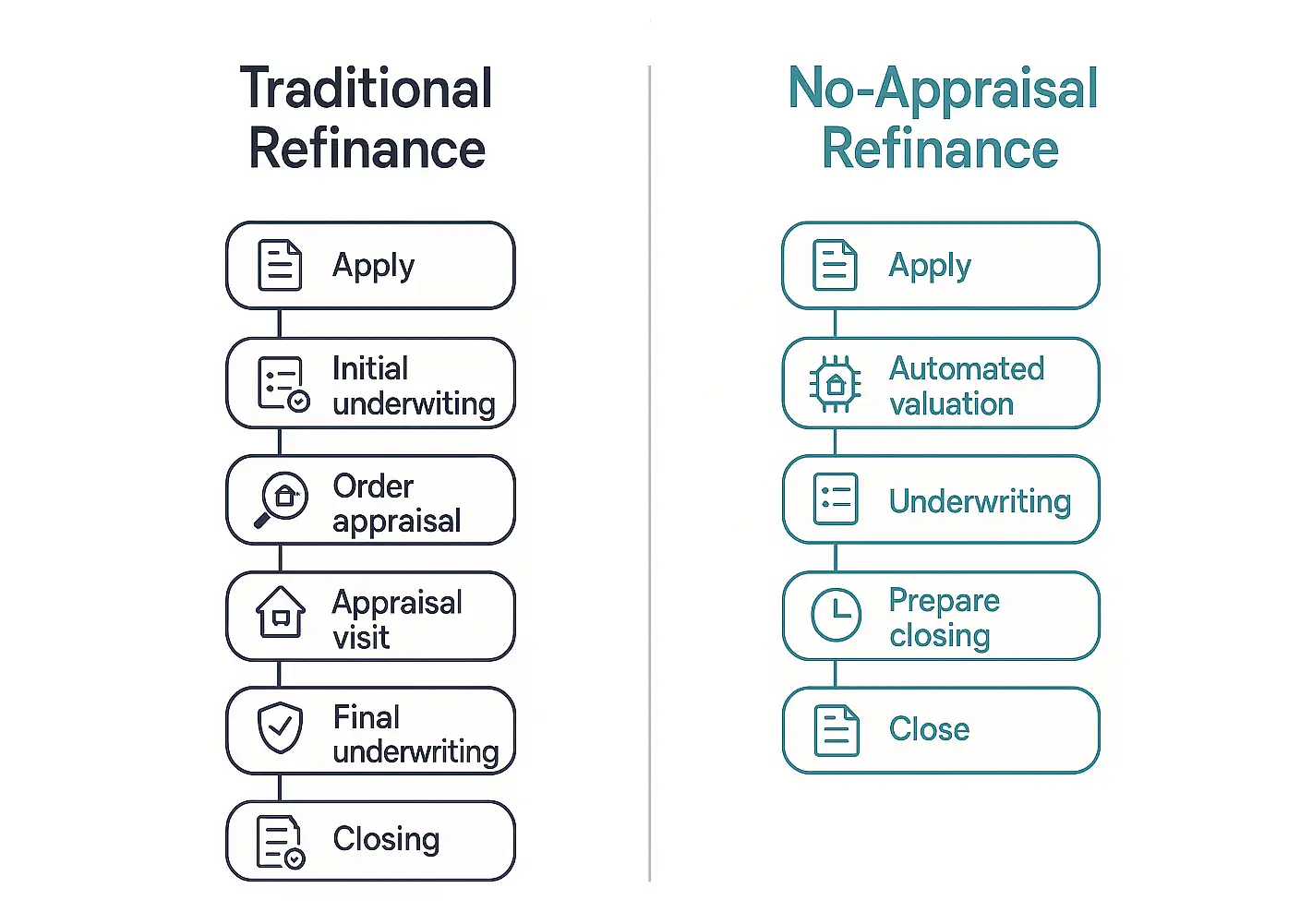
Skipping an appraisal can reduce one fee and one scheduling step, but the refinance decision still turns on total closing costs, payment change, loan term, and how long you expect to keep the loan.
What the Appraisal Alternative Can Save
| Current official example | What it says | What it does not say |
|---|---|---|
| Fannie Mae value acceptance | Fannie Mae’s analysis uses about $550 as the approximate weighted-average appraisal cost savings. | It does not mean a refinance has only $550 of closing costs. |
| Freddie Mac ACE | Freddie Mac reports average appraisal-fee savings of about $600 and, as of Q2 2025, refinance loans with ACE closing about 12 days faster on average than loans using appraisal reports. | Your lender’s fee and timeline can be higher or lower. |
| Government streamline refinance | A no-appraisal path can remove the appraisal charge and scheduling step. | Other lender fees, title costs, points, prepaid items, and program fees can still apply. |
Sources: Fannie Mae value acceptance and Freddie Mac ACE. The published figures are program-level averages, not a promise for your loan.
Once you have a rough lender quote, use the calculator below to compare the payment change, the real closing-cost break-even point, and the effect of restarting your loan term.
No-Appraisal Refinance Cost & Break-Even Calculator
Enter your current loan and a refinance quote. You’ll see the P&I change, closing-cost break-even, term trade-off, and the appraisal cost you might avoid.
Use true refinance costs after credits; leave out prepaid taxes and insurance.
Shown separately because avoiding an appraisal fee is not the refinance break-even calculation.
Your refinance comparison
Current P&I—
New P&I—
Monthly change—
Closing-cost break-even—
Planning estimate only. It assumes the refinance amount equals your remaining balance and entered closing costs are paid separately. Real quotes can also include points, lender credits, mortgage insurance, cash-out, and prepaid items.
The calculator separates the appraisal fee from refinance break-even because those are different decisions. If you want a deeper closing-cost model, our mortgage refinance break-even calculator walks through the same question in more detail.
Where the Time Savings Come From
Skipping an appraisal removes the time needed to order the report, coordinate access when an inspection is required, wait for completion, and review the valuation. That does not make the rest of underwriting instantaneous: title work, disclosures, income or eligibility checks, and lender conditions can still control the closing date.
For one published benchmark, Freddie Mac reports that refinance loans using ACE closed about 12 days faster on average than refinance loans using appraisal reports in Q2 2025. Treat that as program-level historical data, not a promised closing time for your file.
Use the calculator as a planning screen, then compare it with at least two lender quotes. Pay attention to the rate, points, lender credits, closing costs, mortgage insurance, and new loan term—not just the monthly payment.
Pros and Cons of No-Appraisal Refinancing
Potential Advantages
- Lower appraisal-related cost: when no appraisal report is required, the appraisal fee can disappear from the transaction.
- Less scheduling friction: a true no-appraisal-report path can remove the traditional appraisal appointment, although some files still require property data collection.
- Potentially faster processing: removing the appraisal-order and review cycle can shorten the file; Freddie Mac’s published ACE data show a meaningful average refinance-time difference, but your lender’s timeline can vary.
- One less valuation contingency: the loan is not waiting on a new traditional appraisal report, though other underwriting and property conditions can still stop or change the refinance.
Potential Tradeoffs
- No guarantee of approval or savings: an appraisal alternative does not guarantee a lower rate, lower fees, or a better refinance.
- Property information may still be needed: a property data collection, another permitted valuation method, or a full appraisal can still be required.
- The submitted value may not capture every improvement: if you think the lender’s value materially understates the property, ask what valuation options are available before proceeding.
- A lower payment can hide a term reset: extending the repayment period can increase scheduled interest even when the monthly payment falls.
The practical test is simple: prefer the no-appraisal route only when the complete loan offer is competitive and the lighter valuation process is actually a benefit—not just because the appraisal disappears.
When a Full Appraisal May Still Be Required
No-appraisal eligibility is transaction-specific. A full appraisal can still be required when the underwriting result calls for one, the property or transaction falls outside the program’s eligible categories, or the lender has reason to question the submitted value or property condition.
Cash-Out Refinancing
Cash-out rules vary sharply by program. VA cash-out refinancing requires a home appraisal, FHA Streamline is not a cash-out product, and Fannie Mae value acceptance can apply to some cash-out refinances at lower LTV caps. Do not assume one cash-out rule applies across all programs.
Investment Properties
Investment property is also not an automatic disqualifier across every program. Fannie Mae currently allows value acceptance on some one-unit investment-property refinances, while other programs apply different occupancy and property rules. The lender’s actual underwriting findings are the reliable answer.
When the Lender Needs More Property Information
Major renovations, unusual property characteristics, conflicting data, or concerns about the submitted value can make current property information more important. Those facts do not create one universal appraisal rule, but they can cause the lender or underwriting system to require additional collateral due diligence.
Likewise, thin or changing market data can lead to another valuation method or a full appraisal when the lender cannot support the submitted value confidently.
If cash-out, a nonstandard property, or major renovations are part of your scenario, ask about the valuation requirement before assuming the appraisal can be skipped.
If a No-Appraisal Refinance Doesn’t Fit
A no-appraisal refinance is only one way to change your housing debt. If the waiver is unavailable—or the new first mortgage simply is not attractive—compare the structure that matches your actual goal instead of forcing the refinance.
Home Equity Line of Credit (HELOC)
A HELOC keeps the existing first mortgage in place and adds a separate revolving line secured by the home. Rates, draw periods, repayment rules, fees, and valuation requirements vary by lender. This can be worth comparing when you want flexible access to equity without replacing a first mortgage you prefer to keep.
HELOC interest may be deductible only in limited cases when the proceeds meet current home-mortgage-interest rules; see IRS Publication 936.
Home Equity Loan
A home equity loan is a separate second-lien loan that provides a lump sum. Many are structured with fixed payments, but pricing, fees, term, and valuation requirements vary. Compare the combined monthly debt and total borrowing cost with a cash-out refinance rather than assuming the second loan is automatically cheaper.
If you do not need to pull cash out and can make a substantial principal payment, a mortgage recast may be another route if your servicer and loan allow it. Our mortgage recast vs. refinance guide explains that tradeoff.
Frequently Asked Questions
What to Do Next
If a lender offers you a no-appraisal route, treat it as a process benefit—not the reason to refinance. The complete loan still has to make sense on rate, points, lender credits, mortgage insurance, closing costs, and term.
Your next step is to ask at least two lenders to run your real scenario and compare the Loan Estimates side by side. Use the calculator above to test the payment change, closing-cost break-even, and term reset before choosing a loan.
If your real goal is paying the mortgage off sooner rather than lowering today’s payment, model that separately with our mortgage payoff calculator with extra payments.
This no-appraisal refinance guide is for general education only and isn’t personalized financial or legal advice. Rates, fees, underwriting results, property requirements, and program eligibility vary by borrower and lender. Before changing your mortgage, consider speaking with a qualified loan officer, financial planner, or HUD-approved housing counselor who can review your full picture.

