
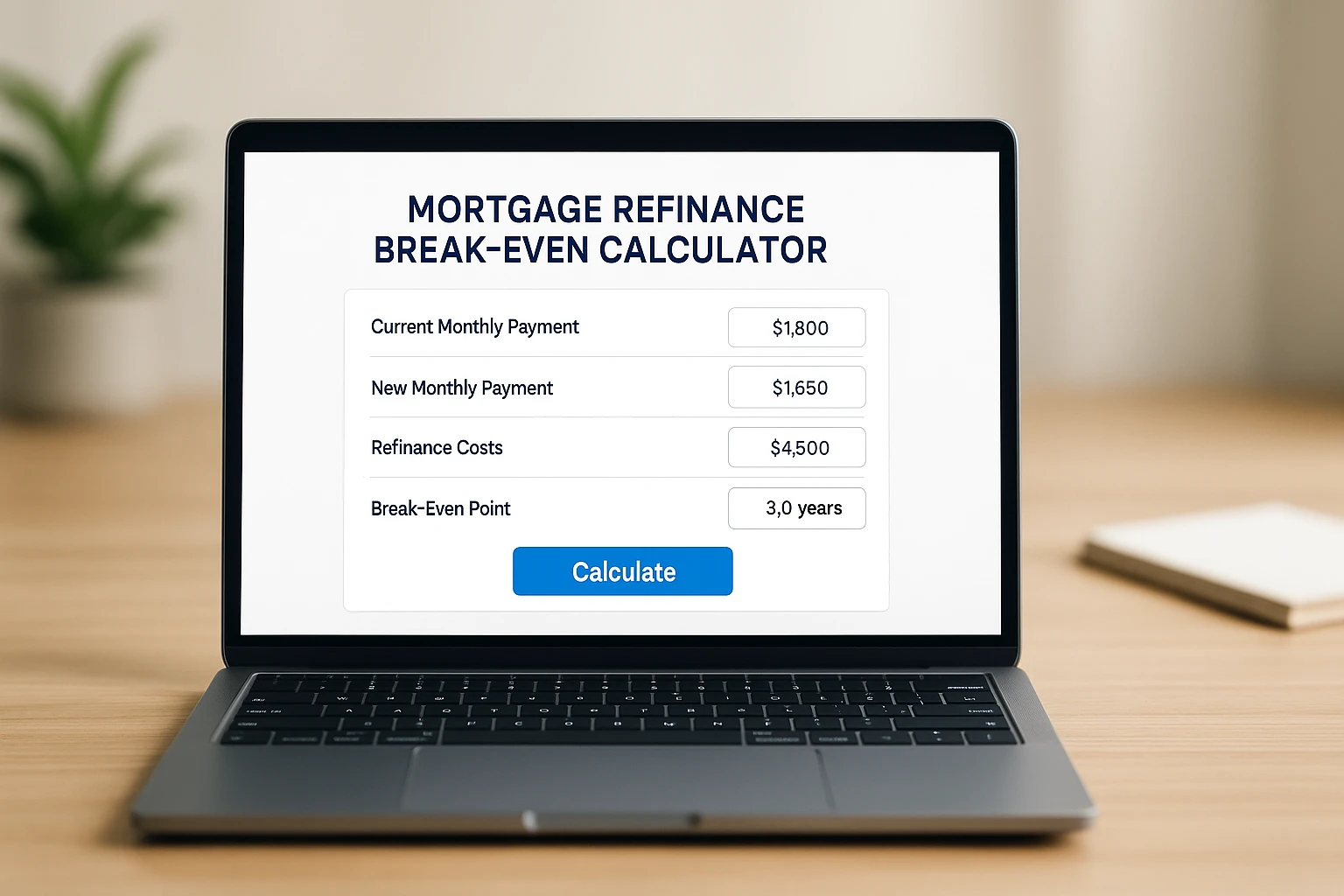
A lower mortgage rate does not automatically make refinancing worthwhile. The first test is simple: how many months of principal-and-interest savings will it take to recover the refinance costs? Use the mortgage refinance break even calculator below to estimate that month, compare it with how long you expect to keep the new loan, and then check the trade-offs the simple math can miss—term length, points or lender credits, and total loan costs. For broader mortgage decisions, see our mortgage guide.
Already have a lender quote? Jump straight to the calculator. Otherwise, the short setup section shows exactly which numbers to pull from your mortgage statement and Loan Estimate.
Jump to the refinance calculator
This post contains affiliate links. If you buy through our links, we may earn a commission at no extra cost to you. Learn more.
Table of Contents
- Refinance Break-Even: 4 Things to Check
- Understanding the Break-Even Point
- What Numbers to Use in the Refinance Calculator
- Interactive Mortgage Refinance Break-Even Calculator
- Mortgage Refinance Break-Even Examples
- Check the Rest of Your Money Before You Refinance
- Is Now a Good Time to Refinance?
- What Else Can Refinancing Change?
- Other Factors That Can Change the Decision
- Before You Commit to a Refinance
- Frequently Asked Questions
- So, Is Refinancing Worth It?
Refinance Break-Even: 4 Things to Check
If you only have a minute, focus on these four decisions:
- Break-even is a timing test: divide the refinance costs you expect to recover by your estimated monthly principal-and-interest savings.
- Your time horizon matters: compare that break-even month with how long you realistically expect to keep the new loan.
- Payment is not the whole decision: a new term, discount points, lender credits, and total loan costs can change whether a lower payment is actually worthwhile.
- Know what this calculator does not model: it does not compare remaining loan balances, lifetime interest, taxes and insurance, or cash-out proceeds.
Understanding the Break-Even Point
When the new loan lowers your monthly P&I, the simple refinance break-even formula is: refinance costs to recover ÷ monthly P&I savings = break-even months. That is how long it takes the payment savings to recoup those costs. If costs are $3,000 and monthly P&I falls by $100, the simple break-even is 30 months.
If you kept that new loan for five years, the same simplified example would produce $6,000 of gross payment savings over 60 months; after subtracting the $3,000 upfront cost, that leaves a $3,000 simple cash-flow surplus. It still would not tell you whether a changed loan term increased or reduced lifetime interest.
Will you keep the new loan long enough to get past its break-even month? That is the first question this calculator is designed to answer.
What Numbers to Use in the Refinance Calculator
You can run a rough estimate from your mortgage statement, but a lender quote or Loan Estimate makes the comparison more useful. After you submit the required application information, the lender must send a Loan Estimate within three business days.
- Amount being refinanced: For a no-cash-out estimate, start with your unpaid principal balance. If a lender quote finances costs into the new loan, use the proposed new loan amount instead.
- Current monthly P&I: Use principal and interest only. Do not include property taxes, homeowners insurance, HOA dues, or other escrow items.
- Quoted note rate and term: Use the loan’s interest rate, not APR. APR incorporates additional loan costs and is useful for comparing offers, but it is not the rate used in the payment formula.
- Refinance costs to recover: Use the refinance costs you want the monthly savings comparison to recover. Do not automatically copy the entire Cash to Close, which is the broader amount due at closing; compare the itemized closing costs, loan costs, and lender credits on the Loan Estimate.
- Time horizon: Use the shorter of how long you expect to keep the home or how long you expect to keep this refinance before selling or refinancing again.
If you do not have an itemized quote yet, Freddie Mac gives 3%–6% of loan principal as a general refinance-cost estimate. Treat that as a rough starting range only and replace it with lender-specific figures when you have them. If an appraisal is one of the costs you are trying to avoid, see when refinancing without an appraisal may be possible.
Interactive Mortgage Refinance Break-Even Calculator
Use your mortgage statement and lender quote; the prefilled numbers are examples, not current rates. This compares monthly principal-and-interest savings with refinance costs and your expected time horizon.
Start with unpaid principal; if costs are financed, use the proposed new loan amount.
Use principal and interest only, not escrowed taxes or insurance.
Use the quoted note rate, not APR.
Use the costs you want the monthly savings to recover, after lender credits.
Use the shorter of how long you expect to keep the home or this refinance.
Calculating estimate…
Verify the quoted payment and loan costs against the Loan Estimate before deciding.
Mortgage Refinance Break-Even Examples
These are simplified hypotheticals to show how the decision changes with the goal. They are not lender quotes, and the simple calculator is appropriate only when payment savings are the main comparison.
Scenario 1: Selling Before Break-Even
Example: Sarah owes $200,000 at 5% and pays about $1,073 per month in principal and interest. A new 30-year loan at 3.75% would be about $926, or roughly $147 lower, with $4,000 of refinance costs. She expects to sell in two years.
- Simple break-even: $4,000 ÷ $147 ≈ 27.2 months.
- At 24 months: $147 × 24 = $3,528 of gross P&I savings, leaving about $472 of the upfront cost still unrecovered.
- Decision: On payment savings alone, this refinance does not recover its costs before her planned sale.
Scenario 2: Shortening the Term
Example: Mark and Lisa owe $300,000 at 4.5% with 25 years remaining. Their scheduled P&I is about $1,668 per month. They compare that with a new 15-year loan at 3.25%, about $2,108 per month, plus $5,000 of refinance costs.
- Monthly P&I change: about $441 higher, so there is no payment-savings break-even.
- Scheduled-interest comparison: keeping the old loan for its remaining 25 years would produce about $200,249 of scheduled interest; the new 15-year loan would produce about $79,441. Adding the $5,000 refinance cost gives a simplified difference of about $115,808.
- Decision: This is a term-and-interest trade-off, not a monthly-savings case. The higher required payment has to fit their budget, and a full comparison should use actual payoff figures and Loan Estimates.
Scenario 3: Cash-Out Refinance
A cash-out refinance adds borrowing to the new mortgage. The calculator can estimate the new P&I if you enter the proposed new loan amount, but it is not designed to judge the full cash-out decision because it does not value the cash received against the larger secured debt. Compare the new loan balance, payment, fees, cash received, and total loan costs on the lender’s Loan Estimate.
| Scenario | Monthly P&I change | Simple break-even | What the example shows |
|---|---|---|---|
| Selling in 24 months | $147 lower | 27.2 months | Costs are not recovered before the planned sale |
| Shortening to 15 years | About $441 higher | N/A from payment savings | Compare term, scheduled interest, and affordability instead |
| Cash-out refinance | Depends on proposed new loan amount | Not a full cash-out test | Compare the new balance, cash received, fees, and Loan Estimate |
The break-even month is only one part of the decision; make sure the new payment and debt picture still fit with the rest of your finances.
Check the Rest of Your Money Before You Refinance
Use the workbook to see income, spending, up to 8 debts, and up to 8 goals together before you commit to a new loan.
Confirm to get the workbook and frugal money tips. Unsubscribe anytime.
Something went wrong. Please check your email address and try again.
Is Now a Good Time to Refinance?
There is no universal rate-drop threshold that makes refinancing worthwhile. Compare your own current mortgage with actual lender quotes, the costs required to obtain the new loan, the change in payment, and how long you expect to keep it. For market context, Freddie Mac publishes weekly U.S. mortgage-rate averages, but a national average is not your personal offer.
Mortgage-rate headlines are not enough to judge a refinance. Test a real quote against your current payment and total loan costs, then compare Loan Estimates from lenders instead of trying to time the market from a headline.
What Else Can Refinancing Change?
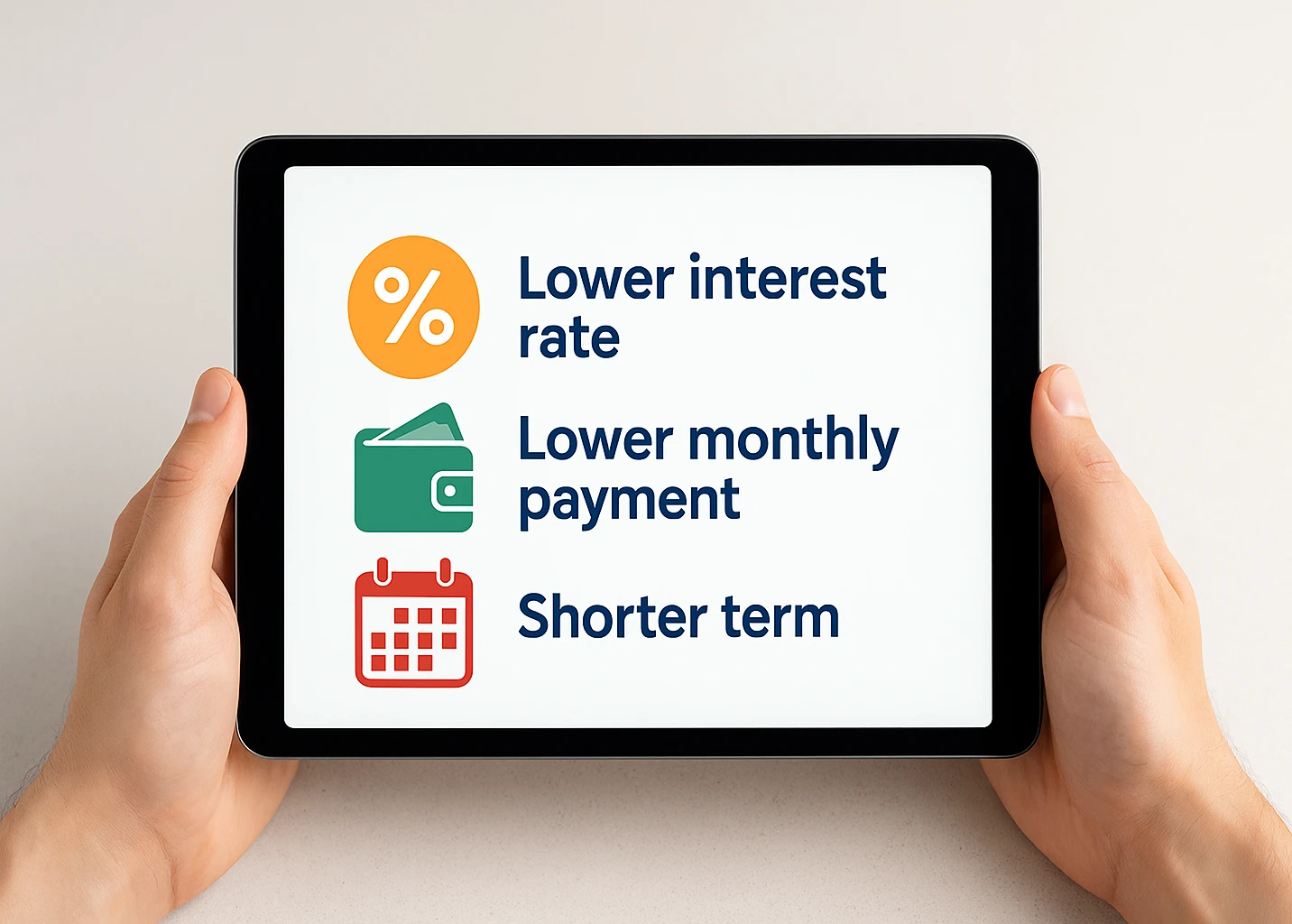
Refinancing replaces your current mortgage with a new loan, so the break-even month answers only one part of the decision. A refinance can also change the required payment, loan term, balance, rate structure, or mortgage-insurance costs.
- Rate and monthly payment: A lower note rate can reduce principal-and-interest payments when the balance and term are otherwise comparable. Extending the term can also lower the payment, but may increase the number of years you pay interest.
- Loan term: A shorter term usually raises the required payment but can reduce the time you pay interest. If your real goal is a faster payoff without replacing the loan, compare our mortgage payoff calculator and guide to biweekly mortgage payments.
- Cash-out borrowing: A cash-out refinance increases the mortgage balance to convert some home equity to cash. Judge the larger secured debt and total loan costs, not just the amount received.
- Rate structure: Moving from an adjustable-rate mortgage to a fixed-rate mortgage can trade future rate uncertainty for a fixed rate and payment structure.
- Mortgage insurance: A new conventional loan may eliminate private mortgage insurance if the new loan no longer requires it; CFPB explains PMI cancellation rules. FHA mortgage insurance follows different program rules, so current home value alone does not automatically end MIP; check the current FHA Handbook 4000.1.
Other Factors That Can Change the Decision
The break-even month is a useful screen, not the whole mortgage decision. Before committing, check the factors that can change either the price of the new loan or the value of keeping it.
Credit Score and Rate Shopping
There is no universal credit-score cutoff that guarantees a lender’s best rate. CFPB notes that higher credit scores generally qualify for more affordable mortgage offers and more lender choices. A mortgage credit check can cause a small temporary score change, but CFPB also explains that multiple mortgage checks within a 45-day window are recorded as a single inquiry, which supports shopping across lenders in a concentrated period.
Prepayment Penalties and Taxes
Check your current loan documents for any prepayment penalty or payoff-related charge that would add to the cost of refinancing. Also consider whether the new loan changes your tax situation; our guide to mortgage interest tax deduction rules covers the general tax questions to review.
Home Equity and Loan-to-Value (LTV)
Your loan-to-value ratio compares the mortgage balance with the property value. More equity generally means a lower LTV, but acceptable LTV limits and pricing depend on the loan program, property, and borrower profile. Use the lender’s actual eligibility and pricing rather than assuming a recent value increase guarantees better terms.
Recasting vs. Refinancing
Some mortgages allow a recast after a qualifying principal reduction: the servicer re-amortizes the remaining balance and lowers the scheduled payment without replacing the loan or changing its interest rate. Availability, minimum principal reductions, and fees vary by servicer and loan. See mortgage recast vs refinance if you are deciding between the two routes.
Before You Commit to a Refinance
If the break-even timeline looks workable, move from an estimate to the actual loan offer. The final check is whether the quoted loan still works when you compare its costs, term, and monthly obligation side by side.
- Compare Loan Estimates on the same basis: line up the loan type and term, then compare interest rate, APR, points or lender credits, cash to close, and total loan costs.
- Ask which charges can change: have each lender identify lender fees and services you may be able to shop for instead of assuming every closing charge is negotiable.
- Price “no-cost” offers carefully: lower upfront cost can be paired with a higher rate or costs financed into the loan, so compare both the payment and the longer-term cost.
- Gather requested documentation: lenders may ask for income, asset, employment, property, and insurance information as underwriting proceeds.
- Avoid unnecessary new credit before closing: new debt or credit changes can affect underwriting and your final loan terms.
- Stress-test the required payment: make sure the payment still fits your budget if an expected expense rises or income temporarily falls.
Frequently Asked Questions
Quick decision check:
- Your expected time with the new loan extends beyond the calculated break-even point.
- You have compared Loan Estimates, including the new term, points or lender credits, cash to close, and total loan costs—not only the interest rate.
- The required payment fits your budget even if an expected expense rises or income temporarily falls.
If the break-even math works but you’re still weighing the new loan against cash reserves, other debts, taxes, or longer-term goals, you can chat with a finance expert about the trade-offs.
So, Is Refinancing Worth It?
If the simple break-even falls comfortably inside the period you expect to keep the new loan, the refinance has passed the first screen—not the final test. Compare actual Loan Estimates and make sure the new term, loan amount, points or lender credits, and required payment still solve the problem you are trying to fix.
If the break-even falls outside your timeline, a lower-cost quote may change the math; if it does not, keeping the current mortgage may be the better fit. A refinance is worth serious consideration when the savings or other benefit you care about outweighs the costs and trade-offs without creating a worse problem elsewhere.
This content is for general education and information only and isn’t personalized financial advice. Your situation is unique, so talk with a qualified mortgage or financial professional before making decisions about refinancing or your home loan. Individual results and savings will vary based on your specific loan terms, credit profile, and housing market.

