

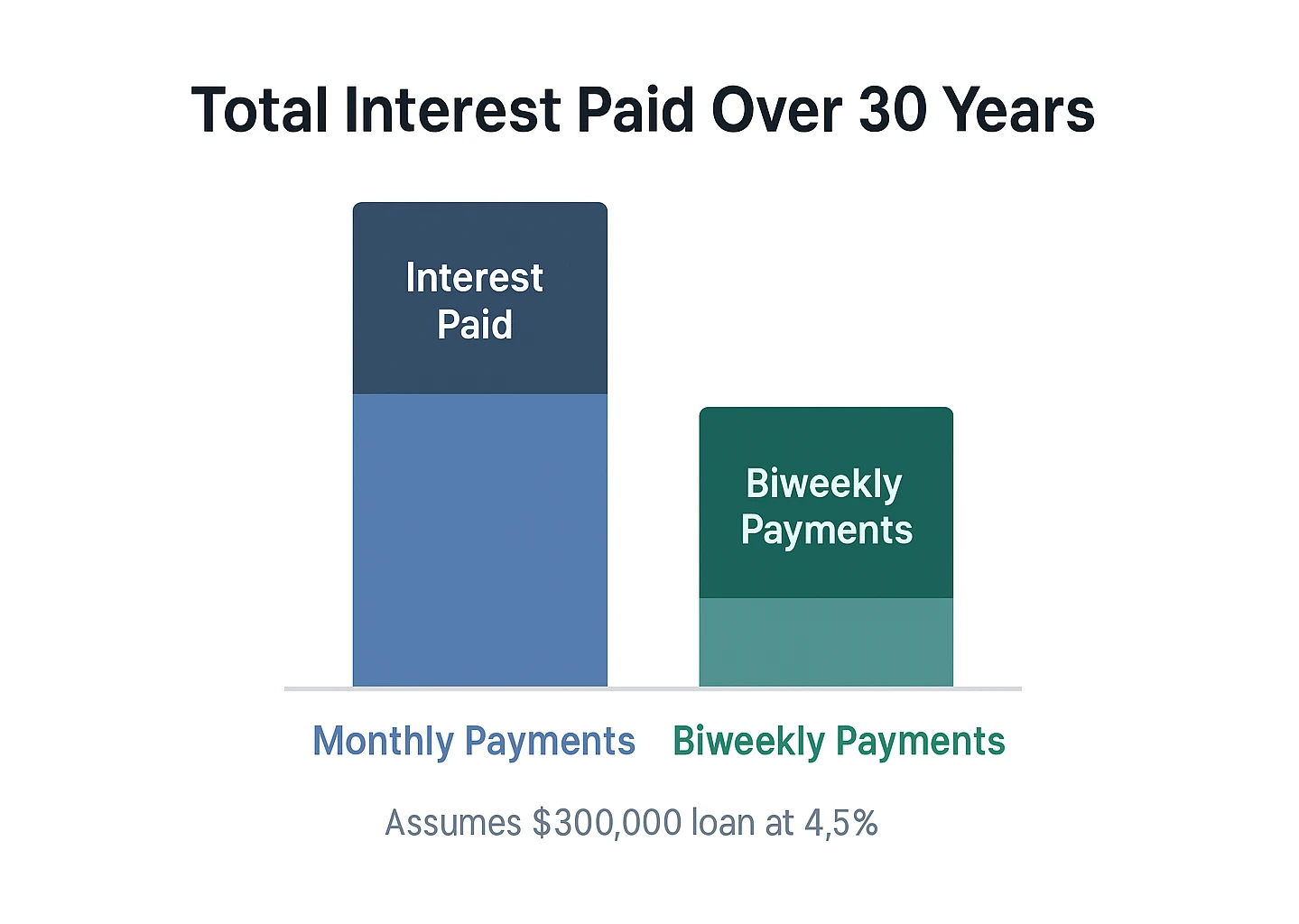
If you’re asking “what happens if I make biweekly payments on my mortgage?” a true biweekly plan turns 26 half-payments into 13 full payments a year—one extra payment that can reduce principal, total interest, and payoff time. In the $300,000, 4.5% hypothetical below, the annual-outlay model saves about $41,500 in interest and shortens the payoff by roughly 4 years and 5 months.
The catch is payment processing. A servicer may not credit each half-payment when it arrives, so the safest comparison is the extra annual principal—not an assumed timing bonus. Use the calculator for your numbers, then confirm how your servicer handles partial and extra payments. For the wider mortgage picture, our homeowner’s guide to mortgages covers refinancing, loan basics, and related decisions.
This post contains affiliate links. If you use a service through one of them, we may earn a commission at no extra cost to you. Learn more.
Table of Contents
- Biweekly Mortgage Calculator
- What Biweekly Mortgage Payments Mean
- Why Biweekly Payments Can Save Interest
- Mortgage Payoff Examples
- Is a Biweekly Mortgage Right for You?
- Check the Rest of Your Money Before You Go Biweekly
- How to Set Up a Biweekly Payment Plan
- Before You Start: 5 Checks
- Frequently Asked Questions
- Bottom Line: Is Biweekly Worth It?
See what one extra annual payment could mean for your own loan.
Biweekly Mortgage Calculator: Estimate Your Savings
Replace the example balance, rate, and monthly principal-and-interest payment with your own numbers. The estimate updates automatically.
Use only principal and interest—not escrow, taxes, insurance, HOA dues, or other charges.
Your estimate
Example estimate: replace the three values above with your own mortgage numbers.
Planning estimate only. It models the annual effect of making 26 half-payments as one extra principal-and-interest payment per year; it does not assume your servicer credits each half-payment immediately. Confirm payment handling and any fees with your servicer.
What Biweekly Mortgage Payments Actually Mean
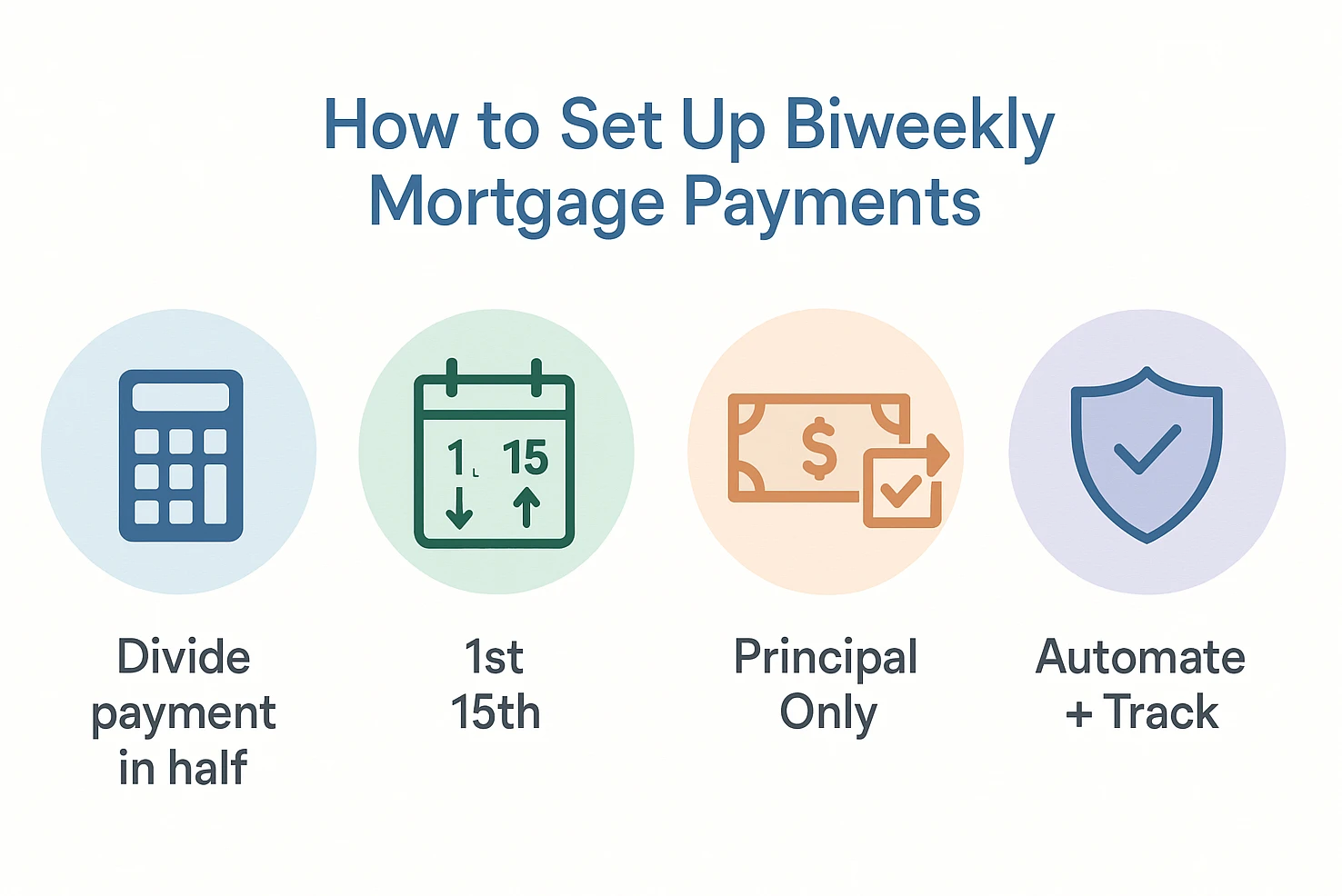
A true biweekly schedule means paying every two weeks—not simply twice a month. Half of a monthly principal-and-interest amount paid every 14 days creates 26 half-payments in a 52-week year. By contrast, paying half on the 1st and half on the 15th creates only 24 half-payments, which still totals 12 full payments.
How the Payment Schedules Compare
The cleanest way to compare biweekly vs. monthly mortgage payments is by annual principal-and-interest outlay. For a $1,500 monthly P&I payment, here’s what changes:
| Payment method | Annual schedule | Annual P&I outlay | Extra P&I vs. monthly |
|---|---|---|---|
| Standard monthly | 12 full payments | $18,000 | None |
| Twice monthly (such as the 1st and 15th) | 24 half-payments = 12 full payments | $18,000 | None |
| True biweekly (every 14 days) | 26 half-payments = 13 full payments | $19,500 | $1,500 |
| Monthly + 1/12 extra P&I | 12 regular payments + $125 extra each month | $19,500 | $1,500 |
Cash-flow reality: A true biweekly schedule has 26 debits, so two months in the year will contain a third half-payment. If that cadence does not fit your budget—or your servicer does not handle half-payments cleanly—adding one-twelfth of your monthly P&I to each regular payment targets the same annual P&I outlay when the extra amount is applied to principal.
CFPB’s mortgage key terms page defines a true biweekly plan as 26 half-payments that total one extra monthly payment per year.
Why Biweekly Payments Can Save Interest
Interest is charged against your outstanding balance, so extra principal can reduce the interest that accrues later. The dependable biweekly benefit is the extra annual payment; any additional timing benefit depends on how your servicer credits partial payments.
- Extra Annual Principal: Twenty-six half-payments add up to 13 full payments, so you send the equivalent of one extra monthly payment each year.
- Servicer Timing: Some servicers may credit partial payments as they arrive, while others may hold them until they equal a full periodic payment. Confirm the actual handling before assuming an extra timing benefit.
On a fixed-rate loan, consistently applying extra money to principal can move the payoff date forward and reduce total interest. The size of the change depends on your balance, rate, remaining term, and how the extra money is applied.
What About Adjustable-Rate Mortgages (ARMs)?
Extra principal can still reduce an ARM balance, but the savings are harder to predict because the interest rate and payment can change over time. The calculator above assumes a constant rate, so treat it as a planning estimate for an ARM and confirm both the payment schedule and future rate-adjustment terms with your servicer. CFPB’s ARM guidance explains why future payments can change.
Mortgage Payoff Examples
These are simplified, hypothetical examples using the same annual-outlay assumption as the calculator: 13 principal-and-interest payments per year rather than 12. Actual results can differ based on your loan terms and servicer handling.
Example 1: 30-Year Mortgage
Assume a $300,000 fixed-rate loan at 4.5% with a $1,520 monthly P&I payment. The second column keeps the monthly schedule; the third models the same annual outlay as 26 half-payments. Results are rounded for illustration.
| Mortgage Detail | Monthly Payments | 13-Payments/Year Model |
|---|---|---|
| Loan Amount | $300,000 | $300,000 |
| Interest Rate | 4.5% | 4.5% |
| Loan Term | ~30 Years | ~25 Years 8 Months |
| Average Monthly P&I Outlay | $1,520 | $1,646.67 |
| Total Interest Paid | ~$247,200 | ~$205,700 |
| Total Savings | N/A | ~$41,500 |
| Time Saved | N/A | ~4 Years 5 Months |
Under this simplified model, the extra annual payment saves about $41,500 in interest and shortens the payoff timeline by roughly 4 years and 5 months.
Example 2: 15-Year Mortgage
On a shorter loan, the same extra annual payment still helps, but there is less future interest available to avoid. For a $300,000 fixed-rate loan at 4.0% with about $2,219 in monthly P&I, this model shortens the payoff from about 15 years to about 13 years and 6 months and reduces total interest from about $99,400 to about $88,500—roughly $10,900 saved and 1 year 7 months sooner.
Is a Biweekly Mortgage Right for You?
The real decision is not “biweekly versus monthly.” It is whether sending one extra payment’s worth of principal each year is the best use of that cash for you.
| Potential advantages | Potential drawbacks |
|---|---|
|
|
When Another Priority May Come First
- Higher-cost debt: Debt charging substantially more than your mortgage may deserve attention first.
- Thin cash reserves or overdue essentials: Extra mortgage principal may be less useful than restoring near-term financial breathing room.
- Irregular income: A rigid every-two-weeks schedule can create avoidable cash-flow pressure.
- A fee-heavy program: If the servicer charges meaningful fees, compare that cost with simply making extra principal payments on your regular schedule.
If you want to compare this approach with rounding up payments, directing windfalls to principal, or other payoff methods, our mortgage payoff strategies and extra-payment calculator covers the alternatives.
If that extra mortgage payment is competing with higher-cost debt, cash reserves, or another goal, compare the rest of your plan before you commit the extra cash.
Check the Rest of Your Money Before You Go Biweekly
Use the workbook to see income, spending, up to 8 debts, and up to 8 goals together before you commit to the extra annual mortgage payment.
Confirm to get the workbook and frugal money tips. Unsubscribe anytime.
Something went wrong. Please check your email address and try again.
How to Set Up a Biweekly Payment Plan
If the extra annual payment fits your plan, choose a method your servicer will actually process the way you intend.
Option 1: Servicer-Supported Biweekly Plan
Start by asking your mortgage servicer whether it offers or accepts a true biweekly plan.
- Confirm whether the servicer accepts half-payments every two weeks.
- Ask whether partial payments are credited immediately, returned, or held until they add up to a full periodic payment.
- Ask about any program or transaction fees and how the extra annual amount is applied.
Caution: Federal servicing rules allow some partial payments to be held in a suspense or unapplied-funds account until enough has accumulated for a full periodic payment. CFPB explains the rule in its mortgage-servicing guidance.
Option 2: DIY the Same Annual Extra Payment
If your servicer does not support true biweekly half-payments, you can often pursue the same annual extra-principal goal without sending partial payments.
- Find your monthly P&I: Use the principal-and-interest portion of your regular payment.
- Choose the extra amount: Either add about one-twelfth of that P&I amount to each regular monthly payment or make one extra P&I-sized payment during the year.
- Follow your servicer’s instructions: Make sure the extra amount is applied to principal rather than simply advancing the next due date.
- Verify the statement: Check the next statement to confirm the principal balance and payment allocation changed as expected.
Before You Start: 5 Checks
- Payment handling: Confirm whether half-payments are credited immediately, held as unapplied funds, or handled another way.
- Fees and penalties: Ask about biweekly-program fees and review your loan terms for any prepayment penalty. CFPB says small extra-principal payments normally do not trigger one, but large lump-sum payoffs can be different. See CFPB’s explanation.
- Escrow and the required payment: If your periodic payment includes taxes or insurance, ask how the servicer wants those amounts handled. The calculator above uses P&I only.
- Cash-flow trade-offs: Make sure the extra mortgage principal does not crowd out a more urgent obligation or cash need.
- Statement verification: After the first extra payment, check that the principal balance and payment allocation changed the way you expected.
If the mortgage-specific mechanics are unclear, your servicer or a HUD-approved housing counselor can help you understand the available options.
Still Unsure Where the Extra Mortgage Payment Should Go?
If you’re choosing between extra mortgage principal and higher-cost debt, cash reserves, or another budget goal, a finance expert can help you think through the broader trade-off. For payment-processing questions, contact your servicer.
Frequently Asked Questions About Biweekly Payments
Bottom Line: Is Biweekly Worth It?
A biweekly plan can be worthwhile when it reliably creates one extra P&I payment per year, the extra cash fits your budget, and your servicer applies it the way you expect. The label itself is not the magic; the extra principal is.
Use the calculator to estimate the payoff difference, confirm the payment method with your servicer, and compare that benefit with other uses of the money. If a lower mortgage rate might matter more than an extra annual payment, our mortgage refinance break-even calculator can show how long a refinance would take to pay for itself.
This content is for informational and educational purposes only and does not constitute financial, tax, or legal advice. Calculations and examples are simplified estimates, not guarantees. Confirm payment instructions and allocation with your mortgage servicer, and consider professional guidance when broader financial trade-offs are material to your decision.

