

Retiring before 65 can create a health-insurance gap when employer coverage ends before Medicare begins. The Affordable Care Act (ACA) Marketplace can help you stay covered between employer insurance and Medicare. If you’re using the ACA for early retirement, the practical decision is bigger than picking a plan: household MAGI, subsidy eligibility, enrollment timing, and local plan costs can all change what coverage looks like.
This guide turns those moving parts into a sequence you can use: check the 2026 subsidy rules, compare ACA coverage with common pre-Medicare alternatives, model MAGI and taxes, enroll, and then plan the Medicare handoff. If you are still building the broader retirement plan, see our early financial independence guide.
This post contains affiliate links. If you use one of these links, we may earn a commission at no extra cost to you. Learn more.
Table of Contents
- 2026 ACA Subsidy Income & MAGI Planner
- Key Takeaways for ACA Coverage in Early Retirement
- Where ACA Fits Among Pre-Medicare Coverage Options
- ACA Marketplace Eligibility for Early Retirees
- Managing MAGI and ACA Subsidies in Early Retirement
- ACA Marketplace Enrollment: Steps and Plan Tiers
- Tax Implications with ACA in Early Retirement
- Hypothetical Example: Sarah’s 2026 ACA Planning
- Bridging to Medicare
- Annual ACA Checklist for Early Retirees
- Free Early-Retirement Money Snapshot
- Frequently Asked Questions
- Next Steps for ACA in Early Retirement
If you already have a rough 2026 household MAGI estimate, use the planner before diving into the rules. It shows where that estimate sits against the general PTC range and usual CSR income band; it does not quote a plan price.
2026 ACA Subsidy Income & MAGI Planner
Enter your projected 2026 household MAGI, tax-household size, and federal-poverty-line region. The tool shows where your income falls under the 2026 Premium Tax Credit rules; it does not guess a local insurance premium.
Use your best estimate of annual household MAGI for Marketplace purposes, not your annual spending target.
2026 planning result
Planning estimate: For 2026, this tool applies the 2025 HHS poverty guidelines under the IRS open-enrollment rule and the IRS 2026 applicable-percentage table. It cannot calculate your actual premium or tax credit because the PTC formula also depends on your local second-lowest-cost Silver plan premium and your full Marketplace eligibility details.
Key Takeaways for ACA Coverage in Early Retirement
- Bridge to Medicare: Marketplace coverage can fill the gap after employer insurance and before Medicare.
- 2026 PTC Range: For most households, Premium Tax Credit eligibility generally requires income from 100% through 400% of the federal poverty level, with limited exceptions below 100%.
- APTC Repayment: For tax years after 2025, excess advance Premium Tax Credit is no longer protected by the old repayment caps, so update projected income when it changes.
- Silver for CSR: If you qualify for cost-sharing reductions, you must choose a Silver plan to receive those extra out-of-pocket savings.
- Enrollment Timing: HealthCare.gov Open Enrollment runs November 1–January 15; losing job-based coverage can also create a Special Enrollment Period.
Where ACA Fits Among Pre-Medicare Coverage Options
The Marketplace is one of several ways to cover the years before Medicare. Marketplace plans combine ACA consumer protections with access to income-based savings for eligible households, which makes them worth comparing with COBRA and other pre-Medicare options.
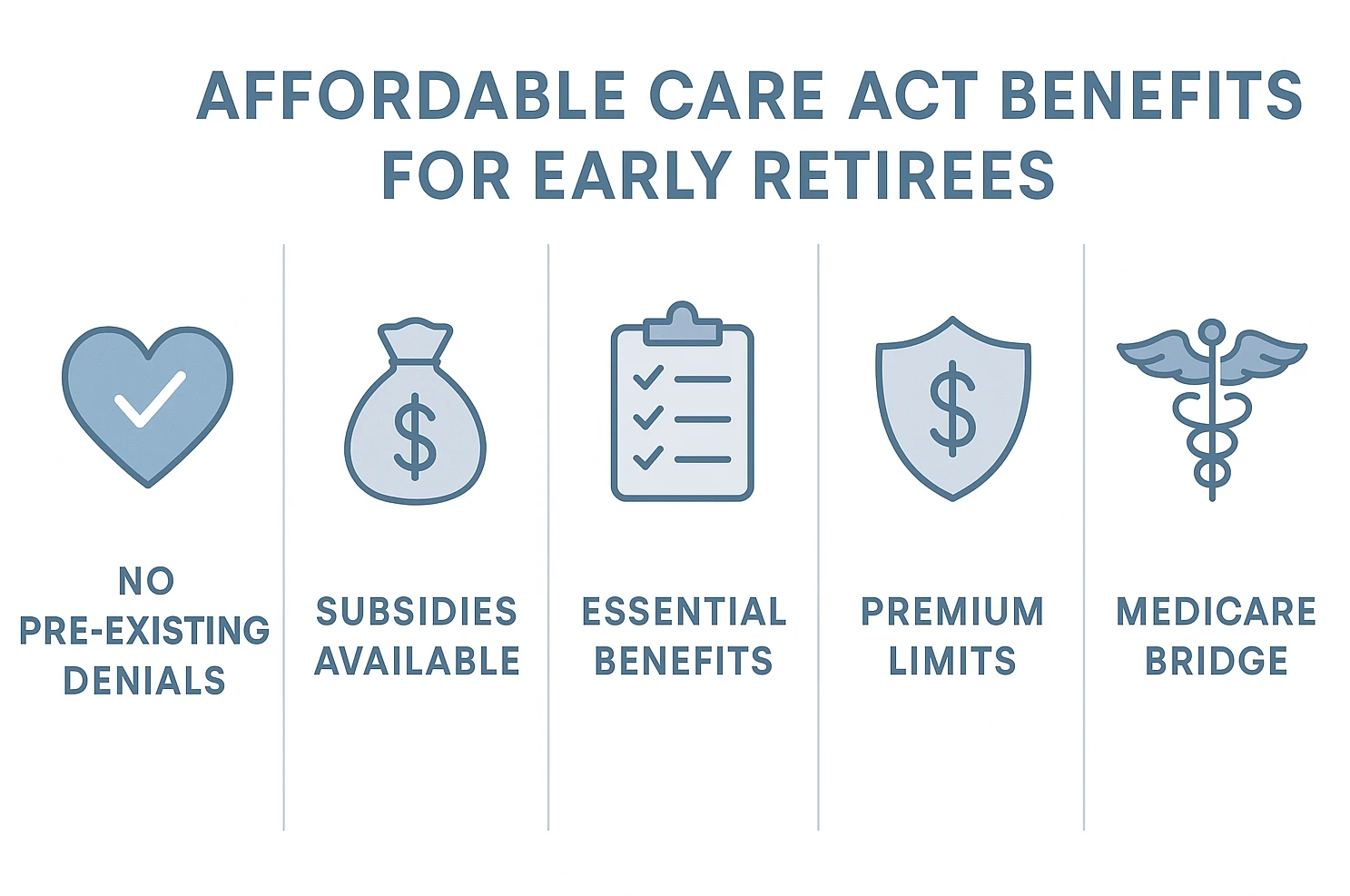
Benefits of ACA Coverage
- Pre-existing conditions: Marketplace plans can’t deny coverage or charge more based only on a pre-existing condition.
- Essential health benefits: Marketplace plans cover the ACA’s 10 essential health-benefit categories, though specific covered services can vary by plan and state.
- Income-based savings: PTC can lower premiums when you qualify, and CSR can reduce out-of-pocket costs for eligible Silver-plan enrollees.
- Age-rating limit: In the individual market, premiums for older adults generally can’t be more than three times the premium for younger adults based on age alone.
- Pre-Medicare bridge: Marketplace coverage can provide a path between employer insurance and Medicare.
How the ACA compares to other options
Compare the coverage rules, network, total annual cost, and eligibility for Marketplace savings—not just the monthly premium.
| Option | Pros | Cons | Marketplace comparison |
|---|---|---|---|
| COBRA | Keeps the employer plan and familiar network | You may pay the full premium; continuation is temporary | Compare total annual cost, network, and Marketplace savings eligibility |
| Short-Term Plans | May have a lower monthly premium | Not ACA-compliant; benefits can be limited and pre-existing conditions may be excluded | Marketplace plans cover ACA essential health benefits and pre-existing conditions |
| Private Off-Marketplace | May offer additional plan choices | Marketplace PTC and CSR savings are unavailable outside the Marketplace | Use the Marketplace when you want to be evaluated for income-based savings |
Decision point: Compare COBRA and Marketplace coverage on total yearly cost, provider network, and subsidy eligibility—not premium alone. For a broader look at pre-Medicare choices, see our health insurance options for early retirees.
ACA Marketplace Eligibility for Early Retirees
Marketplace enrollment and Premium Tax Credit eligibility are related but not identical. To enroll through the Marketplace, you generally must live in the United States, be a U.S. citizen or national or be lawfully present, and not be incarcerated. If you already have Medicare coverage, you can’t enroll in a Marketplace health or dental plan.
PTC eligibility has additional income and other-coverage rules, so check the current Marketplace eligibility rules before relying on an income estimate alone.
Enrollment Windows
Timing matters:
- Open Enrollment: HealthCare.gov runs annual Open Enrollment from November 1–January 15; state Marketplace dates can differ.
- Special Enrollment: Losing job-based coverage can qualify you to enroll outside Open Enrollment, generally within 60 days before or 60 days after the coverage loss. Other qualifying events can include marriage, a move, or a divorce that causes loss of coverage.
If you choose COBRA: Don’t assume you can cancel it later and immediately switch to the Marketplace. Outside Open Enrollment, voluntarily ending COBRA early generally does not create a Special Enrollment Period; COBRA running out can. Check HealthCare.gov’s current COBRA guidance before ending coverage.
Retiring mid-year? Start the Marketplace application before employer coverage ends when your Special Enrollment Period allows it, so you can coordinate effective dates and reduce the chance of a gap.
Next step: Run the 2026 ACA Subsidy Income & MAGI Planner with your projected household MAGI, then confirm the result in your Marketplace application.
Before You Enroll
- Confirm Marketplace enrollment eligibility and whether other coverage affects PTC eligibility.
- Estimate annual household MAGI and household size before you compare savings.
- Identify the Open Enrollment or Special Enrollment window tied to your coverage-loss date.
- Keep supporting documents handy and update projected income or household changes promptly.
Managing MAGI and ACA Subsidies in Early Retirement
Premium tax credits change with projected household income. For early retirees, taxable withdrawals, realized gains, and Roth conversions can change MAGI, so model taxes, cash needs, and Marketplace savings together rather than optimizing one number in isolation.
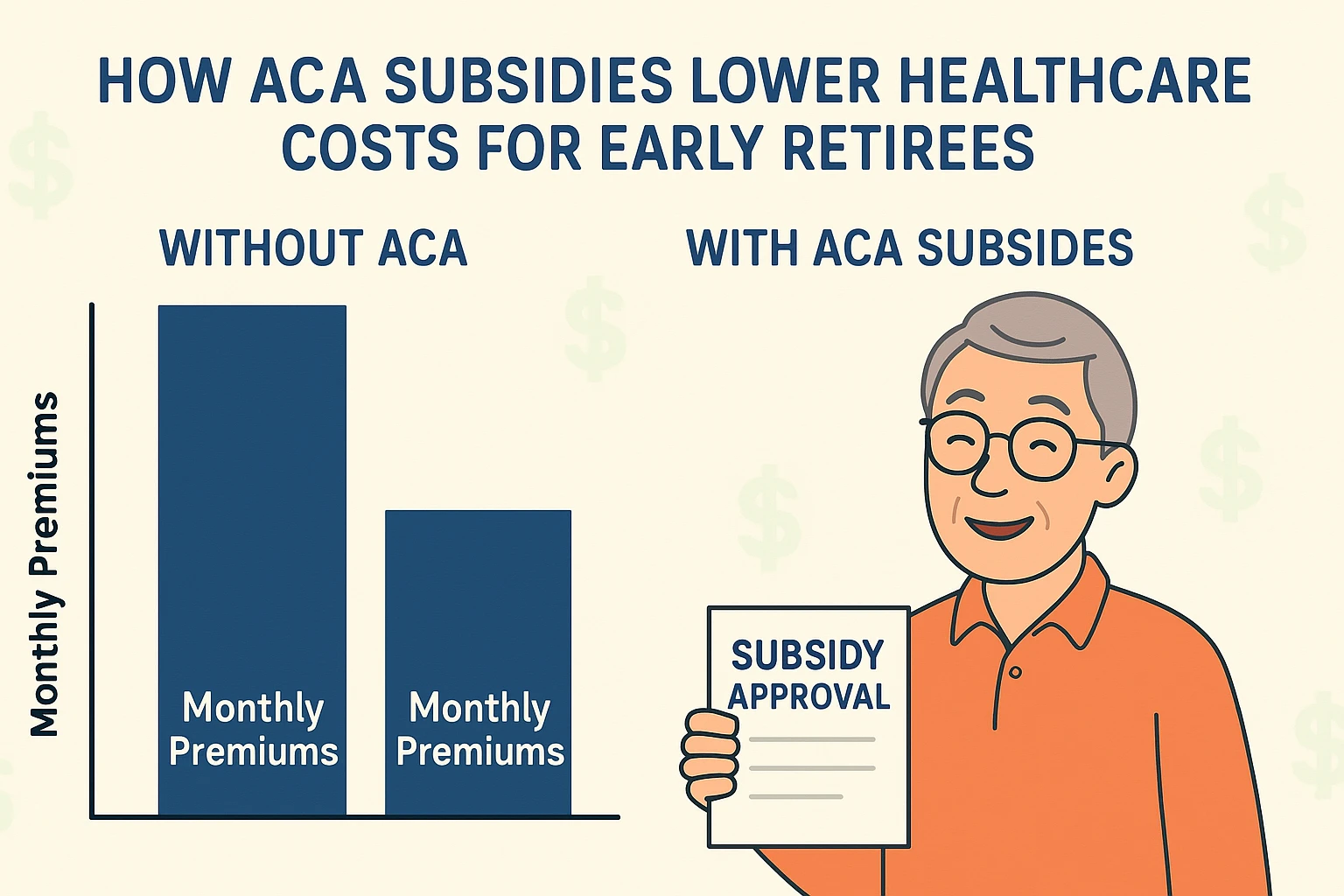
Premium Tax Credits (PTCs)
Your Premium Tax Credit depends on household income, household size, the local second-lowest-cost Silver benchmark premium, and the rest of the Marketplace eligibility rules. For 2026, the temporary enhanced savings that removed the 400% FPL ceiling have ended; for most households, the PTC income range is 100%–400% FPL. See the current IRS PTC eligibility rules.
- 2026 income range: For most households, income must be at least 100% and no more than 400% FPL to qualify for the PTC, with limited exceptions below 100% FPL.
- 2026 applicable percentage: The income-based share used in the benchmark-credit formula rises with FPL and reaches 9.96% in the 300%–400% FPL band; your actual premium still depends on local plan prices.
MAGI basics: Marketplace MAGI starts with AGI and adds untaxed foreign income, non-taxable Social Security benefits, and tax-exempt interest. Model withdrawals and Roth conversions before acting because their tax treatment can change Marketplace income.
Cost-Sharing Reductions (CSRs)
Cost-sharing reductions lower deductibles, copayments, coinsurance, and the out-of-pocket maximum for eligible Marketplace enrollees. They are generally available in the 100%–250% FPL range, and you must choose a Silver plan to receive them. See HealthCare.gov’s cost-sharing reduction guidance.
Model Income Changes Before Acting
- Taxable sales and withdrawals: Realized gains and taxable retirement distributions can change AGI and Marketplace MAGI.
- Roth conversions: The taxable amount can raise AGI. For a step-by-step retirement-account framework, see our Roth conversion ladder guide.
- Side income: Monitor changes and update the Marketplace promptly when your annual estimate shifts.
Reality check: Don’t optimize MAGI for ACA savings in isolation. Taxes, cash-flow needs, account rules, and the 400% PTC ceiling can change which withdrawal strategy makes sense.
ACA Marketplace Enrollment: Steps and Plan Tiers
Start with the official Marketplace. HealthCare.gov or your state exchange is where you compare Marketplace plans and apply for income-based savings.
Enrollment Steps
- Create an account: Visit HealthCare.gov or your state exchange.
- Enter household information: Include household size, projected annual income, and current coverage information.
- Review eligibility: Check the Marketplace result for PTC, CSR, Medicaid, or other coverage guidance.
- Compare total costs: Look beyond the premium to deductibles, copays, coinsurance, out-of-pocket limits, prescriptions, and provider networks.
- Enroll and pay: Choose the plan and follow the insurer’s instructions to pay the first premium so coverage can take effect.
Plan Tiers at a Glance
Metal categories describe how costs are shared, not the quality of care. Actual premiums and cost sharing vary by plan and location.
| Tier | Typical cost share | Useful comparison point |
|---|---|---|
| Bronze | Plan pays about 60%; deductible is generally high | Often lower-premium; Bronze plans are HSA-compatible in 2026 |
| Silver | Plan pays about 70%; deductible is generally moderate | Only metal tier that provides CSR savings when you qualify |
| Gold | Plan pays about 80%; deductible is generally low | Compare when higher premiums may trade for lower costs when you get care |
| Platinum | Plan pays about 90%; deductible is generally low | Compare availability and total annual cost if offered in your area |
See HealthCare.gov’s current plan-category guide for the latest category details.
If you want help comparing coverage choices, this optional service can help you review health-insurance options. For Marketplace subsidies and eligibility, use HealthCare.gov or your state exchange.
Tax Implications with ACA in Early Retirement
ACA savings and tax planning intersect because the Marketplace starts with projected household income and the final credit is reconciled on your tax return.
Reconciling Premium Tax Credits
Advance PTC is based on the income and household information you give the Marketplace, then reconciled on Form 8962 using your final tax-year information. For tax years after 2025, there is no repayment cap on excess advance PTC: if your advance payments exceed the PTC you are ultimately allowed, the full excess is added to your tax liability. Review the current IRS Premium Tax Credit Q&A and report income or household changes to the Marketplace promptly.
- If final PTC is higher: The difference can increase your refund or reduce the tax you owe.
- If advance PTC is higher: For 2026 and later tax years, you repay the full excess because the prior repayment caps no longer apply.
Estimating Income Accurately
Without W-2 wages, estimate MAGI from taxable withdrawals, capital gains, rental income, and similar sources. Update the Marketplace if income shifts.
Model Withdrawals Before Acting
- Roth Conversions: The taxable amount can increase AGI and therefore Marketplace MAGI, so model the conversion before setting your annual income estimate.
- Taxable Accounts: Realized gains can raise AGI even when the cash you spend came from existing savings.
- HSAs: Starting in 2026, Bronze and Catastrophic health plans are treated as HSA-compatible for federal tax purposes, but you still must satisfy the other HSA eligibility rules before contributing.
Hypothetical Example: Sarah’s 2026 ACA Planning
Sarah is 58, has a one-person tax household in the contiguous states or Washington, D.C., and projects $35,000 of 2026 Marketplace MAGI. Using the 2025 FPL that applies to 2026 Marketplace savings, that is about 224% FPL.
That puts the hypothetical household within the general PTC income range and the usual CSR income band. If otherwise eligible, Sarah would need a Silver plan to receive CSR. Her actual premium and tax credit would still depend on local benchmark premiums and final Marketplace eligibility, so this example intentionally does not assign a monthly price.

Bridging to Medicare
For many early retirees, Marketplace coverage is the bridge to Medicare, which most people first become eligible for at 65. For a smooth transition:
- Sign Up: Use your 7-month Initial Enrollment Period—3 months before through 3 months after your 65th birthday month.
- Automatic vs. Active: If you are receiving Social Security retirement or disability benefits at least 4 months before turning 65, Medicare generally enrolls you automatically in Parts A and B; otherwise, sign up through Social Security.
- Avoid Penalties: Sign up when you are first eligible unless Medicare confirms that a different enrollment period applies to you; Marketplace coverage is not a substitute for timely Medicare enrollment.
Marketplace coverage does not end automatically when Medicare starts. Report your Medicare start date so Marketplace coverage and any PTC end at the right time. See HealthCare.gov’s Marketplace-to-Medicare guidance.
Annual ACA Checklist for Early Retirees
- Re-estimate income: Update the Marketplace when projected household income or household size changes.
- Compare total costs: Recheck premiums, deductibles, prescriptions, and out-of-pocket limits rather than renewing on premium alone.
- Check networks: Confirm important doctors, hospitals, and pharmacies are in-network for the new plan year.
- Revisit tax moves: Model large capital gains, retirement distributions, or Roth conversions before year-end when possible.
- Budget for the full year: Track premiums and expected out-of-pocket costs alongside the rest of your cash flow.
If ACA planning is only one part of what you’re trying to organize, this workbook gives you a broader money snapshot; keep using the ACA planner above for Marketplace MAGI.
See Your Early-Retirement Money Picture on One Screen
Track income, spending, up to 8 debts, and up to 8 goals; the SNAPSHOT sheet totals everything automatically.
Confirm to get the workbook and frugal money tips. Unsubscribe anytime.
Something went wrong. Please check your email address and try again.
Frequently Asked Questions
Next Steps for ACA in Early Retirement
Turn the article into a three-part plan: estimate your household MAGI, line up your enrollment window with the date employer coverage ends, and compare Marketplace plans on total annual cost and network—not premium alone. Use the planner above as a screening tool, then let the Marketplace determine your actual eligibility and savings.
Revisit the plan when a Roth conversion, taxable gain, retirement distribution, or household change materially changes your income estimate. Then put Medicare on the same calendar before 65 so the handoff from Marketplace coverage is deliberate instead of rushed.
Educational content only—not legal, tax, medical, or financial advice. Talk with a licensed health insurance agent, tax professional, or the Social Security Administration for guidance specific to your situation.

