
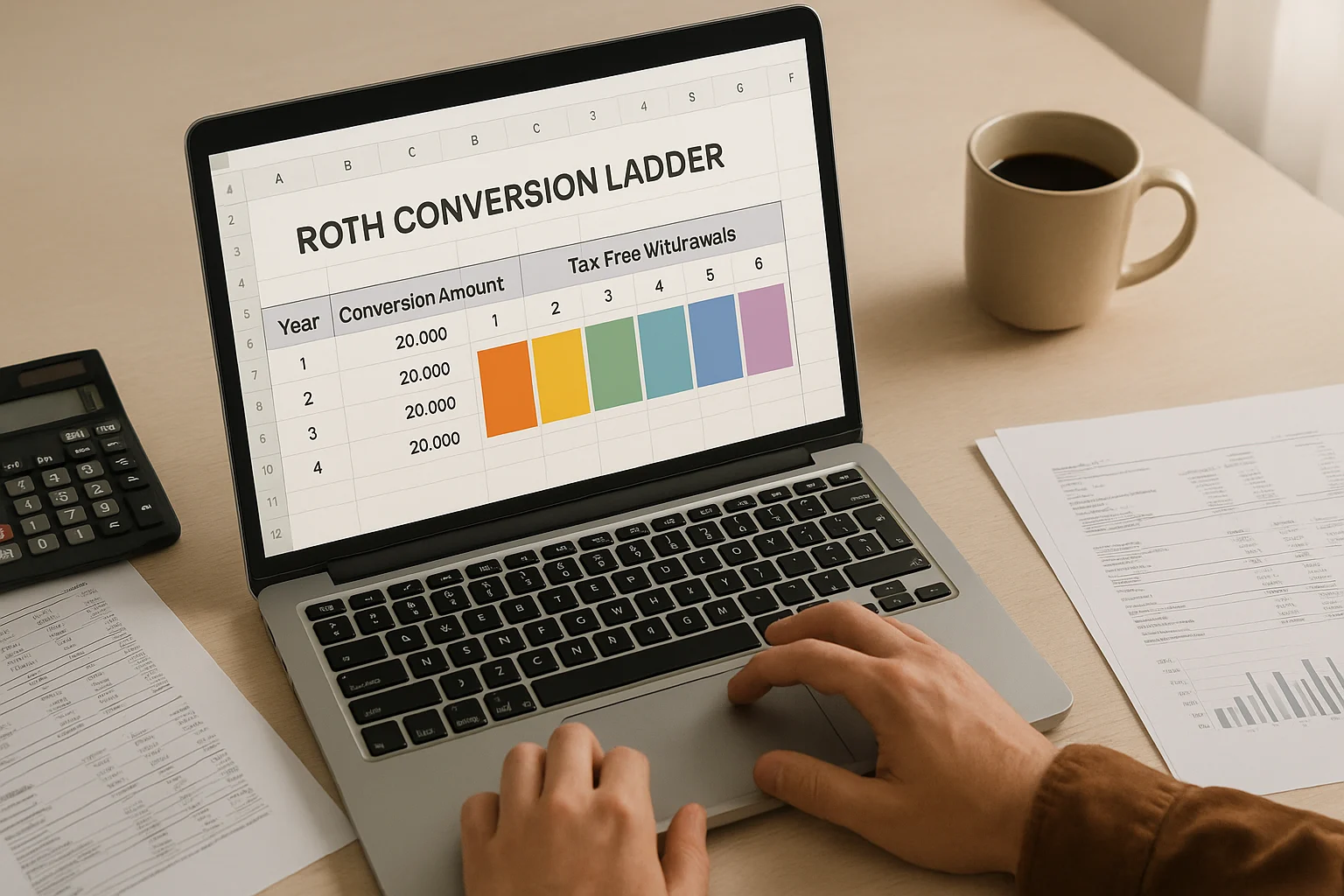
If you searched for a Roth conversion ladder spreadsheet, the calendar is only half the job. You need to track each conversion’s five-year date and decide whether creating taxable income now fits the rest of your plan. This guide gives you a free spreadsheet for the rungs, a 5-year timeline for quick date checks, and the tax-rule guardrails that keep those dates from being mistaken for a blanket tax-free date.
If the account mechanics are still fuzzy, start with this guide to retirement accounts and taxes. If you already know the basics, jump to the 5-year timeline—or download the spreadsheet now and use the rest of the article to pressure-test each rung.
Download the Free Roth Ladder SpreadsheetThis post contains affiliate links. If you buy through our links, we may earn a commission at no extra cost to you. Learn more.
Table of Contents
- Key Takeaways
- Roth Conversion Ladder Basics
- When a Roth Conversion Ladder Can Help
- The Two Roth IRA 5-Year Rules
- Free Spreadsheet & 5-Year Timeline
- How to Build Your Roth Conversion Ladder
- How Much Should You Convert Each Year?
- Before You Convert: Quick Checklist
- Free Money Reset Workbook
- Roth Conversion Ladder FAQs
- Your Next Step: Map One Rung, Then Test the Tax Impact
Key Takeaways
- Conversions can create tax now: The taxable part of a Roth conversion is generally included in income for the year you convert.
- Two five-year rules matter: Each conversion has a separate five-year period for the potential 10% additional tax, while qualified Roth distributions use a different five-year test.
- Conversion size affects more than a bracket: Marketplace MAGI, credits, other income, and later Medicare premiums can all matter.
- Roth IRAs have no lifetime RMD for the owner: That can provide more control over when Roth assets leave the account.
- The spreadsheet handles the calendar: Use it to track conversion years, amounts, and five-year dates; use a tax model or professional advice for the tax decision.
Roth Conversion Ladder Basics
A Roth conversion ladder is a schedule of Roth conversions made in different tax years. Each annual conversion creates another “rung” with its own five-year date, which is why a spreadsheet is useful.
The important distinction is timing versus tax. Moving pre-tax money from a Traditional IRA or eligible workplace plan into a Roth can create taxable income now; the ladder then helps you track when separate conversion five-year periods end. If Roth terminology is new to you, this beginner’s guide to Roth IRAs covers the account basics first.
When a Roth Conversion Ladder Can Help
A ladder is worth modeling when it solves a specific early-retirement cash-flow problem. It is not a requirement for FIRE, and it is not automatically the lowest-tax choice.
Bridge the Years Before 59½
A ladder can create a planned route from pre-tax savings to later Roth withdrawals before age 59½, which is why it often appears in financial independence and early-retirement planning. Other early-access strategies exist, so compare them rather than assuming a ladder is the default.
Choose Conversion Years Deliberately
Lower-income years can create room for conversions, but the right amount depends on filing status, deductions, other income, credits, and future plans. Use the current IRS tax brackets and, if you use Marketplace coverage, current HealthCare.gov savings guidance instead of targeting one bracket from memory.
Keep More Control Over Roth Withdrawals
Roth IRAs do not require minimum distributions while the original owner is alive; traditional IRAs are subject to lifetime RMD rules. Beneficiary rules are different after the owner’s death, so estate-planning decisions deserve a separate check against current IRS guidance.
When a Ladder May Be a Poor Fit
A ladder may be less useful when the conversion tax is unattractive, you already have enough accessible assets for the bridge years, another early-access strategy fits better, or the tracking and tax interactions add more complexity than value. The decision should come from your projected tax and cash-flow picture, not from the strategy’s popularity.
For the underlying account rules, see the IRS guide to Roth IRAs.
The Two Roth IRA 5-Year Rules
“The 5-year rule” can refer to two different Roth IRA clocks. Keep them separate so the ladder calendar does not get mistaken for a complete tax answer:
Qualified-Distribution 5-Year Rule
For a Roth IRA distribution to be qualified, the five-tax-year requirement must be met and the distribution must also satisfy a qualifying condition such as reaching age 59½. The Roth IRA five-year period starts with the first tax year for which a contribution was made to any Roth IRA for you—not merely when an empty account was opened.
If your first Roth IRA contribution was for 2022, the five-tax-year requirement is met beginning in 2027. Whether earnings are part of a qualified distribution still depends on the other IRS conditions.
Conversion 5-Year Rule (Converted Amounts)
Each conversion or qualifying rollover has a separate five-year period that starts January 1 of the conversion year. If you distribute a taxable converted amount within that period, a 10% additional tax may apply unless an exception applies. Roth IRA ordering rules also determine which dollars are treated as distributed first. Here’s a planning example:
| Conversion Year | Amount | Separate 5-Year Date |
|---|---|---|
| 2026 | $25,000 | January 1, 2031 |
| 2027 | $30,000 | January 1, 2032 |
By converting in multiple years, you create staggered five-year dates that can be coordinated with your other early-retirement resources. The calendar is only one part of the decision; tax cost and distribution ordering still need to be modeled.
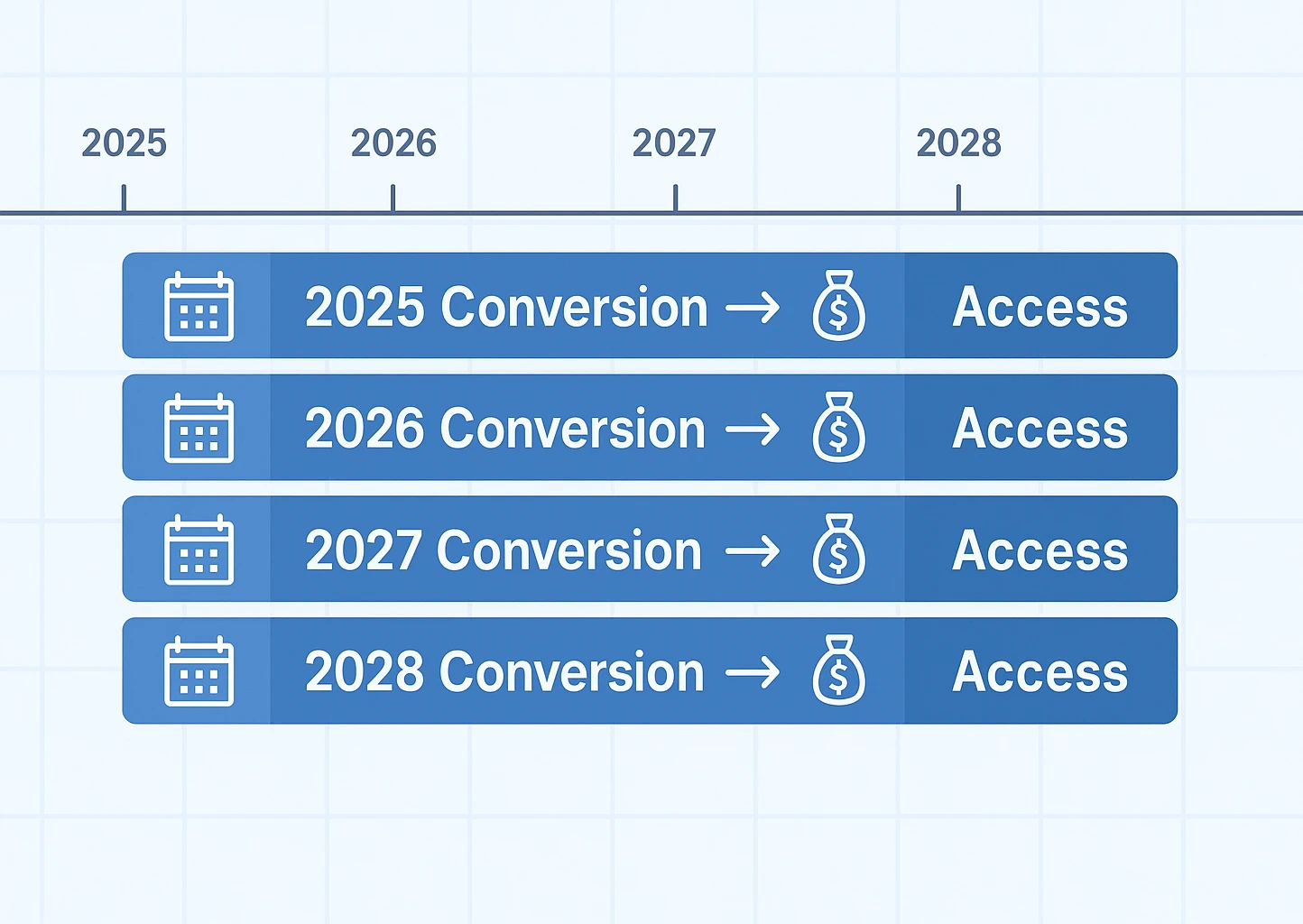
These rules are simplified for planning. For the current IRS treatment of qualified distributions, separate conversion five-year periods, exceptions, and ordering rules, review IRS Publication 590-B before withdrawing money from a Roth IRA.
Your Free Roth Conversion Ladder Spreadsheet & 5-Year Timeline
The spreadsheet is for recordkeeping; the interactive timeline is for quick scenario checks. Together they help you:
- Track the five-year date for each conversion.
- Track conversion amounts and dates.
- Map out future conversions based on your budget.
Download the Free Roth Ladder Spreadsheet

Roth Conversion Ladder 5-Year Timeline
Choose the first conversion year and number of annual conversions. The timeline shows each rung’s five-year date.
Your 5-year timeline
Timeline ready.
Date check only: A five-year date is not a blanket tax-free date. Roth ordering rules, exceptions, age, and the separate qualified-distribution rule can still affect the result.
Once the dates look workable, use the next section to decide what each rung should contain and whether the conversion fits your tax, cash-flow, and health-insurance plan.
How to Build Your Roth Conversion Ladder
Build the ladder in two layers: first map the conversion calendar, then test the tax consequences before executing each rung.
There is no adjusted-gross-income ceiling that by itself blocks a Roth conversion. The taxable part of a conversion is generally included in gross income for the conversion year, so the practical constraint is the tax and benefit impact you are willing to create.
Step 1: Confirm Your Roth IRA Setup
If you do not already have a Roth IRA, establish one with a custodian you are comfortable using. The qualified-distribution five-year period is tied to the first tax year for which a contribution is made to a Roth IRA for you, so opening an empty account by itself is not the key event.
Step 2: Choose the Source Account
Identify which pre-tax account could supply the conversion, such as a Traditional IRA or an eligible distribution from an old workplace plan. Do not automatically roll an old 401(k) into a Traditional IRA for convenience: IRA balances can affect Form 8606 calculations if you also have nondeductible IRA basis, and employer plans are not required to accept every rollover.
Step 3: Model the Conversion Amount
Estimate the marginal tax cost instead of targeting one bracket automatically. Include:
- Spending needs: How much accessible money do you need during the bridge years?
- Marketplace coverage: Taxable conversion income can raise household MAGI and change premium-tax-credit eligibility or amount.
- Other income: Include wages, side income, interest, dividends, capital gains, and other items that affect the return.
Step 4: Execute the Conversion
Use your custodian’s Roth-conversion process, preferably a direct trustee-to-trustee transfer when appropriate. The IRS says taxable conversion amounts are generally included in gross income for the year of conversion and may require additional withholding or estimated tax payments, so decide how the tax will be paid rather than treating “no withholding” as a universal rule. See IRS Publication 590-A.
Step 5: Record the Year and Amount
Record each conversion’s tax year, amount, and separate five-year date. The timeline above handles the calendar view; the downloadable spreadsheet gives you a place to keep the rungs together. You can also browse our free financial tools for other planning worksheets.
Step 6: Recheck the Plan Each Year
If another conversion still fits, add the next rung. Tax brackets, income, Marketplace coverage, account balances, and spending needs can change, so the annual decision deserves a fresh calculation.
Step 7: Plan the Withdrawal Separately
Once a conversion’s separate five-year period has elapsed, the special 10% recapture rule for taxable converted amounts is no longer triggered solely by that five-year period. Roth ordering rules, your age, exceptions, and qualified-distribution rules can still affect the tax result.
How Much Should You Convert Each Year?
There is no universal annual conversion amount. Start with what your bridge plan needs, then test whether that rung creates an acceptable tax and benefit result. Recheck these four areas before choosing each year’s amount.
Lower-Income Years
Early retirement can create lower-income years before Social Security or lifetime RMDs from traditional accounts enter the picture. Those years can be useful for conversions, but compare the current tax brackets and your full return rather than assuming the 10% or 12% bracket is always the right stopping point.
Marketplace Premium Tax Credits
If you buy Marketplace coverage, include proposed taxable conversion income when estimating household MAGI. For 2026, HealthCare.gov says premium-tax-credit eligibility generally falls between 100% and 400% of the federal poverty level; Medicaid eligibility and other details vary by state. Our guide to health insurance for early retirees explains how coverage and income interact.
Market Declines
A market decline can reduce the dollar value of shares you choose to convert, which may reduce the taxable amount for the same number of shares. That can be useful, but it is not a reason to predict the market; conversion size should still come from the tax plan.
IRA Pro-Rata Calculations
If you have nondeductible IRA basis, Form 8606 generally looks across your traditional, SEP, and SIMPLE IRAs when determining taxable and nontaxable portions of distributions and conversions. Moving eligible pre-tax IRA money into an employer plan can sometimes change that calculation, but employer plans are not required to accept rollovers. See the current IRS Form 8606 guidance.
Other early-access methods may fit better for some households, including 72(t) substantially equal periodic payments, taxable-account withdrawals, or strategies discussed in our guide to 401(k) withdrawals without penalty. Once Medicare applies, higher MAGI can also increase income-related Part B and Part D premiums; Social Security’s Medicare premium guidance explains that adjustment.
Before You Convert: A Quick Checklist
Before you execute a rung, make sure the spreadsheet and the tax plan agree.
- Model federal and state tax: The federal bracket is only part of the conversion cost.
- Include health-insurance effects: Check Marketplace MAGI now and Medicare income-related premiums later when they apply.
- Check IRA basis: If you have nondeductible traditional IRA contributions, review Form 8606 and the pro-rata calculation before converting.
- Decide how the tax will be paid: Do not let the withholding choice happen by accident.
- Keep conversion records: Save the year, amount, custodian records, and the five-year date for each rung.
- Re-run the plan annually: Income, brackets, credits, account balances, and spending needs can all change.
If a proposed conversion materially changes credits, Medicare premiums, or several parts of your return at once, consider having a qualified tax professional review the scenario before you execute it.
Get a Second Look Before You Convert
If the five-year dates are clear but the conversion amount still changes taxes, Marketplace income, IRA basis, or other parts of your plan, this can be worth running past a finance professional before you execute the rung.
If this checklist exposed a broader cash-flow question, look at the rest of your household finances before you set the next rung.
See What Your Next Roth Conversion Has to Fit Around
Enter income, spending, up to 8 debts, and up to 8 goals; the SNAPSHOT sheet brings the key numbers together automatically.
Confirm to get the workbook and frugal money tips. Unsubscribe anytime.
Something went wrong. Please check your email address and try again.
Roth Conversion Ladder FAQs
Your Next Step: Map One Rung, Then Test the Tax Impact
Start with one proposed conversion, not a ten-year commitment. Put the year into the timeline, record the amount and five-year date in the spreadsheet, then model what that conversion would do to federal and state tax, Marketplace MAGI when relevant, and your bridge-year cash. If the trade-off works, keep the rung; if it does not, change the amount or year before you convert.
This content is for general educational purposes only and is not tax, investment, or financial advice. Tax laws and health-insurance rules change over time, and what works for one household may not fit another. Before making Roth conversions or other major money moves, talk with a qualified tax or financial professional who understands your full situation.

