

Want work to be optional sooner? Pursuing financial independence early means turning your spending into a target, then building a savings and investing plan around it. Start with the calculator below for a planning estimate; the rest of this guide shows how withdrawal rates, market risk, healthcare, taxes, and lifestyle choices can change whether that number holds up.
FIRE Calculator: Check Your Timeline
Enter your planned spending, current portfolio, annual savings, and planning assumptions. The estimate updates as you change a value and keeps the math in today’s dollars.
Your FIRE Snapshot
Planning estimatePlanning estimate in today’s dollars. This simplified model assumes a steady real return and annual contributions; it does not model taxes, account-access rules, or sequence-of-returns risk.
Stress-test this estimate with the withdrawal-rate guardrails
Treat the estimate as a starting point, then use the guide to pressure-test the assumptions behind it.
This page contains paid/affiliate links. As an Amazon Associate we earn from qualifying purchases, and we may earn commissions from other partners—at no extra cost to you. Links marked with ‘#ad’ are affiliate links, meaning we may earn a commission at no extra cost to you. Learn more.
Table of Contents
- FIRE Calculator
- What Is FIRE?
- How to Start Financial Independence Early (Step-by-Step)
- Free 30-Minute Money Reset
- The 4% Rule (Plus Guardrails)
- Inflation & Volatility Adjustments
- Investment Strategies for FIRE
- Lean vs. Fat FIRE Lifestyle: Choosing a Path
- Coast FIRE: Are You Already on Track?
- Worked Example: How Extra Savings Changes the FIRE Timeline
- Common FIRE Mistakes (and Fixes)
- Books, Communities & Resources
- FIRE with a Partner or Kids
- Health Insurance Before Medicare
- Taxes, Account Access & Where You Live
- Frequently Asked Questions
- Turn Your FIRE Number Into a Plan
What Is FIRE?
FIRE means building enough financial flexibility that paid work becomes optional. “Retire” can mean stopping completely, downshifting, or keeping work you enjoy without depending on every paycheck. Design the FIRE lifestyle around the life you want, not someone else’s checklist. To compare styles, see Fat FIRE vs. Lean FIRE. Prefer a hybrid with part-time income? Our guide to Barista FIRE shows how part-time work can cover part of the spending plan.
How to Start Financial Independence Early (Step-by-Step)
Wondering how to retire early without burning out? Start with a simple plan you can actually stick to. Track your savings rate as a trend, too—the share of income you direct toward saving and investing—so you can see whether the gap is widening without turning FIRE into a deprivation contest.
- Audit cash flow: Track three months of spending and list debts. Then choose a needs/wants/savings split you can sustain; the ranges below are examples, not a rule, so your chosen percentages should add to 100%.
| Category | Illustrative range | How to use it |
|---|---|---|
| Needs | 45–55% | Housing, food, utilities, insurance |
| Wants | 10–20% | Dining, travel, subscriptions |
| Savings/Investing | 25–40% | Automate on payday; raise quarterly |
- Build the buffer: Size your emergency fund to your household, job stability, insurance, and near-term risks; three to six months of essential expenses is a common starting range.
- Automate investing: Use tax-advantaged accounts when they fit your situation, keep fees low, and check the current IRS contribution and eligibility rules before trying to max them out.
- Increase the gap: Add income where it is realistic and target the biggest recurring expenses before chasing tiny cuts.
- Quarterly review: Re-run the calculator, review your allocation, and raise savings when cash flow allows.
If your plan includes a pension, this primer on retiring at 55 with a pension shows how to blend guaranteed income with portfolio withdrawals.
Before you stress-test withdrawal rates, get the parts you can control—income, spending, debts, and goals—into one place.
Get the 30-Minute Money Reset
Five editable sheets roll into one automatic SNAPSHOT view.
Confirm to get the workbook and frugal money tips. Unsubscribe anytime.
Something went wrong. Please check your email address and try again.
The 4% Rule (Plus Guardrails)
The 4% rule is a historical rule of thumb, not a guarantee. In William Bengen’s original research, a 4% first-year withdrawal followed by inflation-adjusted withdrawals was tested against historical U.S. market periods and supported at least 30 years in the scenarios studied. Early retirement can last much longer, so test lower starting rates and flexible spending rules rather than assuming 4% will hold. For a plain-English walkthrough, see our simple guide to the 4% rule; for the source research, see Bengen’s historical withdrawal-rate study.
Inflation & Volatility Adjustments
Stress-test more than one inflation path—for example, 2.5% and 4%—and treat those as scenarios, not forecasts. Re-run the plan when inflation, interest rates, or your spending changes materially. Bonds or TIPS can be part of a short-term spending buffer, but the right mix depends on your horizon and risk tolerance. For tax-sensitive moves such as loss harvesting or Roth conversions, verify the current rules for your accounts before acting.
Investment Strategies for FIRE
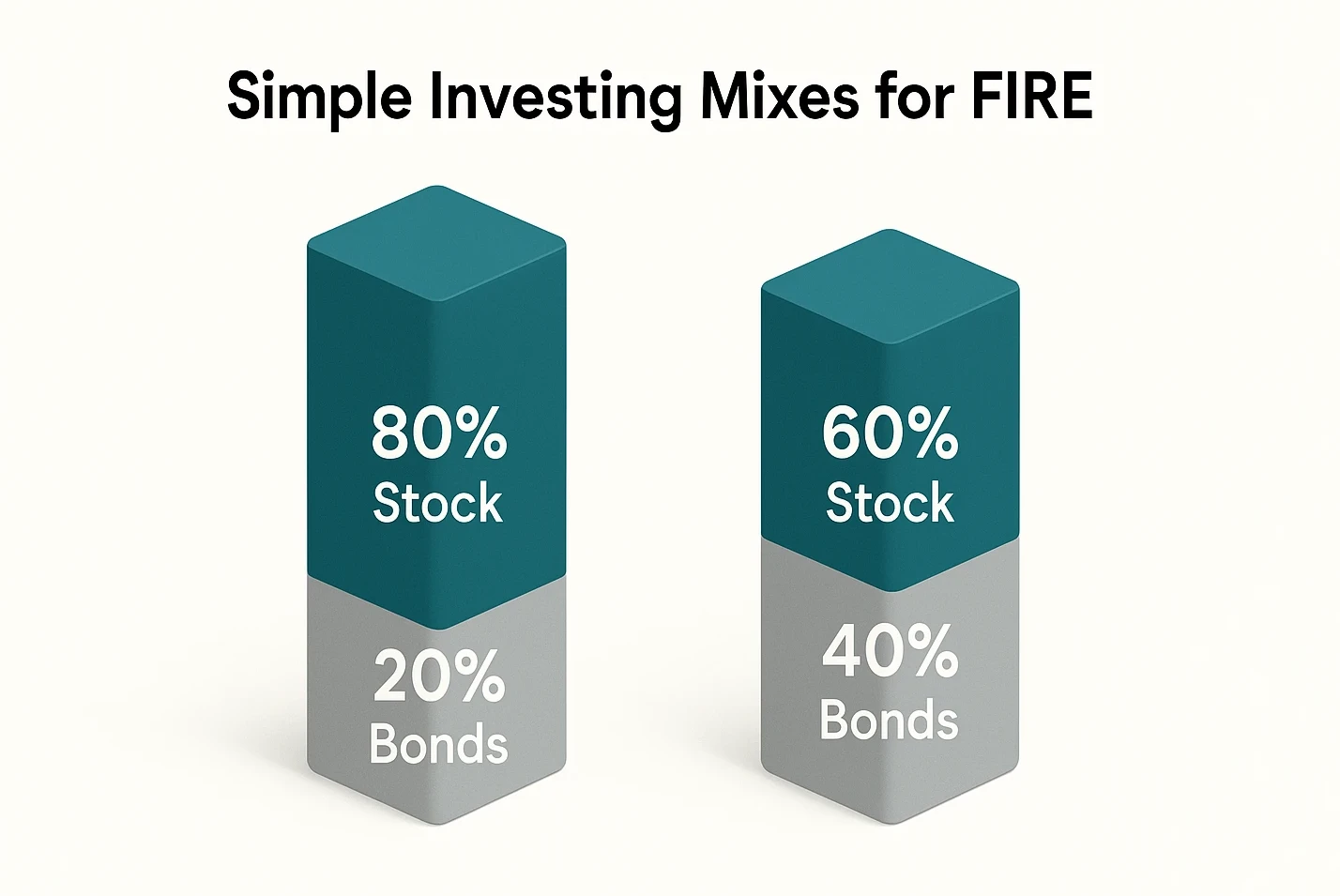
Keep it simple and repeatable. Many use low-cost index funds for broad diversification, then tune risk by adjusting stock/bond mix. Rebalance annually or when bands drift. Planning to stop at 60? Compare allocation and withdrawal examples in how to retire at 60 with $2 million and retire at 60 with $1 million to calibrate your target.
| Portfolio | Why people use it | Watch-outs |
|---|---|---|
| 80/20 Stock/Bond | Higher growth potential; may suit long horizons. | Larger drawdowns—consider a cushion. |
| 60/40 Stock/Bond | More bonds can reduce volatility relative to a more stock-heavy mix. | Lower expected growth than a more stock-heavy allocation. |
| Dividend Tilt | Makes dividend cash flow more visible. | Don’t chase yield—dividends do not replace diversification or total-return analysis. |
| Target-Date Fund | Automatically adjusts its allocation over time. | Glidepaths, holdings, and fees vary by fund. |
Glidepath idea: Some early retirees hold part of their near-term spending in cash or bonds so a market drop does not force immediate stock sales. How much to hold—and whether to change the mix later—depends on your horizon, flexibility, and risk tolerance.
Lean vs. Fat FIRE Lifestyle: Choosing a Path
Lean FIRE targets lower spending and therefore a smaller portfolio. Fat FIRE plans for a higher spending level and usually needs a larger target. Neither is automatically better—the useful question is which spending level you can sustain without turning the path to FI into permanent deprivation. If most income will be Social Security later, practice frugality now with these rich life on Social Security tips. Closing in on 60? Tighten expenses with retirement savings hacks after 60.
Coast FIRE: Are You Already on Track?
If your current investments can grow to your target by the later retirement age you choose without new contributions, you’ve reached the basic Coast FIRE idea. That can give you room to scale back future savings or work hours, but the answer depends heavily on the return and spending assumptions. Use the calculator: set annual savings to $0 and see what the simplified model implies—or try the dedicated Coast FIRE calculator for a focused projection.
Worked Example: How Extra Savings Changes the FIRE Timeline
Consider a hypothetical example: Jamie earns $95k, spends $50k, and saves ~$25k/yr with a $60k portfolio. Under this calculator’s simplified assumptions—a 7% real-return assumption and a 4% withdrawal rate—the target is about $1.25M and the timeline is ~20 years. Jamie bumps savings by $400/month, trims subscriptions, and keeps a 6-month cash buffer. Re-running the same calculator shortens the timeline to ~19 years—useful progress, but not a dramatic overnight change. Wondering about more aggressive targets? See whether retiring at 50 with $2 million holds up over a 40+ year horizon.
Common FIRE Mistakes (and Fixes)
- Lifestyle creep: Route part of each raise to savings before expanding recurring spending.
- Underestimating healthcare: Estimate premiums and out-of-pocket costs for the coverage routes you may use; check HSA eligibility separately.
- All-in on one asset: Diversify and judge the portfolio by total return and risk, not one asset’s story.
- Ignoring taxes: Model taxes before Roth conversions or loss/gain harvesting; rules, account type, and timing matter.
- Burnout from extreme frugality: Budget small “joy” money to stay consistent.
- Over-relying on side hustles: If you’re exhausted, consider Barista FIRE to cover extras without burnout.
- Sequence-of-returns blindness: Decide in advance how you would handle a bad market early in retirement—through flexible spending, a near-term buffer, or another guardrail you understand.
Books, Communities & Resources
Once the math starts working, the bigger question is what you want the freedom to make possible. If that is the part you want to think through, Tanja Hester’s Work Optional is a strong next read: it connects early-retirement planning with healthcare, family, uncertainty, and the life you want the money to support.
For community accountability, explore r/financialindependence. For a neutral overview of how to retire early, see a FIRE movement summary. Prefer expert help on strategy or taxes? You can ask a finance expert online for tailored answers. For an authoritative overview of compounding and investing basics, review the SEC’s Investor.gov introduction to investing and compound growth.
FIRE with a Partner or Kids
Align on the end state (work-optional vs. full stop), savings targets, and timelines. If college is a goal, weigh 529 saving against retirement priorities rather than treating either one as automatic. Review life-insurance needs and coordinate retirement-account and tax decisions across the household. A shared money calendar can keep quarterly check-ins from becoming another forgotten task. For starting small accounts and automating gifts, review Acorns Early to see if it fits your family.
Health Insurance Before Medicare
Early retirees usually compare COBRA, Marketplace plans (ACA), spousal coverage, or direct-from-insurer options. HealthCare.gov says Marketplace savings are based on expected household income for the coverage year and household size. Most IRA and 401(k) withdrawals count toward Marketplace income, while qualified distributions from a designated Roth account do not. HSAs can cover many qualified medical expenses, but eligibility and premium rules have important limits. Re-price plans annually and keep a dedicated healthcare sinking fund. For current federal guidance, see HealthCare.gov’s retiree coverage guide and the IRS HSA guidance in Publication 969. For FrugalHarpy’s deeper walkthroughs, see health insurance options for early retirees and our ACA early retirement guide.
Taxes, Account Access & Where You Live
Where you live can change both the spending side of your FIRE number and the taxes around it. Compare housing, insurance, healthcare access, income tax, and property tax instead of chasing one headline rate. If relocation is part of your plan, browse the best cities to reach FI by 50 and compare the most tax-friendly states for early retirement.
How to Access Money Before Traditional Retirement Age
Retiring before age 59½ makes account access part of the plan, not an afterthought. Map which years can be covered from cash or taxable investments and which withdrawals would need to come from retirement accounts. The IRS generally treats IRA and retirement-plan distributions before age 59½ as early distributions that may face an additional 10% tax unless an exception applies. One important exception is the Rule of 55 for certain qualified-plan distributions after separation from service during or after the year you turn 55; that exception does not apply to IRAs. Before rolling a workplace plan into an IRA, check how the move could affect your access options and taxes, then review the IRS exceptions table and the full early-retirement tax guide.
Need a second opinion on your FIRE plan?
If withdrawal rules, taxes, or account access are the part you’re stuck on, a finance expert can help you work through your specific questions. If you prefer the DIY route, keep going with the guide and use the calculator to test your own scenarios.
Frequently Asked Questions
Turn Your FIRE Number Into a Plan
Turn the guide into a plan by changing one assumption at a time. Re-run the calculator, then pressure-test the result against withdrawal risk, healthcare, taxes, and the lifestyle you actually want to keep. The goal is not the earliest possible exit—it is a work-optional plan you can keep funding without making the years on the way there miserable.
This guide is for general education only and is not investment, tax, or legal advice. No recommendations here guarantee results or performance. Consider a qualified financial, tax, or legal professional for advice specific to your situation.

