

Planning to leave work before age 59½? The early retirement Rule of 55 may let you take qualifying distributions from the 401(k) or 403(b) tied to the employer you leave without the 10% additional tax if you separate in or after the calendar year you turn 55. Taxable amounts still count as income, qualified public-safety employees and private-sector firefighters can have an earlier threshold, and an IRA rollover can change which early-distribution rules apply.
This guide is built around the decisions that matter: whether your separation year qualifies, which account can use the exception, what distributions your plan allows, and what to verify before a rollover. For the broader roadmap, see our guide to financial independence and early retirement.
Educational only—tax rules can change and plans vary. Confirm details with your plan administrator and a qualified tax professional.
This post contains affiliate links. We may earn a commission if you use them and take a qualifying action, at no extra cost to you. Learn more.
Table of Contents
- Rule of 55 Eligibility Checker
- What Is the Early Retirement Rule of 55?
- How to Use the Rule of 55: Step-by-Step
- Rule of 55 Details That Can Change Eligibility
- Tax and Investment Considerations
- Examples: How the Rules Work in Practice
- Avoid These Rule of 55 Mistakes
- How This Rule Fits Into Your FIRE Strategy
- Free 30-Minute Money Reset
- Frequently Asked Questions About the Rule of 55
- Before You Use the Rule of 55: Final Checklist
If eligibility is your first question, use the checker before diving into the details. It screens the main IRS timing and account rules and shows what still needs verification.
Rule of 55 Eligibility Checker
Use this as a screening check, not a final tax determination. Choose the employer plan tied to your separation and your job type; plan distribution rules and rollover history can still change the answer.
Used only to test the calendar-year age threshold.
Use the year you left, or expect to leave, the employer sponsoring this plan.
The public-safety exception can use the earlier of age 50 or 25 years of service under the plan.
The year sliders are prefilled and can be adjusted at any time.
This checker can narrow the rule, but your plan administrator must confirm whether your plan allows the distribution you want.
Educational screening only. Confirm current tax treatment and plan-specific withdrawal rules before acting.
Use the result to decide what to verify next. The eligibility and account sections below explain the rule behind the screen before you request a distribution or move money to an IRA.
What Is the Early Retirement Rule of 55?
The Rule of 55—often called the 401(k) Rule of 55—is the separation-from-service exception under Internal Revenue Code Section 72(t). Under the standard rule, distributions from an eligible employer plan can avoid the 10% additional tax when separation occurs in or after the calendar year you turn 55. Taxable amounts still count as income. Qualified public-safety employees and private-sector firefighters can have an earlier threshold, covered below.
For other paths to avoid the 10% additional tax, see 401(k) withdrawals without penalty.
Who Qualifies for the Rule of 55?
For the standard exception, confirm two things:
- Age/timing: Under the standard exception, separate from service in the calendar year you turn 55 or later. If you turn 55 in December, leaving any time in that calendar year can qualify; leaving in the previous calendar year does not. Qualified public-safety employees and private-sector firefighters can have the earlier age-or-service threshold described below.
- Separation from service: You no longer work for the employer sponsoring the plan you’re accessing.
Why the Calendar Year Matters
The standard timing test uses the calendar year of separation, not whether you have already had your 55th birthday on your last day. You still must end employment with the plan sponsor; retiring, quitting, being laid off, or being terminated can count as a separation from service. For example:
- Scenario A: Sarah, 54, quits on December 31 and turns 55 on January 15 of the following year. She doesn’t qualify for her employer’s 401(k) under the standard age-55 exception because she left before the calendar year she turned 55.
- Scenario B: Mark turns 55 on July 1 and quits on August 1 of the same year. He meets the standard timing requirement because he left in the calendar year he turned 55.
If you are choosing between dates near year-end, confirm the calendar-year test before giving notice; crossing into a different calendar year can change the result.
Which Accounts Qualify Under the Rule of 55?
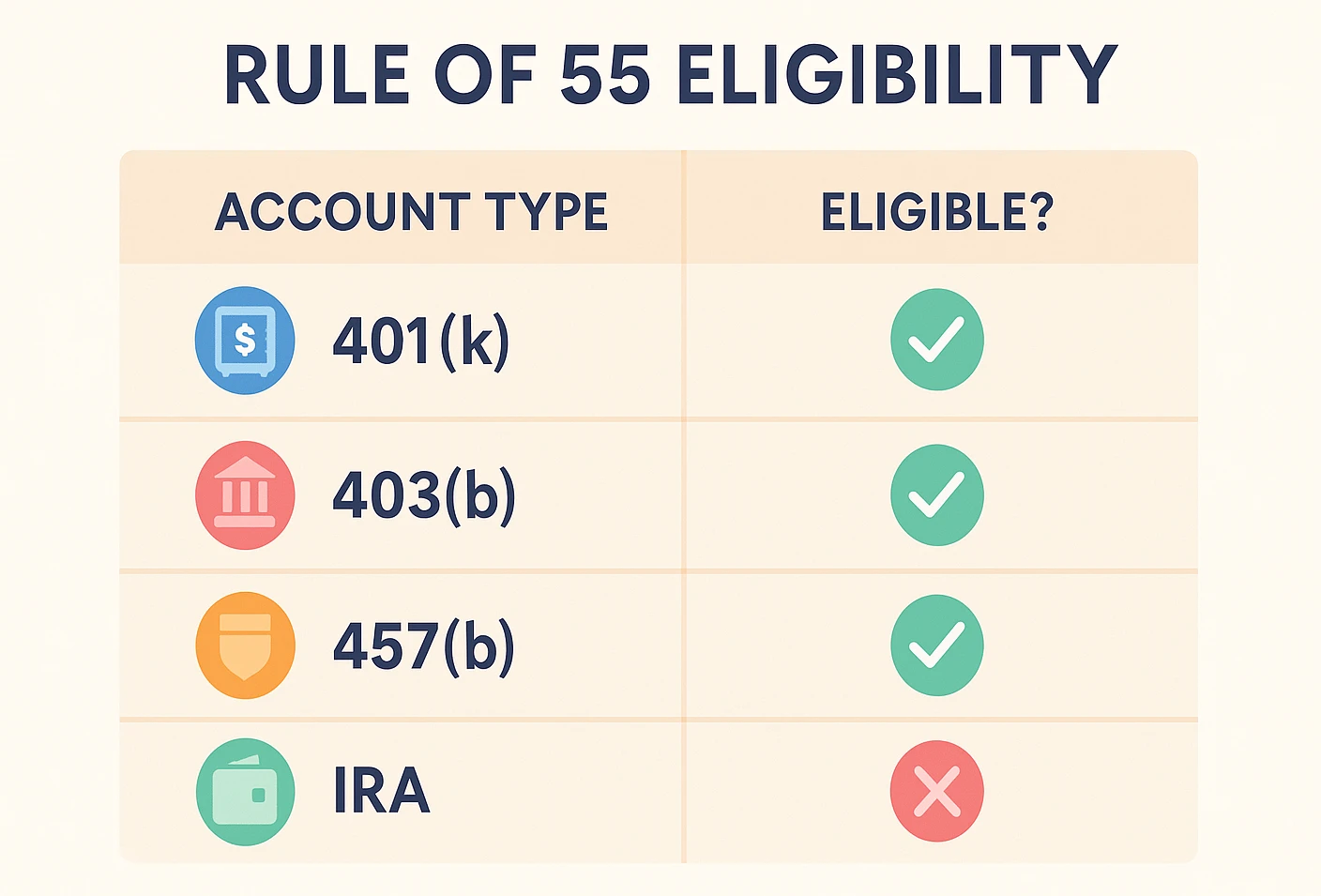
The Rule of 55 applies to qualifying employer plans, not IRAs. For the article’s main use case, that means these plan types tied to the employer you separate from:
- 401(k) plans
- 403(b) plans
Important: An old 401(k) that stays in a former employer’s plan does not qualify based on a later employer separation, and IRAs (Traditional, Roth, SEP, SIMPLE) do not qualify under this rule. If you are still employed and considering rolling eligible old-plan money into the employer plan tied to your upcoming separation, first confirm that the plan accepts rollovers and how it handles post-separation distributions. The IRS notes that employer plans are not required to accept rollover contributions.
Note on governmental 457(b): penalty rules are different—governmental 457(b) distributions aren’t subject to the 10% additional tax after separation from service, and there’s no age-55 requirement. (Rollovers from non-457 plans into a 457(b) can change the penalty treatment; check your plan.)
| Account Type | Penalty Rule at Separation |
|---|---|
| 401(k) tied to qualifying separation | ✅ Standard threshold: separation in or after the year you turn 55. Qualified public-safety employees and private-sector firefighters can use the earlier of age 50 or 25 years of service under the plan. |
| 403(b) tied to qualifying separation | ✅ Standard threshold: separation in or after the year you turn 55. Qualified public-safety employees and private-sector firefighters can use the earlier of age 50 or 25 years of service under the plan. |
| Governmental 457(b) | ✅ Different rule: No 10% additional tax after separation; no age-55 requirement. See note above. |
| Old 401(k) from previous job | ❌ Not based on a later separation while it remains in the earlier employer’s plan. If you are considering a pre-separation rollover into the plan tied to your upcoming separation, verify that the plan accepts it before moving money. |
| Traditional IRA | ❌ Rule of 55 doesn’t apply; IRA exceptions differ (e.g., SEPP/72(t), certain special distributions). |
| Roth IRA | ❌ Rule of 55 doesn’t apply; Roth IRA ordering rules and five-year/59½ tests govern taxation/penalty. |
| SEP IRA / SIMPLE IRA | ❌ Rule of 55 doesn’t apply; SIMPLE IRAs may have a 25% early-distribution penalty in first two years. |
How to Use the Rule of 55: Step-by-Step
Once the timing and account tests fit, use these steps to confirm the plan mechanics and tax impact before requesting money.
Step 1: Separate in the Qualifying Year
Use the separation year—not the date you later take the withdrawal—as the timing test. Under the standard exception, separating in the calendar year you turn 55 or later can qualify; leaving in the prior calendar year does not. Qualified public-safety employees and private-sector firefighters can have an earlier age-or-service threshold.
Confirm the separation year before giving notice.
Step 2: Confirm Your Plan’s Withdrawal Rules
The IRS allows the exception, but your plan’s rules (timing, frequency, forms) decide how you can take money out.
- Ask: “What withdrawal options are available after separation?”
- Confirm whether the plan allows partial, periodic, or only lump-sum distributions.
- Clarify what forms and processing timelines apply.
If the plan only allows a lump-sum distribution, the tax exception may still be available, but the distribution format can create a much larger taxable-income year than a partial-withdrawal strategy. Ask before you resign so you know the plan’s withdrawal options and paperwork in advance.
Step 3: Plan the Withdrawal Amount and Tax Impact
Estimate how much to withdraw and when. As a simple illustration, a $50,000 taxable withdrawal at a hypothetical 22% federal rate would mean about $11,000 of federal income tax before considering other taxes, credits, or withholding.
- Needs: Cover living costs and near-term goals.
- Taxes: Smaller, steady withdrawals may help manage your bracket.
- Investments: Keep the remaining allocation aligned with your horizon.
If the tax impact or account mix is complicated, coordinate the withdrawal plan with a qualified adviser. See IRS early-distribution guidance for the federal additional-tax rules.
Step 4: Request the Distribution
Submit the forms and choose the available payment method. Federal withholding depends on the payment type: an eligible rollover distribution paid to you is generally subject to mandatory 20% withholding, while periodic or other non-rollover payments can follow different withholding rules. Keep your Form 1099-R for taxes. If your 1099-R doesn’t show an applicable exception, you may need Form 5329 to report it. See the IRS rollover and withholding guidance.
Rule of 55 Details That Can Change Eligibility
Three details cause most confusion in practice: which employer plan is tied to the separation, whether the money is moved to an IRA, and whether a special public-safety rule applies.
The Plan Must Be Tied to the Qualifying Separation
The exception is tied to the employer plan from which you separate in the qualifying calendar year. An old 401(k) from a different employer and an IRA do not qualify under that later separation. Some plans allow partial withdrawals while others limit how distributions can be taken, so confirm the available options with your administrator.
Avoid Rolling Over to an IRA Too Soon
Rolling the balance from the qualifying employer plan to an IRA before using the separation exception means later withdrawals from the rolled amount follow IRA early-distribution rules instead of the Rule of 55.
Before you roll over: If you expect to rely on this exception for that balance, confirm the distribution sequence before moving the money to an IRA.
Public-Safety and Private-Firefighter Exception
Qualified public-safety employees taking distributions from a governmental plan, and private-sector firefighters taking distributions from a qualifying employer plan, can use the separation exception after the earlier of age 50 or 25 years of service under the plan. The role, plan type, and separation timing still have to satisfy the IRS definition. See IRS Publication 575.
If your specific situation is messier than the examples above
If your separation date, rollover history, plan type, or public-safety status makes the exception hard to apply to your situation, this can be one of those cases where a quick human second opinion is useful before you move the money.
Tax and Investment Considerations
Penalty-free doesn’t mean tax-free.
Taxes Still Apply
Taxable withdrawals are included in income even when the 10% additional tax does not apply. For example, a $20,000 taxable withdrawal at a hypothetical 24% federal rate would equal $4,800 of federal income tax before other tax effects. For a deeper overview of the additional tax on early distributions, see IRS Topic No. 558.
Roth 401(k) Withdrawals Under the Rule of 55
If the separation-from-service exception applies, it can remove the 10% additional tax from the taxable part of an otherwise nonqualified designated Roth 401(k) distribution. That does not automatically make the withdrawal tax-free: nonqualified designated Roth distributions are treated pro rata as contributions and earnings, and the earnings portion is included in income. A qualified distribution is tax-free only when the designated Roth five-year rule and a qualifying event are met. See the IRS designated Roth account guidance.
Long-Term Impact on Early Retirement Savings
Early withdrawals reduce the amount left to compound. As a simple illustration, $50,000 left invested for 10 years at a hypothetical 5% annual return would grow to about $81,400 before fees and taxes. Test your withdrawal plan against a range of return and spending assumptions rather than relying on one projection.
Retiring before Medicare eligibility? Treat health coverage as a separate cash-flow decision alongside your withdrawal plan.
Examples: How the Rules Work in Practice
These simplified scenarios show why separation timing and account type matter.
Illustrations only: These are hypothetical scenarios, not reader testimonials. Actual tax treatment depends on the plan, timing, and individual circumstances.
Example 1: Qualifying Separation at 55
David leaves work in July after turning 55 in June. He takes about $40,000 a year from the 401(k) tied to that separation. Assuming the other requirements are met, the standard separation exception can remove the 10% additional tax; the taxable portion still counts as income.
Example 2: Two Employer Plans, One Qualifying Separation
Maria, 57, leaves Company B and keeps an older Company A 401(k) separate. The age-55 separation exception can apply to Company B’s plan if the other requirements are met, while the separate Company A plan does not qualify under Maria’s later separation from Company B.
Example 3: Governmental 457(b) — Different Rule
Captain Jones, a 50-year-old firefighter, leaves a governmental employer and takes a distribution from its governmental 457(b). The 10% additional tax generally does not apply to governmental 457(b) distributions after separation, although amounts attributable to rollovers from another plan or IRA can be treated differently. This access comes from the 457(b) rules, not the Rule of 55.

Avoid These Rule of 55 Mistakes
Most mistakes come from using the wrong calendar-year test, moving money to the wrong account, or assuming the plan will allow a distribution automatically.
- Wrong calendar year: Separating at age 54 can still meet the standard timing test if it happens in the same calendar year you turn 55. Separating in the previous calendar year does not.
- Premature IRA rollover: If you roll the qualifying plan balance to an IRA first, later withdrawals from that rolled amount follow IRA rules rather than the Rule of 55.
- Assuming all accounts qualify: The exception is tied to the employer plan from the qualifying separation, not an old employer plan or an IRA.
- Ignoring taxes: Plan for withholding and total tax.
- Skipping plan rules: Confirm distribution options with your administrator.
How This Rule Fits Into Your FIRE Strategy
The Rule of 55 can bridge the gap between leaving work and age 59½. Unlike a Roth conversion ladder or a 72(t) substantially equal periodic payment plan, this exception can allow flexible withdrawals from the employer plan tied to the qualifying separation. The standard threshold is the year you turn 55; qualified public-safety employees and private-sector firefighters can have the earlier age-or-service threshold. You can combine this access with taxable savings or earned income as part of a broader cash-flow plan. If you retire before Medicare, include pre-Medicare health insurance options in that bridge.
If you’re combining this account with taxable savings, earned income, and pre-Medicare costs, look at your broader finances before choosing a withdrawal amount.
Put Your Money Picture on One Screen
Enter income, spending, up to 8 debts, and up to 8 goals, and it totals your whole picture automatically.
Confirm to get the workbook and frugal money tips. Unsubscribe anytime.
Something went wrong. Please check your email address and try again.
Frequently Asked Questions About the Rule of 55
Before You Use the Rule of 55: Final Checklist
If your separation timing and plan type fit the exception, confirm the distribution mechanics before requesting money. The Rule of 55 can remove the 10% additional tax when the exception applies, but taxable amounts still count as income.
- Confirm the plan: Make sure you are using the employer plan tied to the qualifying separation and ask what distribution options it allows.
- Estimate the tax impact: Decide how much you actually need and account for withholding and other taxable income.
- Decide before you roll over: If you expect to rely on this exception, confirm the withdrawal strategy before moving the balance to an IRA.
If the timing or account test fails, compare other ways to take a 401(k) withdrawal without the 10% additional tax before you move money or commit to a withdrawal schedule.
This content is educational and not financial, tax, or legal advice. Confirm details with your plan administrator and a qualified professional before making decisions.

