

Yes, retiring at 60 with $1 million can be realistic for some households—but the account balance alone does not answer the question. The first number to calculate is your spending gap: what your portfolio must cover after reliable income. Healthcare before Medicare, taxes, Social Security timing, and market returns can widen or shrink that gap.
Use the calculator below to test your savings, spending, and Social Security assumptions. Then work through the sections that tighten the biggest age-60 decisions: your budget, starting withdrawal rate, healthcare bridge, and income plan. If you need the broader framework first, see our financial independence and early retirement guide.
Retirement Snapshot Calculator
Enter your savings, age, and annual spending to get a straight-line planning snapshot in today’s dollars. Social Security is optional; choose a real-return scenario to see how sensitive the result is.
Planning snapshot
Enter savings, age, and spending.
Planning estimate only. It uses a constant real return and does not model market sequence, taxes, fees, long-term care, one-time shocks, or income streams other than the Social Security amount you enter. Use it to test assumptions, not to predict an outcome.
This post contains affiliate links. If you buy through our links, we may earn a commission at no extra cost to you. Learn more.
Table of Contents
- Retirement Snapshot Calculator
- Five Tests Your $1M, Age-60 Retirement Plan Needs to Pass
- Can You Retire at 60 With $1 Million?
- Build a Retirement Budget Around Your Spending Gap
- Free 30-Minute Money Reset Workbook
- Withdrawal Rates for a $1M, Age-60 Plan
- Navigating Healthcare Before Medicare
- Social Security Timing at Age 60
- Smart Investment Drawdown Strategies
- Building a Resilient Retirement Portfolio
- Lifestyle Scenarios: Making $1 Million Work
- FAQs About Retiring at 60 with $1M
- Before You Retire at 60, Run the Final Stress Test
Five Tests Your $1M, Age-60 Retirement Plan Needs to Pass
Before you treat $1 million as “enough,” make sure the plan passes these five tests:
- Spending-gap test: How much must the portfolio fund before and after other reliable income begins?
- Withdrawal-rate test: What first-year draw does that gap create, and can you cut spending if markets disappoint?
- Healthcare-bridge test: What will coverage cost from retirement until Medicare eligibility?
- Tax-and-income test: How will Social Security timing, account withdrawals, Marketplace credits, and future RMDs interact?
- Flexibility test: Which expense, work, or timing lever would you change if the plan becomes tight?
Can You Retire at 60 With $1 Million?
For some households, yes. For others, the same $1 million is too tight. The useful way to judge it is as a timeline: the portfolio has to cover different gaps at different ages.
- Ages 60–65: Your plan may need to cover the full spending gap plus pre-Medicare healthcare before other income begins.
- Ages 62–70: Social Security becomes a timing decision. Starting earlier can reduce portfolio withdrawals sooner; delaying can increase the scheduled monthly benefit but lengthens the bridge the portfolio must cover.
- Age 65 and beyond: Medicare changes the healthcare equation, Social Security may shrink the portfolio gap, and later required distributions can affect taxes and cash flow.
That is why good retirement planning models retirement in phases instead of asking whether one balance is “enough” forever. Start by building the age-60 spending gap you need to fund first.

Build a Retirement Budget Around Your Spending Gap
This article models $35,000–$40,000 of annual portfolio-funded spending because that equals a 3.5%–4% first-year draw on $1 million before Social Security or other income. Treat that as a scenario to test, not a target budget for every retiree.
Understanding Your Expenses
Fixed expenses: Housing (mortgage/rent, taxes, insurance), utilities, insurance, debt payments (ideally none), and subscriptions. Keep these lean to reduce your baseline.
Variable expenses: Food, transportation, healthcare (co-pays, prescriptions), entertainment & hobbies (travel, events), clothing/personal care, and gifts/charity. These flex with lifestyle and are your easiest levers. For more ideas on shrinking everyday costs, explore our frugal living and saving guide.
Tips for a $35,000–$40,000 Budget
- Housing: Downsize or relocate to lower-cost areas.
- Transportation: Use one car or a fuel-efficient model.
- Food: Cook at home; limit dining out.
- Travel: Favor local or off-peak trips.
- Healthcare: Budget premiums and out-of-pocket costs.
- Debt: Eliminate high-interest balances.
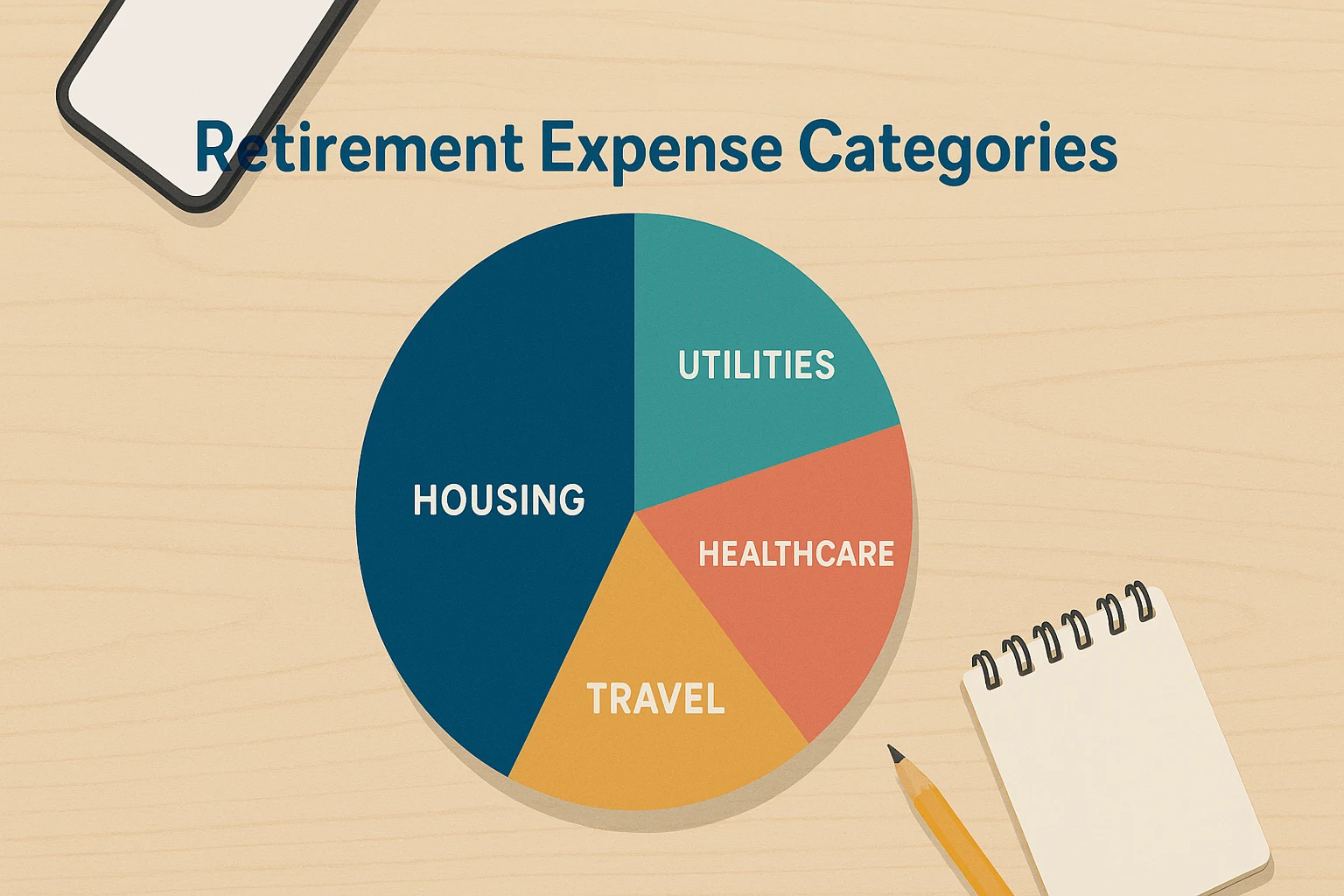
Sample Budget for Retiring at 60 with $1M
| Category | Monthly Budget | Annual Budget | Notes |
|---|---|---|---|
| Housing (paid off) | $800 | $9,600 | Property taxes, insurance, maintenance |
| Utilities | $250 | $3,000 | Electricity, water, internet, phone |
| Groceries | $400 | $4,800 | Mostly home-cooked meals |
| Transportation | $200 | $2,400 | Gas, insurance, maintenance (one car) |
| Healthcare (pre-Medicare) | $600 | $7,200 | Illustrative only—replace with current premiums and out-of-pocket estimates for your household and location |
| Personal care/misc | $150 | $1,800 | Haircuts, toiletries, small purchases |
| Entertainment/hobbies | $300 | $3,600 | Dining out, movies, local activities |
| Contingency/buffer | $300 | $3,600 | Unexpected expenses, small trips |
| Total | $3,000 | $36,000 | Illustrative subtotal; add income taxes and large irregular costs for your household |
This sample shows a $36,000 annual spending subtotal with a buffer. It is not a complete tax-inclusive retirement budget; add expected income taxes and any large irregular costs before comparing the total with the calculator.
Quick gap check: If your all-in spending at age 60 is $40,000 and you have no other income yet, the portfolio must fund the full $40,000—a 4.0% first-year draw on $1 million. If a later $20,000 annual Social Security benefit covers half that spending, the portfolio gap falls to $20,000 from that point forward. Model retirement in phases rather than assuming one withdrawal amount lasts forever.
Before you choose a withdrawal rate, make sure the spending number you’re using fits the rest of your finances. If your budget still feels fragmented, organize the underlying numbers in one place first.
Put the Numbers Behind Your Spending Gap on One Screen
Track income, spending, up to eight debts, and up to eight goals; the Snapshot sheet totals your entries automatically.
Confirm to get the workbook and frugal money tips. Unsubscribe anytime.
Something went wrong. Please check your email address and try again.
Withdrawal Rates for a $1M, Age-60 Plan
Your starting withdrawal rate is one of the biggest levers in a $1M plan because it turns the portfolio into a first-year spending amount. It is not a guaranteed “safe” number: longevity, asset mix, inflation, taxes, and the sequence of market returns all affect how long the money lasts.
The 4% Rule: A Classic Guideline
The “4% Rule” suggests withdrawing 4% of your initial portfolio in year one, then adjusting for inflation annually.
How it works: With $1,000,000, a 4% rate means $40,000 in year one. If inflation is 3% in year two, you’d withdraw $41,200, and so on.
Pros of the 4% Rule:
- Simplicity: Easy to apply.
- Historical basis: See analysis such as the Financial Planning Association paper on safe withdrawals over 30 years.
Considerations for Early Retirement:
- Longer horizons: You may need 35–40+ years at age 60.
- Sequence risk: Early downturns bite when withdrawals are fixed.
- Market uncertainty: Future returns could be lower than history.
A More Conservative 3.5% Starting Point
For a longer retirement horizon, starting closer to 3.5% asks less of the portfolio in the first year than 4%. On $1,000,000, that is about $35,000 before Social Security or other income.
Vanguard’s current early-retirement guidance notes that the classic 4% rule was built around a 30-year horizon and that longer retirements call for customizing the approach rather than assuming the historical rule will fit unchanged.
What you gain:
- More initial margin: The portfolio starts with a smaller annual draw.
- More room to adapt: A lower starting amount can make later spending adjustments less abrupt if markets disappoint.
Trade-off: You begin with less portfolio-funded income, so the budget has to fit.
Navigating Healthcare Before Medicare (Ages 60–65)
For most people, Medicare eligibility begins at 65, so retiring at 60 usually creates about a five-year coverage bridge. Compare current coverage options rather than assuming today’s premium will carry forward.
To compare concrete plan options and costs, review our health insurance options for early retirees guide.
Your Healthcare Options
- COBRA: Continue eligible job-based coverage temporarily—usually up to 18 months after job loss, with longer periods possible for some qualifying events.
- Pros: Same plan and doctors.
- Cons: You may pay the full premium plus an administrative fee, so compare the total cost with Marketplace options.
- Affordable Care Act (ACA) Marketplace:
- Pros: Premium tax credits can lower premiums for eligible households; the amount depends on household size and estimated income.
- Cons: For 2026 coverage, the pandemic-era enhanced savings ended after 2025, so people who still qualify for credits may pay more than under the enhanced rules. Keep your Marketplace application current as expected household income or household size changes.
- Spouse’s health plan:
- Pros: Often the cheaper route.
- Cons: Only works while your spouse is employed and eligible.
- Health sharing ministries:
- Pros: Up-front monthly costs may be lower than some insurance options.
- Cons: They are not insurance, are not legally required to pay claims, and do not provide the same ACA consumer protections.
Budgeting for Healthcare Costs
Start with a monthly line for premiums plus typical out-of-pocket expenses, then adjust for your health and location.
Once you have a rough healthcare budget, compare what coverage is actually available where you live before treating that number as settled.
Social Security Timing at Age 60
Claim timing can reshape your lifetime income—earlier helps cash flow now, later boosts your monthly check.
Claiming Options and Impacts
For people born in 1960 or later, Social Security’s current schedule sets full retirement age at 67:
- Age 62: Claiming then pays 70% of the full retirement benefit for this cohort.
- Age 67: Full retirement benefit.
- Age 70: Delaying to 70 raises the scheduled monthly benefit to 124% of the age-67 amount; the benefit stops increasing after age 70.
Strategies for Age 60 Retirement
Fund early years from your portfolio, then choose a claim age based on needs and risk tolerance:
- Claim at 62: Lowers withdrawals early but locks in reduced benefits.
- Claim at 67: The portfolio covers the bridge to full retirement age, then the full scheduled benefit starts.
- Delay until 70: Produces the highest scheduled monthly benefit, but requires the portfolio or other income to cover a longer bridge first.
Illustrative example for someone with FRA 67 and a $2,000 monthly FRA benefit:
- Age 62: ~$1,400/month
- Age 67: $2,000/month
- Age 70: ~$2,480/month (assuming FRA 67)
If Social Security will be a major part of your income later, plan how to stretch it with our frugal Social Security lifestyle guide.
Planning point: For someone with FRA 67, waiting from 67 to 70 increases the scheduled monthly benefit by 24%. Whether delaying is better depends on cash flow, health, taxes, and longevity.

Smart Investment Drawdown Strategies
There is no universal “best” withdrawal order. The useful goal is to coordinate taxable, tax-deferred, and Roth accounts while watching taxes, Marketplace credits before 65, Social Security, and future RMDs.
If you’re still building your confidence with index funds and asset allocation, walk through our beginner’s guide to index fund investing first.
Coordinate Withdrawals Across Account Types
- Taxable accounts: Selling investments can create taxable gains, but cost basis and the size of the gain matter.
- Tax-deferred accounts: Withdrawals are generally taxable as ordinary income. Under current IRS rules, the applicable RMD age is 75 for people born on or after January 1, 1960; workplace-plan timing can differ, so confirm the rule for each account.
- Roth accounts: Qualified withdrawals can provide tax-free flexibility. Preserving Roth assets for later can be useful, but “Roth last” is not a universal rule.
If coordinating taxable, tax-deferred, and Roth withdrawals leaves you unsure which account should fund which years—or how the choice affects taxes and Marketplace income—this can be worth running past a finance professional before you set the drawdown plan.
Rebalancing and Flexibility
Review your allocation and spending at least annually, and also after major life or market changes. Use a simple rebalancing rule you can follow consistently rather than reacting to every market move.
Building a Resilient Retirement Portfolio
At 60, portfolio design is less about an age formula and more about the job each part of the portfolio must do. Your spending gap, reliable income, risk tolerance, and ability to cut spending all affect the mix.
Match Each Asset to a Job
- Growth assets: Diversified stock funds can provide long-term growth potential, but they also bring larger short-term swings.
- Stability assets: High-quality bonds can reduce reliance on stocks for near-term withdrawals, although bond prices and yields still move.
- Near-term reserves: Cash or short-term high-quality holdings can cover planned spending without forcing a stock sale after a sharp decline.
The percentages are personal. Someone whose essential expenses are largely covered by Social Security or a pension may be able to tolerate a different mix than someone drawing heavily from the portfolio every year.
Diversification and Inflation Protection
Diversification cannot prevent losses, but it reduces dependence on one asset class or market outcome. Treasury Inflation-Protected Securities (TIPS) can be one tool for inflation-sensitive spending, alongside a broader mix of stocks, bonds, and cash.
Lifestyle Scenarios: Making $1 Million Work
These examples show how the same $1 million balance can feel very different depending on spending and earned income. They are planning scenarios, not probability ratings.
The Frugal Retiree
- Portfolio draw: $35,000/year (3.5% starting rate)
- Traits: Mortgage-free, low-cost area, cooks at home.
- Main pressure point: Healthcare, home repairs, or other irregular costs can matter more when the regular budget is already lean.
The Moderate Retiree
- Portfolio draw: $40,000/year (4% starting rate) before later Social Security reduces the gap.
- Traits: Small mortgage, occasional dining out, domestic travel.
- Main pressure point: A 4% starting draw leaves less room for large surprises before Social Security begins.
The Part-Time Work Retiree
- Portfolio draw + earned income: $35,000/year from the portfolio plus $10,000–$20,000 from part-time work.
- Traits: Supplements income to fund extras and reduce portfolio strain.
- Main effect: Earnings reduce what the portfolio has to fund, but they can also change taxes and Marketplace credits.
This style of retirement overlaps with a Barista FIRE approach, where part-time work helps cover extras and reduce sequence risk.

Frequently Asked Questions About Retiring at 60 with $1M
Before You Retire at 60, Run the Final Stress Test
Retiring at 60 with $1 million is not a yes-or-no balance test. You need the spending gap, healthcare bridge, Social Security timing, taxes, and portfolio to work together—and you need a fallback when one assumption changes.
Use the calculator as a first pass, then test the assumptions most likely to move your result: all-in annual spending, pre-Medicare healthcare, the age reliable income begins, and taxes across account types. Get current healthcare quotes and your actual Social Security estimate before acting, then revisit the plan after major life changes and at least annually. The goal is not to prove that $1 million is enough; it is to know which lever you will pull if the plan gets tight.
This content is educational and for general information only—NOT financial, tax, or legal advice. Talk with a fee-only fiduciary advisor and a licensed tax professional before making decisions. Social Security and tax rules can change; confirm current guidance with official sources.

