

Yes—$2 million can be enough to retire at 60, but the useful question is how much of your annual spending the portfolio must cover, for how long, before and after reliable income such as Social Security or a pension begins. Healthcare before Medicare, taxes, inflation, and poor early market returns can all change that answer.
If you’re doing FIRE planning, start with the simulator below to test that gap using your own spending and Social Security estimate. Then use the sections on withdrawal rates, healthcare, taxes, and allocation to stress-test what could break the plan. For the broader framework, see our guide to financial independence and early retirement.
This post contains affiliate links. If you buy through our links, we may earn a commission at no extra cost to you. Learn more.
Table of Contents
- Test Your $2 Million Retirement Plan
- Can You Retire at 60 with $2 Million?
- Free 30-Minute Money Reset
- Safe Withdrawal Rates for Retiring at 60 on $2 Million
- Social Security: Timing Your Benefits
- Asset Allocation: Protecting Your $2 Million
- How to Retire at 60 with 2 Million Dollars: Your Step-by-Step Plan
- Frequently Asked Questions
- Summary: What Makes $2 Million Work at 60
Start with your own numbers before the detailed rules. This estimate shows which assumptions—spending or Social Security timing—put the most pressure on a $2 million portfolio.
Test Your $2 Million Retirement Plan
Use today’s dollars. Enter the annual Social Security benefit you expect at full retirement age; the claiming-age adjustment assumes a full retirement age of 67, which fits people born in 1960 or later.
For FRA 67, this models roughly 70% of the full benefit at 62, 100% at 67, and 124% at 70.
Estimated runway: age 100+
With the default inputs, the model reaches age 100 with about $1.15 million remaining in today’s dollars.
Social Security is modeled at $30,000/year from age 67, so the portfolio draw falls from about $75,000 to $45,000 once benefits begin.
Planning estimate only (5% growth, 3% inflation). Does not model taxes, fees, or sequence-of-returns risk. Verify your benefit with SSA before acting.

Can You Retire at 60 with $2 Million?
Is $2 million enough to retire at 60? It depends on your spending, taxes, healthcare, other income, investment returns, and time horizon. The simplest arithmetic is useful as a reality check: at $80,000 a year, $2 million covers 25 years if you assume no growth, no inflation, no taxes, and no fees. Real retirement planning is harder because all four can change the result, which is why the simulator and stress tests matter.
If your savings are closer to $1 million, our guide to retiring at 60 with $1 million walks through a leaner version of this plan.
Start with Your Lifestyle
Before you run numbers, picture a week in retirement. Will you travel often, pick up new hobbies, or stay close to home? Those choices set your budget. If you’re still deciding what kind of retirement that budget is meant to fund, compare Lean FIRE and Fat FIRE lifestyles before you lock the number. Then total your annual expenses.
Estimating Your Annual Expenses
Many retirees underestimate costs. Commuting may drop, but travel or healthcare can rise. Map the big buckets — housing (mortgage, taxes, utilities, maintenance), food, transportation, healthcare, insurance, leisure/travel, taxes, and a small buffer. Track a few months of spending and include irregular bills like premiums and repairs. Suppose your target is $75,000 a year.
Your retirement budget should match spending to your values. Be honest about needs versus wants.
Healthcare Costs: The Big Challenge
Healthcare is a major wildcard before Medicare. If you retire before 65, your options may include Marketplace coverage or COBRA when it is available. Marketplace premiums vary with factors such as age, location, tobacco use, plan category, and family coverage, while your net premium can also change with household income and premium tax credits. For a deeper walkthrough of your pre-Medicare coverage choices, see our guide to health insurance options for early retirees.
Around 65, most people become eligible for Medicare, but premiums, deductibles, copayments or coinsurance, drug coverage, and optional Medigap can still be material. Long-term care is a separate planning consideration. For federal guidance aimed at retirees, see HealthCare.gov’s retiree coverage guide.
Travel and Leisure Costs
Build travel from the trips you realistically expect to take rather than a generic allowance. Estimate transportation, lodging, food, insurance, family visits, and how often you will travel, then separate must-keep plans from trips you could postpone after a rough market year.
Accounting for Inflation
Inflation erodes purchasing power. If inflation averaged 3% annually, $75,000 today would be about $100,800 in 10 years. Your plan therefore needs room for rising spending rather than assuming today’s budget stays flat. Treasury Inflation-Protected Securities (TIPS) are one inflation-linked bond option, but they are only one piece of an overall allocation.
You’ve estimated retirement spending; now put your current income, spending, debts, and goals together before you decide how much the portfolio needs to cover.
Put Your Retirement Starting Point on One Screen
The 30-Minute Money Reset puts income, spending, debts, and goals together, and its SNAPSHOT sheet totals everything automatically.
Confirm to get the workbook and frugal money tips. Unsubscribe anytime.
Something went wrong. Please check your email address and try again.
Safe Withdrawal Rates for Retiring at 60 on $2 Million
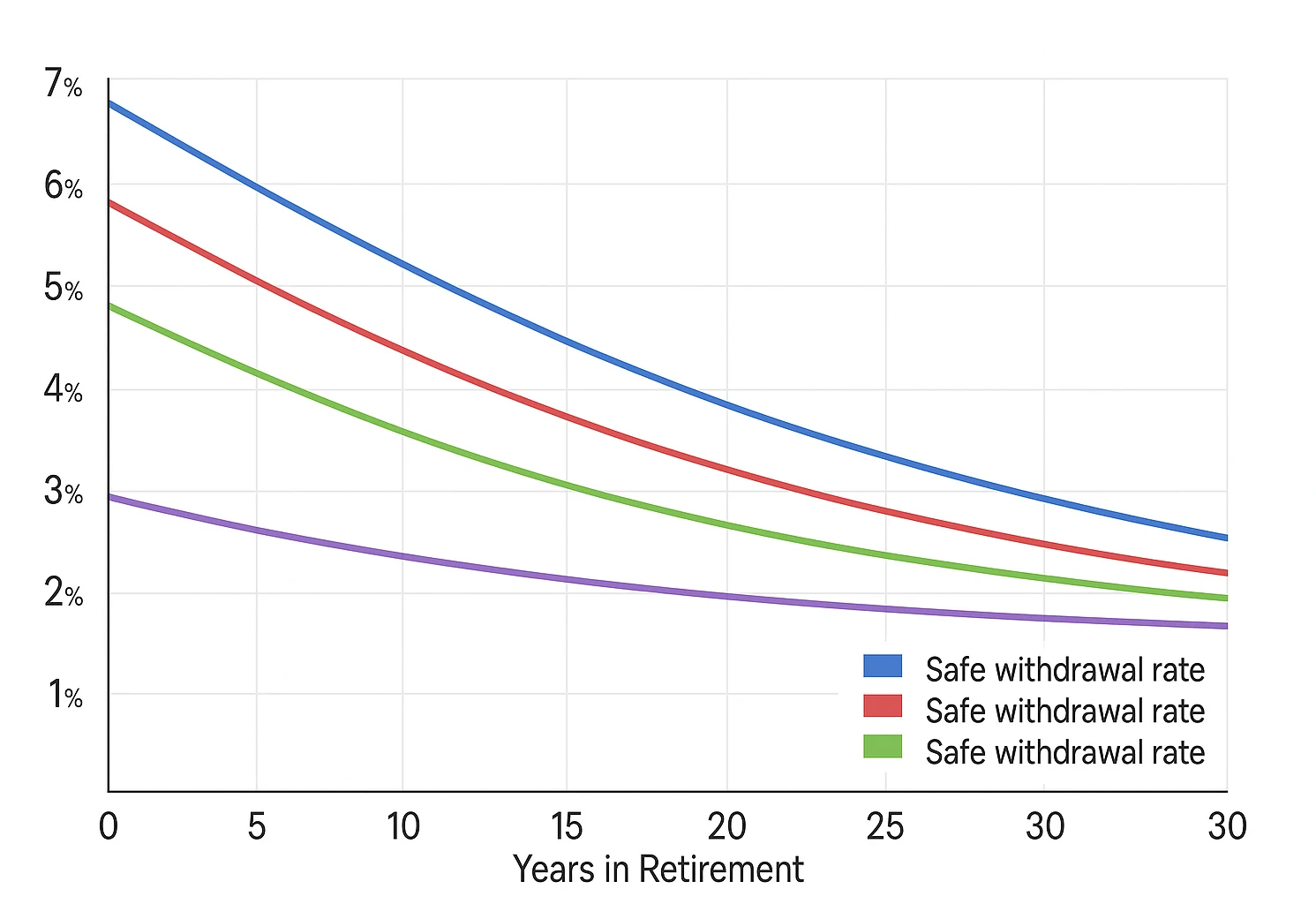
At age 60, your starting withdrawal rate is one of the clearest ways to see how hard the portfolio is working. A lower draw gives the plan more margin; a higher draw asks more from future returns and spending flexibility.
Treat any “safe withdrawal rate” as a planning framework, not a promise. Your actual result depends on the order of market returns, inflation, taxes, fees, Social Security, and whether spending can change after a bad year.
The 4% Rule Explained
The classic 4% rule starts with 4% of the initial portfolio—$80,000 from $2 million—then increases the dollar withdrawal with inflation. It is best treated as a historical planning benchmark, not a guarantee, especially when retiring at 60 can mean a horizon longer than 30 years.
What a 3.5% Starting Rate Changes
A 3.5% starting withdrawal is $70,000 from $2 million. That is a smaller initial draw than 4% and therefore leaves more margin, but it still is not a guarantee; return sequence, taxes, fees, inflation, and future spending changes still matter.
Flexible Withdrawals for Resilience
A flexible spending rule can reduce portfolio withdrawals after poor returns and loosen them after stronger years. The trade-off is lifestyle variability: decide which categories are actually adjustable before a downturn happens.
Social Security: Timing Your Benefits
Social Security can meaningfully ease the load on your portfolio. Timing matters.
Claiming Options: Early, Full, or Delayed
For people born in 1960 or later, Social Security retirement benefits can start at 62 at a reduced amount, full retirement age is 67, and delaying beyond 67 can increase the monthly benefit until age 70.
If your FRA benefit is $2,500/month ($30,000/year) and you retire at 60, your portfolio covers $75,000 until 67. At FRA, that $30,000 annual benefit would reduce the example portfolio draw to $45,000—2.25% of the original $2 million balance before taxes and market changes. If you expect Social Security to be your primary income source later on, our guide to living frugally on Social Security shows how to stretch those checks further.
Strategic Delaying
If your portfolio allows, delaying past full retirement age can raise your monthly benefit through delayed retirement credits. Social Security cost-of-living adjustments are a separate mechanism intended to help benefits keep pace with inflation; delayed retirement credits stop increasing the benefit at age 70.
Your exact claiming adjustment depends on your birth year and claiming month. Verify it at SSA.gov’s delayed retirement credits page before you claim.
Asset Allocation: Protecting Your $2 Million
Your allocation has to do two jobs at once: provide long-term growth and fund near-term withdrawals without forcing you to sell volatile assets at the worst possible time. The right mix depends on how much income comes from the portfolio, how much comes from Social Security or pensions, and how much spending you can cut temporarily.
Balanced Portfolio Approach
Rather than treating a 50/50 or 60/40 portfolio as a universal default, choose a stock, bond, and cash mix you can maintain through a downturn. A near-term cash reserve can reduce the need to sell risk assets for spending, while the longer-term portfolio still needs enough growth potential for a long retirement. If you’re newer to low-cost funds, our beginner’s guide to index investing walks through simple stock and bond funds.
The Bucket Strategy
One version of the bucket approach divides money by when you expect to spend it:
- Short-Term (1–3 years): Cash/CDs for immediate needs.
- Mid-Term (3–10 years): Bonds for income.
- Long-Term (10+ years): Stocks for growth.
The exact time bands are a framework, not a rule. The goal is to cover near-term spending without letting an oversized cash position quietly undermine the growth the rest of a long retirement may need.
How to Retire at 60 with 2 Million Dollars: Your Step-by-Step Plan
Now, combine the pieces into a simple plan.
Step 1: Build Your Budget
Create a detailed budget that separates fixed needs from flexible wants, and include taxes, healthcare, and irregular expenses. Use your own total rather than aiming for a generic retirement budget. If you want help tightening the baseline, start with our guide on living frugally and saving money.
Step 2: Map Income and Portfolio Withdrawals
For the running example, $75,000 of annual spending equals a 3.75% draw on the original $2 million before Social Security. If the FRA benefit is $30,000 a year at 67, the example portfolio draw falls to $45,000, or 2.25% of the original $2 million balance, before taxes and market changes. Add pension or part-time income only when it is realistic for your own plan.
| Age band | Example spending | Example Social Security | Example portfolio draw | Main planning check |
|---|---|---|---|---|
| 60–64 | $75,000 | $0 | $75,000 (3.75% of original $2M) | Price pre-Medicare coverage and taxes |
| 65–66 | $75,000 | $0 | $75,000 (3.75% of original $2M) | Reprice healthcare as Medicare eligibility begins |
| 67+ | $75,000 | $30,000 at FRA | $45,000 (2.25% of original $2M) | Recheck taxes, benefit amount, and portfolio balance |
Illustration only: This uses today’s dollars and the article’s $30,000 FRA-benefit example. It does not model taxes, fees, or changes in the portfolio balance from actual market returns.
Step 3: Optimize Asset Allocation
Choose an allocation you can hold through a meaningful downturn; 50/50 and 60/40 are examples, not defaults. Rebalance using a schedule or threshold that fits the rest of your plan rather than reacting to every market move.
Step 4: Plan Taxes
Traditional IRA distributions are generally fully or partly taxable depending on whether you have after-tax basis; qualified Roth IRA distributions are tax-free. A Roth conversion generally makes previously untaxed converted amounts taxable in the conversion year.
For people born in 1960 or later, current IRS rules set the applicable RMD age at 75, so age 73 is not a hard conversion deadline for this reader profile. Consider Roth conversions in lower-income years, but model the tax impact because added income can also affect Marketplace premium tax credits and Medicare income-related adjustments. See the IRS final RMD regulations for the birth-year rule.
Step 5: Address Healthcare
If you retire before 65, compare Marketplace coverage, COBRA when available, and any other coverage you qualify for. Most people first become eligible for Medicare around 65, so review Parts A and B, drug coverage, Medigap or Medicare Advantage choices, and enrollment timing before your 65th birthday.
Once you know you need a pre-Medicare bridge, compare what coverage may actually be available where you live before locking a healthcare number into the retirement plan.
Step 6: Stress-Test Your Plan
Stress-test more than the base case: try a major early market decline, higher inflation, lower returns, and a longer life. A Monte Carlo analysis can estimate how often a plan meets a chosen goal under its assumptions, but a high simulated success rate is not a guarantee.
Step 7: Stay Flexible
Do a yearly check-in — budget, portfolio, and withdrawals — and adjust as life or markets change.

Frequently Asked Questions
If the pieces don’t obviously fit together yet
If your spending, Social Security timing, taxes, and withdrawals all look reasonable alone but you’re not sure they work together, a finance professional can help before you retire.
Summary: What Makes $2 Million Work at 60
The portfolio balance is only the starting point. Build the plan around three numbers: what you actually spend, how much reliable income arrives later, and how much the portfolio must supply in between. In the running example, $75,000 of spending is a 3.75% initial draw; a $30,000 Social Security benefit at 67 would reduce that example draw to $45,000 before taxes and market changes.
Your next step is to replace every example with your own Social Security estimate, healthcare quotes, tax assumptions, and a harsher market scenario. If the plan still works after that, you have a much stronger basis for deciding what to change—and what not to change—before retiring.
This content is educational and not financial, tax, or legal advice. Verify Social Security rules at SSA.gov and health coverage details at HealthCare.gov. Consider guidance from a fiduciary advisor and a tax professional before acting.

