
Before you send an extra $50 or $100, test what it actually changes. If your loan lets extra money reduce principal, a modest extra can move the modeled payoff date up and reduce future interest. Use the calculator below to compare your current schedule with a monthly extra, an every-two-weeks plan, or a one-time lump sum.
The result is a planning estimate, not a lender payoff quote. Your loan’s interest method, payment-application rules, and any prepayment fee can change the real outcome. If you’re balancing several debts, our debt management plan guide can help you decide where extra cash belongs first.
Auto Payoff Early Calculator
Enter your current balance, the loan’s annual interest rate, the months left, and the extra payment you want to test. This is a planning estimate—not a lender payoff quote.
Change an input to compare another payoff scenario.
Estimate assumes a fixed-rate, fully amortizing loan and excludes fees or prepayment penalties.
Use the estimate as a starting point. The sections below explain what to confirm with your lender, how the payoff strategies differ, and when another financial priority may deserve the extra cash instead.
This post contains affiliate links. If you buy through our links, we may earn a commission at no extra cost to you. Learn more.
Table of Contents
- Before You Pay Extra: 3 Checks
- See What Your Extra Car Payment Has to Compete With
- When Paying Off a Car Loan Early Can Make Sense
- How to Use the Calculator
- Smart Strategies for Car Loan Payoff
- Frequently Asked Questions
- Run the Numbers, Then Confirm the Payoff
Before You Pay Extra: 3 Checks
- Check how the loan handles extras: Confirm that additional money can reduce principal and how your lender credits partial or extra payments.
- Check the prepayment terms: Review your contract for any prepayment fee and confirm any state-law limits that apply to your loan.
- Check the opportunity cost: Keep enough emergency cash and compare the car loan with any higher-cost debt before directing every spare dollar here.
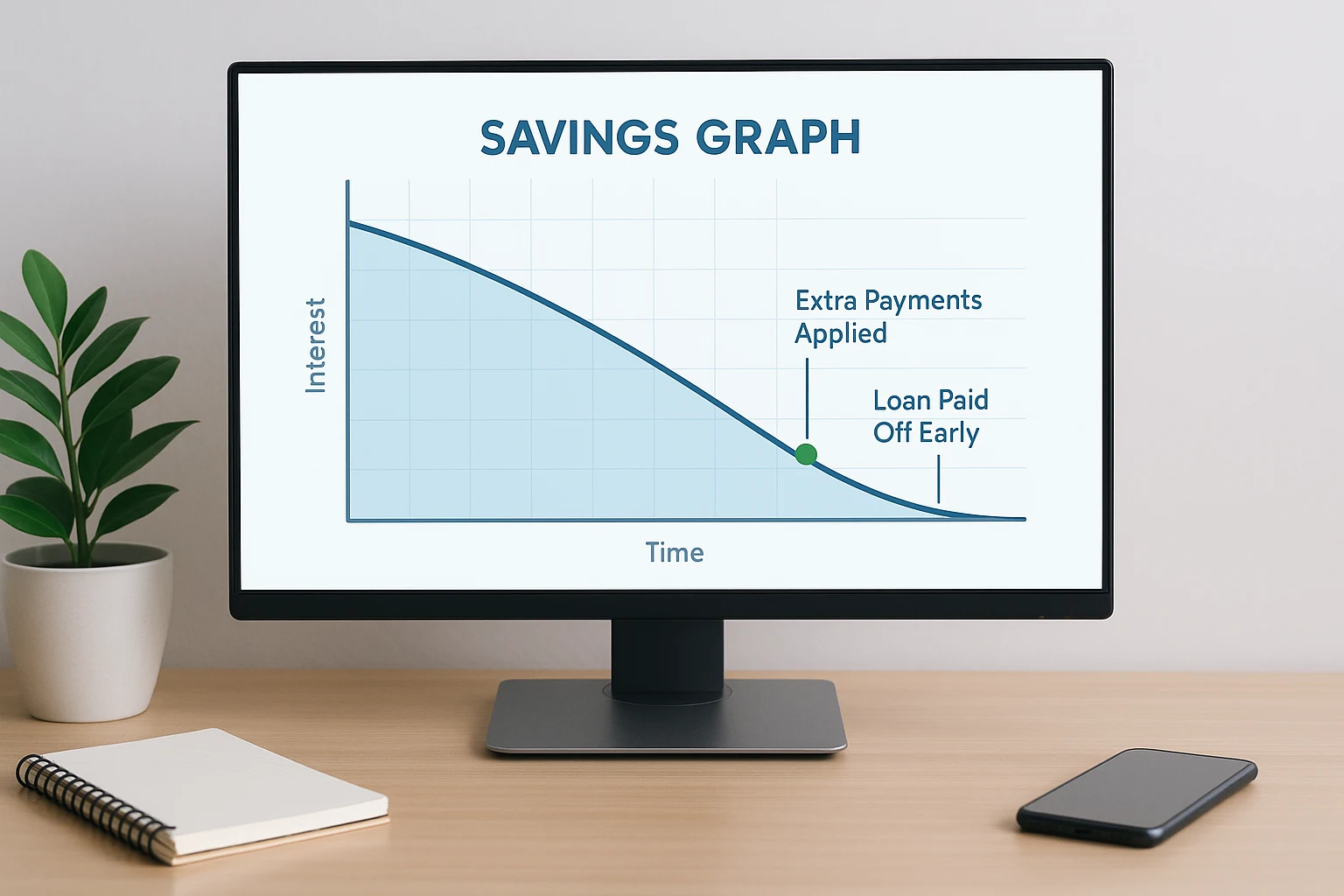
If the opportunity-cost check makes the answer less obvious, put the car loan beside your other debts and goals before you decide where the extra cash should go.
See What Your Extra Car Payment Has to Compete With
Enter income, spending, up to 8 debts, and up to 8 goals; the SNAPSHOT sheet brings the key numbers together automatically.
Confirm to get the workbook and frugal money tips. Unsubscribe anytime.
Something went wrong. Please check your email address and try again.
When Paying Off a Car Loan Early Can Make Sense
On many amortizing auto loans, paying principal down sooner can reduce future interest and free up monthly cash sooner. Whether early payoff is worthwhile depends on your loan’s interest method, any prepayment fee, and what else your budget needs.
Reduce Interest on the Right Loan
On a simple-interest or other amortizing loan, interest is tied to the outstanding balance, so principal paid down sooner can reduce future interest. That is not universal: the CFPB explains that precomputed-interest loans can handle extra payments differently. Check your contract or statement before relying on an early-payoff estimate.
Extra money helps only as your loan allows. Check how your lender applies payments and whether you can request that more of an extra payment go to principal.
Free Up Monthly Cash
Once the loan is gone, that scheduled payment is no longer part of your monthly debt load and the cash can go toward other priorities. Eliminating the payment can also lower DTI, although lender and product limits vary and a lower ratio never guarantees approval.
Build Equity Sooner
Paying the balance down faster can reduce the time you owe more than the vehicle is worth. Once the loan is fully paid, there is no remaining auto-loan balance to satisfy when you eventually sell or trade the car.
How to Use the Calculator
Grab the current balance, annual interest rate, and months remaining from your statement or lender portal. Then choose an extra amount and frequency in the calculator above.
What the Estimate Assumes
This auto payoff early calculator models a fixed-rate, amortizing loan. It rebuilds an estimated regular payment from the balance, annual interest rate, and months remaining, then compares that baseline with the extra-payment scenario you choose.
- Interest is modeled from the outstanding balance.
- Extra payments are modeled as reducing principal.
- Fees, penalties, and lender-specific payment timing are not included.
That makes the result a useful scenario, not an exact payoff quote. The CFPB says auto-loan payments generally go to fees and accrued interest before principal, so review your loan documents or ask the lender or servicer how extra money is applied.
Inputs Needed
- Current Loan Balance: What you owe now (e.g., $21,000 after 12 months).
- Annual Interest Rate: The rate used to accrue interest on the loan (e.g., 4.5%). If your disclosure also shows APR, the two can differ.
- Loan Term: Months remaining (e.g., 48 months).
- Extra Payment Amount: What you can add (e.g., $50).
- Payment Frequency: Monthly, biweekly, or one-time.
Outputs Provided
- Original Payoff Date and New Payoff Date.
- Months Saved.
- Estimated Interest Without Extras vs. With Extras.
- Estimated Interest Saved.
If you want a month-by-month modeled schedule instead of a payoff summary, use our simple loan amortization calculator.
Smart Strategies for Car Loan Payoff
Start with a payment change the calculator can model, then consider whether debt priority or refinancing changes the decision.

Round-Up Method
If your scheduled payment is $387, paying $400 sends $13 extra each month—$624 over 48 months. Whether that extra immediately reduces principal depends on how your lender applies the payment.
Car Loan Payoff with Biweekly Payments
A common biweekly pattern sends half a monthly payment every 14 days. Over 52 weeks, 26 half-payments equal 13 monthly payments. The payoff benefit depends on whether your lender accepts and credits those partial payments when they arrive, so confirm its treatment before changing frequency.
One-Time Lump Sum Payments
A bonus or refund can be tested as a one-time lump sum. Use the calculator to model what $1,000 extra would change on your balance, then confirm how the lender will apply it before sending the money.
Debt Snowball or Avalanche
If you have multiple debts, two common payoff methods are snowball (smallest balance first) and avalanche (highest APR first). The better fit depends on whether you value quicker balance wins or minimizing interest costs. Compare the trade-offs in debt snowball vs. avalanche.
Refinancing with Caution
Refinancing may lower your APR, but avoid stretching the term—smaller payments can mean more total interest. Learn the basics of early payoff and prepayment rules from the Consumer Financial Protection Bureau.
| Strategy | Best Fit | Watch For |
|---|---|---|
| Round-Up | A small recurring extra that is easy to automate. | Confirm the extra is applied as intended. |
| Biweekly | A lender that accepts and credits half-payments when they arrive. | Partial-payment handling can change the real payoff effect. |
| Lump Sum | Bonus or refund money you can use without draining emergency savings. | Check the payment application and any prepayment fee first. |
Track Your Payoff Progress
Once you choose a realistic extra-payment amount, track each balance drop so the plan stays visible. Our free debt payoff tracker gives you a simple place to record the progress.
If the extra payment only works by squeezing the rest of your budget, look at the car’s recurring costs too. Re-shopping comparable insurance coverage may reveal savings you can redirect toward the loan without increasing what leaves your account each month overall.
Frequently Asked Questions
Run the Numbers, Then Confirm the Payoff
Use the calculator to test an extra amount you could actually sustain, then verify the loan rules before you change your payment routine. If the modeled savings still look worthwhile after you account for emergency cash, higher-cost debt, and any prepayment fee, you have a clearer reason to accelerate the payoff—not just a smaller balance to chase.
This calculator and article are educational, not a lender payoff quote or individualized financial advice. Your contract, lender payment rules, interest method, and state law can change the result. Confirm your payoff amount and prepayment terms with your lender or servicer before sending a final or unusually large payment.

