
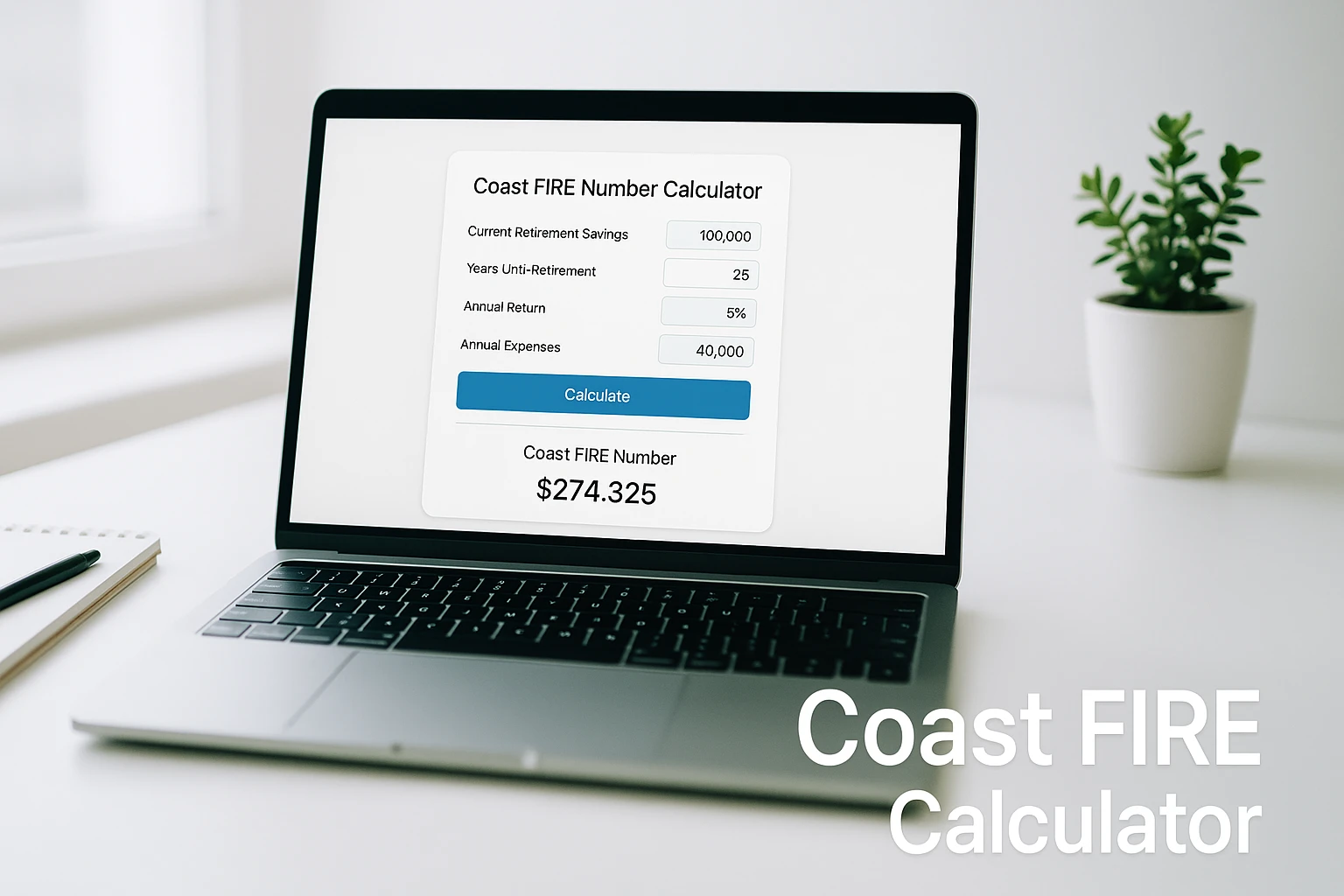
Coast FIRE asks a specific question: could the money you have invested today grow to your retirement target without any new retirement contributions? Use this coast fire number calculator for a planning estimate, then stress-test the assumptions before changing your savings plan. For the broader strategy, see our guide to early financial independence.
Coast FIRE Number Calculator
Start with the sample values, then adjust all five inputs. The calculator uses an after-inflation return so your target and result stay in today’s dollars.
You have not reached the Coast FIRE threshold yet.
With 30 years to grow at 4% after inflation, your current balance is about $258,319 below the estimated amount needed today.
No new retirement contributions are assumed.
Planning estimate only. Assumes no new contributions and a steady after-inflation return.
This post contains affiliate links. If you buy through our links, we may earn a commission at no extra cost to you. Learn more.
Table of Contents
- Coast FIRE Number Calculator
- What is Coast FIRE and How Does it Work?
- What Changes Your Coast FIRE Number?
- Coast FIRE Math (How It Works)
- How to Read Your Coast FIRE Result
- Example Scenarios Using the Calculator
- Coast FIRE vs. Lean FIRE and Fat FIRE
- Free Money Reset Workbook
- After Reaching Your Coast FIRE Number: Next Steps
- Common Coast FIRE Questions (FAQs)
- Before You Decide to Coast
What is Coast FIRE and How Does it Work?
Coast FIRE (also called Coast FI) means your current retirement savings are projected to reach your target by the age you choose without additional retirement contributions—if the assumptions hold. For a clear definition and context, see this overview from Investopedia.
Here’s the practical distinction: after reaching your Coast FIRE number, you still need income or other cash flow for current living costs. What changes is the retirement-saving requirement in the model, not today’s bills.
What Changes Your Coast FIRE Number?
The calculator has two separate ideas: the Coast number your assumptions require today, and the gap or surplus between that number and your current balance.
- More years to retirement: lowers the Coast number because the model gives the balance more time to compound.
- A higher retirement target: raises the Coast number.
- A lower after-inflation return: raises the Coast number; a higher assumption lowers it.
- Your current balance: does not change the Coast number itself—it changes whether you are above or below it.
That last distinction is useful when stress-testing: change one assumption at a time and watch whether the threshold itself moves or only your distance from it.
You’ll notice this Coast FIRE calculator does not ask for monthly contributions. That is deliberate: its core question is what happens if new retirement contributions drop to zero today. Contributions can change how quickly you reach the threshold, but they do not change the threshold for a fixed retirement target, timeline, and return assumption.
Coast FIRE Math: How the Calculator Works
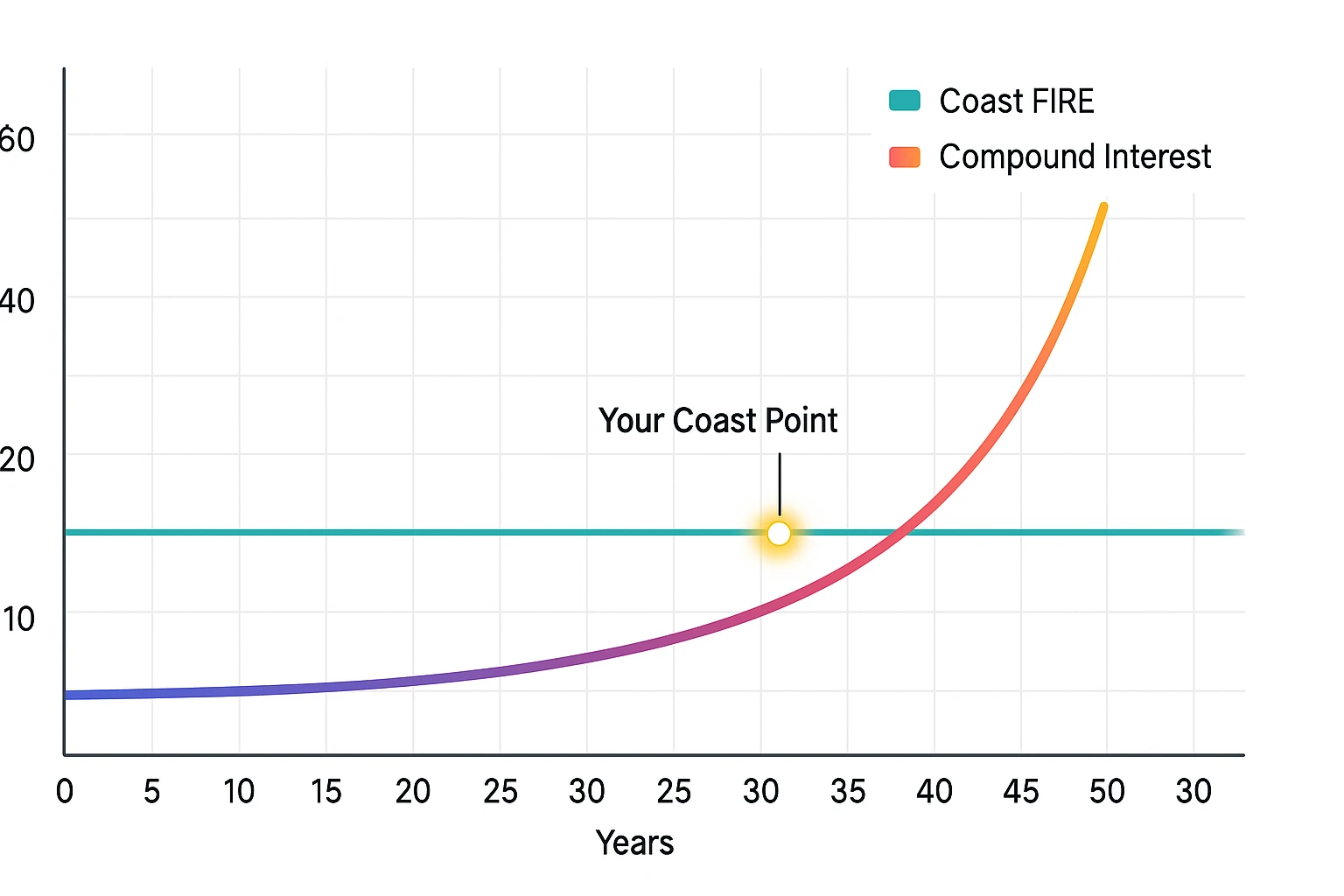
Coast FIRE runs on compound interest—growth on your invested balance and on prior gains.
Coast FIRE Formula: How the Math Works
- Set a retirement portfolio target in today’s dollars.
- Count the years from your current age to your target retirement age.
- Choose an annual return after inflation and stress-test lower and higher assumptions. The calculator’s 4% default is a sample input, not a forecast.
- Discount the future target back to today: Coast number = retirement target ÷ (1 + after-inflation return)years.
- Compare your current invested balance with that Coast number.
For example, a $1,000,000 target 30 years away at a 4% annual return after inflation gives a Coast number of about $308,300 today. The assumption matters: with the same target and timeline, the Coast number is about $412,000 at 3%, $308,300 at 4%, and $231,400 at 5%.
The model does not subtract taxes or investment fees separately. Investor.gov’s real-return definition includes taxes and inflation, while the SEC notes that fees reduce investment returns over time. If you want a more conservative scenario, test a lower return input rather than assuming the 4% sample already accounts for those costs.
Reality check: returns & inflation
Markets do not deliver a steady return every year. Use the estimate as a starting point, then revisit your assumptions periodically and after major life, spending, or market changes.
How to Read Your Coast FIRE Result
The calculator gives you three numbers. Read them together rather than treating the first number as a pass/fail verdict.
- Coast FIRE number today: The estimated balance you would need now for growth alone to reach your target under the assumptions you entered.
- Projected balance: What your current balance could grow to by your target age with no new retirement contributions.
- Gap or surplus today: How far your current balance sits below or above the estimated Coast FIRE number.
A surplus does not tell you that you should stop contributing. It means only that your current balance clears this model’s threshold under the inputs you chose; a lower return, a higher target, or a shorter timeline can change that conclusion.
How much margin is enough?
If a small change in return, retirement age, or target flips the result, this can be one of those final-step decisions worth running past a finance professional before you act.
Example Scenarios Using the Calculator
These examples use the calculator’s default 4% annual after-inflation return assumption so the targets stay in today’s dollars. If you’re aiming to stop full-time work around 60, our step-by-step guide to retiring at 60 with $1 million can help you turn the numbers into a concrete plan.
| Scenario | Age | Retire | Balance | Desired | Result |
|---|---|---|---|---|---|
| Longer runway | 25 | 60 | $75,000 | $1,500,000 | Not there yet — Coast number today ≈ $380,100; current gap ≈ $305,100. |
| Mid-career | 40 | 65 | $500,000 | $1,200,000 | At Coast FIRE — Coast number today ≈ $450,100; current surplus ≈ $49,900. |
| Shorter runway | 50 | 65 | $100,000 | $2,000,000 | Not there yet — Coast number today ≈ $1,110,500; current gap ≈ $1,010,500. |
Coast FIRE vs. Lean FIRE and Fat FIRE
These paths answer different questions. Coast FIRE is about when new retirement contributions may no longer be required by the model; Lean and Fat FIRE describe lower- and higher-spend versions of full financial independence. For a deeper breakdown, see our guide to Fat FIRE vs. Lean FIRE.
| Feature | Coast FIRE | Lean FIRE | Fat FIRE |
|---|---|---|---|
| Primary goal | Let existing retirement savings compound toward a future target | Reach full financial independence with a lower spending target | Reach full financial independence with a higher spending target |
| Saving after the milestone | May reduce or stop new retirement contributions if assumptions still hold | Full FIRE target is already funded | Full FIRE target is already funded |
| Work after the milestone | Usually still covers current living costs | Optional | Optional |
| Spending style | Flexible | Lower-spend by design | Higher-spend by design |

A Coast result answers one retirement-savings question; before changing contributions, make sure today’s cash flow and competing goals still fit.
Check the Rest of Your Money Before You Coast
The Money Reset puts income, spending, up to 8 debts, and up to 8 goals on one screen.
Confirm to get the workbook and frugal money tips. Unsubscribe anytime.
Something went wrong. Please check your email address and try again.
After Reaching Your Coast FIRE Number: Next Steps
Reaching the threshold creates an option, not an instruction. If your balance meets the Coast threshold under assumptions you trust, decide how much margin you want before changing contributions, retirement timing, or work.
Reassess Your Career
- Downshift: Consider a role with less stress or fewer hours.
- Part-time: Trade some income for more time, if your current expenses still work.
- Different work: Shift toward a project or role you value more.
Review the Plan and Portfolio
Review your asset allocation, diversification, fees, and progress periodically; rebalance when your plan or allocation calls for it. For current background, see Investor.gov’s asset-allocation and diversification guide. If you want the basics in plain language first, our beginner’s investing guide explains the building blocks.
Choose What to Do With the Flexibility
If the plan still holds when you stress-test more conservative assumptions, you may have more room in current cash flow for other priorities. To keep spending aligned with your goals while you coast, check out our frugal living guide for practical ways to cut costs without feeling deprived.
Common Coast FIRE Questions (FAQs)
Before You Decide to Coast
Before you act on one estimate, run the calculator again with a lower and higher after-inflation return assumption. If a more conservative test puts you below the threshold, revisit the contribution rate, target, or timeline instead of treating Coast FIRE as a permanent status. If the result changes your contribution rate, retirement age, or work plan, treat it as a planning starting point—not a guarantee.
This calculator and article are for general education and use simplified assumptions. They do not model your complete tax situation, investment fees, sequence-of-returns risk, or personal cash-flow needs. Consider a qualified financial professional before changing retirement contributions, retirement timing, or investment strategy.

