
If the bills are piling up, you’re not alone. A debt management plan gives you one place to start and a path you can actually keep. List what you owe, pick a payoff style that fits your brain, and put the payments on autopilot. We’ll walk it together.
Is this for you?
– You’re juggling three or more balances or double-digit APRs.
– Minimums eat too much of payday.
– You want one clear plan—DIY or with a counselor.
3-Question Debt Plan Quiz
Answer three quick questions. We’ll suggest the best-fit path and your first action.
What’s your highest APR?
Which helps you stick to a plan?
How’s your credit right now?
💡
This post contains affiliate links. If you buy through our links, we may earn a commission at no extra cost to you. Learn more.
Table of Contents
- Key Takeaways
- Understanding Your Debt Landscape
- Building Your Debt Management Plan Foundation
- Choose Your Payoff Strategy
- Debt Consolidation Strategies
- Negotiating with Creditors
- Budgeting for Debt Freedom
- Credit Score Impact and Recovery
- Advanced Debt Management Strategies
- Common Debt Management Pitfalls
- Technology Tools for Debt Management
- Long-Term Financial Health and Debt-Free Strategies
- Your Debt Management Plan: Action Steps
- Frequently Asked Questions
- Conclusion
- References
If your minimums exceed ~40% of income, start with a cash-flow check and a small emergency buffer before choosing a payoff method. A nonprofit credit counselor can review options with you.
Key Takeaways
- Strategic debt management plans can reduce payoff time by 2–5 years versus minimums only.
- Avalanche may save the most interest; snowball can build momentum with quick wins.
- Consolidation may lower rates for qualified borrowers and simplify payments.
- Negotiation can lead to lower rates, modified terms, or settlements.
- Budgeting creates the foundation that makes any repayment plan sustainable.

Understanding Your Debt Landscape
Types of Debt and Their Impact
Not all debt carries the same weight in a debt management plan. Understanding the distinction between different debt types helps prioritize repayment strategies effectively.
Secured Debt includes mortgages, auto loans, and home equity lines of credit. These debts are backed by collateral, typically offer lower interest rates, and may provide tax benefits. In most plans, secured debt receives lower priority unless the asset is at risk of repossession.
Unsecured Debt encompasses credit cards, personal loans, medical bills, and student loans. Without collateral, these debts carry higher interest rates and should typically receive priority. Credit card debt—often at historically high APRs—tends to be the most expensive form of consumer debt; see the Federal Reserve’s G.19 Consumer Credit for current context.
Tax Debt requires immediate attention. The IRS has powerful collection tools including wage garnishment and asset seizure. Tax debt rarely disappears through bankruptcy and accumulates penalties and interest rapidly.
The True Cost of Debt
Michael had $15,000 at 22% APR. Paying $300 a month, he’d be at it for ~7½ years and pay $26k+ total. With avalanche payments and a few trims to his budget, he could finish in about 3 years. Same income—just a cleaner plan.
Building Your Debt Management Plan Foundation
Step 1: Complete Debt Assessment
Create a comprehensive inventory including:
- Creditor name and contact information
- Current balance
- Minimum monthly payment
- Interest rate (APR)
- Payment due date
- Account status (current, past due, collections)
Use this to calculate total debt load and monthly debt service. Many people discover they’re paying 40–60% of their income toward debt—often a sign that a structured plan is essential.
Step 2: Calculate Debt-to-Income Ratio
Financial institutions often view debt-to-income ratios above 36% as problematic; ratios exceeding 50% indicate serious stress. Calculate by dividing total monthly debt payments by gross monthly income.
Example:
Monthly debt payments: $2,400
Gross monthly income: $5,000
Debt-to-income ratio: 48%
Tip: If your ratio is high, a nonprofit counselor can help you compare consolidation, credit counseling, and repayment paths.
Step 3: Analyze Cash Flow
Track income and expenses for at least one month to identify:
- Fixed expenses (rent, insurance, minimum payments)
- Variable necessities (groceries, utilities, transportation)
- Discretionary spending (entertainment, dining out, subscriptions)
The difference between income and essentials determines available funds for accelerated repayment.
Short-term cash-flow tools can help you avoid overdrafts while you work the plan, but they’re not a replacement for savings. Our in-depth Brigit app review explains how its advances and credit-building features work, plus the fees and limits to watch.
Choose Your Payoff Strategy
The Debt Avalanche Method
Avalanche: Sort debts by APR and attack the top rate first. It usually costs less overall. Set every other card to minimums and move the “extra” up the list each time you zero one out.
The Debt Snowball Method
Snowball: Start with the smallest balance. Quick wins keep you showing up—then roll that freed payment into the next card.
Track it with the snowball vs. avalanche Excel spreadsheet. See also: free debt payoff tracker (printable).
The Debt Tsunami Method
A hybrid approach targeting “toxic” debts first—variable rates, promo periods ending, or aggressive collections. Prioritize:
- Debts with expiring promotional rates
- Variable-rate debts in rising-rate environments
- Secured debts at risk of repossession
- Debts with aggressive collection practices
Quick pick:
Avalanche: Highest rate first → lowest total interest.
Snowball: Smallest balance first → fastest wins.
0% Transfer/Consolidation: One payment, lower rate (if you can clear it within promo/term).
Debt Consolidation Strategies
Fixed-rate loans or 0% balance transfers can simplify payments and reduce interest if you retire the balance within the term. Check typical lender requirements in what credit score you need for a consolidation loan.
See also:
– best consolidation loans for a 600 score
– best consolidation loans for a 620 score
Personal Loan Consolidation
Fixed rates (often ~6–24% APR) can beat credit card rates, rolling multiple debts into one predictable payment. Use a simple loan amortization calculator to test payoff times with extra payments.
Many online lenders and marketplaces target borrowers in a crunch. Before you commit to any high-cost or last-resort option, review detailed breakdowns like our Explore Credit loan review and our HonestLoans.net review so you understand the true costs and risks.
Balance Transfer Credit Cards
0% APR promos (12–21 months) help if you can clear the balance before the promo ends. See the best no-fee balance transfer cards for options.
See also: top balance transfer cards for a 600 score.
Example: $10,000 at 0% for 18 months means ~$556/mo to clear it in time—set the transfer payment on payday so you don’t miss the window.
Home Equity Options
HELOCs and home equity loans often carry lower rates but put your home at risk if payments lapse.
Use cases: $20,000+ high-interest debt, stable income, disciplined spending, and an emergency fund in place.
Negotiating with Creditors
Timing and Approach
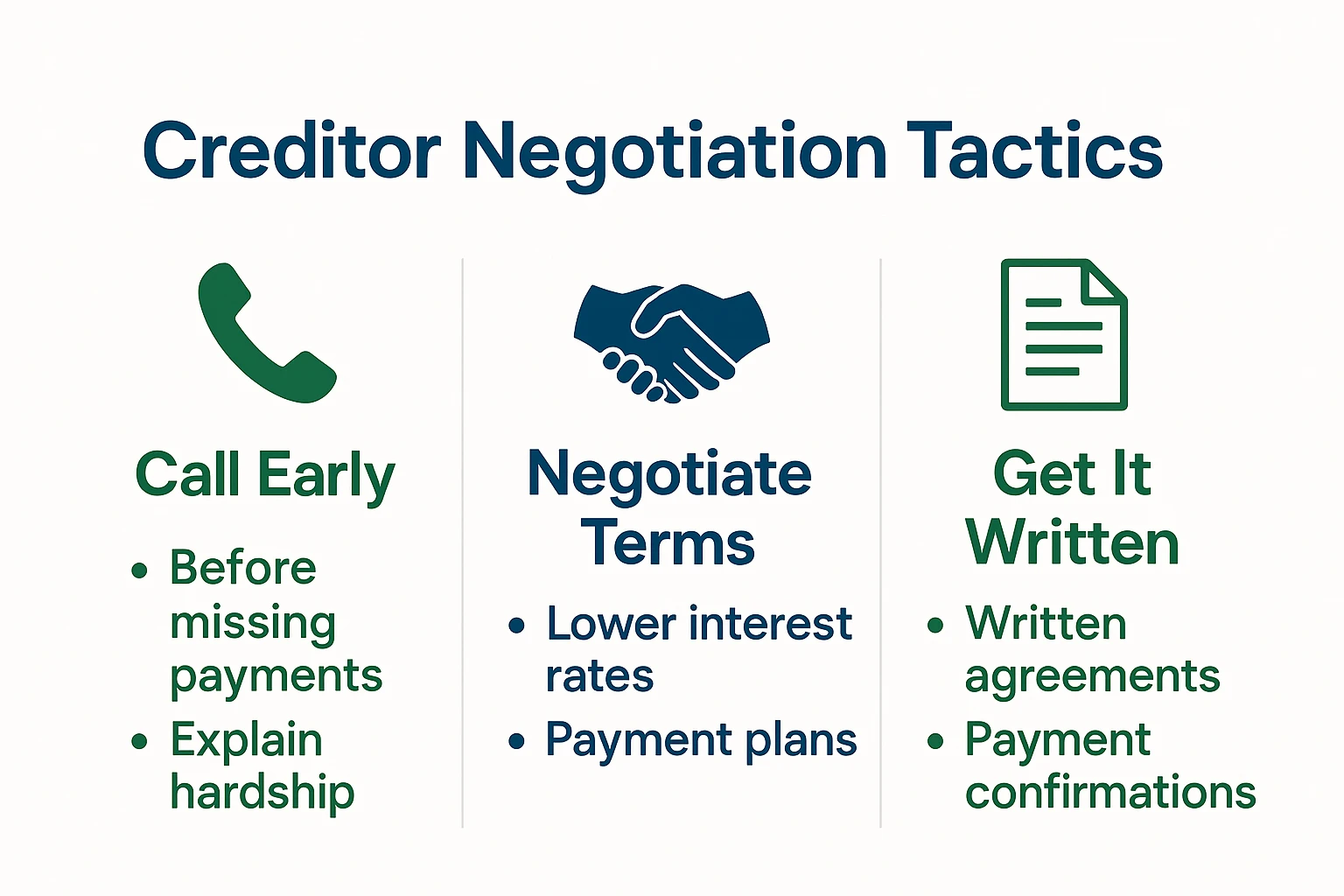
Contact creditors before missing payments. They’re often more flexible with current accounts than delinquent ones. If medical bills are the issue, start with a customized note—use this medical debt settlement letter template. Jot down the date, the person’s name, and what you agreed to.
Common Negotiation Outcomes
Interest reductions: Even a 5% cut can save thousands.
Payment plan modifications: Lower monthly payments over a longer period.
Partial settlements: 40–70% in severe delinquency (credit impact applies).
Hardship programs: Temporary reductions, rate freezes, or fee waivers.
Documentation and Follow-Through
Get agreements in writing. Keep records of dates, representatives, and terms (new payments, rates, fee waivers, settlements).
Budgeting for Debt Freedom
The 50/30/20 Modified for Debt Management
Shift to 50/15/35 during payoff: 50% needs, 15% wants, 35% extra debt payments/emergency fund.
Zero-Based Budgeting for Maximum Impact
Assign every dollar a job before the month starts: income → essentials → debt payments → zero out remaining with plan-aligned priorities.
Emergency Fund Considerations
Conservative: $1,000–$2,500 first.
Aggressive: $500–$1,000 while maximizing payoff.
Balanced: One month of expenses, then split extra between savings and debt.
Credit Score Impact and Recovery
Understanding Credit Score Factors
Payment history (35%): On-time payments matter most.
Utilization (30%): Keep balances <30% (ideally <10%).
Length of history (15%): Keep old accounts open.
Mix (10%): Variety helps slightly.
New credit (10%): Limit applications during payoff.
If you’re not sure where your current number fits on the scale, our guide on what is a good credit score breaks down the common score ranges and what lenders typically look for.
Strategic Credit Improvement
Lower utilization quickly, pay before statement close, request limit increases (without new accounts), and consider authorized-user strategies on strong accounts.
Monitoring and Maintenance
Use monthly score tracking, quarterly report reviews, and dispute inaccuracies fast.
Seeing errors on your report and not sure where to start?
Keep the payoff method you chose—better reports make it work faster.
Before you sign up with any credit repair firm, read our honest Legal Harbor credit repair review so you understand how these services work, what they can and can’t do, and when a DIY approach may be enough.
Advanced Debt Management Strategies
Debt Management Companies vs. DIY Plans
Professionals may negotiate lower rates and consolidate payments (fees often 3–8% annually). DIY keeps full control and privacy with no monthly fees.
Tax Implications of Debt Relief
Forgiven debt may be taxable income. Insolvency exceptions and primary residence exclusions can apply. Consider consulting a tax professional for complex cases.
Business Debt Considerations
Factor in cash-flow timing, tax deductibility of interest, personal guarantees, and asset protection when structuring business and personal obligations.
Common Debt Management Pitfalls
Emotional Spending Triggers
Stress, social pressure, celebrations, and boredom can drive overspending. Build awareness and healthier alternatives.
The Debt Transfer Trap
Consolidation can backfire if old cards are used again. Close or secure paid-off cards, remove from wallets/autofill, and set cooling-off periods for nonessentials.
Perfectionism Paralysis
Don’t wait for the “perfect” plan. Start, then iterate. Consistency beats optimization.
Technology Tools for Debt Management
Debt Tracking Applications
- Debt Payoff Planner: Compares avalanche vs. snowball with payoff projections.
- You Need A Budget (YNAB): Zero-based budgeting with payoff integration.
- Mint: Free comprehensive tracking with debt monitoring.
- Tally: Automated credit card payment optimization.
Prefer spreadsheets or calculators? Try the auto loan payoff calculator and the student loan payoff calculator.
If you work in government or for a qualifying nonprofit, take a moment to review the rules for Public Service Loan Forgiveness (PSLF) so you don’t miss out on potential student loan forgiveness while you’re paying down other debts.
If you prefer app-based tools, our roundup of the best debt payoff tracker apps covers free and paid options that sync with avalanche, snowball, or hybrid payoff plans.
Long-Term Financial Health and Debt-Free Strategies
Building Wealth After Debt Freedom
- Emergency fund: 3–6 months of expenses
- Retirement catch-up: Max employer match
- Diversify: Index funds, real estate, business
- Advanced: Tax optimization, estate planning, philanthropy
Preventing Future Debt Cycles
Automate savings, use waiting periods for wants (24–48 hours) and big buys (30 days), review annually, and refill the emergency fund after use.
Your Debt Management Plan: Action Steps
30-Day Quick Start: How to Get Out of Debt
How to get out of debt starts with action you can sustain.
Week 1: Complete debt inventory and tally totals.
Week 2: Choose avalanche or snowball (use the comparison guide).
Week 3: Contact creditors to negotiate or request hardship options.
Week 4: Implement automation and tracking tools (see the printable tracker).
Need a boost? Read 10 debt payoff success stories.
90-Day Momentum Building
Month 1: Build routines and a starter emergency fund.
Month 2: Optimize budget and cut nonessentials.
Month 3: Evaluate progress and adjust.
Annual Review Process
- Progress toward payoff goals
- Income/expense changes
- New opportunities (refi, transfers, promotions)
- Credit score improvements
- Alignment with long-term goals
Frequently Asked Questions
Conclusion
Progress > perfection. Pick a method today, make the first payment bigger than the minimum, and let next month be a little easier.
Implementing an effective plan turns financial chaos into organized progress. Success requires honest assessment, a chosen method, and consistent execution. Whether DIY or with professional help, the fundamentals are the same: spend less than you earn, prioritize high-interest balances, and keep a long view. Start now, apply a few debt-free strategies, and celebrate each milestone toward freedom. For personalized help, consider an NFCC-member nonprofit or a fiduciary advisor.
References
- Federal Reserve Board. Consumer Credit (G.19). Access current release: federalreserve.gov/releases/g19/current/
- Consumer Financial Protection Bureau. Credit reports & scores resources.
This debt management plan guide is educational and not financial advice. Consider speaking with a certified credit counselor or fiduciary advisor for guidance on your situation.

