

Ever buy a finance book, read 20 pages, and then… life happens? The best money mindset book isn’t the one with the biggest promise; it’s the one you’ll actually finish and use. This guide compares five different approaches—behavior, values, research, confidence, and calm—so you can choose a fit without buying a stack.
Start with the three-question matcher for a quick recommendation, or jump to the three starting points and full reviews. Each review explains who it fits, where it may fall short, and one small action to try. For the broader foundation behind these choices, see our money mindset guide.
This page contains Amazon affiliate links. As an Amazon Associate, I earn from qualifying purchases. Learn more.
Table of Contents
- Find Your Best-Fit Money Mindset Book
- 3 Money Mindset Books to Start With
- How to Choose the Right Money Mindset Book
- The 5 Best Money Mindset Books
- What to Read After Your First Pick
- How to Turn a Money Mindset Book Into Action
- When a Money Mindset Book Isn’t Enough
- Put the Numbers Behind Your Money Mindset on One Screen
- Frequently Asked Questions
- Pick One Book, Then Test One Idea
Not sure whether you want behavior insight, a defined structure, or a calmer approach? Use the matcher first, then jump straight to the full review for the book it recommends.
Find Your Best-Fit Money Mindset Book
Choose the problem you want to solve, the style you’ll actually finish, and the time you have. You’ll get one primary pick plus a backup.
3 Money Mindset Books to Start With
Top 3If you don’t want to use the matcher, choose the kind of help you want first: behavior, structure, or a calmer emotional approach.
The Psychology of Money
Short story-led lessons on financial behavior.
Your Money or Your Life
A defined framework connecting spending, time, and values.
Happy Money
A gentler entry point for money guilt or tension.
How to Choose the Right Money Mindset Book
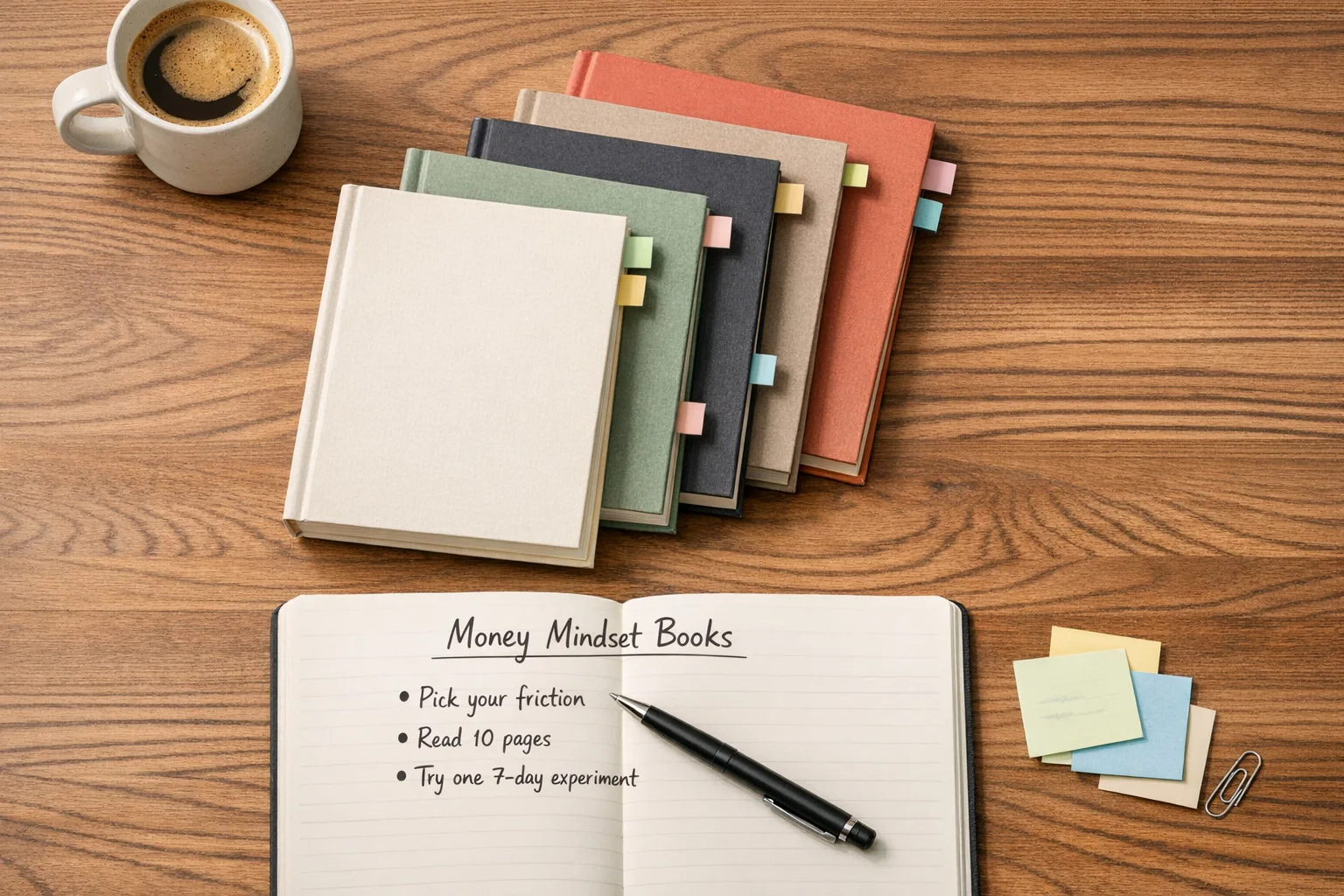
Some books hype you up for a day. The useful ones help you change a decision when you’re tired, stressed, or tempted. Start with the part of your relationship with money you want to change, then choose a format you’ll actually finish. If you also want practical systems to pair with mindset, see our roundup of great budgeting tools.
- Match the book to the problem: behavior, structure, research, confidence, and calm call for different starting points.
- Choose an actionable format: look for prompts, checklists, or experiments you can run this week.
- Prefer a balanced tone: motivating without pretending real bills and constraints disappear.
- Track something observable: calmer check-ins, fewer impulse buys, or more consistent saving give you something real to evaluate.
Quick start: Pick one book, one exercise, and do it for 7 days before adding anything else.
The 5 Best Money Mindset Books
1. Your Money or Your Life by Vicki Robin and Joe Dominguez
Who it’s for: Readers who want spending to feel intentional again and want a framework for connecting money with time, values, and “enough.” If financial independence or early retirement (FIRE) is part of the goal, pair it with our financial independence and early retirement guide.
About the authors: Vicki Robin is a writer and speaker; Joe Dominguez was a financial analyst who taught the nine-step program that became the foundation of the book.
Why it works: It reframes money as “life energy” and gives you a structured nine-step process instead of another list of disconnected tips.
Trade-off: It asks more of the reader than a story-led book. If you want short lessons you can dip into, The Psychology of Money is the easier starting point.
Length: 368 pages in the referenced Penguin paperback edition.
Try this today: Pick one recent purchase and ask, “Was it worth the hours of my life?”
2. The Psychology of Money by Morgan Housel
Who it’s for: Readers who understand the math but still get tripped up by emotion, comparison, fear, or inconsistent behavior.
About the author: Morgan Housel is a finance writer whose work focuses on behavior, risk, and decision-making.
Why it works: Nineteen short stories make abstract money behavior easier to remember, and the format works well when you prefer ideas over a formal program.
Trade-off: This is not a step-by-step budgeting system. If you want a defined sequence to follow, Your Money or Your Life is more structured.
Length: 256 pages.
Try this today: Write your “money story” in five lines—what did you learn about money growing up?
3. Mind Over Money by Claudia Hammond
Who it’s for: Readers who want the research behind spending, avoidance, mental accounting, and other money behaviors—plus ideas they can test in daily life.
About the author: Claudia Hammond is a writer, broadcaster, and psychology lecturer who translates research for general audiences.
Why it works: It gives the “why” behind common money biases, then connects those ideas to practical experiments and environmental changes.
Trade-off: The research focus is denser than the story-led or motivational picks. Choose it when understanding the mechanism matters more than speed.
Length: 384 pages.
Try this today: Track one purchase and name the feeling that showed up just before it—bored, stressed, lonely, excited, or something else.
4. You Are a Badass at Making Money by Jen Sincero
Who it’s for: Readers who know what to do but feel stuck, hesitant, or embarrassed about wanting more—and who respond well to a bold, humorous push.
About the author: Jen Sincero is a bestselling author, success coach, and motivational speaker known for direct self-help writing and belief-focused exercises.
Why it works: It surfaces limiting beliefs quickly and keeps the reader moving with short reflections rather than a technical money curriculum.
Trade-off: The motivational tone is the point. If you want an evidence-heavy explanation of behavior, Mind Over Money is a better fit.
Length: 288 pages.
Try this today: Write one “I can’t earn more because…” sentence, then rewrite it as “What if I could…?”
5. Happy Money by Ken Honda
Who it’s for: Readers whose biggest barrier is tension, guilt, or fear around money and who want a gentler emotional starting point.
About the author: Ken Honda is a bestselling Japanese self-development author whose work bridges personal finance and self-help.
Why it works: It centers the emotional relationship with money and uses gratitude-oriented practices to make routine money moments feel less adversarial.
Trade-off: It is more reflective than tactical. If you want a detailed financial system, pair it with a budgeting or investing guide rather than expecting it to supply one.
Length: 240 pages.
Try this today: The next time you pay for something essential, pause and notice whether you can make the transaction without criticizing yourself.
What to Read After Your First Pick
Don’t buy all five at once. Start with the book that matches your biggest problem, test one exercise for a week, and add a second book only if you can name what is still missing.
- Need more structure? Move to Your Money or Your Life.
- Want deeper psychology? Choose Mind Over Money.
- Need a calmer emotional lens? Try Happy Money.
- Need confidence and momentum? Use You Are a Badass at Making Money.
If you want a more abundance-focused reading path rather than another general money book, our abundance books for beginners guide takes that angle directly.
How to Turn a Money Mindset Book Into Action
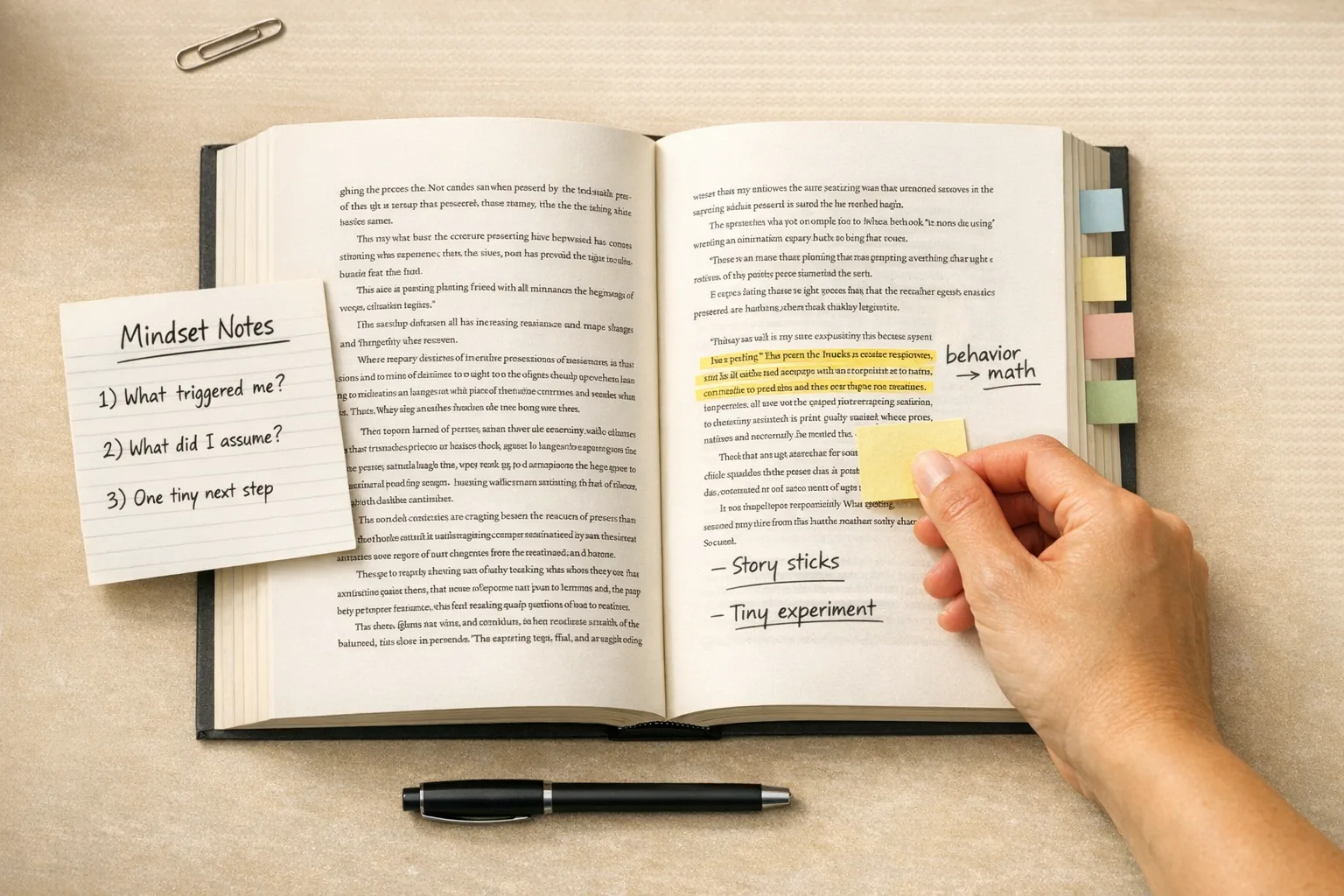
A useful book is one that changes a real decision—not one that leaves you with fifty highlighted quotes. Keep the reading plan small enough that you can test what you learn.
- Read one manageable chunk: a chapter or short section is enough.
- Choose one action: turn the idea into something you can do within the next 48 hours.
- Track one signal: notice a behavior or feeling that should change if the idea is helping.
- Review after a week: keep, adjust, or drop the experiment before adding another one.
| Practice | What it helps with | Example |
|---|---|---|
| Habit tracker | Make a new behavior visible | Gratitude, no-spend day, weekly check-in |
| Emotion log | Spot triggers | Rate anxiety before and after purchases |
| Belief inventory | Catch recurring thoughts | “I don’t deserve wealth” → rewrite |
| Win journal | Build evidence of change | Automated savings, skipped impulse buy |
Common Pitfalls and How to Avoid Them
- Information overload: One book, one change. That’s enough.
- All theory, no practice: For every chapter, do one exercise within 48 hours.
- Expecting instant results: Track calmer check-ins and fewer spirals as real progress.
- Ignoring basics: Pair mindset with simple rules (like the 50/30/20 budget rule) so your actions have a container.
Measuring Your Money Mindset Progress
It’s 2 a.m., you check your bank app, and your stomach drops. That moment is exactly what you’re retraining. Track the shift.
- Emotional: Less anxiety checking balances; calmer money talks; fewer guilt spirals.
- Behavioral: More consistent saving; fewer impulse buys; clearer boundaries.
- Practical: Emergency fund growing; debt shrinking; investing becoming less scary.
Micro-action: Pick one metric above and track it for 7 days—no judgment, just data. If you want a gentle next step on the practical side, start here: Investing 101 for beginners.
When a Money Mindset Book Isn’t Enough
Sometimes you’re not “bad at money.” You’re overwhelmed. Build support that makes the good choice easier.
- Daily practice: Short meditations or breathwork before checking your accounts.
- Community: A friend who won’t shame you—just asks, “What’s the next tiny step?”
- Professional help: If money stress is intense, exploring financial therapy may help you work on the emotional and behavioral side of money alongside the numbers.
If stress is the main issue, you’ll likely want this too: how to overcome money stress.
Not every next step needs another book. If the gap is practical, put the numbers in one place before choosing another strategy.
Put the Numbers Behind Your Money Mindset on One Screen
Enter income, spending, up to 8 debts, and up to 8 goals; the SNAPSHOT sheet brings the key numbers together automatically.
Confirm to get the workbook and frugal money tips. Unsubscribe anytime.
Something went wrong. Please check your email address and try again.
Frequently Asked Questions
Pick One Book, Then Test One Idea
Choose the book that matches the problem you actually want to change, do one exercise within 48 hours, and give it a week before deciding whether it helped. If you’re torn between two titles, use the matcher above and follow its primary pick. You do not need a stack of money books; you need one idea you’ll actually test.
This money mindset book guide is for general education, not personal financial advice. Your situation is unique, and results vary. If you want help tailored to your circumstances, consider talking with a qualified financial professional.

