

It’s 3 AM and you’re doing bill math in your head: what has to clear tomorrow, what can wait, and whether one surprise will tip the month. That loop is what money stress can feel like—too many uncertain decisions competing for attention.
A practical way to reduce money stress is to make the next few decisions more predictable: see what is due, protect essentials, and work on one pressure point at a time.
You do not need all 12 ideas at once. Use the quick tool after the contents to choose the problem that feels loudest, take its first step, and come back for the rest only when it helps. If the numbers are manageable but your thoughts about money still feel stuck, our money mindset guide covers the beliefs-and-habits side.
This post contains affiliate links. If you sign up or purchase through one, we may earn a commission at no extra cost to you. Frugal Harpy earns from qualifying purchases as an Amazon Associate. Learn more.
Table of Contents
- Find Your First Money-Stress Step
- Why Money Stress Feels Hard to Switch Off
- 1. Create Your One-Page Money Snapshot
- 2. Set Up a Simple Bill Calendar
- 3. Automate Minimums and Savings
- 4. Build a Starter Emergency Fund
- 5. Negotiate Key Bills and Expenses
- 6. Tackle High-Interest Debt Strategically
- 7. Create Realistic Spending Boundaries
- 8. Handle Irregular Income Without Panic
- 9. Find Temporary Financial Relief Resources
- 10. Protect Your Mental Bandwidth
- 11. Ask for Help Without Shame
- 12. Establish Weekly Money Check-ins
- Frequently Asked Questions
- Your Next Step: Remove One Surprise
- Get the 30-Minute Money Reset
Find Your First Money-Stress Step
Why Money Stress Feels Hard to Switch Off
The tool gives you a starting point. The steps below work by reducing one of three pressures: unclear numbers, tight cash-flow timing, or uncertainty about what happens next. You do not have to solve all three at once.
If opening your bank app makes you tense, start smaller than “fix the budget.” One page, one calendar, one call, or one short check-in can turn an undefined problem into something you can actually work on.
1. Create Your One-Page Money Snapshot
A useful first move is to get your current picture onto one page. This is not a forever budget; it is a snapshot you can use to see what is fixed, what is flexible, and what needs attention first. If you like templates, this zero-based budget spreadsheet can make the first pass faster.
- List your monthly income (after taxes, including all sources)
- Write down fixed expenses (rent, insurance, minimum debt payments)
- Estimate variable expenses (groceries, gas, utilities)
- Note irregular expenses (quarterly bills, annual fees)
- Calculate what’s left (or how much you’re short)
Tip: Use round numbers at first. Perfection isn’t the goal. Clarity is.
2. Set Up a Simple Bill Calendar to Reduce Money Stress
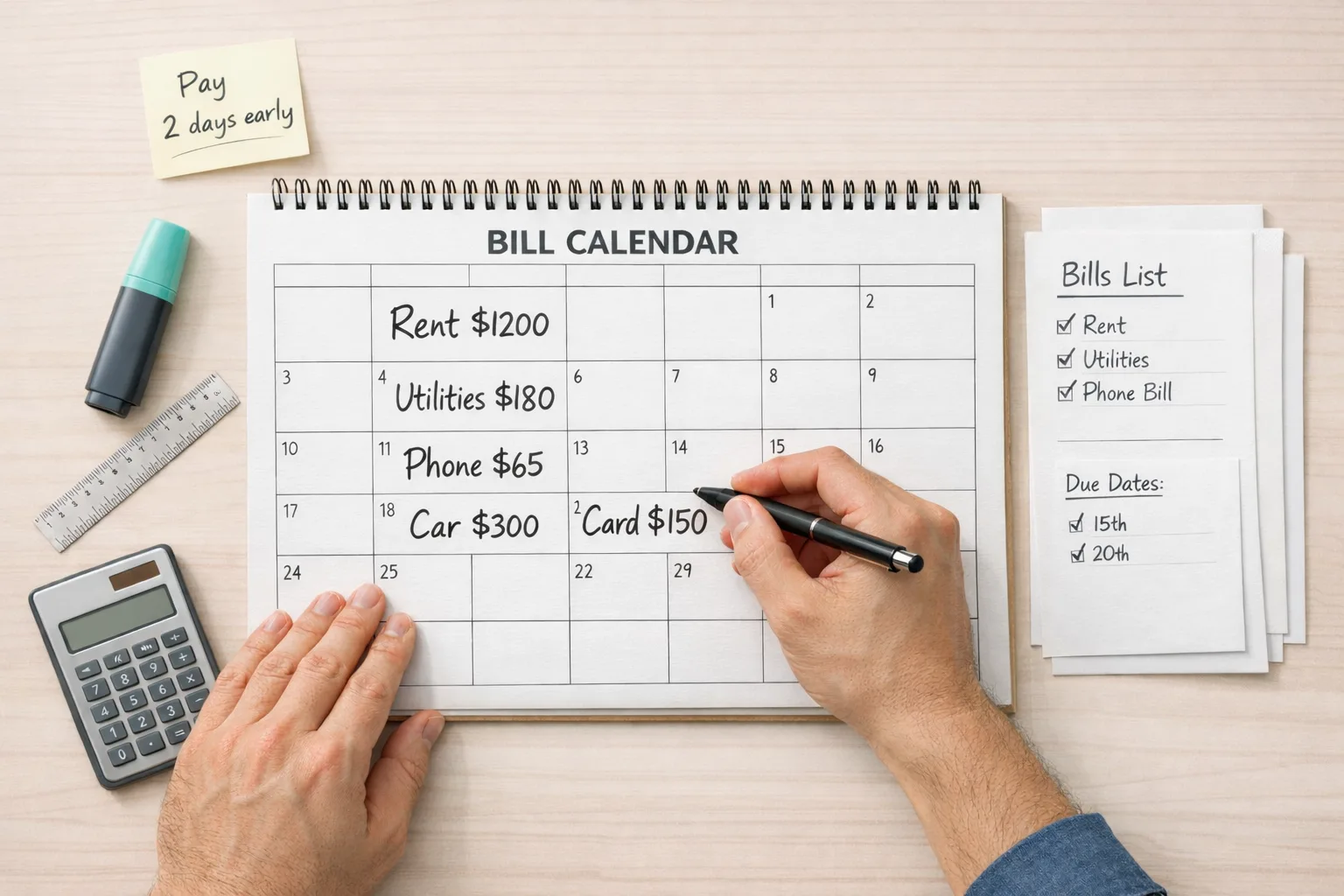
A bill calendar moves due dates out of your head and onto one page, so timing gaps are easier to see.
| Week of Month | Bills Due | Amount | Payment Method |
|---|---|---|---|
| Week 1 | Rent, Phone | $1,200 | Auto-pay |
| Week 2 | Credit Card | $150 | Manual |
| Week 3 | Utilities | $180 | Auto-pay |
| Week 4 | Car Payment | $300 | Auto-pay |
Mark both the due date and the day you plan to pay. If cash runs tight at a predictable point in the month, seeing pay dates and due dates together can help you spot the timing problem before it becomes a surprise.
If part of the stress is having bills, spending, savings, and debt scattered across different places, the Clever Fox Budget Planner puts those jobs into one undated paper planner. It fits readers who genuinely prefer writing things down; skip it if the free spreadsheet or a plain notebook already gives you one place to look.
3. Automate Minimums and Savings
Automation can reduce repeat decisions, but it only helps when the account timing is predictable enough to avoid creating a new cash-flow problem.
- Minimum debt payments: automate them only if the account can reliably cover the withdrawal; otherwise set a reminder
- Basic savings transfer: start with an amount that will not leave bill money short
- Essential bills: automate stable bills when the payment date fits your income timing
Small start > perfect plan: begin with one predictable payment or transfer, then adjust once you know the timing works.
Try this next: Automate one predictable payment—or set a reminder instead if an automatic withdrawal could cause an overdraft.
4. Build a Starter Emergency Fund
Starting point: choose a small buffer that fits your actual cash flow.
The right emergency-fund target depends on your situation. Even a small dedicated buffer can give an unexpected bill somewhere to land besides a credit card or another missed payment.
- Choose a starter target: base it on the kind of unexpected expense that has knocked your month off course before
- Keep it separate: use a safe, accessible place where it is less likely to blend into everyday spending
- Fund it when cash flow allows: regular contributions are useful, but uneven contributions still count when income varies
- Use it for unplanned needs: if you draw it down, make rebuilding it the next savings job rather than treating the fund as “failed”
Try this next: Pick one starter target and one place to keep it. The amount can grow later.
5. Negotiate Key Bills and Expenses
A few calls can sometimes free up cash flow without changing your whole budget. What is available depends on the company and your account, so ask rather than assume.
- Cell phone plans: ask whether a lower-cost plan, loyalty discount, or account-specific promotion is available
- Insurance: compare quotes and ask your current insurer which discounts or coverage options apply
- Credit cards: ask the issuer whether a lower rate, due-date change, or hardship/payment option is available
- Utilities: ask about payment plans, budget billing, or hardship assistance
- Subscriptions: compare a cheaper tier with canceling what you no longer use
Simple script: “Hi, I’m reviewing my expenses and I’d like to lower my monthly bill. What lower-cost, payment, or hardship options are available for my account?”
Try this next: Pick one bill and make the call during your next available window.
6. Tackle High-Interest Debt Strategically
If you’ve been making payments and the balance barely moves, interest and fees may be part of the reason. Extra payoff works best only after essentials and required minimum payments are covered.
Choose your approach:
- Debt avalanche: pay extra toward the highest interest rate first
- Debt snowball: pay extra toward the smallest balance first for quick wins
If you’re torn, this breakdown of debt snowball vs. avalanche can make the trade-off clearer. Neither approach is universally best: highest-interest-first generally saves more interest, while smallest-balance-first can make progress visible sooner.
7. Create Realistic Spending Boundaries
If several small purchases keep blurring together, a few simple boundaries can be easier to follow than a detailed category system.
The 50/30/20 guideline (adjust as needed):
- 50% needs (housing, food, transport, minimum debt payments)
- 30% wants (fun, eating out, hobbies)
- 20% savings + extra debt payments
Boundary tools that help: weekly spending check-ins, a separate “spending” account, or a cooling-off rule for non-essential purchases above a threshold you choose. If you want examples and edge cases, our 50/30/20 budget rule guide walks through how to adjust it realistically.
8. Handle Irregular Income Without Panic
Irregular income can feel like you’re constantly guessing. Instead of forcing every month into one average, build the plan around when money actually arrives and when bills are due.
- Look back over several months to see your income range and timing
- Put expected income dates and bill due dates on the same calendar
- Choose a conservative spending baseline that does not depend on a strong month
- Use stronger months to build a buffer or cover known irregular expenses when you can
- If you have business income, keep business and household cash flow distinct enough to see what is actually available for personal bills
Try this next: Map your next month’s expected income dates against your bill due dates. If the timing creates a squeeze, ask whether a due-date change or payment arrangement is available.
9. Find Temporary Financial Relief Resources
Sometimes you don’t need another tip. You need breathing room. If you’re looking for financial stress aid, these short-term resources can help reduce immediate pressure while you stabilize the rest.
- Local assistance programs: in the U.S., 211 can help you find local housing, utility, food, and other assistance resources
- Utility assistance: ask your provider about payment plans, temporary discounts, or other hardship options that may be available
- Food support: food banks and benefit programs
- Housing support: housing counseling and rental help
- Credit counseling: start with an overview from the Consumer Financial Protection Bureau guide
Reminder: Using help isn’t failure. It’s a smart bridge while you rebuild stability.
10. Protect Your Mental Bandwidth
Money worry steals attention. If you feel your chest tighten when you open your banking app, pause for a moment before you act. Then do the next small step.
- Set specific “money times” (so worry doesn’t run all day)
- Turn off non-essential spending notifications
- Use default decisions to reduce decision fatigue
- Practice a 24-hour rule for non-essentials
- Batch money tasks into one short session
Try this next: Set one 15-minute “money time” on your calendar this week.
11. Ask for Help Without Shame
When the numbers or the stress feel hard to untangle alone, talking to someone can turn a vague problem into a clearer list of options.
- Professional: fee-only planners, nonprofit credit counselors, financial therapists, tax prep support
- Personal: a trusted friend, an accountability partner, a supportive community
If anxiety is affecting sleep, appetite, or relationships, it may also help to talk to a licensed mental health professional alongside the money plan.
Want a second opinion on your payoff plan?
If your balances, rates, or cash flow make the choice unclear, you can ask a finance expert how to think through the trade-off.
12. Establish Weekly Money Check-ins
Time commitment: 15 minutes per week
Short check-ins help you catch timing problems, missed charges, or drifting spending before they have another week to grow. You’re not “doing finance.” You’re doing maintenance.
Your 15-minute script:
- Review last week’s spending (no judgment, just data)
- Check bills coming in the next 7–10 days
- Confirm balances match your expectations
- Celebrate one small win
- Pick one focus for the week ahead
Tip: Same day, same time each week makes this easier to keep. If follow-through is your sticking point, these budgeting habits that stick can help you keep the routine when life gets busy.
If your next step is getting the numbers out of your head and onto one screen, use the free reset below before your next check-in.
Get the 30-Minute Money Reset
Track income, spending, up to 8 debts, and up to 8 goals; the Snapshot sheet totals everything automatically.
Confirm to get the workbook and frugal money tips. Unsubscribe anytime.
Something went wrong. Please check your email address and try again.
Frequently Asked Questions
Your Next Step: Remove One Surprise
You do not need to work all 12 steps this week. Pick the problem creating the most uncertainty right now and do only its first move:
- Bills: put due dates and planned pay dates on one calendar
- Debt: if essentials and minimums are covered, choose the payoff method you can follow
- Irregular income: map expected income dates against bill due dates
- Overwhelm: make the one-page money snapshot and stop there for today
Then schedule a 15-minute check-in for next week. The goal is not to feel perfectly calm about money; it is to make the next decision easier than the last.
This money stress guide is for general education, not personalized financial, legal, or mental health advice. If you’re dealing with persistent distress or a complex situation, consider talking with a qualified professional. Your circumstances are unique, so what works best can vary.

