
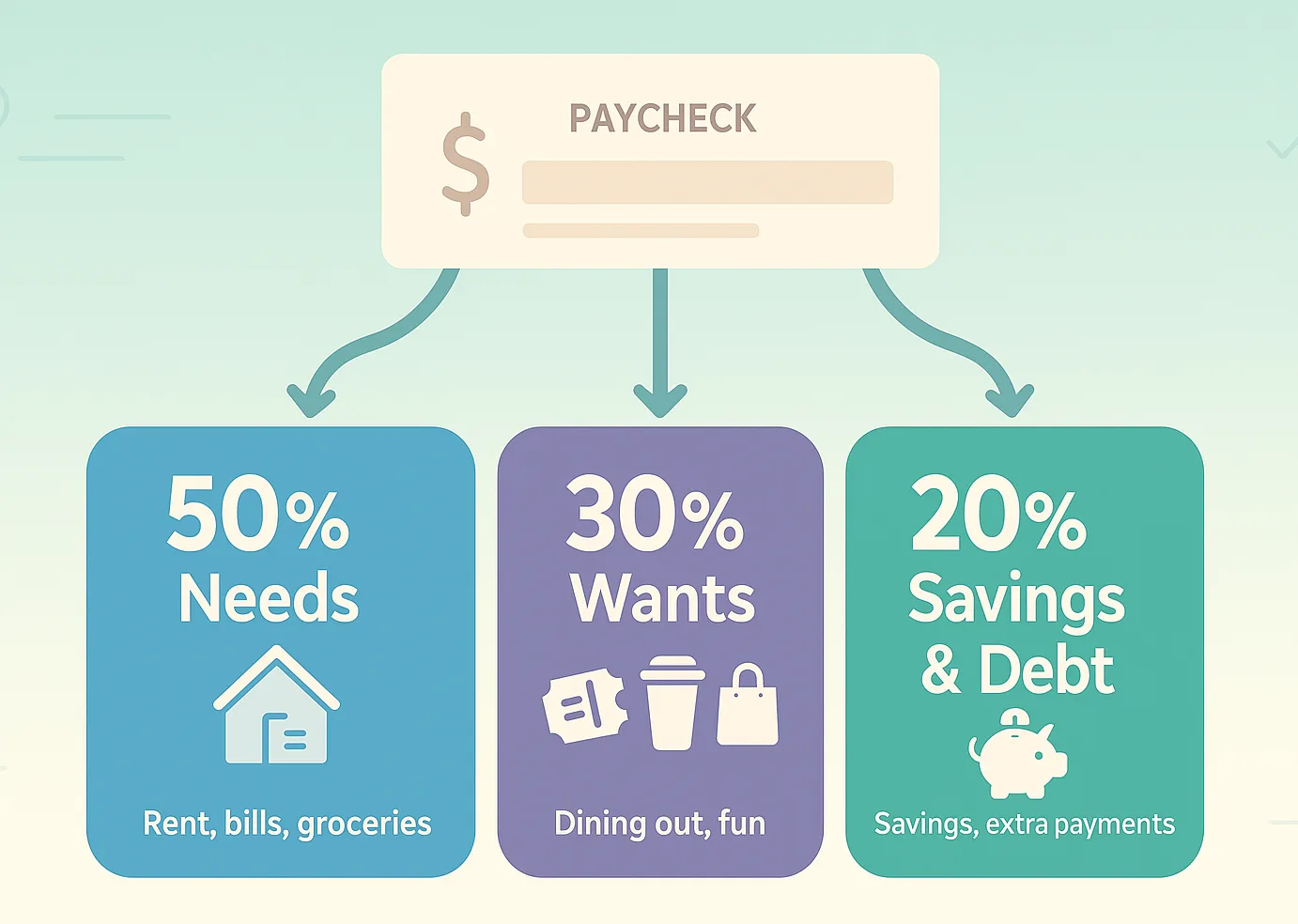
Ever open your bank app and wonder where the month went? The 50/30/20 budget rule turns take-home pay into three broad targets: 50% for needs, 30% for wants, and 20% for savings and extra debt payments. In this guide, you’ll calculate your own targets, see where the rule bends, and decide whether it fits your situation. For a broader cost-cutting strategy, see our complete guide to frugal living and saving money.
Think of the split as a benchmark, not a grade. If essentials or required debt already take more than the textbook share, keep those obligations covered and use the percentages to see where the pressure is. The useful question is not “Can I obey 50/30/20 perfectly?” but “What do these targets show me about my money?”
The percentages only mean something once they are dollars. Turn your own take-home pay into targets first, then judge whether the split fits.
This post contains affiliate links. If you buy through our links, we may earn a commission at no extra cost to you. As an Amazon Associate I earn from qualifying purchases. Learn more.
Table of Contents
- Calculate Your 50/30/20 Budget Targets
- Key Takeaways
- Understanding the 50/30/20 Budget Breakdown
- How to Calculate Your 50/30/20 Budget Targets
- Adapting the 50/30/20 Budget for Different Situations
- Is the 50/30/20 Budget Rule Right for You?
- Comparing the 50/30/20 Budget Method to Other Approaches
- Common Pitfalls and How to Avoid Them
- Implementing the 50/30/20 Budget: Tools and Techniques
- Put Your Budget Numbers in One Place Before You Adjust the Split
- Frequently Asked Questions
- Your Next 50/30/20 Step
Calculate Your 50/30/20 Budget Targets
Enter your average monthly take-home pay to turn the 50/30/20 percentages into dollar targets you can compare with your real spending.
Use income after taxes and payroll deductions.
Enter your monthly take-home pay to see your 50/30/20 targets.
Your monthly targets
- Needs 50%
- $0
- Wants 30%
- $0
- Savings & extra debt 20%
- $0
These are planning targets, not pass/fail requirements. If your real essentials or debt obligations do not fit the split, adjust the framework instead of forcing the percentages.
Key Takeaways
Use the 50/30/20 rule as a starting framework, not a scorecard. The goal is to make your money easier to see and adjust.
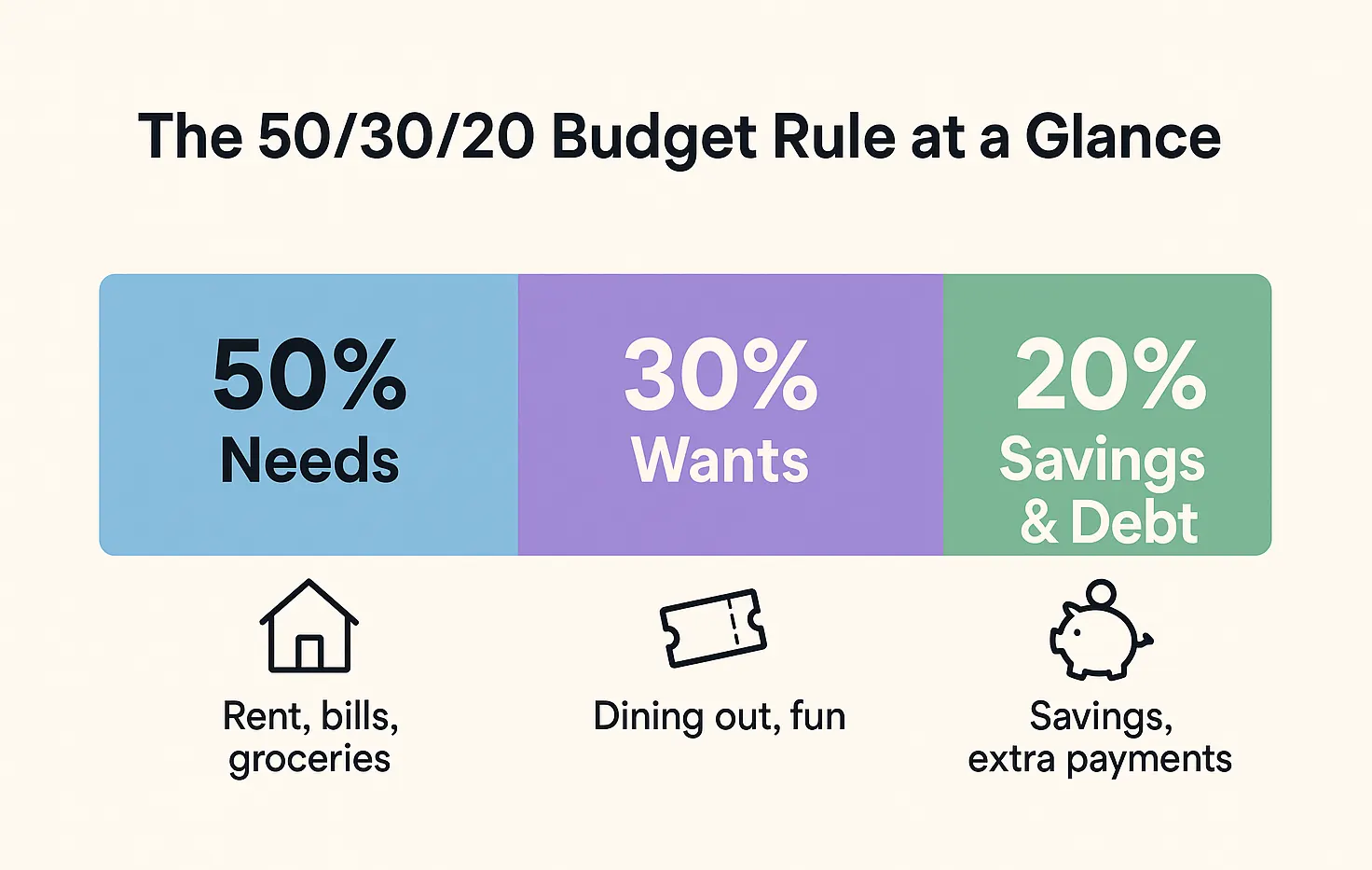
- Use take-home pay. The standard targets are 50% for needs, 30% for wants, and 20% for savings and extra debt payments.
- Treat the percentages as guardrails. If real essentials or required debt payments do not fit, adapt the split rather than forcing it.
- Define needs by consequence. Focus on what is required for basic obligations, health, safety, work, and household functioning—not whether an expense feels important.
- Expect the first month to be imperfect. Tracking reveals where your current spending differs from the target.
- Change one pressure point at a time. A simpler plan you can review is more useful than a perfect-looking ratio you cannot maintain.
If you’re just starting to cut expenses and build better habits, our how to start living frugally guide walks you through simple changes that can make the framework easier to use.
Understanding the 50/30/20 Budget Breakdown
Elizabeth Warren and Amelia Warren Tyagi popularized this three-part framework in their book “All Your Worth.” The shorthand is simple, but the useful work is deciding what belongs in each bucket and how rigidly the targets should guide your own plan.
The 50% Needs Category 🏠
The largest portion goes to needs: the baseline expenses required to keep housing, food, utilities, transportation, healthcare, insurance, and required payments covered. A useful test is consequence—if removing an expense creates serious hardship or prevents you from meeting a basic obligation, it is probably a need.
When you write these out for the first time, don’t be surprised if this list feels longer than you expected—that’s a discovery moment, not a failure.
Essential needs include:
- Housing costs (rent, mortgage, property taxes, insurance)
- Utilities (electricity, gas, water, basic internet)
- Groceries and essential household items
- Transportation (car payments, gas, public transit, insurance)
- Minimum debt payments (credit cards, student loans)
- Healthcare expenses and insurance premiums
- Required childcare or caregiving costs
Important note: Classify the function, not the brand or price tag. A service can be a need when it is required for work, health, safety, or basic household functioning, while an optional upgrade to that same service can still be a want.
The 30% Wants Category 🎯
This category covers discretionary spending: things you value and enjoy but could reduce, delay, or replace without missing a basic obligation. The 30% target creates room for enjoyment without requiring every discretionary purchase to feel like a budgeting mistake.
Common wants include:
- Dining out and takeaway meals
- Entertainment (streaming services, movies, concerts)
- Hobbies and recreational activities
- Travel and vacations
- Shopping for non-essential items
- Gym memberships and fitness classes
- Premium versions of services (upgraded phone plans, luxury car features)
The key challenge is distinguishing between needs and wants without pretending the line is identical for everyone. Groceries are generally a need, for example, but convenience upgrades or premium versions may be wants unless a health, work, or household requirement makes them necessary.
You don’t have to eliminate every latte or night out to be “good with money”; you just want those choices to live inside a clear boundary.
The 20% Savings and Debt Repayment Category 💰
This final category is where you build a financial buffer, work toward future goals, and make extra debt payments when that is a priority.
The 20% should cover:
- Emergency fund contributions based on the unexpected costs and income risks you want the fund to cover.
- Retirement savings (401(k), IRA contributions).
- Extra debt payments beyond minimums.
- Short-term savings goals (vacation fund, car down payment).
- Investment accounts (stocks, bonds, mutual funds).
Even if you can’t hit the full 20% right away, consistently putting something aside builds the “I can do this” habit that matters most long term.
How to Calculate Your 50/30/20 Budget Targets
If you’re trying to figure out how to budget money without turning your life into a spreadsheet, this simple percentage formula gives you a realistic starting point.
Using Take-Home Pay vs. Gross Income
Use take-home pay, not gross income. Base the calculation on the money available after taxes and payroll deductions so the targets reflect cash you can actually allocate.
Using gross income can make the targets look larger than the cash that actually reaches your account, so start with the amount you can really allocate each month.
Here’s a practical example:
- Monthly take-home pay: $4,000
- Needs budget (50%): $2,000
- Wants budget (30%): $1,200
- Savings/debt budget (20%): $800
Step-by-Step Calculation Process
- Determine your monthly after-tax income from all sources.
- Multiply by 0.50 for your needs budget.
- Multiply by 0.30 for your wants budget.
- Multiply by 0.20 for your savings/debt budget.
- List all current expenses and categorize them.
- Compare actual spending to target allocations.
- Adjust the plan where the gap is useful and realistic—sometimes that means changing spending, and sometimes it means changing the percentages.
Biweekly-pay shortcut: If your take-home paycheck is reasonably consistent, multiplying one biweekly paycheck by about 2.17 gives a useful monthly average because 26 pay periods are spread across 12 months.
If the numbers you calculate don’t match your current reality yet, treat them as a direction to move toward rather than a judgment on where you are.
Illustrative mismatch: If take-home pay is $4,000 but real needs total $2,400, your needs are 60% of take-home pay—not 50%. Do not pretend $400 of essential bills disappeared. Cover the real needs, then decide whether the remaining pressure is best handled by reducing wants, changing a large recurring cost, adjusting the savings/extra-debt target for now, or using a more detailed budgeting method.
Adapting the 50/30/20 Budget for Different Situations
Variable Income Earners 📊
Freelancers, commissioned salespeople, and gig workers face unique challenges with this 50/30/20 budget approach. Here’s how to make it work:
If your income jumps around from month to month, you’re not bad with money — you just need a system that bends with your reality instead of fighting it.
Strategy 1: Choose a conservative baseline
Use a lower-but-typical take-home month as your starting point, then check that the number still reflects your real required expenses. An unusually bad month may be too restrictive to use as the permanent baseline.
Strategy 2: Create a Rolling Average
Calculate your average monthly take-home income across several recent months and use that figure as a planning baseline.
Strategy 3: Implement a Tiered System
- Tier 1 (Low income months): Focus heavily on needs, minimal wants.
- Tier 2 (Average income months): Follow standard 50/30/20 allocation.
- Tier 3 (High income months): Direct more of the extra cash toward savings, debt, or upcoming irregular expenses.
The goal here isn’t to make your income magically predictable, it’s to give you a calm, repeatable way to react when it swings up or down.
High Cost-of-Living Areas 🏙️
In expensive cities like San Francisco or New York, housing costs alone might exceed 50% of income. Consider these modifications:
If essential costs already exceed the 50% target, do not cut food, healthcare, required transportation, or other necessities just to make the ratio look right. Cover real needs first, reduce wants where that is reasonable, choose a savings/debt amount you can sustain, and revisit the split as housing costs or income change.
Possible pressure points to review:
- Housing arrangements or location, when a change is genuinely realistic.
- Large recurring bills that may have lower-cost alternatives.
- Income opportunities that matter more than trimming already-lean essentials.
Different Life Stages 👨👩👧👦
Early-career households:
- Housing, transportation, and starting an emergency fund can dominate the first version of the budget.
- Shared housing or other temporary arrangements can change the needs percentage substantially.
Families and caregivers:
- Childcare, healthcare, and other required care costs can push needs above the textbook target.
- The useful question is which costs are temporary, which are recurring, and what savings goal remains realistic alongside them.
Households approaching retirement:
- Housing and healthcare costs can look very different from earlier working years.
- Retirement saving may deserve more priority when the household’s own timeline or progress calls for it.
Is the 50/30/20 Budget Rule Right for You?
When This Framework Is Easiest to Use
If you’re comparing approaches to budgeting for beginners, the 50/30/20 budget rule is usually easiest to use when:
- Your monthly take-home income is reasonably predictable or you have a reliable average to budget from.
- Your essential costs fit near the target range without skipping bills, food, healthcare, or required transportation.
- Your debt obligations still leave room for some discretionary spending and future goals.
- You prefer broad guardrails over detailed tracking of every category.
- You are new to budgeting and want a simple starting framework instead of dozens of detailed categories.
The Main Trade-Off
The rule trades detail for simplicity. Three broad buckets are easy to start and review, but they can hide irregular expenses, unusually high fixed costs, or goals that need more precise categories. That trade-off is useful when simplicity helps you act; it is a limitation when the missing detail is exactly what you need.
When to Consider Alternatives 🔄
Consider a different method—or a heavily adjusted version of this one—if you:
- Have high debt levels requiring aggressive repayment (consider a debt snowball vs avalanche guide to choose a payoff strategy).
- Earn highly variable income that fluctuates dramatically month-to-month.
- Live in extremely high cost-of-living areas where 50% doesn’t cover basic needs.
- Have aggressive financial goals that call for saving far more than the standard 20% bucket.
- Prefer detailed control over every spending category.
If you check several of these boxes, start with a more detailed method first and revisit 50/30/20 later once your income and debt feel more stable.
If your income, debt, or essential costs make the percentages hard to apply, a second opinion can help you identify which assumptions to revisit:
Get a Second Opinion on Your Budget Numbers
Bring your take-home income, essential costs, and minimum debt payments so the conversation starts with the numbers that shape your split.
If you prefer to keep working through it yourself, compare the alternatives below or adjust the percentages as planning targets rather than treating them as pass/fail rules.
Comparing the 50/30/20 Budget Method to Other Approaches
50/30/20 vs. Zero-Based Budgeting
Zero-based budgeting requires assigning every dollar a specific purpose before spending, creating a detailed plan where income minus expenses equals zero.
You don’t have to commit to one method forever. A short trial can show whether broad guardrails or detailed categories are easier for you to maintain.
If you want to test that stricter style alongside the 50/30/20 budget rule, you can download our free zero-based budgeting spreadsheet and compare how each method feels for a month.
| Feature | 50/30/20 Rule | Zero-Based Budgeting |
|---|---|---|
| Planning detail | Three broad buckets | Every dollar assigned to a category or goal |
| Ongoing work | Review the three bucket totals | Maintain and reallocate individual category amounts |
| Flexibility | Room to move spending within each broad bucket | Room to change the plan through deliberate reallocation |
| Best fit | Readers who want simple guardrails | Readers who want detailed control over each dollar |
50/30/20 vs. Envelope System
The envelope system assigns a fixed amount to specific spending categories, traditionally using cash envelopes so the remaining balance is visible.
Envelope system advantages:
- Creates a visible hard boundary for the categories you manage with cash.
- Can be useful for spending categories where a physical limit changes behavior.
- Provides tangible feedback as the envelope balance falls.
50/30/20 advantages:
- Works with digital payments and credit cards.
- Less restrictive within categories.
- Easier to implement with modern payment methods.
50/30/20 vs. Pay-Yourself-First
Pay-yourself-first prioritizes savings by immediately setting aside money for financial goals before any other spending.
Pay-yourself-first may fit better when:
- Your main priority is automating a savings goal before discretionary spending happens.
- You do not need the budget itself to separate needs from wants.
50/30/20 may fit better when:
- You want broad guardrails for needs, wants, and future goals in the same system.
- You prefer three big buckets to detailed category-by-category planning.
Common Pitfalls and How to Avoid Them
Mislabeling Wants as Needs ⚠️
A common mistake with this kind of budget is treating preferences as requirements without checking what function the expense actually serves.
Common mislabeling examples:
- Premium cable packages (basic internet is a need, 200+ channels are wants).
- Brand-name groceries when generic options exist.
- Eating out for convenience (groceries are needs, restaurant meals are wants).
- Latest smartphone models (basic phone service is a need, premium features are wants).
Solution: Ask what function the expense serves and what happens if you reduce or remove it. Serious hardship, health or safety consequences, loss of required transportation, or an inability to work point toward a need; preference or convenience points more toward a want.
Ignoring Irregular Expenses
A monthly split can look fine until a car repair, annual insurance premium, holiday expense, or other non-monthly cost arrives.
Prevention strategy: Turn predictable annual or seasonal costs into monthly sinking-fund amounts, then classify them by purpose. A yearly insurance premium may still be a need; holiday gifts may belong with wants.
Setting Unrealistic Expectations
Some people expect immediate perfection with this budgeting method and abandon it after one imperfect month. Reality check: It can take several monthly cycles to learn your real spending patterns and make useful adjustments.
Think of your first few months as data gathering rather than pass/fail.
Implementing the 50/30/20 Budget: Tools and Techniques
You only need one tracking system you will actually review. Use a spreadsheet or app if automatic totals help; use paper if writing the numbers down makes the three buckets easier to notice and revisit.
Spreadsheet Method 📊
Create a simple three-column spreadsheet tracking needs, wants, and savings/debt payments. Update weekly or bi-weekly to monitor progress. If you prefer a basic template to start from, you can use a simple budget worksheet from Consumer.gov and adapt it to the 50/30/20 categories.
If you’re an Excel person, our free Excel budget spreadsheet templates give you ready-made layouts you can plug 50/30/20 percentages into.
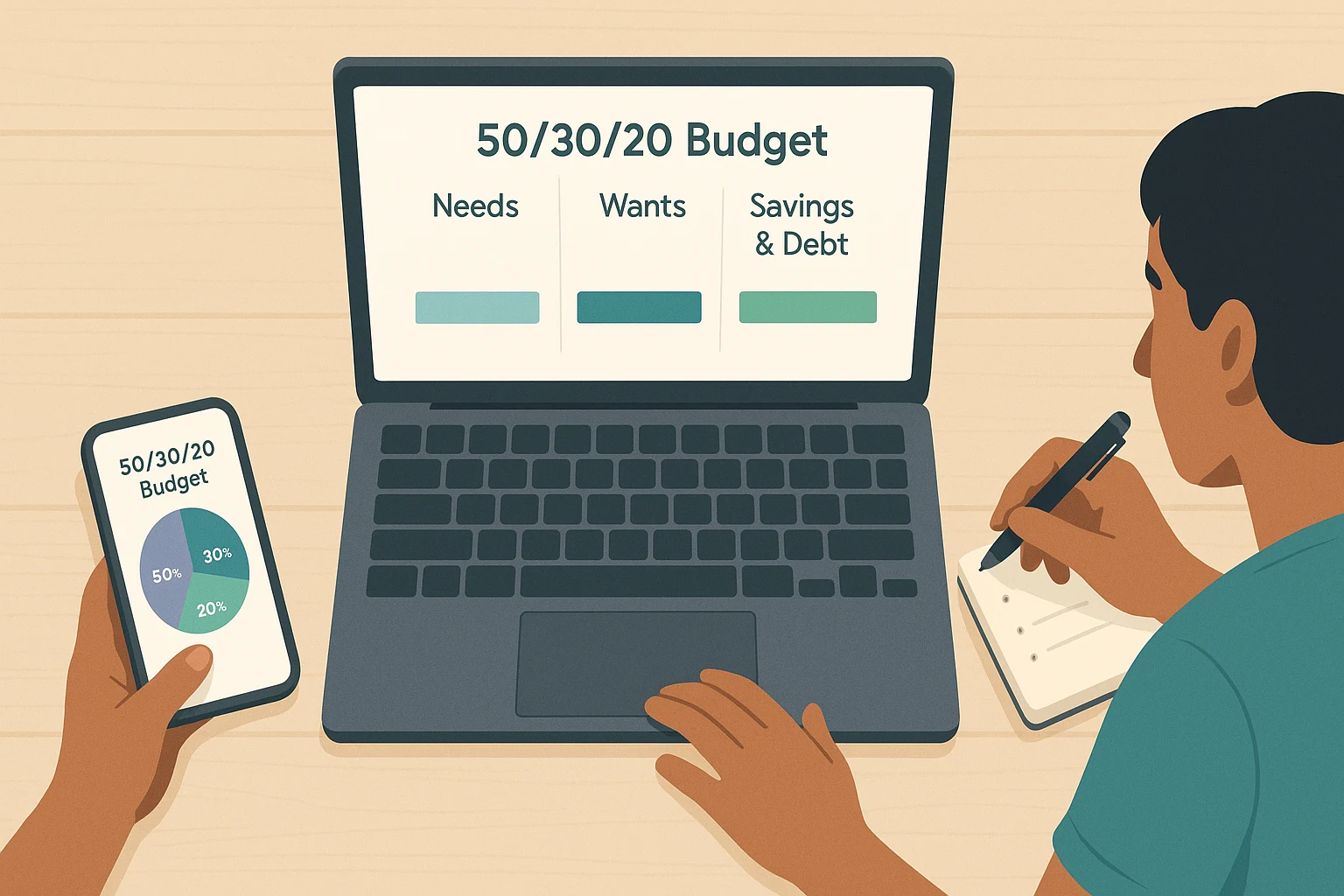
Basic spreadsheet structure:
- Column A: Expense description.
- Column B: Amount.
- Column C: Category (Need/Want/Savings).
- Row totals showing percentage of income for each category.
Paper Budget Planner ✍️
If you are more likely to review a budget when it is on paper, use a planner as the home for your three bucket totals instead of trying to make it do every calculation. Write your monthly take-home pay at the top, track needs, wants, and savings or extra debt, then total the three buckets during your weekly check-in.
Prefer Pen and Paper?
The Clever Fox Budget Planner is an undated 12-month planner with dedicated bill, expense, savings, and debt-planning sections, so it can support this workflow without forcing you into an app.
If a notebook or spreadsheet you already own works just as well, use that instead. The planner only earns its place if it makes your budget review easier to repeat.
Budgeting Apps and Account Dashboards
Tools such as YNAB, Credit Karma, and the Empower Personal Dashboard can help you review transactions, organize spending, and monitor financial goals. Features differ by service, so choose the tool whose current workflow matches how much detail you actually want.
Common features may include:
- Imported or linked transactions.
- Spending categories and reports.
- Goal or target tracking.
- Alerts or account dashboards when the service provides them.
Quick setup tip: In whichever app or dashboard you use, map your spending into three broad groups—“Needs (50%),” “Wants (30%),” and “Savings & Debt (20%)”—when the tool allows it. Then compare your real totals with the targets instead of relying on a specific menu path that may change over time.
Bank Account Structure
Some people use separate bank accounts to make the three categories easier to see:
- Checking account 1: Needs (50% of income).
- Checking account 2: Wants (30% of income).
- Savings account: Savings and debt payments (20% of income).
This method can make category boundaries more visible, but the accounts themselves do not decide whether a purchase is a need or a want.
If separate accounts help you create clearer spending boundaries, focus on the structure rather than a specific bank: keep everyday needs, discretionary spending, and savings/debt money easy to distinguish.
Weekly Check-ins
Schedule brief weekly reviews to track progress and make adjustments. Ask yourself:
- Am I staying within each category’s limits?
- Are there any upcoming expenses I need to plan for?
- Do any expense categorizations need adjustment?
If you want more structure for those check-ins, our budgeting habits that actually stick article gives you simple routines to pair with your 50/30/20 plan.
If the weekly check-in shows that the three buckets are not telling you enough, step back to a wider financial snapshot before you change the plan.
Put Your Budget Numbers in One Place Before You Adjust the Split
Confirm to get the workbook and frugal money tips. Unsubscribe anytime.
Something went wrong. Please check your email address and try again.
Frequently Asked Questions
Your Next 50/30/20 Step
The 50/30/20 rule is most useful when it turns a vague money problem into one visible comparison: what the three targets say, what your real spending says, and where the biggest gap sits.
Use this four-step check:
- Run the calculator above with a typical month of take-home pay.
- Track one month of real spending and sort it into needs, wants, and savings/extra debt.
- Compare the totals with the targets without treating the difference as a grade.
- Change the biggest pressure point first—or choose a more detailed method if three broad buckets do not give you enough control.
If you want a simple place to track the three buckets, use our free Excel budget spreadsheet templates. The goal is not to hit 50/30/20 perfectly; it is to leave your budget review knowing what your numbers are telling you and what to change next.
References
[1] Warren, Elizabeth, and Amelia Warren Tyagi. “All Your Worth: The Ultimate Lifetime Money Plan.” Free Press, 2005.
[2] Consumer Financial Protection Bureau. “Learning about budgets”.
[3] Consumer Financial Protection Bureau. “An essential guide to building an emergency fund”.
This 50/30/20 budget rule guide is for general education only and is not financial, investment, or tax advice. For personalized guidance, consult a qualified financial professional.

