

If you’re trying to increase your income without turning every evening into a second job, start with one lever: earn more in your main role, add active side income, or build something that may pay later. You do not need all three at once. This guide helps you choose the lane that fits your timeline and gives you a first step you can take this week.
Choose based on urgency, skills, and the time you can realistically repeat each week. Once one route shows traction, you can decide whether to deepen it, adjust it, or add another.
This post contains affiliate links. If you use them, we may earn a commission at no extra cost to you. Learn more.
Table of Contents
- Find Your Next Income Path
- Understanding the income growth landscape
- Side hustles for near-term income
- Freelancing and skill-based income
- Career moves that can raise your paycheck
- Passive income you can start building
- Keep investing separate from your near-term income plan
- Common obstacles and how to beat them
- Pick one 30-day income test
- Check Your Money Picture Before You Scale the Plan
- Your 90-day income plan
- Frequently Asked Questions
- Build the income path you can repeat
Find Your Next Income Path
Answer three quick questions to get one practical starting lane, a realistic weekly scope, and a jump to the matching section.
How fast do you need extra money?
What kind of path feels realistic right now?
How much time can you give this each week?
3 choices left
Answer each row to see the income path that best matches your current goal.
Start with the question you can answer most confidently.
Understanding the income growth landscape
Whichever lane the selector pointed you toward, the same three levers sit underneath it: earn more in your main role, add flexible side income, or build repeatable systems that can grow over time. Choose the income lever that deserves your next focused block instead of trying to do everything at once.
Here’s the mindset shift that helps: you’re not looking for 20 new ideas. You’re looking for one repeatable lane that can survive real life—tired weeks, busy seasons, and low motivation days. That’s why this guide keeps coming back to focus and simple systems.
Quick income math: For time-for-money paths, divide your monthly target by the hours you can realistically give them. If you want $400 more a month and can give about 16 hours, the path needs to average roughly $25 per hour before expenses and taxes. Then compare that target with what you expect to keep after obvious costs—such as platform fees, supplies, or mileage—and taxes, not just the headline rate. Raises and longer-build assets need a different test because their payoff is not tied neatly to weekly hours.
Your first step: Pick one lever (raise, side offer, or asset) to focus on for 30 days.
Side hustles for near-term income
If speed matters, start with work you can offer before you feel “ready”: short gigs, simple services, or skill-based help with a clear outcome. If you’re worried about wasting weekends, set one boundary up front: a fixed schedule and a clear stopping time.
If you want a bigger menu that fits a tighter budget, browse these frugal side hustle ideas and pick one you can repeat weekly.
Example: If you’re already the “organized friend” who makes plans and follows up, you can package that skill as paid help—calendar cleanup, inbox triage, simple customer replies, or scheduling—without building a complicated offer.
If you need something you can start with $0, these easy side hustles with no money can help you get moving without overthinking it.
Your first step: Write down 3 services you could offer this week (even if you start small).
Quick-start side hustle ideas
- Freelance writing/editing: Start with one niche you already understand (work, hobby, or life experience).
- Virtual assistant work: Pick one specialty (inbox cleanup, scheduling, customer replies) instead of “everything.”
- Tutoring: Choose one subject and one audience (middle school math, ESL conversation, etc.).
If you’re filling small gaps in your week, paid survey sites worth your time can be a low-stress add-on—just keep expectations realistic and treat it as “extra,” not a main plan.
If decision fatigue hits, use this rule: pick the option where you can get your first “yes” fastest. That usually means something you can show today (a sample, a tiny portfolio, or a clear one-paragraph offer).
| Gig type | Good for | What to watch |
|---|---|---|
| Rideshare / delivery | Flexible driving blocks | Vehicle costs, slow hours |
| Task services | Hands-on local work | Travel time between jobs |
| Pet sitting | Flexible bookings | Weekend/holiday availability |
Reality check: The “best” side hustle is the one you can repeat weekly without resenting it.
Freelancing and skill-based income
Freelancing scales when you stop selling “hours” and start selling outcomes. If you’ve ever underpriced yourself and then felt resentful halfway through the work, that’s a signal: your offer needs clearer boundaries. Aim for a tight package, a simple process, and a price you’d feel proud saying out loud.
If you’re deciding where to start, this Upwork review for freelancers breaks down what to expect before you invest time into proposals.
Example: Instead of “I can help with marketing,” try “I’ll rewrite your top 3 landing page sections so they’re clearer and easier to act on.” Same skill, but with a clearer finish line and less room for scope creep.
Your first step: Draft one offer: who it’s for, what you deliver, and what “done” looks like.
A tiny outreach plan you can repeat
Pick one channel (LinkedIn, email, a local community group) and send 5 respectful messages a week. Keep it simple: who you help, what problem you solve, and one example of a result you can create. Track replies in a single note so you don’t lose momentum.
Set the boundary first: Decide your turnaround time before you take your first client.
Turn repeated help into a defined offer
Teaching, coaching, consulting, or training can work when people already ask you for the same kind of help. The useful move is to define a start, a finish, and a deliverable instead of promising vague expertise.
Example: If you’ve helped friends improve resumes, that can become a defined service: “resume refresh + LinkedIn headline + 30-minute review call.” The value is the clear finish line, not a vague promise to “help with careers.”
Another example: If you’re the person who sets up budgets, Google Sheets, or “finally organized” systems for family, you could package the task as “60-minute budget setup + simple tracker.” The deliverable is concrete and easy to explain.
Try this: List five questions people ask you often. The repeated ones are candidates for a defined service, lesson, or small product.
Career moves that can raise your paycheck
Don’t overlook your main job as an income lever. If you’ve ever thought, “I do a lot here—why doesn’t my pay reflect it?”, start collecting evidence before you ask for more. Focus on measurable wins—time saved, revenue supported, errors reduced—then use those receipts in a raise or promotion conversation.
For pay and outlook research across hundreds of roles, the U.S. Bureau of Labor Statistics’ Occupational Outlook Handbook is a solid starting point.
Your first step: Write 3 “proof bullets” you can bring to a compensation conversation.
A simple negotiation script (fill-in-the-blank)
“Based on the scope I’m covering and the results I’ve delivered (X, Y, Z), I’d like to discuss adjusting my compensation. What would it take to reach a salary of ___ within the next ___ months?”
If you want the full playbook, this step-by-step raise script helps you prep what to say and when to say it.
Before you send it: Practice the script out loud once so the ask sounds natural when the conversation starts.
When a raise is not the only option
If your employer has no realistic path to higher pay, test the external job market before assuming you need a second income stream. Update your resume, compare roles that match your experience, and use interviews to learn whether changing employers is worth the trade-off.
Compare the whole move: Look at pay, benefits, commute or remote expectations, schedule, and stability—not salary alone.
Passive income you can start building
“Passive” doesn’t mean effortless—it usually means you do the work up front, then try to earn from the same asset repeatedly. If you’re hoping for a quick fix, that can feel slow at first. Keep the first asset small enough to finish, test, and improve.
If you want more options beyond templates, these realistic passive income ideas can help you choose one lane to test first.

Starter assets that reduce overwhelm
- A simple Notion template: One problem, one audience (meal plan, client tracker, study schedule).
- A mini-guide: Answer one specific “how do I…?” question in a format you can finish and update.
- A short lesson: Teach one focused skill and pair it with a useful worksheet or reference.
Validate before you build (so you don’t waste weekends)
- Ask 5 people: “If I made a simple X for Y, would you want it?”
- Share a draft: A rough version beats a perfect version that never ships.
- Pick one place to show it: One audience, one platform, one week of posting.
Your first step: Choose one asset idea and write the exact person it’s for in one sentence.
Keep investing separate from your near-term income plan
Investing can support long-term wealth, but it’s not a reliable “next week” income plan. The SEC’s Investor.gov guidance on asset allocation and diversification notes that the right mix depends on your time horizon and risk tolerance, and diversification can reduce—but not eliminate—risk. That makes investing a longer-term wealth tool, not a substitute for income you need on a short deadline.
Before you invest: Investor.gov recommends paying down high-interest debt before investing. If that is not your situation, define what the money is for and how long you can leave it invested before choosing an approach.
Common obstacles and how to beat them
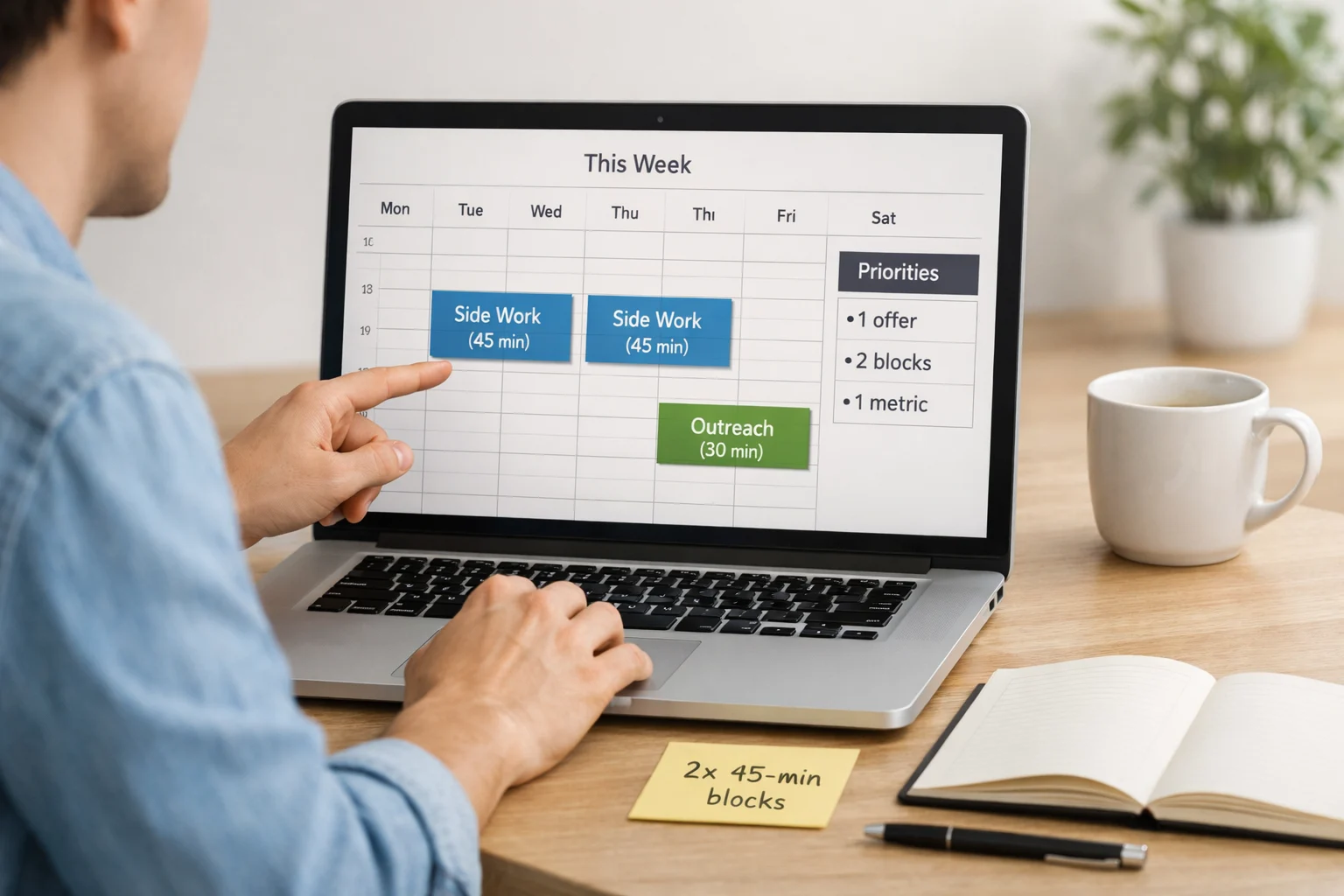
Time: Start with two protected blocks a week. If your schedule is chaotic, consistency beats intensity. Put two 45-minute sessions on your calendar this week and treat them like appointments.
Confidence: Start with a smaller, clearly scoped version of work you already know how to deliver. Build from there as your experience grows.
Money management: Track income and expenses from day one. The IRS says gig income is taxable, and independent contractors may need to make estimated tax payments, so keep records and plan for taxes as you go. If your situation is unclear, consider checking with a tax professional.
Pick one 30-day income test
If you’ve read the options and still have a few good candidates, use this as a final recap. You’re not choosing a forever plan; you’re choosing one 30-day test that gives you useful evidence.
| Your situation | 30-day test | This week’s first step |
|---|---|---|
| You need extra cash fast | Active income (gigs or a simple service) | Choose one offer + one schedule block and run it twice |
| You have a marketable skill | Freelancing with a clear package | Write one offer + send 5 outreach messages |
| You’re solid at your job | Career growth (raise/promo track) | Draft 3 proof bullets + request a comp chat |
| You want long-term compounding | Build a small asset | Pick one audience + outline a template/mini-guide in 30 minutes |
Before you turn that 30-day test into a 90-day plan, it helps to see the money you’re starting from—not just the extra-income number you’re chasing.
Check Your Money Picture Before You Scale the Plan
See income, spending, up to 8 debts, and up to 8 goals together on the SNAPSHOT sheet before deciding what your extra income needs to accomplish.
Confirm to get the workbook and frugal money tips. Unsubscribe anytime.
Something went wrong. Please check your email address and try again.
Your 90-day income plan
Think in three phases: test, repeat, then scale. If you’re searching for how to make more money without adding chaos, commit to one lane for the first 30 days and use evidence—not enthusiasm—to decide what happens next.
- Days 1–30: Run one focused test and capture the first useful signal—payment, reply, interview, or completed asset.
- Days 31–60: Repeat what works and fix the bottleneck slowing the path.
- Days 61–90: Scale carefully—raise rates, ask for more responsibility, increase volume, or improve the asset only when the first two months give you evidence.
Your first step: Write one goal number, then schedule the first action your path requires: outreach, a compensation conversation, a gig shift, or an asset work block.
Make the plan easier to repeat
Before you add more hours, remove one bottleneck. Time tracking can show whether a service is worth the effort, scheduling can cut back-and-forth, and reusable templates can speed up proposals, invoices, or checklists.
Keep it small: Fix one bottleneck for a week before adding another tool or system.
Frequently Asked Questions
Build the income path you can repeat
You don’t need the perfect plan—you need a test you can learn from. Pick the lane that fits your timeline, give it 30 focused days, and track one useful signal: money earned, replies received, interviews booked, or an asset finished.
At day 30, make one decision. Keep it if the signal is improving and you can repeat the work; adjust the offer, price, or process if the signal is promising but the money, time, or scope is wrong; drop it if the path is not sustainable.
The route worth keeping is the one that produces a signal you can repeat without crowding out the rest of your life.
This guide is for general education, not personalized financial, tax, or career advice. Your situation and results may vary. Consider talking with a qualified professional about your specifics.

