
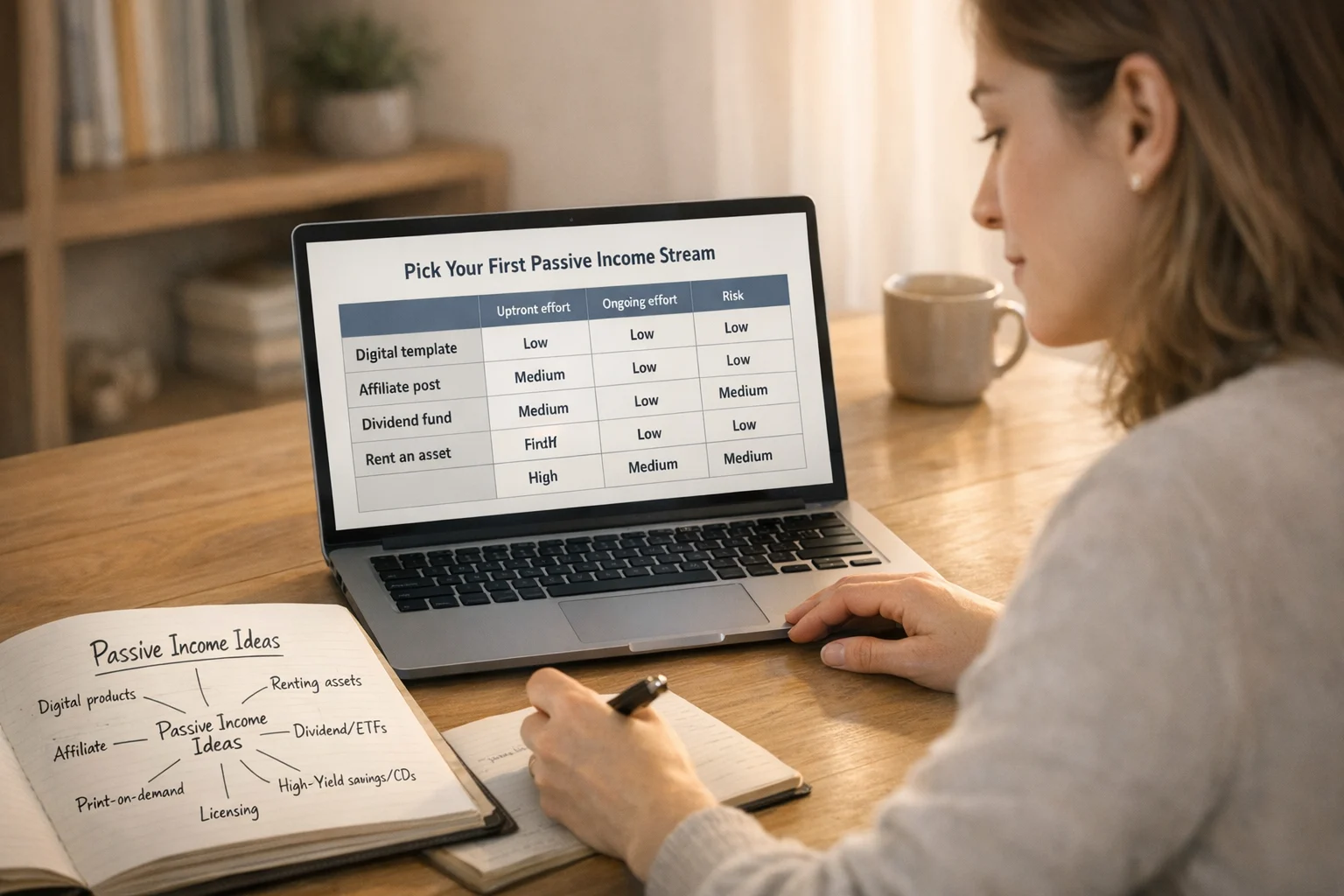
Passive income ideas are easier to compare when you start with what you actually have: cash you can set aside, a skill or idea you can build around, or an underused asset. “Passive” usually means work or capital up front, followed by lighter maintenance rather than no work at all. If your real problem is income now, our increase your income guide covers more active side hustles and career moves.
Below are seven passive income ideas with very different starting inputs, maintenance demands, and uncertainty. If you’re deciding how to make passive income without burning out, don’t launch seven passive income streams at once: use the selector, compare the trade-offs, and define one test or review point that actually fits the route.
This post contains affiliate links. If you buy through our links, we may earn a commission at no extra cost to you. Learn more.
Table of Contents
- Pick Your First Passive Income Stream
- Compare 7 Passive Income Ideas by Time, Money, and Risk
- 1. Digital Products: Templates, Courses, and Downloads
- 2. Affiliate Marketing Through Niche Micro-Sites
- 3. Index Funds, ETFs, and Dividend Income
- 4. High-Yield Savings and CD Ladders
- 5. Print-on-Demand Products
- 6. Licensing Creative Assets and Stock Content
- 7. Renting Underused Assets and Spaces
- When to Add a Second Passive Income Stream
- Get a One-Screen Money Snapshot Before You Add Another Stream
- Tax Considerations to Know
- Frequently Asked Questions
- Choose One Stream and Finish the First Milestone
Compare 7 Passive Income Ideas by Time, Money, and Risk
Use the selector for a starting match; use this table to compare all seven before you commit money or weeks of effort. The key difference is what each route asks you to bring up front, how much work remains afterward, and what can derail the plan.
| Idea | Starting input | Ongoing work | Main trade-off |
|---|---|---|---|
| Digital products | Time + a skill or process to package | Low–Medium | Demand must be validated; updates and support may continue |
| Affiliate micro-site | Time + useful content | Medium | Traffic and commissions are uncertain; trust takes time |
| Index funds / ETFs | Long-term investable money | Low | Market losses are possible, and distributions can change |
| High-yield savings / CDs | Cash principal | Low | Rates, access rules, penalties, and insurance coverage matter |
| Print-on-demand | Design time | Medium | No inventory, but demand and margins can vary |
| Licensing assets | Creative assets you have rights to license | Low | Marketplace demand and licensing terms affect the outcome |
| Renting assets / spaces | An underused asset or space | Low–Medium | Logistics, wear, local rules, and liability can add work |
If you’re a beginner, use the table to eliminate bad fits first. Start with the resource you can actually supply—cash, time, a skill, or an existing asset—then read the one or two matching sections instead of trying to build every stream at once.
1. Digital Products: Templates, Courses, and Downloads
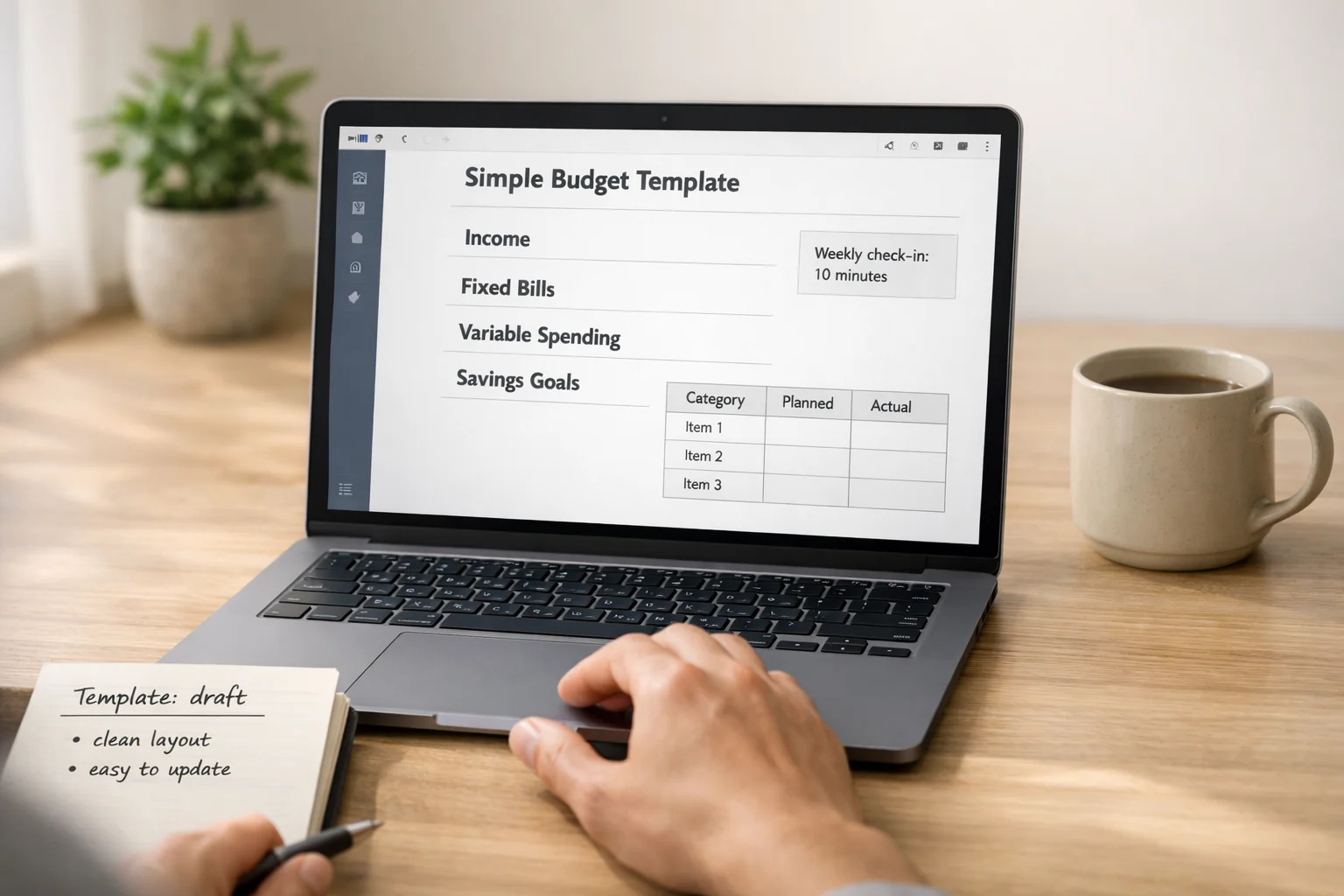
Digital products can become lower-maintenance income after you build the asset, test the demand, and set up delivery. Think of a budget template, a meal-planning spreadsheet, or a short mini-course. If the template route appeals to you, a zero-based budget spreadsheet is a useful example of turning a repeatable process into a reusable tool.
How it works
- Create a helpful asset once.
- Host it on a platform or your site.
- Drive traffic with evergreen content (or simple social posts).
Best for
People who can explain a process clearly and don’t mind a couple rounds of feedback.
Effort vs. maintenance
| Stage | What you do | What makes it easier |
|---|---|---|
| Setup | Build the product, write the description, set up delivery | Use a proven format (template, checklist, swipe file) |
| Maintenance | Light updates, support emails, occasional refresh | Create a short FAQ + “how to use it” guide |
Write one job-to-be-done sentence: “This helps someone who ____ do ____ in ____ minutes.” Then build the smallest useful version.
2. Affiliate Marketing Through Niche Micro-Sites
Affiliate marketing is simple in concept: you publish useful content and may earn a commission when a reader takes a qualifying action through your link. The hard part is trust. A recommendation is more useful when it explains who the option fits, who should skip it, and what trade-off matters before the click.
Best for
People who like writing “buyer’s guide” content and answering specific questions.
Keep it ethical
- Be clear that links may be affiliate links.
- Make the recommendation from the reader’s trade-offs, not the commission.
- State who should skip the option and what limitation could change the decision.
Choose one narrow reader question: outline the clearest answer you can give, including who the answer is and is not for.
If you publish the affiliate stream on your own site, privacy and terms setup becomes a separate website task. Termly’s privacy policy generator offers privacy-policy, terms, and cookie-consent tools; review what your site actually needs before publishing.
3. Index Funds, ETFs, and Dividend Income
Funds can generate income through dividends or interest, but the payout is only one part of the decision. Broad index funds, dividend-focused funds, and other ETFs can all lose value, and their distributions can change. Before investing, start with your time horizon and risk tolerance, then compare the fund’s strategy, holdings, fees, and expenses; Investor.gov explains both time horizon and diversification and the trade-offs of mutual funds and ETFs.
What to compare before you invest
- When you may need the money and how much loss you can tolerate
- What the fund actually holds and how diversified those holdings are
- Fees, expenses, and the role the fund would play in your broader plan
What changes the risk
| Option | What can change | Main trade-off |
|---|---|---|
| Broad market index fund | Market value moves with the underlying holdings | Broad diversification can reduce single-company concentration, but not market risk |
| Dividend-focused index fund | Market value and dividend payments can change | Diversification depends on the fund’s actual strategy and holdings |
| Single dividend-paying stock | The company’s share price and dividend policy can change | Your result is concentrated in one company |
Check the plan before the payout: decide when you may need the money, then review holdings, fees, risks, and diversification before treating any distribution as a reason to choose the fund.
If you need the broader foundation before comparing funds, start with our beginner investing guide.
4. High-Yield Savings and CD Ladders
This is the stability-first lane. A savings account or CD will not remove every trade-off, but it can give cash a clearer job while you build something else. Rates and account terms change, so compare the current details instead of anchoring to a number you saw months ago.
A simple CD ladder spreads money across staggered maturity dates instead of tying every dollar to one date. The FDIC’s deposit account guide explains the basic difference between savings accounts and CDs; confirm the actual rate, maturity, renewal, and withdrawal terms with the institution you are considering.
Two simple approaches
- High-yield savings: generally offers easier access than a CD, and the rate can change.
- CD ladder: splits money across staggered maturities; early-withdrawal penalties or other terms may apply.
Separate the money first: create a dedicated savings bucket, then compare current rates, access rules, fees, and CD penalties before moving cash.
If staggered maturities are the part you want to model, our CD ladder plan walks through the structure separately.
5. Print-on-Demand Products
Print-on-demand (POD) can fit if you like making designs but don’t want to store finished inventory yourself. The common trap is posting random designs and hoping. A more testable path is building around one niche and one consistent style, then watching which designs earn attention before you expand.
Where POD wins
- No need to hold finished inventory yourself
- Lets you test designs without ordering a large batch up front
- Can work well when the designs share one clear niche or audience
Test one niche, not five: create a small set of related designs, then watch which ideas earn attention before expanding.
6. Licensing Creative Assets and Stock Content
If you already create photos, videos, music loops, or graphics, licensing can turn your backlog into something that earns over time. Picture that camera roll you never look at—now imagine 20 of those shots cleaned up, tagged, and uploaded with intent.
Common asset types
- Stock photos and short video clips
- Music loops and sound effects
- Icons, textures, and design assets
Start with the backlog: choose a small batch of existing files, clean up the names and metadata, and learn one platform’s submission rules before creating more.
7. Renting Underused Assets and Spaces
If you have something useful that sits idle—gear, a parking spot, a spare room, or storage space—you may be able to rent it out. The work becomes more repeatable when the rules, scheduling, handoff, and cleanup process are clear.
Examples
- Parking or storage space
- Tools and hobby gear
- Car sharing (where it’s legal and practical)
Write the handoff rules before listing: define scheduling, pickup or access, condition checks, and what happens if something goes wrong.
When to Add a Second Passive Income Stream
Multiple passive income streams can sound safer than relying on one, but stacking unfinished systems creates a different risk: you stop learning what any one stream actually needs. Add a second stream only after the first has a repeatable setup and you understand its normal maintenance.
Use the right evidence for the route
- Products, content, POD, and licensing: look for evidence that real people want the thing—qualified clicks, inquiries, downloads, or sales—then judge whether the ongoing work is manageable.
- Renting: compare realistic demand with the coordination, platform costs, wear, insurance, and liability the asset creates.
- Savings and CDs: make the decision from account terms, access, penalties, and insurance coverage rather than waiting for a short run of “results.”
- Funds and ETFs: review whether the investment fits your objective, diversification, fees, risk tolerance, and time horizon; short-term performance is not a reliable pass/fail test.
Make the second stream do a different job
A useful second stream should reduce dependence on the same bottleneck. For example, a content-based stream and a cash-management stream rely on different inputs; two sites that depend on the same traffic source may look separate but still share the same weakness.
Set the review rule before you start: write down what would count as evidence to continue, what would make you change or stop, and when you will review the decision. For investing, make that review about plan fit rather than chasing short-term performance.
If money—not time or skill—is the input you still need to clarify, take a snapshot of what already has a claim on your cash before you add another stream.
Get a One-Screen Money Snapshot Before You Add Another Stream
Enter income, spending, up to 8 debts and 8 goals; the SNAPSHOT sheet totals everything automatically.
Confirm to get the workbook and frugal money tips. Unsubscribe anytime.
Something went wrong. Please check your email address and try again.
Tax Considerations to Know
Taxes are easier to deal with before the records pile up. Digital sales, affiliate income, rentals, interest, and dividends can create different tax questions depending on the facts and jurisdiction, so use current guidance for the place where you file.
If you’re building any kind of side income, keep basic records from day one—income, expenses, and supporting documents—so you’re not reconstructing everything at tax time. For U.S. readers, the IRS says records should clearly show income and expenses and support items reported on a return; its recordkeeping guidance explains the basics.
Create one records folder now: keep income, expenses, and supporting documents together instead of rebuilding the trail later.
Frequently Asked Questions
Choose One Stream and Finish the First Milestone
Choose the idea you can set up responsibly with the resource you already have. If you are still undecided, run the selector again, compare the matching section with the at-a-glance table, and complete one concrete setup step before adding another stream.
For a business-style stream, look for one early sign that real people are using or buying what you built. For savings or investing, compare current terms, costs, risk, and time horizon instead of treating a short run of interest or market returns as proof. The goal is a system you understand well enough to maintain—not a pile of half-started “passive” projects.
This guide is general education, not personalized financial or tax advice. Your situation and results can vary, so consider a qualified professional for decisions that affect your finances.

