

Ever rehearse how to ask for a raise, then freeze when it’s time to start the raise conversation? Picture this: Sarah, a marketing coordinator at a mid-sized SaaS company, just led a product launch campaign that hit 180% of goal—yet her salary hasn’t budged in 18 months. Sound familiar? For the bigger picture on growing your paycheck, see our increase your income guide.
Here’s the core script in 5 steps:
- Thank + context (set a collaborative tone)
- Share 2–3 wins (numbers beat opinions)
- Connect to business value (why it mattered)
- Make a clear ask (range or number)
- Agree on next steps (timeline + follow-up)
Learning to ask for a raise isn’t about “being brave.” It’s about walking in with proof, a clear number, and a plan for what you’ll say if the first answer is “maybe.” Below, you’ll get a simple framework, a word-for-word script, and ready responses to the most common pushbacks—so the conversation stays professional (and productive).
This post contains affiliate links. If you buy through our links, we may earn a commission at no extra cost to you. Learn more.
Table of Contents
- Key Takeaways
- Raise Request Prep Quiz
- The Foundation: Research and Preparation
- Timing Your Request Strategically
- Preparing for the Conversation
- The Step-by-Step Script: How to Ask for a Raise
- Negotiating Alternatives When Budget is Limited
- Following Up and Securing Agreements
- When the Answer is No: Next Steps and Alternatives
- Salary Negotiation Tips and Long-Term Strategy
- Common Mistakes When Asking for a Raise
- Industry-Specific Considerations
- Building Your Confidence for the Conversation
- Frequently Asked Questions
- Conclusion
Key Takeaways
If you only read one section, make it this one—these are the moves that tend to change the outcome.
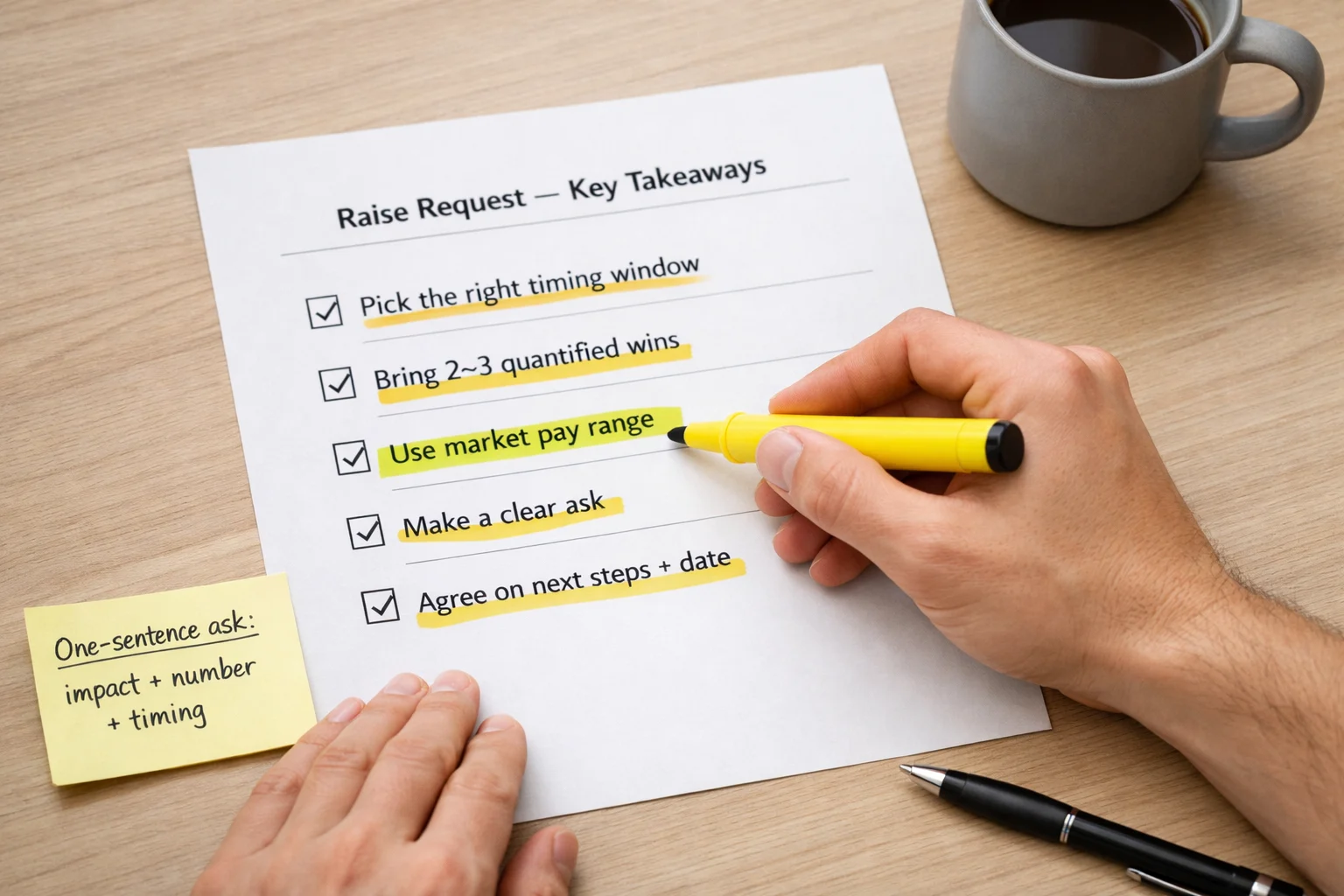
- Timing is everything: Align your request with performance review cycles, budget planning periods, and company wins for maximum impact
- Data drives decisions: Quantify your achievements with specific metrics and research market rates to build an unshakeable case
- Preparation beats improvisation: Use a structured script and anticipate objections to maintain confidence during the conversation
- Alternatives create opportunities: When budget constraints exist, negotiate for bonuses, accelerated reviews, or expanded responsibilities
- Follow-up secures success: Document agreements and establish clear timelines to ensure promises translate into action
Micro-action: Write your ask in one sentence (impact + number + timing) and keep it on a sticky note. Real talk: If you only have 15 minutes tonight, list your top 3 wins and add one number to each.
Quick shortcut: Use the quiz below to pick your best approach, then copy the matching script.
Raise Request Prep Quiz
Pick your best option—then use the matching script section below.
The Foundation: Research and Preparation
Understanding Your Worth in the Market
If you’ve ever found yourself late at night bouncing between salary sites and wondering, “Am I actually underpaid?”—start here. Before you bring up asking for a raise, get clear on your market value and your company context. If your workplace uses pay bands, try to confirm the band for your role—internal equity can matter as much as outside market data. Also look at total compensation (base + bonus + equity) so you’re comparing apples to apples. If money worries are making this feel extra urgent, try these ways to reduce money stress before you walk into the meeting.
Primary Research Sources:
- Glassdoor and PayScale for role-specific data
- LinkedIn Salary Insights for industry benchmarks
- Robert Half Salary Guide for comprehensive market analysis
- Bureau of Labor Statistics for official government data (official wage data)
Create a salary range based on your experience level, location, and company size. Example: if the market rate for your position ranges from $65,000 to $85,000 and you’re earning $58,000, you have a clear gap to discuss.
Documenting Your Impact
Transform your day-to-day work into measurable outcomes. If you’re thinking, “But I do a hundred little things,” pick the few that saved time, protected revenue, improved quality, or reduced risk.
Achievement Documentation Template (example numbers):
| Project/Initiative | Specific Results | Business Impact | Timeline |
|---|---|---|---|
| Q3 Lead Gen Campaign | 40% increase in qualified leads | $120K in new pipeline value | 3 months |
| Website Redesign | 25% improvement in conversion rate | 15% boost in online sales | 6 months |
| Process Optimization | Reduced campaign setup time by 30% | Saved 10 hours/week team capacity | Ongoing |
Micro-action: Open a doc and list 5 wins from the last 90 days—add one number to each. Quick test: can you say your top 3 wins in 30 seconds?
Timing Your Request Strategically
Optimal Timing Windows
The when of asking for a raise can be just as important as the how. If you’re tempted to do this in the hallway at 5:58 p.m., don’t—pick a moment when your manager can actually think and act. Aim for review season, right after a strong deliverable, or when budgets are being planned. If the company is in cost-cut mode, pivot to a future date or alternatives you can lock in now.
Best Times to Ask:
- Budget planning season (often late-year for many companies)
- After completing major projects or exceeding quarterly goals
- During annual performance reviews when compensation is already being discussed
- Following company wins like new funding, major client acquisitions, or strong earnings
Times to Avoid:
- During layoffs or company restructuring
- Immediately after poor company performance
- When your manager is dealing with personal or professional stress
- Right before major deadlines or busy periods
Reading the Room: Company Health Indicators
Before you ask, sanity-check whether the company can say yes. Positive indicators include:
- Recent hiring sprees or expansion announcements
- Increased client acquisition or contract renewals
- Positive press coverage or industry recognition
- Investment in new technology or office improvements
Micro-action: Pick your best timing window and send a calendar invite request today (two time options).
Preparing for the Conversation
Setting Up the Meeting
Don’t ambush your manager with a salary request during a casual hallway conversation. If your manager is always slammed, this matters even more—give them a heads-up so they can show up focused. If you’re nervous, that’s normal: a calendar invite is your “permission slip” to keep it professional and focused. Schedule a dedicated meeting using this approach:

Email Template for Scheduling:
Subject: Meeting Request - Performance and Career Discussion

Hi [Manager's Name],

I'd like to schedule 30 minutes to discuss my performance, recent contributions, and career development.

I have a few achievements and goals I’d like to review.

Would you have time next week?

Thank you,
[Your Name]
Creating Your Presentation Materials
Prepare a one-page summary document that includes:
- Your current role and tenure
- Key achievements with quantified results
- Market research data
- Your requested salary range
- Future goals and commitments
This gives your manager something concrete to review (and forward) when approvals go through HR or finance.
Micro-action: Build your one-page summary tonight. Keep it to one screen—no scrolling.
The Step-by-Step Script: How to Ask for a Raise
Opening the Conversation
If your voice gets shaky at the start, that’s normal—use a prepared opener so you don’t have to improvise in the moment:
“Thank you for taking the time to meet with me today. I really value the opportunity to work here and contribute to [specific team/company goal]. I wanted to discuss my role, the impact I’ve been making, and explore opportunities for growth in my compensation.”
Presenting Your Case
Use this structure to keep the conversation clean and business-focused:
Step 1: Highlight Recent Wins
“Over the past [time period], I’ve focused on delivering results that directly support our team’s objectives. Let me share some specific examples…”
Step 2: Quantify Your Impact
“The lead generation campaign I managed resulted in a meaningful lift in qualified prospects, which translated into stronger pipeline. Additionally, the process improvements I implemented save our team hours each week.”
Step 3: Connect to Business Value
“These contributions have helped our department exceed its quarterly targets and positioned us well for the upcoming product launch.”
Making the Ask
This is where many people stumble, but directness paired with data creates confidence:
“Based on my research of market rates for similar roles and the value I’m delivering, I’d like to discuss adjusting my compensation to the $72,000 to $78,000 range. This aligns with industry standards for someone with my experience and track record.”
Critical Element: After stating your number, remain silent. Let your manager respond first. If your stomach drops when you say it, keep your eyes on your notes and just breathe—silence is part of the script.
Quick examples (steal the structure, swap the details):
- Hourly role: “Since taking on closing shifts and training new hires, our order errors dropped 18%. I’d like to talk about moving my hourly rate from $18 to $20.”
- Analyst/IC: “I automated our weekly report and saved the team ~6 hours a week. Based on market rates and my impact, I’m asking to move to $78K–$84K.”
- Manager: “We hit our Q2 goals two weeks early and reduced churn by 7%. I’d like to discuss adjusting my base to reflect the scope I’m leading.”
Handling Common Responses
Response 1: “Let me think about it”
“I appreciate you considering this. What additional information would be helpful for your decision? And what timeline should I expect for follow-up?”
Response 2: “Budget is tight right now”
“I understand budget constraints can be challenging. Are there alternative ways we could structure this, such as a performance bonus, accelerated review timeline, or expanded responsibilities that could lead to a promotion?”
Response 3: “You’re already paid fairly”
“I value your perspective. Could we review the market data I’ve gathered together? I’d also love to understand what additional achievements or milestones would position me for a salary adjustment in the future.”
Micro-action: Read your opener + your ask out loud twice. Quick test: can you say the number calmly, then stop talking?
Recommended read: Never Split the Difference — a negotiation classic for calmer, clearer asks.
If you like scripts, this one helps you handle pushback without over-explaining.
Negotiating Alternatives When Budget is Limited
Creative Compensation Solutions
If you hear “not this quarter,” don’t panic. Many managers can’t move base pay immediately, but they can often move something—especially if you propose options that fit how approvals work.
One-Time Bonuses
- Performance bonuses tied to specific metrics
- Retention bonuses for continued employment
- Project completion bonuses for major initiatives
Accelerated Review Cycles
- Move from annual to biannual reviews
- Create milestone-based evaluation points
- Establish clear promotion timelines
Enhanced Benefits Package
- Additional vacation days
- Professional development budget
- Flexible work arrangements
- Health and wellness benefits
Professional Development Investments
- Conference attendance and training programs
- Certification reimbursements
- Tuition assistance for relevant courses
- Mentorship or coaching programs
The Step-Up Plan Strategy
When immediate raises aren’t feasible, propose a structured growth plan:
“If a salary adjustment isn’t possible right now, I’d like to outline specific milestones for a future increase. Could we set goals and a follow-up date in six months?”
If you’re building a bigger earnings plan beyond this one conversation, map out your next 6–12 months (skills, scope, and your target number) so you’re not improvising later. If you want ideas that don’t rely on a raise, here are realistic passive income ideas to explore.
Micro-action: Write down two alternatives you’d genuinely accept (bonus, review date, PTO, PD budget) and bring them to the meeting.
Following Up and Securing Agreements
Post-Meeting Communication
After a good conversation, it’s easy to walk away thinking, “Great—we’re aligned,” and then nothing happens. A short follow-up email keeps it moving and gives your manager something to act on.
Follow-Up Email Template:
Subject: Follow-up on Our Career Discussion

Hi [Manager's Name],

Thank you for the thoughtful conversation yesterday about my role and compensation. I appreciate your time and consideration.

To summarize our discussion:
- We reviewed my recent achievements, including [specific examples]
- You'll be reviewing my request for a salary adjustment to $[X] range
- We discussed [any alternative options mentioned]
- Next steps: [specific actions and timeline]

I'm excited to continue contributing to our team's success and look forward to hearing back from you by [agreed-upon date].

Best regards,
[Your Name]
Documenting Agreements
Whether you get a “yes,” a future date, or an alternative offer, document the decision and timeline in writing. It prevents misunderstandings and makes the next step obvious.
Micro-action: Send your recap email within 24 hours and include one clear follow-up date.
Frequently Asked Questions
When the Answer is No: Next Steps and Alternatives
Understanding the “No”
Getting a “no” stings, even if you expected it. The goal is to turn it into a clear “not yet” with specifics.
- What factors influenced this decision?
- What would need to change for this to be reconsidered?
- When should we revisit compensation next?
- Are there other ways to recognize my contributions?
Creating a Development Roadmap
Use the “step-up plan” idea from earlier: get specific milestones, who signs off, and a date to revisit. You’re aiming for clarity, not a vague “we’ll see.”
Try this line: “What would you need to see from me to approve this at the next review—and when should we meet to check progress?”
Exploring External Options
Sometimes the fastest pay growth is outside your current role. If you go that route, keep it professional and time-bound—especially if you still want to preserve relationships.
Before Job Searching: give your employer a clear window to respond (with dates), and keep documenting outcomes.
If You Receive an External Offer: present it as market validation (not a threat), and ask for a response by a specific date.
If you’re not ready to job hop, some people start a side hustle for extra income while they quietly explore options.
If a raise isn’t coming soon and you want another income stream while you wait (or look around), many people start small freelance gigs. It’s flexible and can add up without quitting your job.
One solid platform to browse projects is Upwork — and our Upwork review breaks down what to expect before you jump in.
Micro-action: Leave the meeting with one follow-up date on the calendar—no date, no plan.
Salary Negotiation Tips and Long-Term Strategy
Building Long-Term Relationships
If you only talk about pay once a year, it can feel like you’re starting from zero every time. A steady paper trail makes your next conversation calmer because the evidence is already there.
Consistent Performance Excellence
- Exceed expectations regularly, not just before asking for raises
- Take on additional responsibilities that showcase leadership potential
- Mentor newer team members and contribute to company culture
Strategic Communication
- Keep your manager informed about your achievements throughout the year
- Participate actively in team meetings and strategic planning
- Volunteer for high-visibility projects that align with company priorities
How to Get a Promotion Through Performance Reviews
Annual performance reviews provide natural opportunities to discuss compensation. Prepare by:
- Gathering feedback from colleagues and clients
- Creating a comprehensive achievement portfolio
- Setting ambitious but realistic goals for the upcoming year
- Researching industry trends and skill requirements
Micro-action: Send your manager a monthly “3 wins” email (one screen, max).
Common Mistakes When Asking for a Raise
Emotional Approaches
❌ Don’t Say: “I need more money because my rent went up”
✅ Do Say: “Based on my performance and market research, I believe my compensation should reflect the value I’m bringing to the organization”
Personal financial needs, while real, don’t constitute business justification for salary increases.
Ultimatum Tactics
Threatening to quit unless you receive a raise often backfires, especially without a concrete alternative offer. Instead, focus on collaborative problem-solving and mutual benefit.
Inadequate Preparation
Walking into a salary negotiation without research, documentation, or a clear ask significantly reduces your chances of success. Preparation demonstrates professionalism and respect for your manager’s time.
Poor Timing
Asking for a raise during company layoffs, after missing major deadlines, or during particularly stressful periods shows poor judgment and situational awareness.
Micro-action: Rewrite your ask so it starts with one measurable win, then your range.
Industry-Specific Considerations
Tech and Startups
- Equity compensation may be significant
- Rapid growth can create frequent promotion opportunities
- Market rates change quickly due to high demand for talent
Example: If equity is part of your package, pair the raise ask with a quick refresh conversation: “I’d like to align my base with market—and discuss whether a refresh grant makes sense given my scope.”
Traditional Corporate Environments
- Formal review processes and budget cycles
- Emphasis on tenure and incremental advancement
- Comprehensive benefits packages may offset lower base salaries
Example: When salary bands are strict, ask what level you’re being mapped to: “If my scope matches Level X, what’s the path and timeline to move me there?” It often unlocks the compensation conversation.
Non-Profit Organizations
- Mission-driven work may limit salary ranges
- Grant funding cycles affect budget availability
- Professional development opportunities often abundant
Example: If base pay is capped, propose a concrete alternative: “If salary can’t move this quarter, can we set a 90-day review date and add a professional development budget tied to the outcomes I’m delivering?”
Micro-action: Add one industry-specific lever to your notes (equity, level mapping, or a budget-friendly alternative).
Building Your Confidence for the Conversation
Mental Preparation Techniques
Visualization Exercises
Practice the conversation mentally, imagining positive outcomes and confident delivery. Visualize yourself staying calm during tough questions and presenting your case clearly.
Role-Playing Practice
Ask a trusted friend or mentor to practice the conversation with you. This helps identify weak points in your argument and builds comfort with the script.
Positive Self-Talk
Replace negative thoughts (“I don’t deserve this”) with evidence-based affirmations (“I have consistently exceeded my targets and deserve fair compensation”).
Managing Nervousness
If your heart races right before the meeting, you’re not alone. Use a pause, breathe, and lean on your notes—preparedness is what reads as “confidence.”
Breathing Techniques
- Take deep breaths before entering the meeting
- Pause and breathe if you feel overwhelmed during the conversation
- Use silence strategically rather than filling every moment with words
Micro-action: Do a 2-minute rehearsal standing up right before the meeting—opener, win, ask, stop.
Conclusion
Learning to ask for a raise successfully requires preparation, timing, and confidence. Use the framework, keep it business-focused, and make the next step crystal clear.
In the example above, Sarah used a version of this framework to land a meaningful adjustment—because she walked in with proof, a clear ask, and a plan for the follow-up.
If you only do two things this week, do these: schedule the meeting, and build the one-page “wins + numbers” summary. Those two moves alone make you sound like someone who’s already operating at the next level.
Your Next Steps:
- Research your market value using the resources outlined in this guide
- Document your achievements with specific, quantifiable results
- Choose optimal timing based on company cycles and performance
- Schedule a dedicated meeting with your manager
- Practice your script until you feel confident and natural
- Prepare for various responses including alternatives to direct salary increases
The conversation about your compensation is ultimately a conversation about your professional worth and future potential. Approach it with the same strategic thinking you bring to your best work projects, and you’ll be well-positioned for success.
This how to ask for a raise guide is general education, not personalized career or legal advice. Pay practices and policies vary by company and location, so consider speaking with HR, a mentor, or a qualified professional for your situation. Results depend on role scope, performance, and budget.

