

Picture this: Sarah stares at her kitchen table covered in credit card statements, student loan paperwork, and a calculator with a cracked screen. She’s drowning in $47,000 of debt across six different accounts, and every month she struggles to decide which bill to pay first. Sound familiar? Without a clear debt payoff tracker app guiding her, every payment feels like a guess instead of a step toward freedom. If you also want a bigger-picture roadmap alongside your app, you can pair it with our debt management plan guide.
If you’re like many Americans with credit card balances around the national average [1], managing several debts can feel like trying to solve a puzzle with missing pieces. The good news is that the right debt payoff app can turn that chaos into a clear, step-by-step roadmap toward financial freedom.
Your Best-Fit Debt Payoff App Tool
Answer 3 quick questions to get a tailored debt payoff app match.
Your recommendation will appear here
Choose an answer above to get a personalized suggestion.
💡 You can change answers anytime to see how your match changes.
This post contains affiliate links. If you buy through our links, we may earn a commission at no extra cost to you. Learn more.
Table of Contents
- Key Takeaways
- Debt Payoff App Quiz: Find Your Best-Fit App
- What Makes a Great Debt Payoff App?
- The 7 Best Debt Payoff Tracker Apps for 2025
- How to Choose the Right Debt Payoff Tracker App for Your Needs
- Debt Elimination Strategies: Snowball vs. Avalanche
- Staying Motivated During Your Debt Payoff Journey
- Common Mistakes to Avoid When Using Debt Tracking Apps
- Frequently Asked Questions
- Conclusion
- References
For millions of Americans carrying an average of $6,194 in credit card debt alone [1], managing multiple debts can feel like solving a complex puzzle without all the pieces. The good news? A quality debt payoff app can turn this chaotic process into a clear, manageable roadmap to financial freedom.
Whether you owe $5,000 or $50,000, the right digital tool can be the difference between spinning your wheels and finally making real progress. These apps don’t just track balances—they create personalized strategies, provide motivation through visual progress, and help you stay accountable to your financial goals.
This guide shares general information to help you compare debt payoff apps. It isn’t financial, legal, or tax advice. Always check each app’s latest terms and availability and talk to a qualified professional if you need personalized help with debt.
Key Takeaways
- Free apps like Debt Payoff Planner offer robust features including snowball and avalanche methods, making debt elimination accessible to everyone.
- Premium options provide advanced automation such as bank syncing, detailed reporting, and comprehensive budgeting integration for serious debt fighters.
- Method selection matters more than app choice—avalanche saves money on interest while snowball provides psychological wins.
- Hands-on manual entry vs. automated bank syncing is the core style choice when picking an app.
- Security features vary significantly across platforms, making privacy-conscious users prioritize apps with strong encryption and no data selling.
If you feel overwhelmed and just want a clear place to start, many readers begin with a free, focused tool like Debt Payoff Planner and only add something heavier like YNAB later if they realize they want full-budget tracking too.
What Makes a Great Debt Payoff App?
Before diving into specific recommendations, understanding the essential features helps narrow down choices based on individual needs and preferences.
Core Functionality Requirements
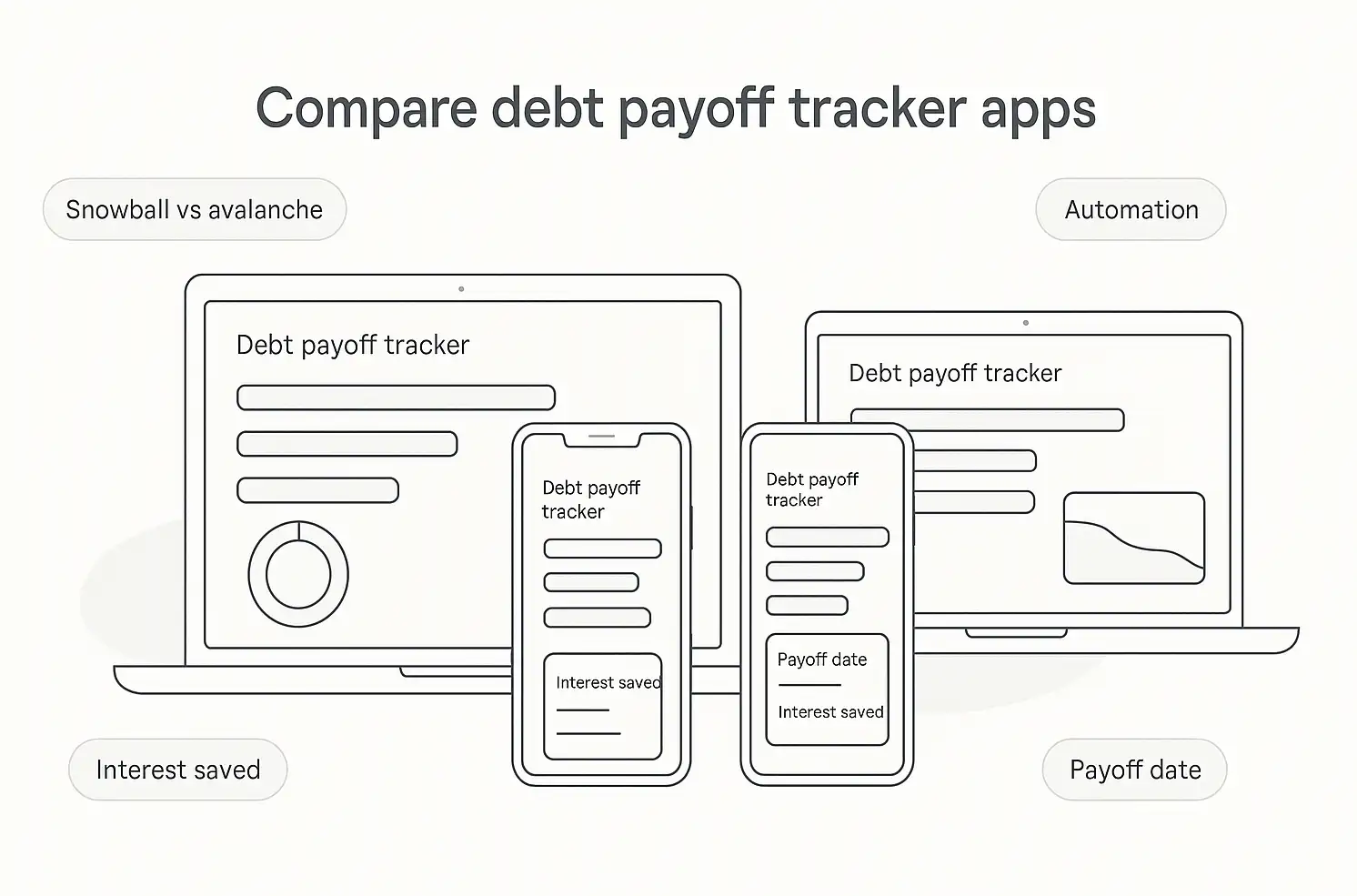
The foundation of any effective debt tracking tool starts with accurate calculation engines. The best apps support both popular debt elimination strategies: the debt snowball method (paying smallest balances first for psychological wins) and the debt avalanche method (targeting highest interest rates to minimize total cost).
Multiple debt support is non-negotiable for most users. Whether juggling credit cards, student loans, auto payments, or personal loans, the app should handle various debt types with different interest rates, minimum payments, and terms.
Payoff projections provide the motivation needed during tough months. Quality apps show exactly when each debt disappears and how much interest gets saved with different payment strategies.
Advanced Features That Matter
Bank integration eliminates manual data entry but raises privacy concerns for some users. Apps with secure syncing automatically update balances and payments, while manual entry options give users complete control over their financial data.
Budgeting integration helps users find extra money for debt payments by tracking spending and identifying areas to cut back. Some apps excel as standalone debt trackers, while others provide comprehensive financial management.
Progress visualization through charts, graphs, and milestone celebrations keeps users motivated during the long journey to debt freedom. The psychological aspect of debt payoff often determines success or failure.
Security and Privacy Considerations
Financial apps handle sensitive information, making data encryption and privacy policies crucial evaluation criteria. The best platforms use bank-level security, never sell user data, and provide transparent information about data handling practices. For more guidance on staying safe when using financial apps, you can review this online privacy and security guide from the Federal Trade Commission.
The 7 Best Debt Payoff Tracker Apps for 2025
Not sure which tool to start with? Use the quick comparison snapshot below to skim pricing, platforms, automation, and payoff methods for each app. In a few seconds you’ll see which options support snowball or avalanche, whether they sync with your bank, and which ones protect your data with manual entry only. Then you can jump down to the detailed reviews for a deeper look at the apps that actually fit your debt situation.
Quick Comparison Table
| App | Platforms | Best For | Debt Strategy | Bank Syncing | Cost |
|---|---|---|---|---|---|
| Debt Payoff Planner | iOS, Android | Free, focused debt payoff | Snowball & Avalanche | No | Free; optional ~$2.99/mo |
| YNAB | iOS, Android, Web | Budgeting + debt elimination | Snowball & Avalanche | Yes | ~$14/mo or $99/yr |
| Tally (closed 2024) | iOS, Android (historically) | Credit card automation (case study) | Automated card payoff optimization | Yes | Service closed; previously fee-based |
| Mint (discontinued 2024) | iOS, Android, Web (historically) | All-in-one money dashboard benchmark | Basic payoff tracking | Yes | Free, ad-supported (when active) |
| Debt Analyzer | iOS | Strategy and scenario comparison | Snowball & Avalanche comparisons | No | ~$0.99 one-time |
| Goodbudget | iOS, Android, Web | Envelope budgeting + debt | Custom order, snowball-like | No (manual entry) | Free; Plus ~$7/mo |
| Unbury.Me | Web | Quick, private web calculator | Snowball & Avalanche | No | Free |
1. Debt Payoff Planner (Best Free Option)
Pricing: Free with optional premium features ($2.99/month)
Platforms: iOS, Android
Debt Payoff Planner earns the top spot for free users seeking a comprehensive debt payoff app without breaking the bank. The interface strikes the perfect balance between simplicity and functionality, making it ideal for beginners overwhelmed by debt management.
Key Features:
- Complete snowball and avalanche method support
- Unlimited debt tracking across all categories
- Visual progress charts and payoff timelines
- Payment reminder notifications
- Export capabilities for tax preparation
Ideal For: Budget-conscious users who prefer manual entry and don’t need bank syncing. Perfect for families wanting to involve multiple people in debt planning without subscription costs.
Limitations: No automatic bank integration in free version, limited budgeting features, occasional ads in free tier.
The app shines in its educational approach, explaining debt strategies clearly and showing exactly how extra payments accelerate payoff timelines. Users consistently praise the motivational aspects, with many reporting increased payment consistency after seeing visual progress.
At a glance: big strengths are clear payoff timelines, flexible extra payment options, and easy snowball or avalanche toggles. The main trade-offs are no automatic syncing and only basic budgeting tools. This makes it best for users who want a focused debt dashboard they can update in a few minutes a week, and not ideal for anyone who insists on full bank automation and all-in-one budgeting inside the same app.
2. YNAB (You Need A Budget) – Best Overall Budgeting Software Integration
Pricing: $14/month or $99/year (34-day free trial)
Platforms: iOS, Android, Web
YNAB is first and foremost powerful budgeting software, but its debt tracking tools also make it a top choice if you want one home for your whole money life. The platform’s “give every dollar a job” philosophy naturally extends to debt elimination planning.
Key Features:
- Bank syncing across 12,000+ institutions
- Real-time balance updates
- Built-in debt payoff planning tools
- Detailed spending analysis to find extra payment money
- Goal tracking and milestone celebrations
Ideal For: Serious budgeters ready to transform their entire financial life, not just track debt. Best for users comfortable with a learning curve in exchange for powerful features.
Limitations: Higher cost than dedicated debt apps, steeper learning curve, overwhelming for users wanting simple debt tracking only.
YNAB’s strength lies in helping users find extra money for debt payments through detailed spending analysis. The platform’s educational resources and active community provide ongoing support throughout the debt elimination journey.
3. Tally (Previously Best for Credit Card Automation)
Pricing (when available): Free basic features, Tally+ at $300 annual fee
Status: Tally has shut down and is no longer available to new users as of 2024.
Until 2024, Tally took a unique approach by offering a line of credit to pay off higher-interest credit cards, then managing payments automatically. This debt payoff app was designed for users with strong credit scores who wanted hands-off debt management.
Key Features (when active):
- Automatic credit card payoff optimization
- Lower interest rate line of credit (for qualified users)
- Hands-free payment management
- Credit score monitoring
- Late fee protection
Ideal For (historically): Credit card debt holders with good credit scores who wanted automated optimization and didn’t mind a credit inquiry for the line of credit. If you’re not sure where your score stands, our guide on what is a good credit score explains typical ranges and simple ways to improve yours.
Limitations: Credit approval required, limited to credit card debt only, geographic restrictions, potential impact on credit utilization.
Tally’s automation appealed to busy professionals who understood the math behind debt optimization but lacked time for manual management. The service worked particularly well for users juggling multiple credit cards with varying interest rates.
Note: Because Tally has closed, use this description as a case study and look for current apps that offer similar automation and credit card payoff support.
4. Mint (Now Discontinued, Helpful Benchmark)
Pricing (when available): Free (ad-supported)
Status: Mint was discontinued in early 2024, and existing users were encouraged to move to other tools.
For many years, Mint provided robust debt and budget tracking within a complete personal finance ecosystem. While it wasn’t exclusively a debt app, its comprehensive approach made it valuable for users wanting everything in one place.
Key Features (when active):
- Free bank syncing and balance updates
- Debt payoff goal setting and tracking
- Spending categorization and budgeting
- Bill reminder notifications
- Credit score monitoring
Ideal For (historically): Users wanting comprehensive financial tracking without subscription costs, comfortable with ads and data monetization in exchange for free features.
Limitations: Ad-supported model, data privacy concerns, limited debt-specific features compared to specialized apps, occasional syncing issues.
Mint excelled at showing the big picture relationship between spending, saving, and debt payoff. The platform’s strength lay in helping users understand how lifestyle choices impact debt elimination timelines.
Note: Today, you can’t sign up for Mint as a new user, but it’s still a useful reference point when evaluating other budgeting and debt payoff dashboards.
5. Debt Analyzer (Best for Strategy Comparison)
Pricing: $0.99 (one-time purchase)
Platforms: iOS only
This simple but powerful app focuses exclusively on debt mathematics, making it perfect for users who want to understand exactly how different strategies impact their financial future.
Key Features:
- Side-by-side strategy comparisons
- Detailed interest calculations
- Multiple extra payment scenarios
- Clean, distraction-free interface
- One-time purchase model
Ideal For: iOS users who prefer one-time purchases over subscriptions, math-oriented individuals who want detailed calculations without extra features.
Limitations: iOS only, no bank syncing, minimal visual motivation features, basic interface design.
Debt Analyzer appeals to analytical users who make decisions based on hard numbers rather than gamification or visual progress. The app’s strength lies in its precise calculations and scenario modeling.
6. Goodbudget (Best Envelope Method Integration)
Pricing: Free (limited envelopes), Plus at $7/month
Platforms: iOS, Android, Web
Goodbudget combines traditional envelope budgeting with modern debt tracking, making it ideal if you want budgeting software that keeps your spending plan and debt payoff strategy in one place.
Key Features:
- Digital envelope budgeting system
- Debt tracking integrated with spending plan
- Household sharing capabilities
- Manual entry focus for privacy
- Web and mobile sync
Ideal For: Families using envelope budgeting methods, privacy-conscious users preferring manual entry, couples wanting shared financial planning.
Limitations: No bank syncing, manual entry required for all transactions, limited free version, learning curve for envelope method newcomers.
The app’s strength lies in connecting debt payoff with spending discipline through the proven envelope method. Users report better spending control and faster debt elimination when budgeting and debt tracking work together.
7. Unbury.Me (Best Free Web Tool)
Pricing: Completely free
Platforms: Web browser only
This simple web-based calculator provides powerful debt analysis without downloads, accounts, or data sharing. Perfect for users wanting quick strategy comparisons or privacy-focused debt planning.
Key Features:
- Instant debt strategy comparisons
- No account creation required
- Complete privacy (no data stored)
- Clean, fast interface
- Shareable results
Ideal For: Privacy-focused users, quick strategy comparisons, users who don’t want another app on their phone, financial advisors helping clients.
Limitations: Web-only access, no progress tracking over time, no reminders or notifications, basic feature set.
Unbury.Me excels as a decision-making tool for choosing debt strategies. Many users start here to understand their options before moving to full-featured tracking apps.
How to Choose the Right Debt Payoff Tracker App for Your Needs
Choosing the right debt tracking tool depends on your debt mix, tech comfort, and financial goals. The decision process becomes much clearer when you break it into a few key areas.
Think of this section like a simple menu, not a test: skim the headings, notice what sounds most like your real life, and choose one app that feels “good enough” to try for a couple of weeks.
Assess Your Debt Situation
Multiple debt types require apps with flexible categorization and different calculation methods. Users with only credit card debt might benefit from specialized tools that focus on credit card automation, such as the now-closed Tally or similar services, while those juggling student loans, auto payments, and credit cards need comprehensive platforms like YNAB or other all-in-one budgeting apps.
Debt complexity also matters. Simple situations with 2–3 debts work well with basic calculators or a free debt payoff tracker printable, while complex scenarios involving variable interest rates, promotional periods, or irregular payments benefit from advanced features.
Determine Your Management Style
Hands-on managers who enjoy daily financial engagement prefer apps with detailed tracking, manual entry options, and comprehensive reporting. These users often choose YNAB or Goodbudget for maximum control and insight.
Set-and-forget users want automation and minimal daily interaction. Tally’s automatic management or Mint’s passive tracking appealed to busy individuals who preferred background debt optimization when those services were available.
Privacy and Security Preferences
Privacy-focused users should prioritize apps with strong encryption, clear privacy policies, and minimal data sharing. Manual entry apps like Goodbudget or web tools like Unbury.Me provide maximum privacy control.
Convenience-focused users comfortable with data sharing can leverage bank syncing and automatic features in apps like Mint (when it was active) or current alternatives such as YNAB for streamlined management.
Budget Considerations
Free options like Debt Payoff Planner and other no-cost budgeting apps provide robust features without ongoing costs, which can be especially helpful if your budget already feels tight.
Premium investments can make sense for users with complex financial situations or those wanting comprehensive money management beyond debt tracking. If you actually use the tools and stick with your plan, the monthly cost can pay for itself through better financial decisions and faster debt elimination.
Real-World Examples
Example 1 — Solo borrower: Alex, 28, has three credit cards and a tight budget. They chose Debt Payoff Planner because it’s free, simple, and doesn’t require bank syncing. A quick weekly check-in is enough to stay on track.
Example 2 — Couple with mixed incomes: Maya and Jordan share rent and a car payment but keep some spending separate. They use YNAB to see their full picture and Goodbudget-style envelopes to keep shared categories like groceries and gas under control without oversharing every personal purchase.
3-Step Next-Action Checklist
- Pick your top 1–2 apps from the list above that match your management style and budget.
- Set aside 30 minutes to add every debt (balance, rate, minimum payment) and create a first-pass payoff plan.
- Schedule a weekly 10-minute check-in to update balances, adjust your plan, and celebrate progress.
Want to speed up your timeline without taking on more debt? One flexible option is to add a small, steady side income.
Even an extra $100–$200 a month from a side gig can make your app’s payoff timeline noticeably shorter.
Debt Elimination Strategies: Snowball vs. Avalanche
Understanding the two primary debt elimination methods helps users choose apps that support their preferred approach and personality type.
The Debt Snowball Method
The snowball approach focuses on psychological momentum by targeting the smallest debt balances first, regardless of interest rates. Users make minimum payments on all debts while throwing extra money at the smallest balance until it’s eliminated, then rolling that payment to the next smallest debt. If you’d like a deeper breakdown with examples, our debt snowball vs. avalanche guide walks through how both strategies compare.
Advantages:
- Quick wins provide motivation and momentum
- Simplifies decision-making process
- Reduces number of accounts faster
- Works well for people who need emotional encouragement
Best Apps: Debt Payoff Planner, YNAB, Goodbudget
The snowball method appeals to users who struggled with debt consistency in the past or those who need regular motivation to stay on track. Many financial experts recommend this approach for people with emotional spending issues or those who’ve failed at debt elimination before.
The Debt Avalanche Method
The avalanche strategy prioritizes mathematical optimization by targeting highest interest rate debts first. Users make minimum payments on all debts while directing extra payments toward the highest interest rate balance, saving the most money over time.
Advantages:
- Minimizes total interest paid
- Mathematically optimal approach
- Faster overall payoff timeline
- Appeals to analytical personalities
Best Apps: Debt Analyzer, Unbury.Me, YNAB
The avalanche method works best for disciplined users who can stay motivated by long-term savings rather than quick wins. This approach particularly appeals to users with significant high-interest credit card debt where interest savings make a substantial difference.
Hybrid Approaches
Many successful debt eliminators combine both methods, starting with snowball for motivation then switching to avalanche once momentum builds. Some apps support custom ordering, allowing users to create personalized strategies based on their specific situation and goals.
Staying Motivated During Your Debt Payoff Journey
The psychological aspects of debt elimination often determine success or failure more than mathematical optimization. The best debt payoff apps incorporate motivational features that help users persist through challenging months.
Visual Progress Tracking
Progress bars and charts provide immediate visual feedback on debt reduction progress. Seeing balances shrink and payoff dates approach creates positive reinforcement that encourages continued effort.
Milestone celebrations mark important achievements like paying off individual debts or reaching halfway points. Apps that acknowledge these victories help users appreciate progress during long payoff journeys.
Community and Accountability
Sharing features allow users to involve family members or accountability partners in their debt elimination journey. Apps like Goodbudget excel at household financial coordination.
Online communities within apps or associated forums provide support, encouragement, and practical tips from others facing similar challenges. The social aspect of debt elimination significantly improves success rates.
Goal Setting and Rewards
Specific payoff dates create concrete targets that feel more achievable than vague “someday” goals. Apps that calculate exact payoff timelines help users stay focused on the finish line.
Reward planning for debt-free milestones provides positive motivation throughout the process. Many users plan meaningful (but budget-friendly) celebrations for major debt elimination achievements.
If you need a boost on tough days, reading real-life debt payoff success stories can remind you that people with messy balances still become debt-free.
Common Mistakes to Avoid When Using Debt Tracking Apps
Even the best tools can’t prevent user errors that derail debt elimination progress. Understanding common pitfalls helps users maximize their chosen app’s effectiveness.
Over-Reliance on Technology
Apps supplement but don’t replace fundamental financial discipline. Users who expect apps to automatically solve debt problems without behavior changes often experience disappointment.
Manual verification remains important even with automatic syncing. Bank errors, duplicate transactions, or syncing delays can create inaccurate data that leads to poor decisions.
Inconsistent Usage
Sporadic tracking undermines the benefits of debt monitoring. Users who update apps irregularly miss opportunities to adjust strategies and lose motivational momentum.
Abandoning apps mid-journey when motivation wanes represents a common failure pattern. Choosing sustainable tools and building habits around regular usage prevents this issue.
Perfectionism Paralysis
Endless app switching in search of the “perfect” tool wastes time and energy better spent on actual debt payments. Most apps provide adequate functionality for successful debt elimination.
Over-optimization of strategies can distract from the simple truth that consistent payments matter more than perfect mathematical optimization.
Frequently Asked Questions
Conclusion
Choosing the right debt payoff app can turn your debt from an overwhelming weight into a manageable, step-by-step journey toward freedom. Whether someone prefers the comprehensive features of YNAB, the simplicity of Debt Payoff Planner, or the automation of tools like Tally once offered, the best app is the one that gets used consistently.
The key to successful debt elimination isn’t finding the perfect app—it’s building sustainable habits around tracking progress, making consistent payments, and staying motivated through inevitable challenges. Start with any quality app that matches your budget and technical comfort level, then focus on the daily actions that actually eliminate debt.
Remember Sarah from our opening story? She chose Debt Payoff Planner for its free features and clear strategy comparison. Eighteen months later, she’s eliminated three credit cards totaling $23,000 and has a clear timeline for becoming completely debt-free. The app didn’t pay off her debt—but it provided the roadmap and motivation she needed to do it herself.
Take action today: Download one of these recommended apps, input your current debts, and see your personalized payoff timeline. The journey of a thousand miles begins with a single step, and debt freedom starts with knowing exactly where you stand and where you’re going.
References
Source: Federal Reserve Bank of St. Louis, “Consumer Credit Outstanding,” Economic Data, 2024.
This debt payoff tracker app guide is for general education and doesn’t provide personalized financial, legal, or tax advice. Always confirm current terms and availability with each app and consider speaking with a qualified financial professional or nonprofit credit counselor before making major debt decisions.

