
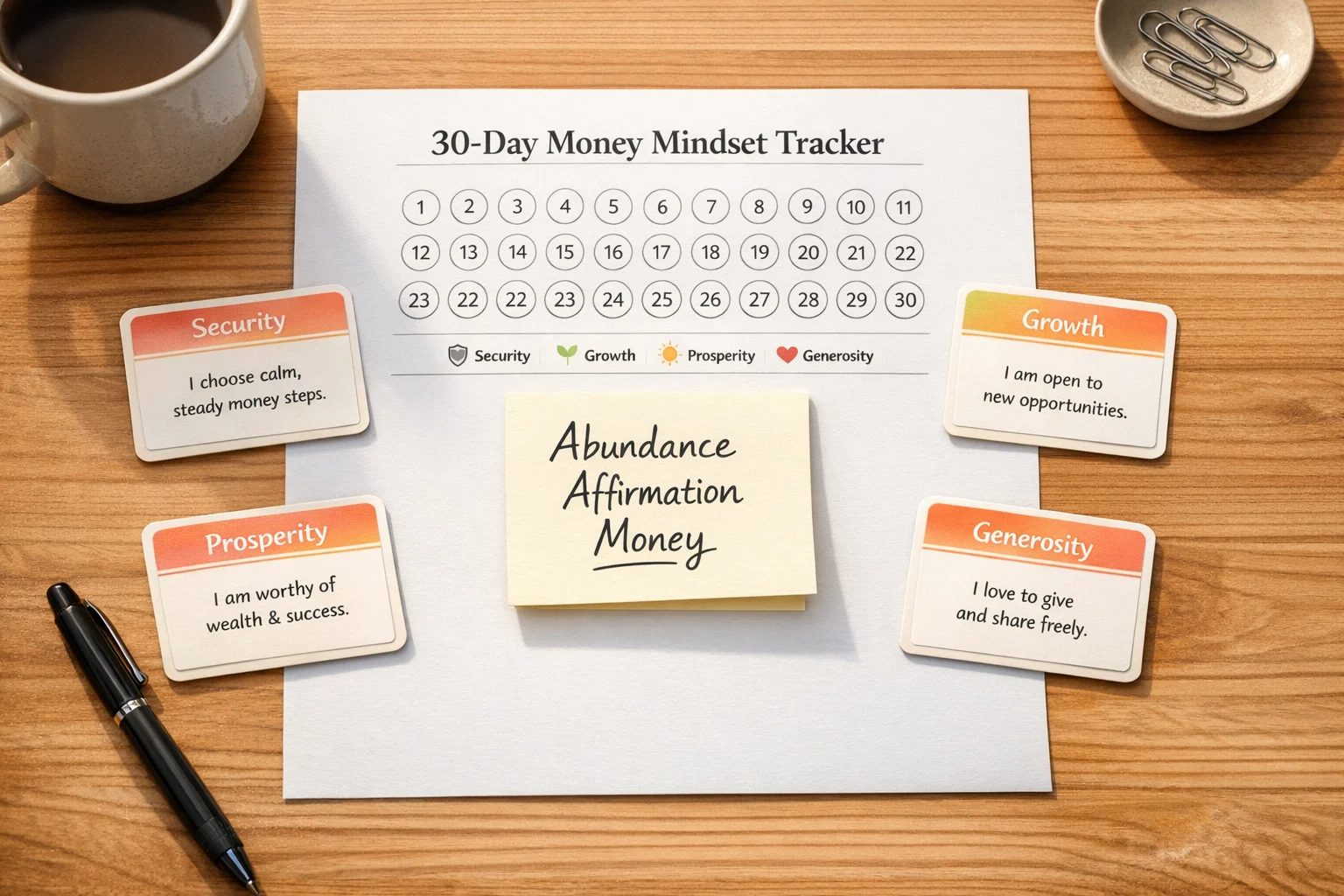
If you’re looking for abundance affirmation money statements that feel grounded and useful, start with a line you can believe and an action you can take. This guide gives you 30 statements with action cues, plus a quick theme picker for security, growth, prosperity, and generosity.
Use the line as a cue, not a promise. Bring it into a real money moment—budgeting, bill pay, saving, or reviewing a goal—then do one small action you control. For the broader framework behind this approach, start with our money mindset guide.
This post contains affiliate links. If you purchase through them, we may earn a commission at no extra cost to you. As an Amazon Associate, I earn from qualifying purchases. Learn more.
Table of Contents
- Pick a Theme, Get 5 Money Affirmations
- How to Use Money Affirmations in a Grounded Way
- 30 Money Affirmations With Action Cues
- Make Money Affirmations a Habit
- Track Actions, Not Just Feelings
- See the Numbers Behind Your Next Money Check-In
- When Money Affirmations Feel Fake or Frustrating
- Make the Practice More Useful
- Frequently Asked Questions
- Start With One Believable Line
Not sure which set fits today? Pick the theme that matches the money moment you’re dealing with right now.
Pick a Theme, Get 5 Money Affirmations
Choose one theme. You’ll get five money affirmations with one small action cue for each.
What do you want to focus on today?
How to Use Money Affirmations in a Grounded Way
Before you keep any affirmation, run it through three questions:
- Can I believe it? If the wording makes you argue with yourself, soften it to “I’m learning to…” or “I can…”.
- Does it point to something I can influence? “I review my plan before reacting” is more grounded than a statement that promises a financial outcome.
- What action follows? Name the next small step—check the numbers, review a goal, learn something, or make a planned adjustment.

Money affirmations are best treated as prompts, not financial interventions. In psychology, self-affirmation usually means reflecting on important values, attributes, or relationships—not simply repeating a positive sentence. A meta-analysis of self-affirmation interventions found small positive effects on message acceptance, intentions, and behavior in health contexts. That supports the broader idea of pairing reflection with action, but it does not show that money affirmations increase income or wealth.
Generic positive self-statements are also not universally helpful. In experiments published in Psychological Science, some participants with low self-esteem felt worse after repeating an unrealistically positive statement, while benefits for participants with higher self-esteem were limited. If a line feels implausible or makes you tense, soften it rather than forcing it.
If Financial Independence, Retire Early is part of your goal, the same rule applies during market swings or slow-progress periods: choose wording about the behavior you control, not a promised outcome. If you’re newer to the concept, this FIRE method beginner guide explains the broader framework.
30 Money Affirmations With Action Cues
These 30 financial affirmations are grouped into four themes: security, growth, prosperity, and generosity. Treat them as templates, not predictions. If a line feels too absolute, soften it to “I’m learning to…” or “I can…”. If you want shorter, quote-style options, browse these abundance affirmation quotes.
Financial Security Affirmations
Use these when stability, calmer follow-through, and protecting the basics are the priority.
- “I am worthy of financial security and peace of mind.”
Action cue: Check your emergency fund balance and celebrate any progress. - “I’m open to building steadier income over time.”
Action cue: Review your income sources and brainstorm one new possibility. - “I make smart decisions that protect my financial future.”
Action cue: Read one article about personal finance or investing. - “My spending can align more closely with my values and goals.”
Action cue: Review yesterday’s spending and name one “values” purchase. - “I am building a stronger financial foundation over time.”
Action cue: Review one automatic transfer, bill, or reminder that supports a financial goal. - “I can create more financial breathing room over time.”
Action cue: Identify one recurring cost or upcoming expense you want to review. - “I can handle financial challenges one step at a time.”
Action cue: Update your budget or spending tracker with recent transactions. - “I strengthen my financial security through consistent choices.”
Action cue: Review your progress toward one money goal.
Opportunity and Growth Affirmations
Use these when you want to focus on skills, income options, learning, or recovering from a setback.
- “I notice opportunities that fit my skills and values.”
Action cue: Send one networking message or refresh your LinkedIn headline. - “I can grow my earning power by building useful skills and creating value.”
Action cue: Identify one way to improve your work performance this week. - “I’m open to earning from more than one source.”
Action cue: Write down one side-hustle idea that fits your existing skills and available time. - “I can learn something useful from financial setbacks.”
Action cue: Write down one lesson from a past money mistake. - “I can learn to invest in ways that fit my goals and risk tolerance.”
Action cue: Learn one investing concept that applies to a goal you already have. - “I can use automation to keep long-term goals moving.”
Action cue: Review one automatic transfer or reminder tied to a long-term goal. - “I can get better at spotting useful opportunities.”
Action cue: Spot one inefficiency that could save you money or time. - “I can keep expanding my financial knowledge.”
Action cue: Read a chapter from a money book or listen to one podcast episode.
If freelance work fits your skills and available time, browse freelance projects on Upwork to see what clients are actually hiring for. If client work would crowd out your main job or recovery time, skip it.
Abundance and Prosperity Affirmations
Use these abundance affirmations when that language motivates you, but you want to keep it tied to real choices and constraints.
- “I’m open to creating more financial abundance through consistent choices.”
Action cue: Write one sentence about what more financial breathing room would let you do. - “I can stay open to income from more than one source while staying grounded.”
Action cue: Check for forgotten accounts, rebates, or refunds. - “I am allowed to want more comfort and financial breathing room.”
Action cue: Plan one small joy purchase that fits your budget. - “My money mindset can support more deliberate financial choices.”
Action cue: Replace one negative money thought with a practical reframe. - “I can practice an abundant mindset without ignoring reality.”
Action cue: Name one financial constraint you need to plan around this month. - “Money is a tool that can support the life I want to build.”
Action cue: Write three goals money supports (health, time, freedom, family). - “My consistent actions can strengthen my financial position over time.”
Action cue: Complete one small task toward a money goal today.
Generosity and Impact Affirmations
Use these when you want money goals to stay connected to giving, relationships, and community impact.
- “I can share in ways that fit my current resources.”
Action cue: Choose one way to give time, money, or practical help that fits your current resources. - “As my resources grow, I can choose to support what matters to me.”
Action cue: Research one cause you’d like to support as you progress. - “I can create value for others while building my own financial stability.”
Action cue: Share a useful resource or practical help with someone who asked. - “Money can expand the ways I serve and contribute.”
Action cue: Volunteer your time or skills for a cause you care about. - “I am grateful for the resources and progress I have today.”
Action cue: Write a thank-you note to someone who helped your journey. - “I can share useful lessons without pretending my path fits everyone.”
Action cue: Share one practical tip with a friend who asked for help. - “I can use money as a force for good in my life and community.”
Action cue: Choose one way your next money milestone could support something you value.
Make Money Affirmations a Habit
You do not need a daily streak. Attach one statement to a money moment you already have, then use the format that fits your routine.
Morning cue: Read one statement while you make coffee if that genuinely helps you remember it. Skip this if mornings have nothing to do with your money decisions.
Weekly check-in: During your budget review, read through your current theme and do one action cue. If you need a simple framework for the numbers, the 50/30/20 budget rule can be a helpful starting point.
Stress reset: When an unexpected expense, market dip, or tough bill has you spiraling, pick one security-focused line and do the action cue before making a decision.
Track Actions, Not Just Feelings
The point is not to prove that an affirmation “worked.” Track what you actually did after using it. If you already use a spreadsheet or app, keep the system simple; if you want options, browse this list of free financial tools and pick one you’ll actually stick with.
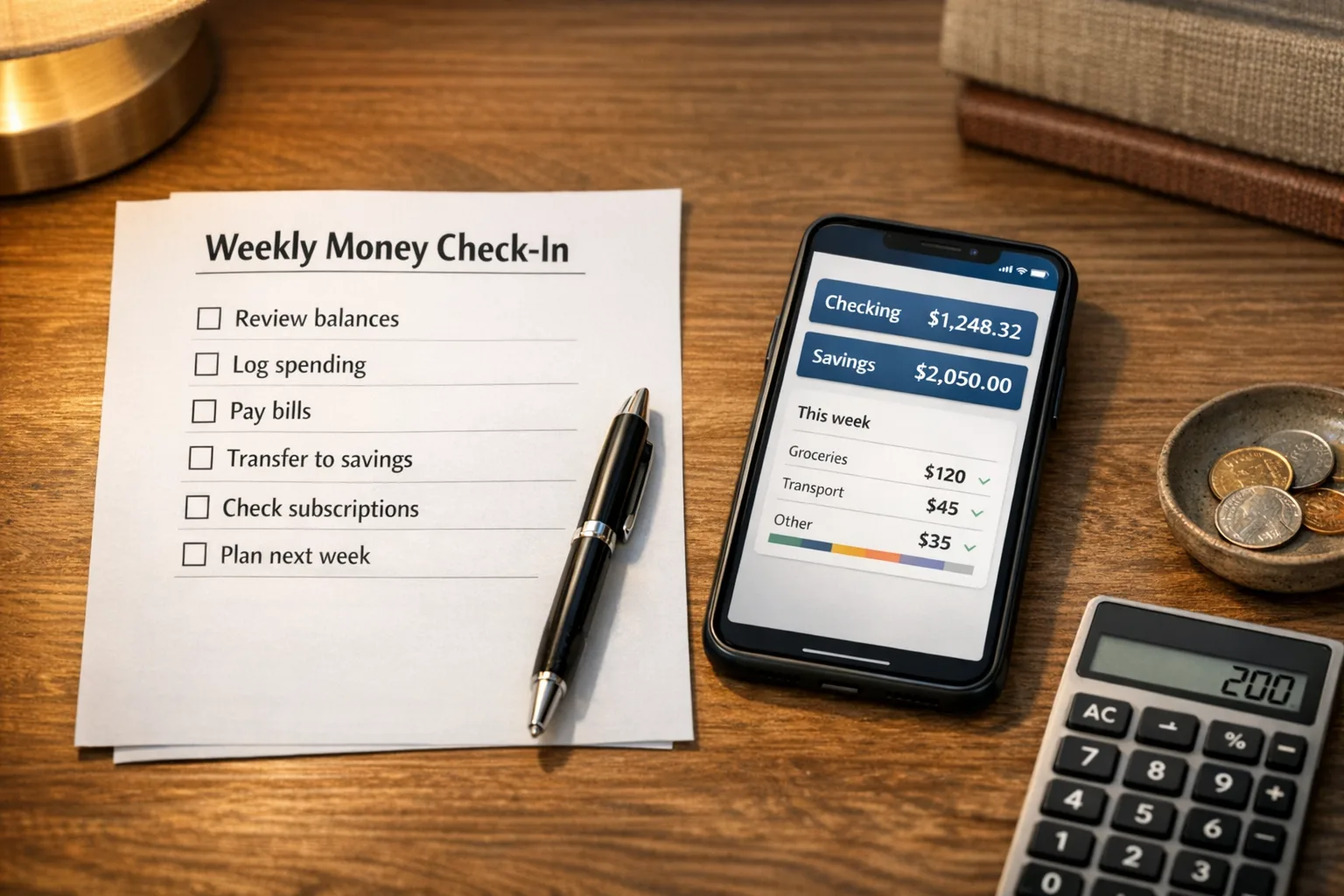
The Affirmation Journal (simple version): once a week, note your dominant money feeling, one action you took, and one win—big or small.
| Week | Dominant Money Feeling | Key Action Taken | Observed Win |
|---|---|---|---|
| 1 | Anxious → Hopeful | Automated savings | Started an emergency fund |
| 2 | Scarcity → Curious | Explored extra income ideas | Took one small “growth” step |
| 3 | Worried → More informed | Checked retirement contribution settings | Confirmed the next review step |
If you want your next money check-in to include the numbers behind the habit, put income, spending, debts, and goals in one place before choosing the next action.
See the Numbers Behind Your Next Money Check-In
Enter income, spending, up to 8 debts, and up to 8 goals; the SNAPSHOT sheet brings the key numbers together automatically.
Confirm to get the workbook and frugal money tips. Unsubscribe anytime.
Something went wrong. Please check your email address and try again.
When Money Affirmations Feel Fake or Frustrating
“This feels fake when money is tight.” Start with bridge lines like “I’m learning to build more stability” or “I’m taking one step today.” The goal is believable progress, not pretending.
“I don’t see results fast enough.” Look for behavioral wins first: opening an account or statement you used to avoid, checking your budget without panic, or completing one planned transfer. If money stress is hitting hard lately, these practical money stress tips can help you steady the basics.
“A downturn makes me doubt everything.” Use the practice to slow the reaction, not to talk yourself out of real risk. Choose one security-focused line, check the relevant numbers or plan, then decide what to do next.
Make the Practice More Useful
Visualize the action: Instead of picturing a vague future, picture the exact behavior you want to do next—logging into your bank, setting an auto-transfer, or opening your plan before you react.
Use a real memory: Recall a money decision you handled thoughtfully, even if it was small. Pair the statement with that concrete example so the wording has something real to point to.
Put the cue where the decision happens: Keep one line near the place you actually make money choices—your wallet, phone reminder, budget sheet, or laptop.
What Repetition Is For
Small choices repeat, and familiar cues can make a preferred response easier to remember when money gets tense. The useful test is behavioral: does the phrase help you check the numbers, pause before reacting, or take the next planned step?
If you want a companion practice, try this abundance mindset exercises list alongside your weekly check-in.
Go Deeper: Practical Money Mindset Reads
If the phrases help but you want more context for the behavior underneath them, these two books go deeper than another affirmation list. Choose by the question you want to work on:
| Best for | Book | Next step |
|---|---|---|
| Behavior and judgment | The Psychology of Money — explores how behavior and judgment shape financial decisions. | |
| Values, time, and financial independence | Your Money or Your Life — connects spending with values, time, and financial independence. |
If neither description matches what you need, compare the five approaches in our money mindset book guide—or skip the purchase; the action cues above are enough to use the practice without a book.
Frequently Asked Questions
Start With One Believable Line
You do not need perfect optimism or a long routine. Pick one statement you can believe, attach it to a real money moment, and use the action cue to decide what happens next. If the wording makes you argue with yourself, soften it or drop it.
- Choose one theme. Use the picker or full list to find a statement that matches what you need now.
- Choose one recurring cue. A budget review, bill-pay session, savings transfer, or goal check is enough.
- Judge the behavior, not the vibe. Keep the line if it helps you check, pause, learn, or act; rewrite or retire it if it does not.
The affirmation is doing its job when it helps you meet the next money decision with a little more clarity and follow-through—not when it promises an outcome.
This guide is for general education and habit-building, not personalized financial or mental-health advice. Affirmations do not guarantee financial results. If money stress is affecting your daily life, consider support from a qualified financial or mental-health professional.

