

If one unexpected expense can make you feel like you’re always one step behind, “abundance mindset” may sound like advice to pretend everything is fine. This guide takes the opposite approach: these abundance mindset exercises use gratitude, evidence, planning, and small actions to build practical money confidence by helping you notice options without ignoring real constraints.
Start with the matcher to choose one habit for this week, then treat the seven exercises as options you can rotate through rather than a seven-step program. If you want the broader framework behind scarcity and abundance, our money mindset guide goes deeper.
This page contains paid/affiliate links. Amazon disclosure: “As an Amazon Associate I earn from qualifying purchases.” Frugal Harpy may also earn commissions from other partners—at no extra cost to you. Links marked with ‘#ad’ are Amazon affiliate links. Learn more.
Table of Contents
- Find Your Best Starting Habit
- How to Use These Abundance Mindset Exercises
- 1. Gratitude Journaling with Money-Specific Prompts
- 2. Evidence Logs That Counter Scarcity Stories
- 3. Visualization Paired with Next-Step Planning
- 4. Identity-Based Affirmations Tied to Behaviors
- 5. Generosity Micro-Acts That Fit Your Budget
- 6. Weekly Opportunity Scanning Sessions
- 7. Reframing Setbacks into Learning Reviews
- Turning These Practices into Lasting Habits
- Measuring Your Progress
- Put Income, Spending, Debts, and Goals on One Screen
- Frequently Asked Questions
- Your 7-Day Starting Plan
Not sure which exercise fits first? Use the matcher below to choose one starting habit from your current friction, available time, and goal.
Find Your Best Starting Habit
Choose the answers that fit an ordinary week. You’ll get one habit to start now and one to add later.
Your starting habit
Your result will name one habit to start with and one to layer in later.
Keep the first step small enough to repeat.
Use that result as your first experiment. The four rules below make any of the seven exercises easier to repeat.
How to Use These Abundance Mindset Exercises
- Keep the practice small. Start with the shortest version you can repeat in an ordinary week.
- Use evidence, not hype. Log concrete wins and setbacks so you can see what is actually changing.
- Pair mindset with action. Each exercise ends with a practical next step.
- Measure behavior too. Track follow-through and real money actions, not just how motivated you feel.
1. Gratitude Journaling with Money-Specific Prompts
If the quiz sent you here because money feels anxious, start with this low-pressure practice. You’re not pretending everything is fine; you’re giving yourself a concrete prompt to notice what is already supporting you. If anxiety is running the show, this pairs well with practical strategies to overcome money stress without forcing toxic positivity.
Start each morning by writing down three money-related things you’re grateful for. Keep it small and concrete:
- “I’m grateful the grocery budget covered what I needed this week.”
- “I appreciate the small automatic transfer I already set up.”
- “I’m thankful I noticed a charge before it renewed.”
For a research-backed version of this exercise, see UC Berkeley’s Greater Good gratitude journal practice.
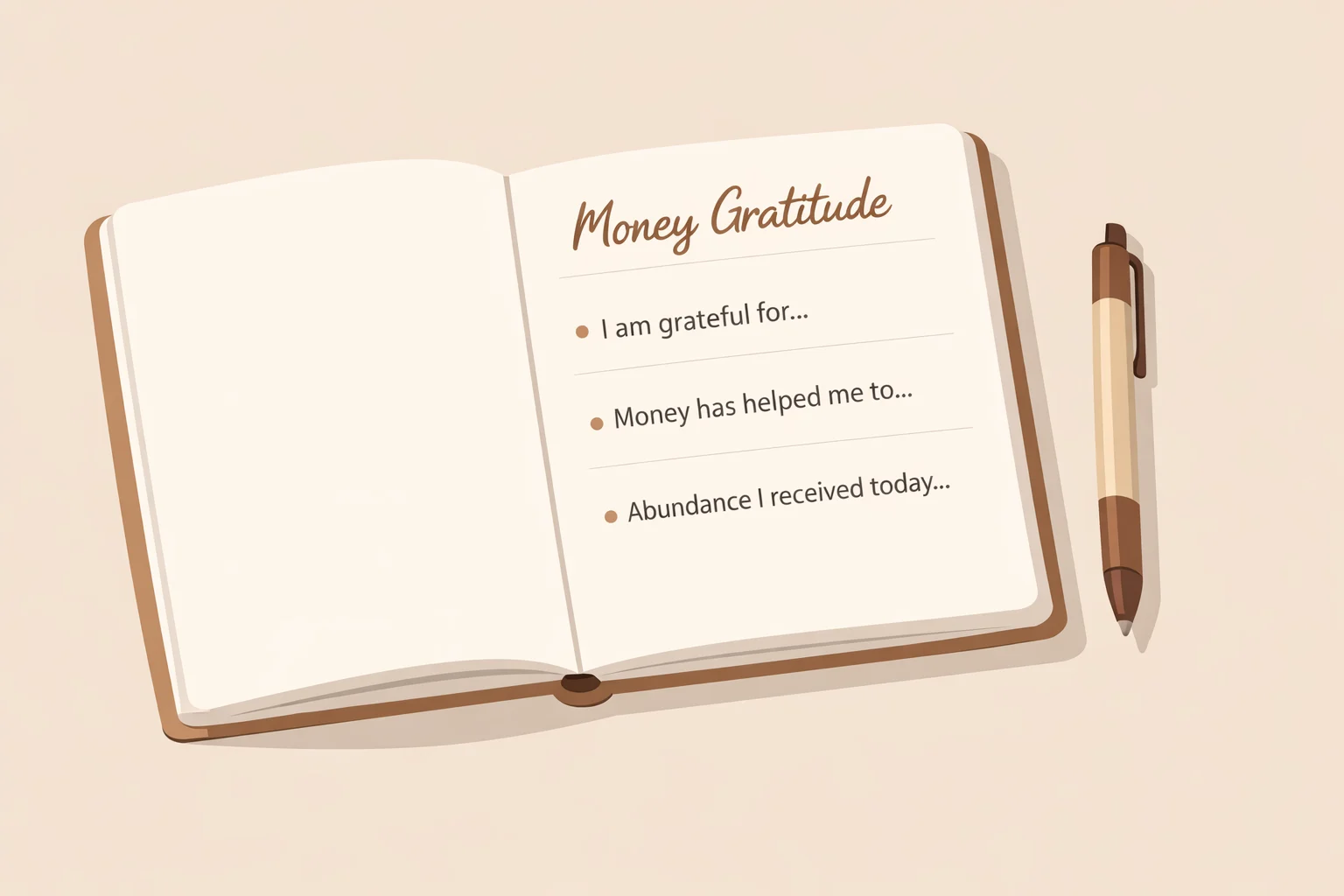
Try this today: Set a 2-minute timer and write one “money win” from the last 24 hours.
Best for: guided prompts when blank pages make you stall.
The Five Minute Journal is undated and uses short daily prompts. Add one money-specific line—“Today’s money win: ___”—so the journal supports the exercise instead of replacing it. If a notebook you already use works, keep it.
2. Evidence Logs That Counter Scarcity Stories
If the quiz sent you here because you feel stuck—or suggested this as a follow-on habit for more proof—use it as your evidence anchor. Scarcity thoughts can feel absolute; a written log gives you specific examples to review instead.
Create a simple weekly log of concrete examples that challenge limiting money beliefs. Organize entries by the story you’re trying to interrupt:
- “There’s never enough money.” Cancelled an unused renewal and kept that amount in this month’s plan.
- “Good opportunities don’t happen for me.” Found a free workshop, got a referral, or spotted a project worth pitching.
Try this today: Write one sentence: “One piece of evidence that I have more options than I noticed yesterday is…”
3. Visualization Paired with Next-Step Planning
If the quiz suggested this as a follow-on habit for momentum, use it to turn a fuzzy goal into a plan you can act on. Visualization is the prompt; the next step is the useful part.
Part 1 (5 minutes): Pick one financial situation you want to improve over the next 3–12 months. Picture what is concretely different: what gets automated, what balance changes, or what decision feels easier?
Part 2 (10 minutes): Write three “bridge actions” that could move you toward that specific outcome:
- One action today
- One action this week
- One action this month
Try this today: Write your “today action” on a sticky note and place it where you’ll see it.
4. Identity-Based Affirmations Tied to Behaviors
If the quiz sent you here because you’re avoiding money tasks, start with a statement tied to one behavior you can complete. The goal is not to repeat a phrase until it feels true; it is to choose an action you can point to.
Swap vague affirmations for identity statements tied to actions:
- Instead of: “I am wealthy.” Try: “I’m someone who saves a small amount each payday.”
- Instead of: “Money flows to me.” Try: “I’m someone who looks for one income opportunity each week.”
If you want more examples, these money affirmations with action cues use the same “statement + behavior” pattern.
Try this today: Pick one identity line and do the smallest action that makes it true.
5. Generosity Micro-Acts That Fit Your Budget
This is for the “I have to hold tight or I’ll lose everything” feeling. Tiny generosity is not a financial strategy, and it should never strain your budget; the exercise is simply to practice giving in a way that feels sustainable.
Try micro-acts that feel joyful and sustainable:
- Make a helpful introduction between two contacts
- Send a useful resource or offer a small favor
- If it already fits your budget, add a modest extra tip or small gift
For the research background, the 2008 paper Spending Money on Others Promotes Happiness reported several studies linking prosocial spending with greater happiness.
Try this today: Do one non-money version—send a helpful resource to someone you like.
6. Weekly Opportunity Scanning Sessions
If the quiz sent you here because you feel ready to grow, use this weekly scan to look deliberately for options instead of waiting for them to feel obvious.

Set aside 20 minutes to scan for opportunities in three buckets:
- Earn: freelance work, side hustles, skills you could offer
- Save or use: benefits or credits, refunds owed, subscriptions to cancel, or resources you already have
- Learn or connect: free workshops, mentors, people to ask, or questions worth researching
If you want a fast idea list to seed your scan, try these side hustles that fit a frugal lifestyle.
Try this today: Write down two “problems people complain about” that you could solve.
7. Reframing Setbacks into Learning Reviews
This is the one you use when you feel embarrassed, behind, or like you “should’ve known better.” A learning review turns the moment into data instead of a verdict on you.
Use a simple 4-step review:
- Facts: What happened (no drama, just details)?
- Lessons: What did this teach you?
- Next move: What one change matters most?
- Growth: What did you do right by showing up?
Try this today: Write one lesson from a recent money mistake—then one tiny “next move.”
Turning These Practices into Lasting Habits
To turn these practices into abundance mindset habits, give one practice a reliable cue instead of relying on motivation alone.
- Morning coffee: one money-gratitude line
- Weekly planning: opportunity scan + evidence log review
- After a setback: a 10-minute learning review
Best for: making the habit visible in your weekly plan.
The Clever Fox Weekly Planner combines undated weekly and monthly pages with goals and habit tracking. If your current calendar or notebook already keeps the cue visible, keep using it instead.
If you want more structure for making money routines stick, these budgeting habits that stick pair especially well with mindset work.
For the habit-formation research behind repetition and cues, see Lally et al.’s classic 2010 study of habit automaticity: Modelling habit formation in the real world.
Try this today: Pick one habit and “stack” it onto something you do daily—same cue, same time.
Measuring Your Progress
Track both how the practice feels and what you actually do. That keeps progress from depending on mood alone.
- State: before a money task, how tense or calm do you feel?
- Follow-through: did you complete the habit when its cue came up?
- Practical action: what did you actually do next—check a balance, cancel a charge, send a pitch, move money, or ask a useful question?
Use one simple tracker you’ll actually open; this roundup of free financial tools can help you pick a clean, low-friction option.
Try this today: Pick one behavior to track for seven days, such as completing your 2-minute journal or checking your balance without putting it off.
If your seven-day habit check makes you want a clearer baseline, this is the point to look at the money itself—not just the behavior.
Put Income, Spending, Debts, and Goals on One Screen
Enter income, spending, up to 8 debts, and up to 8 goals; the SNAPSHOT sheet brings the key numbers together automatically.
Confirm to get the workbook and frugal money tips. Unsubscribe anytime.
Something went wrong. Please check your email address and try again.
Frequently Asked Questions
Your 7-Day Starting Plan
For the next seven days, use only the quiz’s first recommendation. Choose its smallest version, attach it to a repeatable cue, and track one behavior—not whether you feel “abundant” all day. At the end of the week, keep the practice if it helped you notice or take a useful action; otherwise, retake the starter-habit matcher and choose a better fit. Add the follow-on habit only after the first one feels easy to repeat.
If the week shows that the habit is easy enough to repeat but your money system still feels harder than it needs to be, compare minimalist budgeting tools and choose the simplest setup you can keep using.
This guide is for general education, not personalized financial or mental health advice. Your situation and results can vary. If money stress feels persistent or overwhelming, consider talking with a qualified professional who can help you choose an appropriate next step.

