
If you’re choosing between a 401(k), Roth 401(k), traditional IRA, Roth IRA, HSA, or taxable brokerage account, do not start by asking which account is “best.” Start with three questions: which accounts can you use, when do you want the tax benefit, and how much access do you need before retirement? The investments inside the account are a separate decision.
This US-focused retirement account guide compares those choices using 2026 federal limits and current tax rules, then gives you an adaptable funding order. If you want the fastest route, use the two-question tool after the table of contents; if you want the details, work through the account types, tax treatment, and action plan in order.
This post contains affiliate links. If you buy through our links, we may earn a commission at no extra cost to you. Learn more.
Table of Contents
- Find Your Retirement Account Starting Point
- Quick Overview of Retirement Account Types
- Retirement Accounts for Self-Employed & Small Business Owners
- How Retirement Accounts Are Taxed
- See What Your Next Retirement Contribution Has to Fit Around
- Create Your Retirement Account Action Plan
- Make Your Retirement Plan Easier to Follow
- Frequently Asked Questions
- Choose Your Next Retirement-Account Step
Want the shortest route through this guide? Use the tool below to find the section that matches the retirement-account decision you are trying to make.
Find Your Retirement Account Starting Point
Answer two quick questions. You will get a section to review next—not a personalized recommendation. This tool does not know your income eligibility, tax bracket, plan fees, debt, HSA eligibility, cash needs, or full financial picture.
Before you compare the accounts, write down whether you have a workplace retirement plan, whether it offers a match, and which retirement accounts you already own. Those three facts will make the comparison below easier to apply to your situation.
Quick Overview of Retirement Account Types
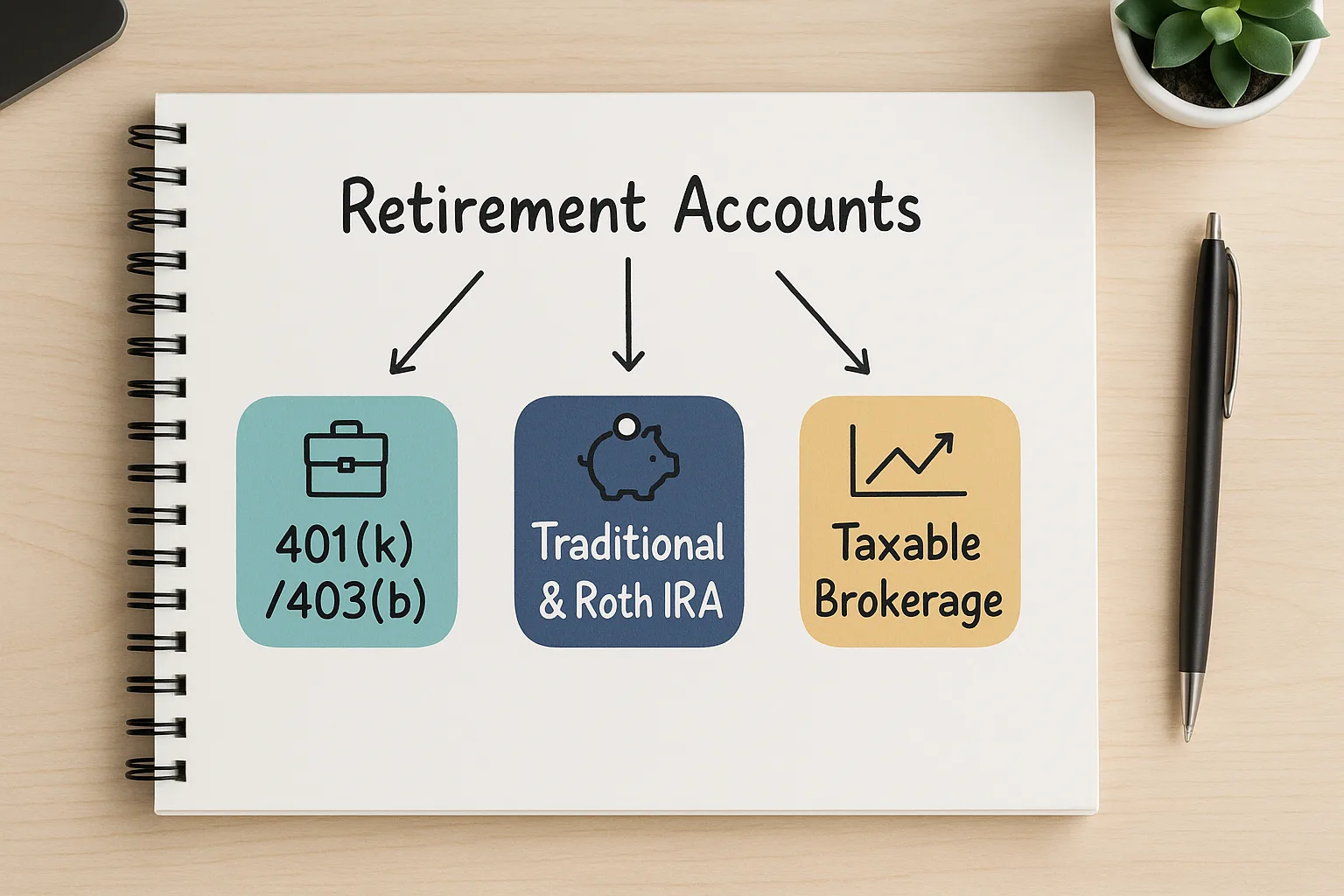
For understanding retirement accounts, start by separating the account from the investment inside it. A 401(k), IRA, or HSA sets tax and withdrawal rules; the funds, stocks, bonds, or other investments you choose inside the account determine how the money is invested. If choosing the investments is the part you need next, our beginner’s guide to investing treats that as a separate decision.
Most US retirement saving fits into five practical buckets: employer plans such as 401(k)s and 403(b)s, individual retirement accounts, self-employed plans, HSAs for eligible savers, and taxable brokerage accounts for money that sits outside a retirement wrapper. You do not need every bucket. You need to understand which ones you can actually use and what trade-off each creates.
| Account type | When it is available | Federal tax pattern | First thing to check |
|---|---|---|---|
| 401(k), 403(b), or 457(b) | When an employer offers the plan | Traditional and/or Roth treatment, depending on the plan | Match, vesting, fees, investment choices, and Roth availability |
| Traditional IRA | Under the IRA contribution rules | A deduction may be available; taxable amounts are generally taxed when distributed | Deductibility, workplace-plan coverage, and the annual IRA limit |
| Roth IRA | When contribution and income rules are met | After-tax contributions; qualified distributions can be tax-free | Income eligibility and the qualified-distribution rules |
| HSA | When the HSA eligibility rules are met | Potential federal tax benefits on contributions, earnings, and qualified medical distributions | Health-plan eligibility, contribution limit, and account costs |
| SEP IRA, SIMPLE IRA, or solo 401(k) | For qualifying self-employed or small-business situations | Plan-specific contribution and tax rules | Employees, compensation, contribution formula, and administration |
| Taxable brokerage account | Outside the retirement-plan system | Dividends, interest, and realized gains may create current tax | Flexibility, taxes, investment risk, and why the money needs to stay accessible |
Micro-action: Start with the rows you can actually use. Then compare the tax treatment and first-check column before deciding where the next dollar should go.
401(k) Plans: Start With Your Employer Plan Rules
A 401(k) is an employer-sponsored defined contribution plan. Before comparing it with an IRA, check whether your employer matches contributions, what the vesting schedule is, what investment options and fees the plan offers, and whether the plan includes a Roth feature. The IRS 401(k) contribution-limit page is the primary source for current federal limits.
Traditional 401(k): The Tax-Deferred Approach
How it works: Traditional 401(k) elective deferrals are generally made pre-tax for federal income-tax purposes, reducing current taxable income. Tax is generally due when taxable amounts are distributed later.
2026 employee contribution limit:
- Standard elective-deferral limit: $24,500.
- If the plan permits catch-up contributions, the general age-50+ catch-up is $8,000.
- For participants who are age 60, 61, 62, or 63 during 2026, the higher catch-up limit is $11,250 instead of $8,000.
One 2026 catch-up rule is easy to miss: some age-50+ participants with more than $150,000 of 2025 FICA wages from the employer sponsoring the plan must make their 2026 catch-up contributions as Roth contributions. Because the rule is plan-specific, confirm how your plan is implementing it. IRS Notice 2025-67 lists the $150,000 threshold.
Your plan can impose lower limits, and employer contributions follow a separate overall plan limit. The IRS updates these amounts for cost-of-living changes, so recheck them when a new tax year begins.
Roth 401(k): Pay Tax Now for Potentially Tax-Free Qualified Withdrawals
How it works: Roth 401(k) contributions are included in current taxable income. Qualified distributions can be tax-free, but the account must meet the applicable qualified-distribution rules. Traditional and Roth 401(k) deferrals share the same employee elective-deferral limit. The IRS explains the five-year and qualifying-event tests in Roth Account in Your Retirement Plan.
When a Roth 401(k) may be worth comparing:
- Your current marginal tax rate is relatively low compared with the rate you reasonably expect to face on future withdrawals.
- You want some retirement money in both pre-tax and Roth tax buckets rather than betting everything on one future tax outcome.
- Your plan’s Roth option has reasonable investment choices and fees.
Age by itself does not make Roth automatically better. Current income, expected future taxable income, state taxes, plan quality, and the value of a deduction today all matter.
Individual Retirement Accounts (IRAs): More Choice, Different Limits
Traditional and Roth IRAs are individual accounts rather than employer plans. They often offer a wider investment menu than a workplace plan, but the annual contribution limit is much lower and tax benefits can depend on income and workplace-plan coverage.
Traditional IRA: When Your Contribution May Be Deductible
2026 IRA contribution limit: $7,500 across all of your traditional and Roth IRAs combined, or $8,600 if you are age 50 or older.
Traditional IRA deduction phase-outs for 2026 depend on workplace-plan coverage and filing status. For someone covered by a retirement plan at work, the deduction phases out from $81,000–$91,000 for single/head-of-household filers and $129,000–$149,000 for married filing jointly when the contributing spouse is covered. Different rules apply when only the other spouse is covered. See the IRS 2026 retirement-limit update before relying on a threshold.
Roth IRA: After-Tax Contributions, Potentially Tax-Free Qualified Withdrawals
A Roth IRA does not provide a deduction for contributions. In exchange, qualified distributions can be tax-free, and the original owner is not required to take lifetime RMDs. That can be useful, but it does not make a Roth IRA automatically superior to a traditional account.
Roth IRA income phase-outs for 2026:
- Single or head of household: $153,000–$168,000 of modified AGI.
- Married filing jointly: $242,000–$252,000 of modified AGI.
Important Roth IRA rules:
- No lifetime RMD for the original owner: You can leave money in a Roth IRA while you are alive; beneficiaries have separate distribution rules.
- Contributions, conversions, and earnings follow different distribution rules: Before taking money out, check the Roth IRA ordering and qualification rules rather than assuming every withdrawal is treated the same.
- Qualified earnings need more than age alone: The five-year requirement and a qualifying event, such as reaching age 59½, matter for tax-free qualified distributions of earnings.
For current IRS guidance on Roth IRA contribution and distribution treatment, see Topic no. 451, Individual retirement arrangements.
Health Savings Accounts (HSAs): A Health-Cost Account With Long-Term Value
If you are eligible to contribute to an HSA, it belongs in the retirement-account comparison because unused balances can stay in the account for future qualified medical expenses. HSA contributions may receive favorable federal tax treatment, earnings can grow tax-free, and distributions may be tax-free when used for qualified medical expenses. The IRS Publication 969 explains the eligibility and tax rules.
2026 HSA contribution limits: $4,400 for self-only HDHP coverage or $8,750 for family HDHP coverage. An eligible individual age 55 or older can contribute an additional $1,000. The IRS 2026 Publication 15-B lists those limits. Eligibility depends on your health coverage and other rules, so verify that you qualify before treating the HSA as part of your funding order.
Retirement Accounts for Self-Employed & Small Business Owners
If you work for yourself or run a small business, start with three questions: do you have employees, how does the plan calculate contributions, and how much administration are you willing to take on? Those answers matter more than choosing the account with the biggest-looking limit.
- SEP IRA: Employer-funded contributions with rules that depend on compensation and, when applicable, eligible employees.
- SIMPLE IRA: A small-employer plan with employee salary-reduction contributions plus employer contribution requirements.
- Solo 401(k): A one-participant 401(k) for an eligible owner-only business, allowing both employee and employer contribution roles under the plan rules.
Choosing among these options depends on compensation, whether you have employees, contribution goals, administrative burden, and the plan’s rules. A solo 401(k), SEP IRA, and SIMPLE IRA do not use the same contribution formula. The IRS Publication 560 resource covers the current rules for small-business retirement plans.
Micro-action: Block 20 minutes to compare a SEP IRA and solo 401(k), then write down the plan features you still need to verify—especially employee eligibility, contribution formulas, and administrative requirements—before opening one.
How Retirement Accounts Are Taxed: Traditional, Roth, and Taxable
Retirement tax planning starts with a simple question: do you want the main federal income-tax benefit now or later? Traditional accounts generally defer income tax on deductible or pre-tax contributions; Roth accounts use after-tax contributions and can provide tax-free qualified distributions; taxable brokerage accounts do not have the same retirement-account tax wrapper.
Start With Tax Timing, Not the Label
A traditional account can be attractive when the deduction is valuable today. A Roth account can be attractive when paying tax today is relatively less costly than paying it on future withdrawals. Because nobody knows future tax law or your exact retirement income, splitting savings between tax treatments can also be a reasonable way to avoid making an all-or-nothing forecast.
If you still feel shaky on basic returns and forms, our beginner’s guide to filing taxes walks through the filing process so the tax terminology here has more context.
That gives you a clearer way to compare the major tax buckets:
Tax Diversification Strategy
One way to reduce reliance on a single future tax outcome is to spread retirement savings across different “tax buckets” when that fits your situation:
| Tax Treatment | Account Types | Typical Tax Timing | Key Planning Point |
|---|---|---|---|
| Tax-Deferred | Traditional 401(k), Traditional IRA | Potential deduction or pre-tax contribution now; taxable amounts are generally taxed when distributed | RMD timing depends on account type, employment status, and birth year |
| Roth | Roth 401(k), Roth IRA | Contributions are after-tax; qualified distributions can be tax-free | No lifetime RMDs for the original owner of a Roth IRA or designated Roth 401(k)/403(b) account |
| Taxable | Regular brokerage account | Dividends, interest, and realized gains may create current tax | More flexible access, but no retirement-account tax shelter |
RMD timing depends on account type and the owner’s circumstances, and some workplace plans can allow a non-owner who is still employed to delay distributions. Roth IRAs and designated Roth accounts have no lifetime RMD for the original owner. Check the IRS RMD comparison chart before relying on a generic age rule.
Your plan does not need every account type at once. Start with the accounts you can actually use, compare the tax treatment and costs that matter to your situation, and add another account only when it solves a distinct job such as employer matching, medical costs, tax diversification, or flexible taxable investing.
Advanced Strategies for High Earners
Backdoor Roth IRA Conversion
A “backdoor Roth” is not a separate account type. It usually means making a nondeductible contribution to a traditional IRA and then converting some or all of that IRA amount to a Roth IRA.
- Confirm you are eligible to make the traditional IRA contribution and keep records of any nondeductible basis.
- Evaluate the tax effect of the conversion, especially if you already hold pre-tax money in traditional, SEP, or SIMPLE IRAs.
- Report nondeductible IRA contributions and Roth conversions correctly; Form 8606 is central to that reporting.
This strategy can create an unexpected tax bill when pre-tax IRA balances are involved, so it is a tax-planning technique rather than a loophole or automatic next step.
If you’re planning to bridge the gap to early retirement, our Roth conversion ladder step-by-step guide and spreadsheet shows how to turn a series of conversions into a predictable income plan.
Mega Backdoor Roth
A “mega backdoor Roth” is available only in some employer plans. The plan generally needs to allow after-tax employee contributions beyond the regular elective-deferral limit and also provide a workable Roth conversion or rollover path.
- Check the plan document for after-tax contribution rules and the overall defined-contribution limit.
- Confirm whether the plan allows an in-plan Roth conversion or a distribution/rollover that can move after-tax amounts to a Roth destination.
- Understand how any pretax earnings are handled before moving money.
The IRS explains how pretax and after-tax amounts are allocated in rollovers of after-tax plan contributions. Plan-specific rules matter here, so this is an area where professional tax guidance can be useful.
Tax Planning Beyond Retirement Accounts
Retirement-account decisions are only one part of a household tax picture. If you own a home and itemize deductions, our guide to the mortgage interest tax deduction for FIRE can help you see how housing costs and tax savings fit into your overall plan, and our mortgage tax deduction example walks through how the numbers might look in practice.
Micro-action: Look at your latest tax return and jot down whether most of your retirement savings are going into pre-tax, Roth, or taxable accounts so you know which “tax buckets” you’re using today.
The next contribution has to fit the rest of your money, not just the account limit, so take a quick snapshot before you work through the action plan.
See What Your Next Retirement Contribution Has to Fit Around
Enter income, spending, up to 8 debts, and up to 8 goals; the SNAPSHOT sheet brings the key numbers together automatically.
Confirm to get the workbook and frugal money tips. Unsubscribe anytime.
Something went wrong. Please check your email address and try again.
Create Your Retirement Account Action Plan
Turn the account rules into one decision at a time. The right sequence depends on your benefits, cash flow, debt, taxes, and existing accounts—not on how many months you have been “working the plan.”
A practical starting framework is to protect the basics first, compare the next tax-advantaged dollar second, and add advanced strategies only when they solve a real problem. If you are HSA-eligible, include the HSA in that comparison rather than automatically treating an IRA or extra 401(k) contribution as the next step.
Stage 1: Stabilize the Basics
- Understand the employer plan: match, vesting, Traditional/Roth availability, investment choices, and fees.
- Protect near-term cash needs: do not let a higher retirement contribution crowd out essential bills or the liquid reserve you rely on for emergencies.
- Choose a sustainable contribution: automate only the amount you have decided fits your current cash flow.
- Use an investment approach you understand: a diversified target-date fund can be one simple option when its glide path, fees, and risk fit you.
Stage 2: Compare the Next Tax-Advantaged Dollar
- Compare additional workplace-plan contributions with an IRA based on tax treatment, fees, investment choices, and convenience.
- If you are HSA-eligible, compare the HSA’s separate medical-expense tax treatment with the other accounts competing for the same dollar.
- Increase contributions in a step your budget can absorb rather than following a universal percentage target.
- If a Roth conversion becomes relevant, estimate the tax effect first and understand how to avoid the IRS underpayment penalty if the conversion changes what you owe.
Stage 3: Add Complexity Only When It Solves a Real Problem
- Evaluate backdoor Roth or mega backdoor Roth strategies only when your income, existing IRA balances, and plan rules make them relevant.
- Add a taxable brokerage account when you need investing flexibility outside retirement wrappers and it fits your goals.
- Use professional guidance when taxes, estate planning, self-employment income, or withdrawal rules are too consequential to handle from a general guide. If IRS notices are part of the problem, our Tax Expert Now review explains one online-help option.
If you’re a public school teacher, your pension can materially change how much you need from retirement accounts. You can run the numbers for your own state with our New Jersey teacher pension calculator, Georgia teacher retirement calculator, and Illinois teacher pension calculator.
Troubleshooting Common Challenges
“I can’t afford to save more”
- Keep the current contribution steady while you map essential spending, minimum debt payments, and your emergency reserve.
- If a small increase fits, test it before committing to another increase. If filing costs are part of the squeeze, see how to file your taxes for free.
“I’m overwhelmed by investment choices”
- Start by understanding the diversified options already available in the account. A target-date fund can be one comparison point, not an automatic default.
- Choose a simple allocation you can explain before adding more funds, accounts, or automation tools.
“I’m worried about market crashes”
- Check whether your investment mix still matches the time horizon, withdrawal needs, and level of loss you can tolerate without abandoning the plan.
- Avoid changing a long-term allocation solely because prices fell; review whether your goal or risk capacity changed first.
- If retirement is close, withdrawal timing and sequence-of-returns risk deserve more attention than they do for someone decades away.
“I need money from a retirement account now”
- Check whether cash reserves or another source can cover the need without disrupting long-term retirement money.
- Before taking a distribution, learn the rules for 401(k) withdrawals without penalty and verify the tax consequences that apply to your situation.
- Roth IRA contributions can have different withdrawal treatment from earnings and conversions; check the ordering rules before assuming the account is a simple emergency fund.
Micro-action: Pick the stage that matches your actual constraint today and write down one decision you can complete before adding another layer.
When one unanswered rule is holding up the decision
If a plan rule, tax question, or conversion detail is the blocker, JustAnswer’s finance service lets you ask a financial professional online. If the general framework above is enough, skip the paid help and verify the rule directly with your plan or the IRS.
Make Your Retirement Plan Easier to Follow
Once the account mechanics are clear, behavior matters only if it helps you carry out a decision you already understand. Keep practical constraints separate from avoidance: a tight budget or unstable job needs a cash-flow solution, while procrastination, fear, or constant plan changes may need a simpler process.
Separate a Real Constraint From an Avoidance Pattern
- If cash is genuinely tight, protect essential spending and a usable reserve before forcing a larger contribution.
- If the decision is clear but you keep delaying, shrink the next action to one reversible step: enroll, make one contribution change, or schedule the comparison.
- If fear is driving investment changes, compare the proposed change with your written goal, time horizon, and risk tolerance before reacting to recent market moves.
Micro-action: Finish one sentence: “I need more information about ___” or “I know the next step, but I keep avoiding ___.” The response should match the sentence.
Four Questions About Follow-Through
This is a reflection check, not a financial or psychological assessment. Do not score it or use it to choose Traditional versus Roth, set a savings rate, or decide how aggressively to invest.
- When markets fall, am I tempted to change the plan even if my goal and time horizon have not changed?
- Do I keep researching accounts after I already have enough information to make the next reversible decision?
- Am I keeping extra cash because I need it soon, or because any investment loss feels unacceptable?
- When my income rises, do I deliberately decide what happens to the extra cash, or does spending absorb it automatically?
Use the answers as process signals: set a review rule for market reactions, a decision deadline for research paralysis, and a deliberate contribution review when income or cash flow changes.
Common Behavioral Roadblocks
“I Started Late”
Starting later leaves less time for compounding, but regret does not improve the next decision. Compare realistic levers you can still control: contribution amount, retirement timing, spending target, or a combination of smaller changes.
“Investing Feels Too Risky or Complicated”
Keeping long-term retirement money entirely in cash can create inflation risk, while investing introduces market risk. If investment choice is the blocker, compare the diversified options already available in the account by fees, allocation, and risk rather than choosing solely to avoid short-term volatility.
“Current Bills Come First”
Sometimes they should. Essential expenses, minimum debt payments, and a usable emergency reserve can take priority over increasing retirement contributions. Revisit the contribution when the cash-flow constraint changes rather than forcing a universal savings percentage.
“I Keep Tinkering With the Plan”
More accounts, funds, and strategy changes can create work without improving the outcome. Use a review trigger such as a job change, major tax change, or scheduled annual check so ordinary market noise does not become constant re-optimization.
Build Sustainable Retirement Habits
Automate What You Have Already Decided
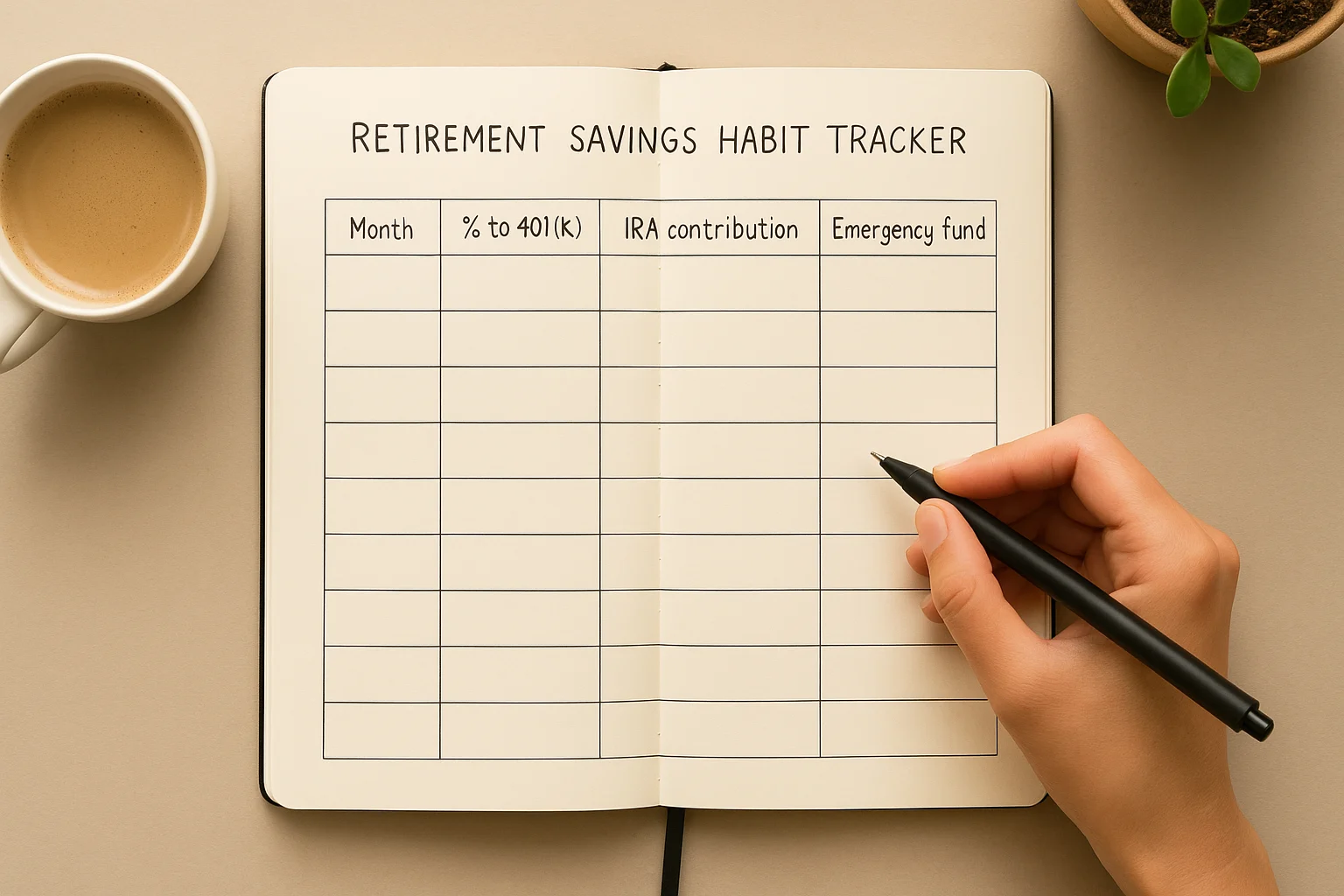
Payroll deductions or scheduled IRA transfers can reduce repeated decisions once the amount and account choice make sense. Review automatic escalation against cash flow before it increases contributions.
Use Small, Testable Contribution Changes
If a large increase would strain the budget, test a smaller step. Moving from 5% to 6%, for example, is not a rule; it is a way to see whether the higher contribution still fits before increasing again.
Review on a Schedule, Not Every Headline
Check contributions, fees, allocation, beneficiaries, and major life changes on a schedule that fits the account, and review sooner when a job change, tax change, withdrawal need, or other material event changes the decision.
Micro-action: Put one retirement-plan review on your calendar and define what would justify an earlier review.
Frequently Asked Questions
Choose Your Next Retirement-Account Step
Do not finish this guide by trying to choose every account at once. Finish by identifying the next decision you can verify.
- If you have a workplace plan, check the match, vesting, Traditional/Roth options, investment choices, and fees.
- If you are comparing an IRA or HSA, confirm the current eligibility and tax rules before deciding where the next dollar should go.
- If you are still unsure, name the missing fact—plan cost, tax treatment, cash need, or eligibility—and verify that fact before moving money.
Then make one funding change your cash flow can support and schedule the next review after a meaningful trigger such as a raise, job change, tax change, or withdrawal need.
If taxes, conversions, self-employment income, pensions, or withdrawal rules make the answer complicated, use the relevant guide or qualified professional help for that specific problem. You do not need a perfect lifetime account map before making the next sound decision.
This retirement account guide is for general education and is not personalized financial, tax, or investment advice. Everyone’s situation and results are different, and tax laws can change. Consider speaking with a qualified financial planner or tax professional before making major decisions about your retirement accounts.

