
VTSAX vs FXAIX is mostly a coverage decision: whole U.S. market or S&P 500. VTSAX gives you broader U.S. exposure across large-, mid-, and small-cap companies; FXAIX focuses on the S&P 500. Both are low-cost index mutual funds, so the more important differences are what they own, how you can buy them, and which exposure you actually want.
If you already know your preference, the two-question picker below gives you a fast starting point. If not, the comparison table shows the benchmark, coverage, expenses, and minimums side by side. If you’re still building the basics, start with the beginner’s guide to investing.
This post contains affiliate links. If you buy through our links, we may earn a commission at no extra cost to you. Learn more.
Table of Contents
- Interactive Fund Picker: VTSAX or FXAIX?
- VTSAX vs FXAIX: Head-to-Head Comparison
- Who Should Choose Which Fund?
- Check the Rest of Your Money Before You Choose a Fund
- Vanguard vs Fidelity: Account Availability Matters
- Frequently Asked Questions
- Your Bottom Line: VTSAX vs FXAIX
Interactive Fund Picker: VTSAX or FXAIX?
Choose the market coverage you want, then tell us where you’ll hold it. The result is a comparison starting point—not individualized investment advice.
Answer both questions to see the comparison lean and the main thing to verify before you act.
Use the picker as a shortcut, then compare the fund details below before choosing. Your broader asset allocation, risk tolerance, taxes, and the investments actually available in your account can matter more than this two-fund comparison.
VTSAX vs FXAIX: Head-to-Head Comparison
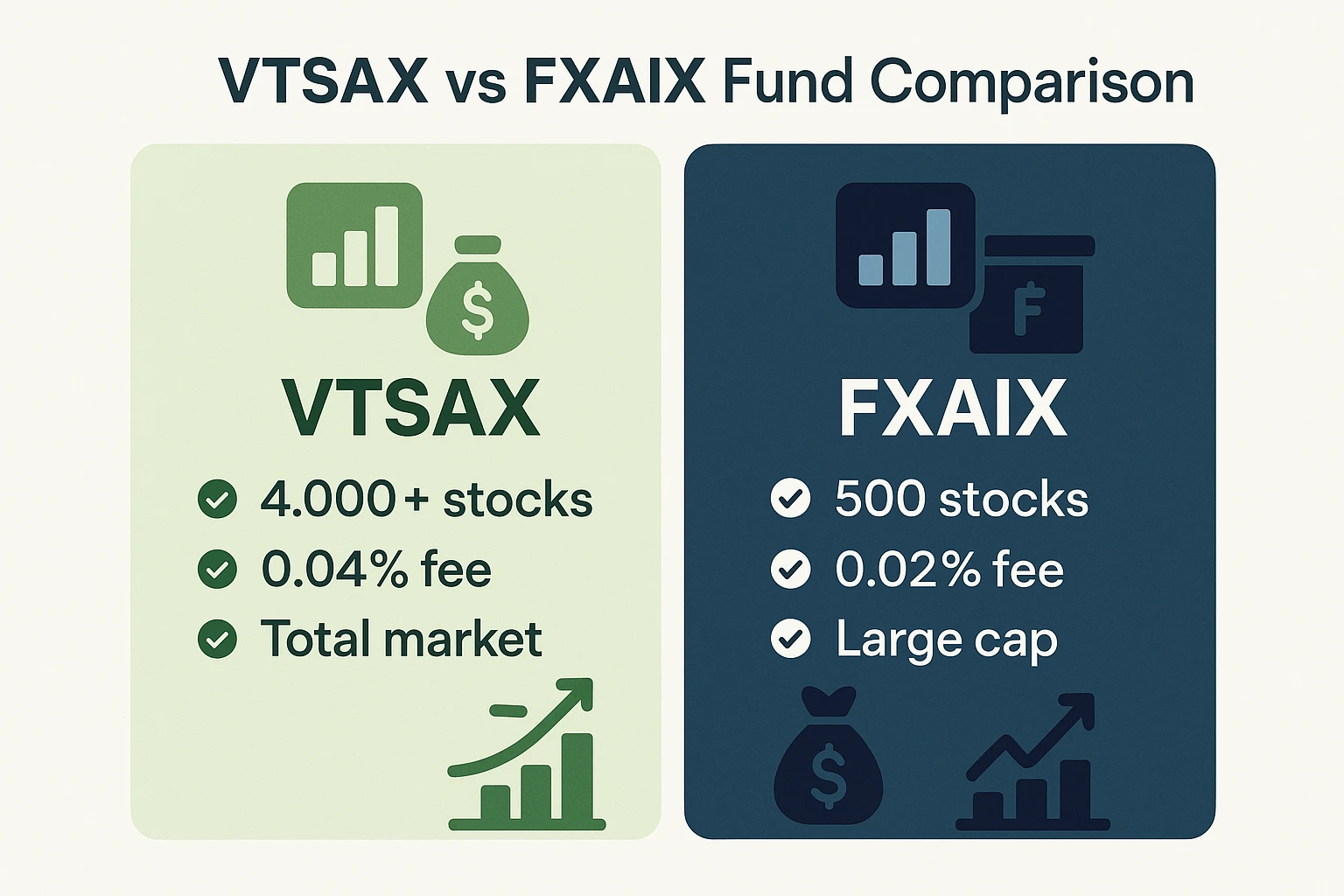
The durable differences are market coverage, benchmark, expense ratio, investment minimum, and how each fund fits the account you actually use.
| Feature | VTSAX | FXAIX |
|---|---|---|
| Benchmark | Morningstar US Total Market Index | S&P 500 |
| Market coverage | Broad U.S. market: large, mid, and small companies | Large-cap U.S. stocks in the S&P 500 |
| Expense ratio | 0.04% | 0.015% |
| Investment minimum | $3,000 for Admiral Shares when investing directly with Vanguard | $0 |
The expense-ratio gap is 0.025 percentage points. Whether that matters more than market coverage, account availability, or fund format depends on how you plan to invest.
If VTSAX’s direct minimum is the only obstacle to total-market exposure, VTI gives you the ETF share class of the same portfolio; brokerage purchase rules vary.
VTSAX: Vanguard Morningstar Total Stock Market Index Fund
VTSAX tracks the Morningstar US Total Market Index, a total stock market index fund approach spanning large-, mid-, and small-cap U.S. stocks. Vanguard renamed the fund and benchmark in July 2026; the ticker and investment objective did not change.
- Coverage: thousands of U.S. stocks across company sizes.
- Minimum: $3,000 for Admiral Shares when investing directly with Vanguard; different eligibility rules can apply through intermediaries or workplace plans.
- Idea: own a broad slice of the U.S. stock market in one fund.
Prefer an ETF? VTI is the ETF share class of the same total-market portfolio. If you’re deciding between structures, this primer on ETF vs mutual funds for retirement can help.
FXAIX: Fidelity 500 Index Fund
FXAIX tracks the S&P 500, an index of 500 leading large-cap U.S. companies.
- Coverage: large-cap U.S. stocks.
- Minimum: $0.
- Idea: track the U.S. large-cap market through the S&P 500.
Overlap and Concentration: Why They Often Move Together
These funds overlap heavily because the S&P 500 itself represents roughly four-fifths of U.S. equity market capitalization. VTSAX adds mid- and small-cap stocks beyond that large-cap core, but the biggest U.S. companies still drive much of both funds’ day-to-day movement. Sector weights change over time, so the more durable distinction is breadth, not whichever sector is largest this month.
Historical Performance: Don’t Let One Snapshot Decide
Past returns can show how the two market segments behaved, but they are a weak reason to choose between the funds because leadership changes over time. The key structural difference does not: VTSAX follows the broad U.S. market, while FXAIX follows the S&P 500.
For the latest month-end returns, holdings, and expenses, use the official Vanguard VTSAX profile and the official Fidelity FXAIX profile. Compare the same ending date and return period before drawing conclusions.
Both funds invest in stocks and can lose substantial value during market declines. A sharp drop is a reason to revisit your risk tolerance and plan—not evidence by itself that an index fund is malfunctioning.
Who Should Choose Which Fund? (Total Stock Market vs S&P 500)
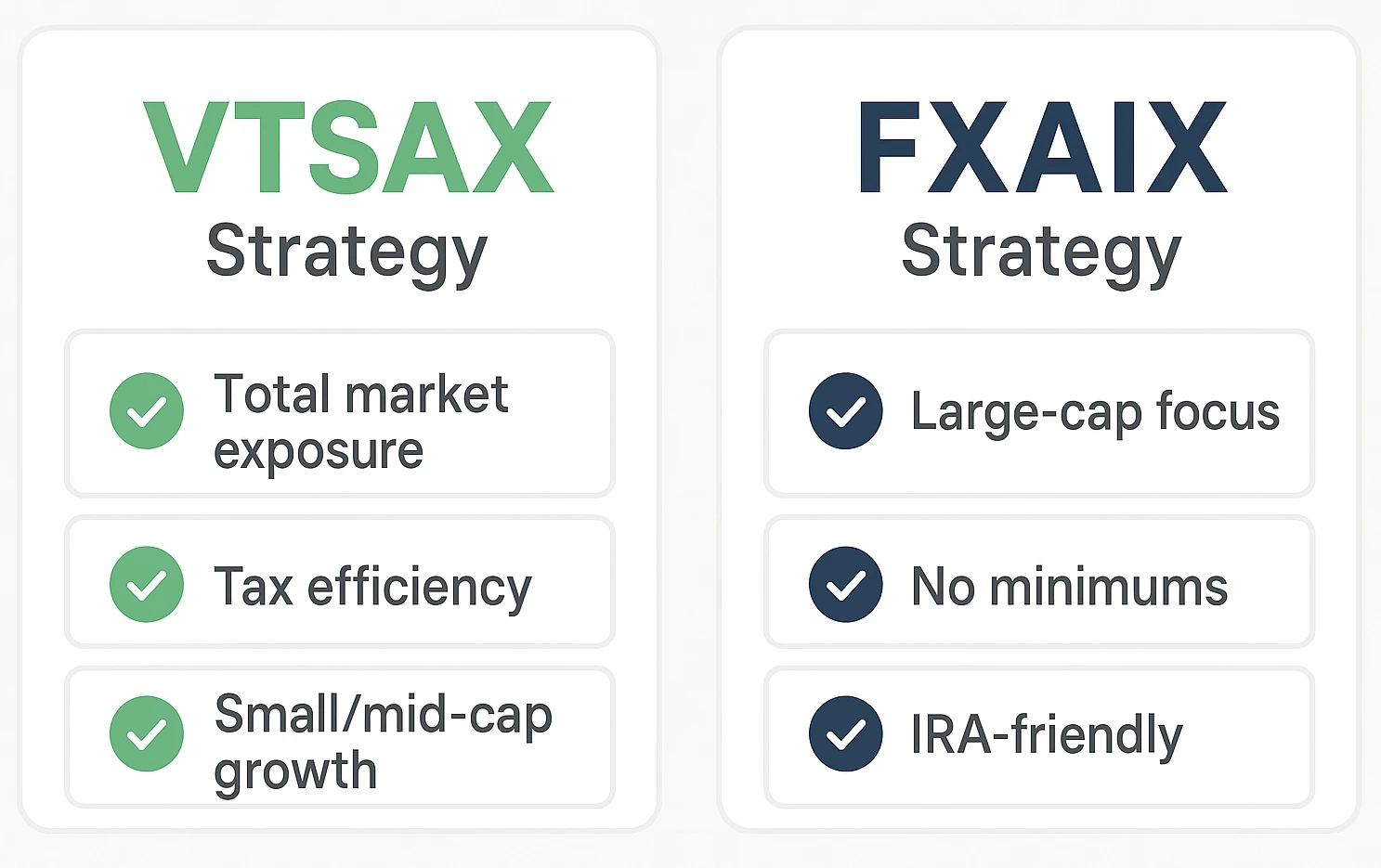
This is the core total stock market vs S&P 500 decision: decide how broad you want your U.S. stock exposure to be, then check which implementation fits your account.
VTSAX/VTI: When Broader U.S. Market Coverage Fits
- You want large-, mid-, and small-cap U.S. stocks in one portfolio.
- You intentionally prefer total-market breadth over an S&P 500-only core.
- You can meet VTSAX’s direct minimum or prefer the ETF share class, VTI.
FXAIX: When an S&P 500 Core Fits
- You intentionally want S&P 500 large-cap exposure.
- You want a mutual fund with no investment minimum.
- Your account offers FXAIX or a comparable S&P 500 index option without unnecessary friction.
Beginners: Choose Coverage Before the Ticker
Do not let the minimum investment choose the market exposure for you. If you want broad U.S. market coverage but cannot meet VTSAX’s $3,000 direct minimum, VTI or another total-market option available in your account can fill that job. If you specifically want the S&P 500, FXAIX’s $0 minimum is convenient. Do not let the share price decide either: a higher per-share price does not make one mutual fund inherently more expensive than another in the way a higher expense ratio or transaction fee can.
Hypothetical example: An investor with $500 who wants total-market coverage does not need to switch to an S&P 500 strategy just because FXAIX has a $0 minimum. The investor can look for an available total-market ETF or fund instead. The decision is coverage first, implementation second.
You’ve decided on coverage. Before you start worrying about which brokerage carries which fund, make sure putting more money into this investment is actually the right next use of the money.
Check the Rest of Your Money Before You Choose a Fund
Use the SNAPSHOT to see income, spending, up to 8 debts, and up to 8 goals together before you commit more money to investing.
Confirm to get the workbook and frugal money tips. Unsubscribe anytime.
Something went wrong. Please check your email address and try again.
Vanguard vs Fidelity: Account Availability Matters
A Vanguard vs Fidelity decision is partly about implementation, not just fund philosophy. At Fidelity, FSKAX vs FXAIX is the cleaner same-provider version of the total-market-vs-S&P-500 decision, while Fidelity currently lists VTSAX as a transaction-fee fund. At Vanguard, VTSAX vs VFIAX is the same-provider comparison. Before moving an account for one ticker, check whether your current brokerage offers an in-house fund targeting the exposure you want and whether buying an outside mutual fund would add transaction fees or other friction.
| Exposure you want | Vanguard mutual fund | Fidelity mutual fund |
|---|---|---|
| Broad U.S. total market | VTSAX | FSKAX |
| S&P 500 | VFIAX | FXAIX |
These funds are not identical across companies, but each row keeps the decision focused on the market exposure you want. Check your account’s current fund menu, minimums, expense ratios, transaction fees, and trading rules before acting.
If you understand the coverage difference but account rules, taxes, transaction fees, or the rest of your investing plan still affect the decision, a finance expert can help you sort out the broader questions to verify before you make a change.
Frequently Asked Questions
Your Bottom Line: VTSAX vs FXAIX
Choose VTSAX/VTI for broad U.S. market exposure or FXAIX for an S&P 500 core. Then open the fund list in the account you actually use and verify the available ticker, investment minimum, expense ratio, and any transaction fee before buying. If your brokerage offers a same-exposure alternative instead, that may let you keep the market coverage you wanted without moving accounts just to match the ticker in this article.
This article is general education, not personalized financial advice. Everyone’s situation and risk tolerance are different, so talk with a qualified financial professional before making big investing decisions. Past performance never guarantees future results, and you can lose money when you invest. Your results and comfort level may be very different from someone else’s, even if you choose the same funds.

