

Two investors can hold the same overall mix of stocks and bonds yet end up with different after-tax results depending on which accounts hold which assets. An asset location strategy is one form of tax-efficient investing: it tries to reduce avoidable tax drag by coordinating taxable, tax-deferred, and Roth accounts without changing the household’s target asset allocation. The benefit can be meaningful, but it depends on your tax rate, holdings, time horizon, account rules, and the tax cost of making changes. If you’re still building your foundation, our beginner’s guide to investing shows you how to set up the core portfolio this strategy builds on.
Asset allocation answers what you own; asset location answers where you hold it. Set the household’s stock, bond, and other investment mix first, then use asset location to decide which holdings belong in taxable, tax-deferred, or Roth accounts. This guide gives you the planner and placement map first, then explains the tax mechanics and exceptions to check before you move anything.
This post contains affiliate links. If you use these links, we may earn a commission at no extra cost to you. As an Amazon Associate, I earn from qualifying purchases. Learn more.
Table of Contents
- Key Takeaways
- Asset Location Starting-Point Planner
- Quick Asset Location Strategy Cheat Sheet: What Goes Where
- Understanding the Tax Landscape Across Account Types
- How to Implement an Asset Location Strategy Across Accounts
- Advanced Considerations and Exceptions
- Rebalancing, Tax-Loss Harvesting, and Taxable Account Investing
- Monitoring and Adjusting Your Strategy
- See the Rest of Your Money Before Your Next Portfolio Review
- Common Mistakes to Avoid
- Frequently Asked Questions
- Put Your Asset Location Strategy Into Practice
Key Takeaways
- Asset location strategy means coordinating investments across account types to potentially reduce avoidable tax drag without changing your target allocation.
- Taxable accounts are often good candidates for tax-efficient stock index funds, tax-loss-harvesting positions, and municipal bonds when their after-tax yield is competitive.
- Tax-deferred accounts (traditional 401(k)/IRA) often suit holdings that generate taxable interest, ordinary income, or frequent distributions.
- Roth accounts can be valuable for assets with higher expected long-term returns because qualified distributions can be tax-free, but tax treatment is not a reason to take more investment risk.
- Implementation starts with your overall asset allocation, then uses new contributions and rebalancing to improve tax efficiency without creating an avoidable tax bill.
Quick action: If you’re skim-reading, use the planner below for a starting point, then follow the section link in your result for the reasoning behind it.
Asset Location Starting-Point Planner
Choose the holding and the accounts you’re comparing. You’ll get a starting point—not a personalized tax recommendation—and a link to the section that explains the trade-off.
This planner focuses on tax characteristics, not your full allocation, state taxes, unrealized gains, or withdrawal plan.
The cheat sheet below gives the fast static version of the same decision. Use the account-tax section after it when you want to understand why a placement is a starting point rather than a fixed rule.
Quick Asset Location Strategy Cheat Sheet: What Goes Where
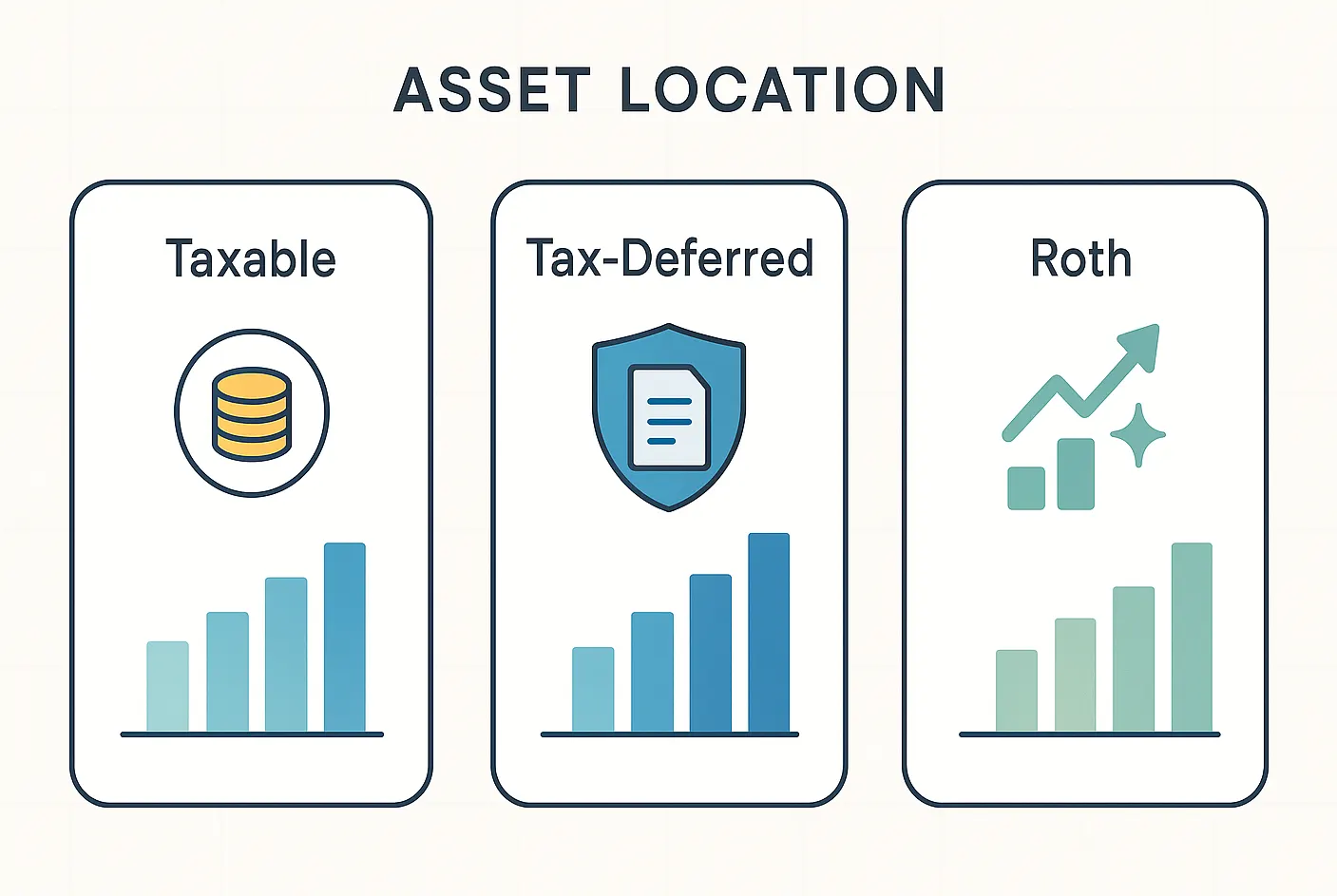
Use this cheat sheet as a starting pattern, not a set of fixed rules. Broad, low-turnover stock index funds often fit well in taxable accounts; taxable bond funds and many REIT funds are common candidates for tax-deferred accounts; and diversified assets with higher expected long-term returns can be candidates for Roth space when they fit your risk plan. Municipal bonds depend on their taxable-equivalent yield, and an existing appreciated position may be better left where it is than sold just to “optimize” location. Pick one account today and label each holding as “review for taxable,” “review for traditional,” or “review for Roth” — no trades yet, just tags.
| Account type | Common candidates | Why it fits |
|---|---|---|
| Taxable brokerage | Broad low-turnover stock index funds; municipal bonds when their after-tax yield is competitive | Can preserve tax-loss-harvesting flexibility and may benefit from preferential tax treatment on qualified dividends and long-term gains. |
| Traditional 401(k)/IRA | Taxable bond funds, many REIT funds, high-turnover strategies | Defers current tax on interest, distributions, and internal trading until money is withdrawn. |
| Roth IRA/401(k) | Diversified higher-expected-return assets that fit your long-term allocation | Qualified distributions can be tax-free, so higher expected growth may benefit from Roth treatment without changing your risk target. |
Taxable Account Priorities
Broad low-turnover stock index funds are a common starting point for taxable accounts because their tax burden is often more controllable than interest-heavy holdings. Municipal bonds belong here only when their after-tax yield beats the taxable alternative, and some international funds can gain an additional taxable-account benefit when the fund passes eligible foreign taxes through for a credit. Those are useful tie-breakers, not reasons to sell an appreciated holding without checking the tax cost first.
Traditional Account Priorities
Taxable bond funds, many REIT funds, and higher-turnover strategies are common candidates for traditional tax-deferred space because the account postpones current tax on interest and distributions. The eventual withdrawal tax still matters, so this is a placement trade-off rather than a free tax reduction.
Roth Account Priorities
Roth space can be valuable for diversified assets with higher expected long-term returns, but the account label should not change your risk target. Do not use potential tax-free qualified withdrawals as a reason to concentrate in a single stock, sector, or specialized strategy.

Understanding the Tax Landscape Across Account Types
Taxable Brokerage Accounts: Where Tax Drag Shows Up
Taxable brokerage accounts offer flexibility, but taxable interest, dividends, capital-gain distributions, and realized gains can create current-year tax costs. The size of that tax drag varies widely with the investment, holding period, tax bracket, and state. A fund can also generate a taxable distribution even when you never sold shares yourself.
If you need a refresher on how each account type works, our retirement accounts and taxes guide walks through 401(k)s, IRAs, and Roth accounts in more detail.
Common sources of taxable drag include:
- High-yield dividend stocks and funds
- Actively managed funds with frequent trading
- Taxable bond funds generating ordinary income
- REITs and other pass-through entities
Taxable accounts also have useful features: tax-loss harvesting, potentially lower rates on qualified dividends and long-term capital gains, and—under current federal basis rules—a basis adjustment that generally applies to inherited property. Those advantages can make taxable space valuable rather than simply “the account to avoid.”
As a first step, flag any high-yield bond or REIT funds in taxable for review, but do not sell solely to improve location; the tax cost of moving an appreciated holding can outweigh the benefit for years.
Tax-Deferred Accounts: What Happens at Withdrawal
Traditional 401(k)s and IRAs generally defer current tax on investment income and gains. For pretax balances, distributions are generally included in ordinary taxable income, so the original character of the investment return is not preserved the way it can be in a taxable brokerage account. That trade-off is one reason interest-heavy or frequently distributing holdings are often considered for tax-deferred space.
Traditional accounts are often considered for:
- Taxable bond funds often fit naturally because their interest would generally be taxable as ordinary income in a brokerage account.
- High-turnover strategies can defer current taxes on internal trading and distributions while held in the account.
- Tax deferral can keep money invested longer, although the eventual withdrawal tax still matters.
Roth Accounts: When Qualified Withdrawals Are Tax-Free
Roth IRAs and designated Roth accounts can provide tax-free qualified distributions when the rules are met. That can make Roth space attractive for diversified assets with higher expected long-term returns, especially when you expect to leave the money invested for years. But Roth tax treatment does not make a concentrated or speculative position safer, and the best placement still depends on your overall allocation and withdrawal plan.
If you’re new to Roth accounts, our beginner’s guide to Roth IRAs explains how contributions, withdrawals, and tax-free growth work.
Roth space may be especially useful for:
- Diversified equity holdings with higher expected long-term returns, when they fit your target allocation
- Holdings you expect to keep invested for a long period
- Assets whose taxable distributions would otherwise create recurring tax drag
Do not use the Roth label by itself as a reason to concentrate in a single stock, sector, or speculative asset.
Tax Efficiency Tiers at a Glance
Another way to think about placement is by how often a holding can create taxable income or distributions and how much control you have over realizing gains. The table below is a screening tool, not a ranking that applies identically to every fund or taxpayer.
| Tax Efficiency | Asset Types | Taxable Event Frequency | Typical Tax Treatment |
|---|---|---|---|
| Often less tax-efficient | Taxable bonds, many REIT funds, high-turnover funds | Often frequent | Interest and other distributions may be taxed as ordinary income; REIT distribution character can vary |
| Mixed | Dividend stocks, many mutual funds | Varies by fund and holding | May include qualified dividends, ordinary dividends, and capital-gain distributions |
| Often more tax-efficient | Low-turnover stock index funds, some municipal bonds | Often lower or more controllable | Qualified dividends and long-term gains may receive preferential rates; some municipal-bond interest may be federally tax-exempt |
How to Implement an Asset Location Strategy Across Accounts
Treat Every Account as One Portfolio
Asset location can sound as if it requires rebuilding a carefully planned asset allocation. It does not. A 401(k) at work, an old IRA, a Roth IRA, and a taxable brokerage account may appear on separate statements, but the holdings should still add up to one target portfolio.
Before you move anything, run these five checks:
- Confirm the target allocation across all accounts combined.
- Identify the tax characteristic you are trying to improve—for example, taxable interest, recurring distributions, or the treatment of long-term growth.
- Check the cost and constraints of moving the holding, including unrealized gains in taxable accounts and the investment menu inside employer plans.
- Choose the account that best fits the holding without changing the portfolio risk you intended to take.
- Prefer new contributions and routine rebalancing when they can improve location without creating an avoidable taxable sale.
Hypothetical Example: Keep the Allocation Intact
Sarah has $300,000 total invested with a target allocation of 70% stocks, 20% bonds, and 10% REITs:
- Taxable account ($150,000): $150,000 total stock market index fund
- Traditional 401(k) ($100,000): $60,000 bond fund, $30,000 REIT fund, $10,000 broad stock index fund
- Roth IRA ($50,000): $50,000 diversified small-cap stock fund
Her overall allocation is now $210,000 in stocks (70%), $60,000 in bonds (20%), and $30,000 in REITs (10%). This is one hypothetical way to coordinate the accounts while preserving the target allocation; it is not proof that these exact placements are optimal for every investor.
Doing this as part of a broader money review? Jump to the free Money Reset to put your income, spending, debts, and goals on one screen.
Advanced Considerations and Exceptions
The basic placement pattern is useful, but these are the factors most likely to change the answer for a specific holding or household.
The Qualified Dividend Advantage
Not all dividends receive preferential tax treatment. Qualified dividends from most U.S. corporations and qualified foreign corporations face capital gains tax rates (0%, 15%, or 20% depending on income). Non-qualified dividends face ordinary income rates. For formal definitions and current thresholds, see the IRS guidance on qualified dividends.
This distinction can matter for asset location:
- Funds that distribute mostly qualified dividends may be more tax-friendly in taxable accounts than funds distributing ordinary income.
- Holdings that distribute more ordinary income are stronger candidates for tax-advantaged space, subject to your overall allocation and account constraints.
Foreign Tax Credit Considerations
Some international funds pass foreign taxes through to shareholders. When the fund reports your share on Form 1099-DIV, you may be able to claim a foreign tax credit in a taxable account; the IRS explains the requirements here.
That credit can favor taxable placement for some international funds, but it is only one factor. Dividend tax treatment, fund structure, turnover, your own tax situation, and the opportunity cost of using tax-advantaged space can change the answer.
Extra Tax Layers in Taxable Accounts
Short-term capital gains (for investments held one year or less) are taxed at your ordinary income rate, while long-term gains usually get lower rates. That difference is why holding periods matter so much when you decide what to buy and sell in a taxable account.
Higher-income investors may also owe the 3.8% Net Investment Income Tax (NIIT). Under current IRS rules, it applies to the lesser of net investment income or the amount by which modified adjusted gross income exceeds the statutory threshold: $200,000 for single/head-of-household filers, $250,000 for married filing jointly, and $125,000 for married filing separately. See the current IRS NIIT guidance.
Factor Fund Placement
Factor funds do not belong in one account type by default. Check the fund’s actual turnover, distribution history, expected holding period, and role in the rest of your portfolio. A low-turnover factor ETF may be reasonable in taxable, while a strategy that regularly distributes short-term gains may be a stronger candidate for tax-advantaged space.
Required Minimum Distributions and Future Tax Rates
Required minimum distributions can change the tax picture later in retirement. RMD starting age depends on your birth year; current rules generally use age 73 for earlier affected cohorts and age 75 for later cohorts, so check current IRS guidance for the age that applies to you. Traditional IRAs generally follow that schedule, while some workplace plans can delay RMDs until retirement. Roth IRAs and designated Roth workplace accounts do not require lifetime RMDs for the original owner. See the IRS RMD guidance. Asset location decisions near retirement should therefore be coordinated with expected withdrawals and conversion plans rather than based on account labels alone.
Where Do HSAs and 529 Plans Fit?
HSAs can receive unusually favorable federal tax treatment when you are eligible: qualifying contributions may be deductible or excluded from income, earnings can grow tax-free inside the account, and distributions used for qualified medical expenses may be tax-free. See IRS Publication 969. That does not automatically mean “put the riskiest asset in the HSA”; the right investment mix depends on when you expect to use the money for medical costs. For 529 plans, earnings can be federally tax-free when distributions are used for qualified education expenses, so the investment mix should follow the beneficiary’s education timeline rather than a generic asset-location rule. See the IRS 529 guidance.
When to Break the Rules
Low Tax Bracket Investors
Some taxpayers qualify for a 0% federal rate on net long-term capital gains and qualified dividends, but that rate is determined by taxable-income thresholds—not simply by being in the 10% or 12% ordinary-income bracket. If much of your investment income falls in the 0% capital-gain band, the benefit of aggressive asset-location changes may be smaller.
Employer Plan Limitations
Many 401(k) plans offer limited investment options, which can force compromises in placement. In those cases, use the available options that best fit the portfolio rather than treating an unavailable “ideal” fund as a requirement.
Municipal vs. Taxable Bond Decision
The break-even tax rate for municipal bonds varies by the bonds being compared and by your tax situation. For a simple federal comparison, start with:
Taxable-equivalent yield = municipal yield ÷ (1 – marginal federal tax rate)
Then account for state taxes and bond-specific factors before treating the result as a decision rule.
When Asset Location Turns Into a Tax Question
If the next move depends on realized gains, your tax bracket, the foreign tax credit, RMD timing, or a Roth conversion, a tax expert can help you identify the rules that apply before you sell or move assets.
Rebalancing, Tax-Loss Harvesting, and Taxable Account Investing
Rebalance With New Contributions First
Rather than selling investments to rebalance, direct new contributions toward underweight asset classes in the account types you have already identified as good fits. This can move the portfolio back toward its target allocation without creating a taxable sale solely for rebalancing.
Tax-Loss Harvesting Coordination
Tax-loss harvesting applies to taxable investments because losses inside retirement accounts are not deductible. Under the wash-sale rule, a loss can be disallowed if you buy substantially identical stock or securities within 30 days before or after the loss sale; IRS guidance also specifically includes purchases in an IRA or Roth IRA. See IRS Publication 550.
Wash sale considerations for asset location:
- Coordinate purchases across taxable accounts, IRAs/Roth IRAs, and a spouse’s accounts when harvesting a loss.
- Do not assume that switching fund companies or tickers automatically avoids the rule; the IRS standard is whether the securities are “substantially identical.”
- If you use a temporary substitute, choose exposure that is clearly different enough for your tax professional or records process to defend, or wait outside the wash-sale window before repurchasing the original security.
Managing Capital Gains Distributions
Mutual funds and ETFs can make taxable capital-gain distributions even if you reinvest them. Before a large taxable purchase near year-end, check whether the fund company has published a distribution estimate and record date.
Strategies to minimize impact:
- Check the fund company’s distribution estimates and record dates before a large taxable purchase.
- Do not move an existing appreciated holding solely because it distributed a gain once; compare the tax cost of selling with the expected future benefit.
- ETFs can be more tax-efficient than comparable mutual funds, but they can still make taxable distributions.
Keep a simple one-page map of which account holds each asset class so rebalancing does not become a fresh placement decision every time.
Monitoring and Adjusting Your Strategy
When to Review Your Asset Location
Asset location is worth revisiting periodically and after changes that affect the tax or withdrawal picture.
Review when:
- Changes in tax brackets affecting municipal bond attractiveness.
- New investment options in employer plans.
- Shifts in fund characteristics (turnover, dividend yield).
- Rebalancing needs across account types.
Track:
- Overall asset allocation across all accounts.
- Tax drag in taxable accounts.
- Contribution room in tax-advantaged accounts.
- Opportunities for Roth conversions.
If you’re exploring conversions as part of early retirement planning, our Roth conversion ladder guide walks through how staged conversions can complement your asset location choices.
Tie the review to a recurring event you already remember—tax filing, an annual portfolio review, or open enrollment—and revisit it sooner after a major income, job, account, or retirement change.
Life Stage Adjustments
- Early career: Build the target allocation first, then compare Roth and pretax contributions based on eligibility, current tax rate, and expected future tax situation.
- Peak earnings: Revisit pretax-versus-Roth savings and compare municipal bonds with taxable bonds on an after-tax-yield basis rather than by bracket alone.
- Pre-retirement: Review unrealized gains, RMD timing, planned Roth conversions, and near-term spending before relocating assets.
- Retirement: Coordinate withdrawals across taxable, tax-deferred, and Roth accounts with your tax plan instead of following a fixed withdrawal order.
If you’re also planning retirement withdrawals, our simple guide to the 4% rule explains one common starting framework for thinking about portfolio spending.
If this portfolio review is part of a broader money check-in, the Money Reset gives you a separate snapshot of income, spending, debts, and goals on one screen.
See the Rest of Your Money Before Your Next Portfolio Review
Put income, spending, up to 8 debts, and up to 8 goals on one screen so your investing decisions stay connected to the rest of your finances.
Confirm to get the workbook and frugal money tips. Unsubscribe anytime.
Something went wrong. Please check your email address and try again.
Common Mistakes to Avoid
The biggest mistakes usually come from letting tax optimization override the rest of the investment plan:
- Chasing perfection. A simple placement plan you can maintain is better than a complex scheme that makes you delay investing or rebalance constantly.
- Ignoring the investment menu. Employer plans, fund minimums, and available share classes can limit what you can place where. Work with the options you actually have.
- Using too many overlapping funds. More holdings create more placement and rebalancing decisions without necessarily improving diversification. Simplify when multiple funds are doing the same job.
- Ignoring fees and trading costs. Expense ratios, account fees, spreads, and transaction costs belong in the same decision as the expected tax benefit.
Frequently Asked Questions
Put Your Asset Location Strategy Into Practice
You do not need a perfectly optimized portfolio to use asset location well. Start with the clearest tax-efficiency mismatch, preserve your target allocation, and make sure the cost of moving an existing position does not erase the expected benefit.
A practical implementation order:
- Map your accounts and holdings so you can see the portfolio as one whole.
- Flag the clearest placement mismatches rather than trying to optimize every holding at once.
- Use new money and rebalancing first when they can improve location without a taxable sale.
- Review the plan after meaningful changes in income, account options, tax rules, or your withdrawal strategy.
Want a deeper DIY reference? The Bogleheads’ Guide to Investing, 2nd Edition goes beyond general index-fund basics into taxable-account investing, tax-sheltered accounts, and placing funds for maximum after-tax return.
It fits readers who want a broader framework to study on their own; if you only need the checklist above, you can skip the extra resource.
The goal is not to find one permanent “best account” for every asset. It is to make a few defensible placement decisions, keep the portfolio’s risk where you intended it, and avoid creating a tax bill in the name of tax efficiency.
This guide is general education about U.S. federal tax and investment concepts, not personalized tax, investment, or legal advice. State tax treatment and individual circumstances vary, and tax rules can change. Before selling appreciated holdings, changing retirement-account investments, or making a large Roth conversion, consider a qualified tax or financial professional who can review your situation.

