

Picture this: day traders are glued to their phones, chasing every blip in the market, while you quietly build a calm, long-term FIRE portfolio from your laptop. Instead of guessing what will pop next week, you’re using value investing strategies and fundamental analysis to quietly buy great businesses at fair prices and hold them for years — without staring at stock tickers all day.
If you’re still getting comfortable with stocks and index funds, it can help to start with the big picture. For a simple walkthrough of diversified stock investing, check out our beginner’s guide to investing before you dive into individual companies.
Value Investing Scorecard
Pick your company’s stats and see how it scores on classic value metrics.
P/E ratio
Free cash flow yield
Return on invested capital (ROIC)
Debt load
Your scorecard result
Choose options above to see how your stock lines up with classic value metrics.
💡 Unsure about a metric? Start with the middle option and tighten later.
This post contains affiliate links. If you buy through our links, we may earn a commission at no extra cost to you. Learn more.
Table of Contents
- Key Takeaways
- Understanding Value Investing for FIRE Success
- Key Value Investing Metrics and Fundamentals
- Building Your Practical Value Investing Workflow
- Avoiding Common Value Investing Pitfalls
- Integrating Value Picks with Index Fund Strategy
- Rebalancing and Dollar-Cost Averaging Tactics
- Advanced Strategies for FIRE Optimization
- Real-World Case Study: Building a FIRE Value Portfolio
- Technology Tools for Modern Value Investors
- The Psychology of Successful Value Investing
- Frequently Asked Questions
- Conclusion
Key Takeaways
- Value investing and fundamental analysis together provide a disciplined framework for building a durable FIRE portfolio through quality stock selection.
- Margin of safety and economic moats are essential concepts that protect your capital while generating sustainable returns over decades.
- Core valuation metrics like P/E ratios, free cash flow yield and return on invested capital help you spot potentially undervalued businesses.
- A thoughtful review of management quality, competitive advantages and capital allocation helps you avoid value traps.
- A simple, repeatable workflow for screening, analysis and position sizing keeps your decisions calm and consistent.
Understanding Value Investing for FIRE Success
The Perfect Marriage: Value Investing and FIRE Goals
This investing style and FIRE share one core belief: patience pays. Both reject get-rich-quick schemes in favor of steady compounding over long stretches of time. When FIRE-minded investors adopt Buffett’s style, they gain lower portfolio turnover, fewer emotional mistakes and a clearer link between today’s savings rate and tomorrow’s freedom. It can feel frustrating when friends brag about quick trading wins, but this slower route is designed to support your future self, not impress anyone today.
If you’re still designing your overall path to financial independence, our guide to financial independence and retiring early can help you map out your target number and timeline before you dive deep into stock selection.
Core Principles That Drive Long-Term Wealth
Margin of Safety: You aim to buy stocks below a conservative estimate of intrinsic value. If a company is worth $100 per share, a patient value investor might only buy at $70, leaving room for errors and market mood swings.
Economic Moats: Buffett’s term for durable competitive advantages that protect profits, such as:
- Brand loyalty (Coca-Cola, Apple)
- Network effects (Visa, Mastercard)
- High switching costs (Microsoft, Oracle)
- Cost advantages (Walmart, Costco)
Quality Over Quantity: Instead of owning 50+ tickers you barely know, you focus on 15–25 businesses you understand deeply and are happy to hold for years.
Micro-action: jot down a one-sentence version of your FIRE goal in your notes app so every investing choice has a clear destination.
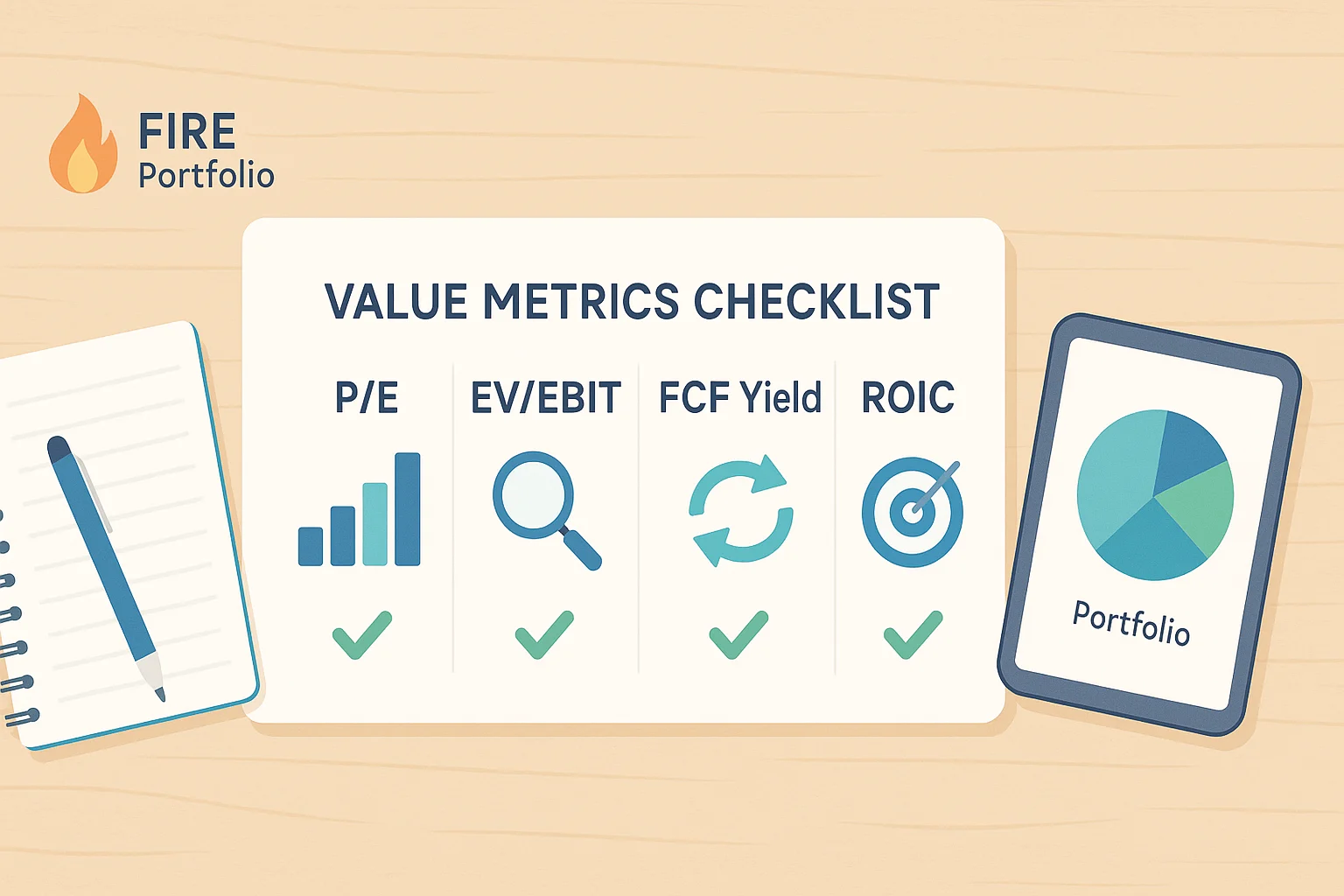
Essential Value Investing Strategies and Fundamental Analysis Metrics
Valuation Ratios: Your Financial Compass
Valuation ratios help you understand what you’re paying for a dollar of earnings, cash flow or assets. They’re not magic by themselves, but they keep you from overpaying for a good story.
Imagine comparing two companies after a long day at work: one has a flashy story and a sky-high multiple, the other quietly produces steady profits at a much lower valuation. These ratios help you notice the difference before hype or fear take over.
| Metric | Formula | What It Reveals | FIRE-Friendly Range |
|---|---|---|---|
| P/E Ratio | Price ÷ Earnings per Share | How much you pay for $1 of earnings | 10–20× for mature companies |
| Earnings Yield | Earnings per Share ÷ Price | Implied annual return if earnings stay flat | 5–10% (inverse of P/E) |
| EV/EBIT | Enterprise Value ÷ Operating Income | Valuation that includes debt and cash | 8–15× for quality businesses |
| Free Cash Flow Yield | Free Cash Flow ÷ Market Cap | Cash generation relative to price | 5–12% for durable businesses |
These ranges are rough starting points, not hard rules. Sector norms, interest rates and growth expectations matter a lot, so always compare companies to close peers rather than the whole market. For a neutral walkthrough of key investing basics, you can also read the SEC’s Introduction to Investing guide on Investor.gov, which explains core concepts like risk, diversification and fees in plain language.
Quality Indicators: Separating Winners from Pretenders
Return on Invested Capital (ROIC): Measures how efficiently a company turns investor dollars into profits. Many long-term investors look for businesses that can sustain ROIC in at least the low-teens, as long as it comfortably exceeds the cost of capital, because that gap is where value is typically created according to many investor-education resources from major firms and research providers.
Debt-to-Equity Ratio: High leverage amplifies both gains and losses. Many FIRE investors prefer companies with debt-to-equity under 0.5 so they can sleep at night during recessions.
Revenue Growth Consistency: Steady 5–15% annual growth usually beats flashy but erratic surges. Smooth growth points to a resilient business model, and many long-term investors prefer steady, predictable expansion over boom-and-bust cycles described in investor education materials.
Micro-action: pick one company you already own and look up its P/E, earnings yield and ROIC using a free screener, just to see how it stacks up.
Building Your Practical Value Investing Workflow
Step 1: Screening for Candidates
Start with basic filters so you’re only spending time on reasonably strong businesses. When you’re tired after work, a simple, saved screener can keep you from doom-scrolling random stock lists and instead surface a short, focused watchlist.
Financial Health Screen:
- Market cap > $1 billion (avoids the riskiest micro-caps)
- Positive earnings for at least 5 years in a row
- Debt-to-equity < 0.6
- Current ratio > 1.2 for adequate liquidity
Valuation Screen:
- P/E ratio < 25
- Price-to-book < 3
- EV/EBIT < 20
- Free cash flow yield > 4%
Quality Screen:
- ROIC > 10%
- Gross margin > 20%
- Revenue growth > 0% (no declining trend)
Step 2: Deep Dive Analysis
Once you have 20–30 names, switch from quick filters to thoughtful reading.
Read the 10-K Annual Report: Focus on how the company actually makes money, major risks and how management describes the future.
Assess the Competitive Position: Can competitors easily copy this model? Does the company have pricing power or meaningful switching costs?
Evaluate Management: Look for leaders who own meaningful stock, communicate clearly and allocate capital prudently through dividends, buybacks and sensible reinvestment.
Step 3: Simple Valuation Approaches
Comparable Company Analysis: Compare your candidate’s P/E, EV/EBIT and growth rates to 3–5 peers. A business trading at 11× earnings while similar peers trade at 15× might be interesting—if quality is comparable.
DCF-Lite with Conservative Assumptions: Project free cash flows 5–10 years out using growth that’s lower than the recent average, then discount back at 10–12%. For example, if a company generated $10 per share of free cash flow last year and you assume just 3% growth, you might estimate intrinsic value around $140 per share. Buying at $90 would give a healthy margin of safety, similar to the conservative examples you’ll see in beginner-friendly discounted cash flow explainers from large investment firms and investor-education sites.
It’s better to be approximately right than precisely wrong. Focus on obvious bargains where even cautious assumptions still look attractive. Any numbers you plug into a model are just estimates, not guarantees of future returns.
Step 4: Position Sizing and Risk Management
Start with 2–3% positions while you’re learning. As conviction grows, core holdings might reach 5–8% each, with a total of 15–25 individual stocks plus broad index funds for diversification.

Avoiding Common Value Investing Pitfalls
The Value Trap Danger
Not every cheap stock is a bargain. Value traps look inexpensive but face permanent challenges such as dying industries, bloated cost structures or major technological disruption.
Maybe you’ve seen a stock chart that’s fallen 60% and felt tempted to call it a bargain. Before you click buy, ask whether the underlying business is still healthy or if something fundamental has broken.
Leverage and Yield-Chasing Risks
Chasing ultra-high dividend yields or heavily indebted companies can backfire fast. Dividends are often cut during downturns, and high leverage can wipe out equity holders when cash flow stumbles.
Behavioral Mistakes
Impatience, overconfidence and anchoring on past prices are common enemies. Commit to a written plan and position-size limits before emotions get involved.
Integrating Value Picks with Index Fund Strategy
The Core-Satellite Approach
Many FIRE investors use a simple “core-satellite” structure: low-cost index funds as the core and carefully chosen value stocks as satellites. This lets you chase a bit of outperformance without betting your entire future on a handful of names. For example, some people keep most of their money in a broad world or S&P 500 index fund and experiment with a much smaller side portfolio of individual ideas.
To understand how that core might support your long-term withdrawal plans, you may also want to review the classic 4% rule for financial independence so you know how much annual income your portfolio may reasonably support. It’s also worth reading a neutral explainer from a large investment firm or investor-education site so you understand where the 4% guideline came from and when it may not apply.
Tax-Efficient Implementation
Hold broad index funds and high-yield assets in tax-advantaged accounts when possible, and keep low-turnover individual stocks in taxable accounts where you can harvest losses. For a deeper dive on which assets fit best in which accounts, see our asset location strategy guide.
If Roth accounts are new to you, our beginner’s guide to Roth IRAs walks through the basics of tax-free growth and withdrawals.
Rebalancing and Dollar-Cost Averaging Tactics
Simple systems beat complicated reactions. A quarterly or semi-annual rebalance plan plus automated monthly investing removes most guesswork and helps you buy more when markets are down. On days when your feed is full of scary headlines, that little automatic transfer can quietly scoop up a few extra shares for your future self.
You can also keep a small cash buffer to deploy during major sell-offs—essentially pre-committing to buy when others are fearful.
Micro-action: choose a rebalance frequency that feels realistic for you (for example, every 6 or 12 months) and add a recurring reminder to your calendar.
Advanced Strategies for FIRE Optimization
Once you’re comfortable with the basics, you might explore international value opportunities, sector rotation or conservative options overlays such as covered calls. None are required for FIRE success, but they can add nuance if you enjoy the process. If you’re still getting the basics down, it’s completely fine to skim this section now and come back later once your core plan feels solid.
Prefer to talk through your own numbers with a finance pro?
Real-World Case Study: Building a FIRE Value Portfolio
Imagine a couple in their early 30s saving 40% of their combined income. They follow the workflow above, start with a heavy index-fund core, then gradually build a portfolio of 15 high-conviction value stocks purchased during market pullbacks.
Over a decade, their mix of broad diversification and selective value bets helps them modestly outperform a pure index strategy while still sleeping well at night. To check whether you’re already close to “enough,” you can plug your own numbers into our Coast FIRE calculator.
Technology Tools for Modern Value Investors
Screeners like FINVIZ or Morningstar can help you apply the filters from this guide quickly. Instead of doom-scrolling random stock tips, you might spend ten quiet minutes after dinner running a simple screen and saving one or two tickers to read about this weekend. Just remember: tools narrow your list; they don’t replace thoughtful reading of annual reports and earnings calls.
The Psychology of Successful Value Investing
The hardest part of this approach is usually emotional, not mathematical. You’ll often be buying when headlines are scary and prices feel like they could fall further.
A simple written checklist, clear long-term targets and a strong understanding of each business you own make it much easier to hold through volatility and stay on track toward FIRE. Even a one-page “rules for my future self” taped near your desk can remind you what to do on days when markets feel chaotic.
Frequently Asked Questions
Conclusion
A value-focused investing approach combined with solid fundamental analysis offers FIRE enthusiasts a time-tested path to building sustainable wealth. By focusing on quality businesses, buying with a margin of safety and sticking to a calm, repeatable process, you give yourself a much better shot at reaching financial independence on your own terms — without needing to chase every market headline.
This guide to value investing and fundamental analysis is for general education and entertainment only and isn’t personalized investment, tax or financial advice. Your situation, risk tolerance and local tax rules may be very different, so consider speaking with a qualified financial professional before making big money decisions. Investing always involves risk, and individual results will vary.

