
Debt payoff success stories are most useful when they show what changed—not just the final number. The ten stories below come from named interviews and first-person guest posts covering student loans, credit cards, medical debt, car loans, and a mortgage. Their reported payoff totals range from $30,000 to more than $266,000, but the useful comparison is the lever each household changed: spending, income, housing, interest, budgeting, or a combination.
Use these stories for tactics, not deadlines. Income, APRs, family costs, housing, savings, and debt mix can make two similar balances behave very differently. For the broader framework behind choosing and sequencing a plan, see our debt management plan. The figures below are reported by the linked storytellers or publishers; FrugalHarpy did not independently audit their financial records.
Table of Contents
- 10 Real Debt Payoff Success Stories
- What These Debt Payoff Stories Have in Common
- Free Money Reset Workbook
- Snowball, Avalanche, or Cash-Flow First?
- Debt-Free Date Estimator
- Frequently Asked Questions
- Build Your Own Debt Payoff Plan
10 Real Debt Payoff Success Stories
These are condensed, paraphrased summaries of the linked original stories. Notice what each person changed and what made the reported timeline possible. A fast result often came with an unusual income, savings, housing, or workload advantage—so the “don’t copy blindly” line matters as much as the payoff number.
Arden: $155,000 of Student Loans in 16 Months
Reported payoff: $155,000 · 16 months
Arden reported leaving physician-assistant school with more than $155,000 in graduate student loans. She attacked both sides of the equation: cutting recurring expenses while pursuing overtime, additional PA work, teaching, babysitting, pet sitting, and other paid work.
What changed
She treated every expense cut as fewer hours she would need to work and kept searching for higher-value income opportunities rather than relying on frugality alone.
What to borrow
When the budget is already tight, increasing income can matter more than finding another tiny cut.
Don’t copy blindly
A 16-month payoff on six-figure debt depended on unusually high work intensity and earning capacity. Use the tactic, not the timeline.
Amanda and Josh: $133,763 in 43 Months
Reported payoff: $133,763 · 43 months
Amanda’s debt began with student loans, a car, and a credit card; after she and Josh combined finances, the total reached $133,763 across multiple debts. Their system used a zero-based budget, cash envelopes, higher income, and deliberate lifestyle limits.
What changed
Amanda sold an upside-down Prius and replaced it with a cheaper used car, reducing the vehicle-debt problem by about $17,000 in one move.
What to borrow
Look for one large structural decision—vehicle, housing, recurring bill, or income change—before obsessing over dozens of tiny cuts.
Don’t copy blindly
Selling a financed vehicle can involve negative equity and replacement costs. Run the complete numbers before treating a big move as an automatic win.
Megan and Colten: $120,000 of Student Loans in 26 Months
Reported payoff: $120,000 · 26 months
Megan and Colten tied debt payoff to a family goal: creating room for Megan to stay home after having a child. They cut restaurant meals, clothing, impulse spending, gym costs, and other discretionary expenses, while both added part-time income.
What changed
Their extra work added about $2,000 a month, and they reported averaging roughly $5,000 a month toward student loans.
What to borrow
A specific “why” can make trade-offs easier to evaluate: this expense or extra shift either moves the goal closer or it does not.
Don’t copy blindly
They also described the process as difficult. Extreme cuts plus nights and weekends of extra work are not a sustainable template for every household.
Brian and His Wife: $109,000 of Credit Card Debt in 50 Months
Reported payoff: $109,000 · 50 months
Brian reported that his family’s $109,000 was spread across five credit cards after years of overspending without a plan. They enrolled in a debt management program through a local credit union, reduced card interest rates, used a debt snowball, and stopped using the cards.
What changed
They built a spreadsheet budget, cut wants, packed lunches and cooked at home, and added part-time income from Brian’s wife.
What to borrow
When interest and multiple card payments are overwhelming the plan, compare structured repayment help as well as do-it-yourself methods.
Don’t copy blindly
A debt management program is a formal arrangement with its own terms. The useful lesson is to compare legitimate options—not to assume another household’s rate reduction will be available to you.
Lydia Senn: $36,000 on One Income in Two Years
Reported payoff: $36,000 · about 2 years
Lydia Senn’s story involved student-loan, credit-card, and medical debt while her family was operating on one income. The highest-impact changes she described were getting current on bills, moving to a lower-cost area and more affordable home, and practicing very tight frugality.
What changed
Housing cost was not treated as untouchable. Moving changed the size of the monthly problem rather than asking the same income to stretch indefinitely.
What to borrow
If the budget has no margin, examine the biggest fixed costs before assuming motivation is the missing ingredient.
Don’t copy blindly
In hindsight, Lydia said she would give herself more time and listen to fewer shame-based messages. Faster is not automatically healthier.
Alyssa Hunt: $30,000 of Student Loans in Two Years
Reported payoff: $30,000 · 2 years
Alyssa Hunt had eight unconsolidated federal student loans with different interest rates. She kept making the required monthly minimums while separately saving enough to wipe out one whole loan at a time, starting with the highest-rate loan.
What changed
Instead of spreading extra cash across all eight balances, she gave the saved lump sum one target and followed an interest-rate order.
What to borrow
When several loans have different rates, a clear targeting rule can make extra money easier to deploy.
Don’t copy blindly
The source headline says she did it while “paying the minimum,” but the full story also describes saving substantial lump sums for individual loan payoffs. Minimum-only repayment was not the whole strategy.
James and Andrea: $62,000 in Seven Months
Reported payoff: $62,000 · 7 months
After getting married, James and Andrea combined finances and found their shared household expenses were much lower than their two former individual budgets. They used some savings to eliminate smaller loans, kept an emergency fund, and directed a large share of two incomes to the remaining debt.
What changed
They agreed to keep normal expenses below half of combined income while both were working, which created a large monthly payoff margin.
What to borrow
Before setting an aggressive timeline, calculate the actual gap between essential spending and income. That gap—not motivation—sets the ceiling.
Don’t copy blindly
The seven-month pace reflected two incomes plus existing savings. Their own story emphasizes balancing payoff speed with emergency-fund security.
Lauren Mochizuki and Her Husband: $266,329.01 in 33 Months
Reported payoff: $266,329.01 · 33 months
Lauren Mochizuki reported a starting total of $266,329.01: credit cards, two car balances, and a condo mortgage. She and her husband held monthly budget meetings, reduced expenses, refinanced the mortgage, planned large costs ahead, and substantially increased work hours.
What changed
Lauren took a second emergency-room nursing job, and both spouses worked extensive extra shifts while directing the added income toward their goal.
What to borrow
For a very large target, a budget can organize the plan, but income and major fixed-cost decisions may determine whether the numbers can move quickly.
Don’t copy blindly
The total included a mortgage, and the reported workload was exceptionally intense. This is not a clean benchmark for someone comparing only credit-card or student-loan debt.
Sarah and Her Husband: $100,000 on One Income in Four Years
Reported payoff: about $100,000 · 4 years
Sarah, a stay-at-home mother, described paying off about $100,000 while her household lived on one income. Their debt included student loans, dental costs, credit cards, car loans, and a loss from selling a home after a short ownership period.
What changed
They reviewed several months of real spending, used a zero-based budget by paycheck, and continued putting money into savings because protecting the household against emergencies mattered alongside debt payoff.
What to borrow
Build the plan from observed spending and actual pay cycles instead of an idealized monthly budget you have never followed.
Don’t copy blindly
Their priority was keeping one parent at home, so their budget reflected that choice. Your best plan may preserve different goals or safety margins.
Zach and Katie: $34,000 in Six Months
Reported payoff: $34,000 · 6 months
Zach Buchenau and his wife Katie reported combining $34,000 of debt when they married. Before attacking it, they aligned on the goal, saved what they could from the wedding budget, and discussed the plan frequently.
What changed
They started with about $12,000 in savings, kept roughly $4,500 as an emergency fund, put the rest toward debt, then used a strict budget and debt snowball.
What to borrow
Agree on the safety buffer before sending every spare dollar to debt. That turns “be aggressive” into an actual rule.
Don’t copy blindly
Starting with savings and wedding gifts materially changed their six-month math. Compare your starting cash position before using their pace as a reference.

What These Debt Payoff Stories Have in Common
The amounts are memorable, but the repeatable part is what happened before the final payment. Across the ten stories, five patterns show up again and again:
- They created margin. Some cut spending; others changed housing, sold a vehicle, refinanced, added work, or combined several levers.
- They used a clear targeting rule. Snowball, highest-rate-first, or a budget-led sequence reduced the number of decisions they had to make each month.
- Fast timelines usually had unusual inputs. High overtime, two incomes, existing savings, major asset changes, or very low spending explain much of the speed.
- Safety still mattered. Several households kept or rebuilt savings rather than treating zero cash as the price of progress.
- The plan matched a life goal. Staying home with children, reducing financial risk, freeing cash flow, or building a different future made the sacrifices more concrete.
The useful question is not “How fast did they do it?” It is “Which lever changed their monthly math?”
The stories show which lever changed the monthly math. Before you choose a payoff method, map your own numbers so you can see what you’re actually working with.
Put Your Debts and Goals on One Screen
The editable workbook holds 8 debts and 8 goals, and the Snapshot sheet totals your income, spending, debts, and goals automatically.
Confirm to get the workbook and frugal money tips. Unsubscribe anytime.
Something went wrong. Please check your email address and try again.
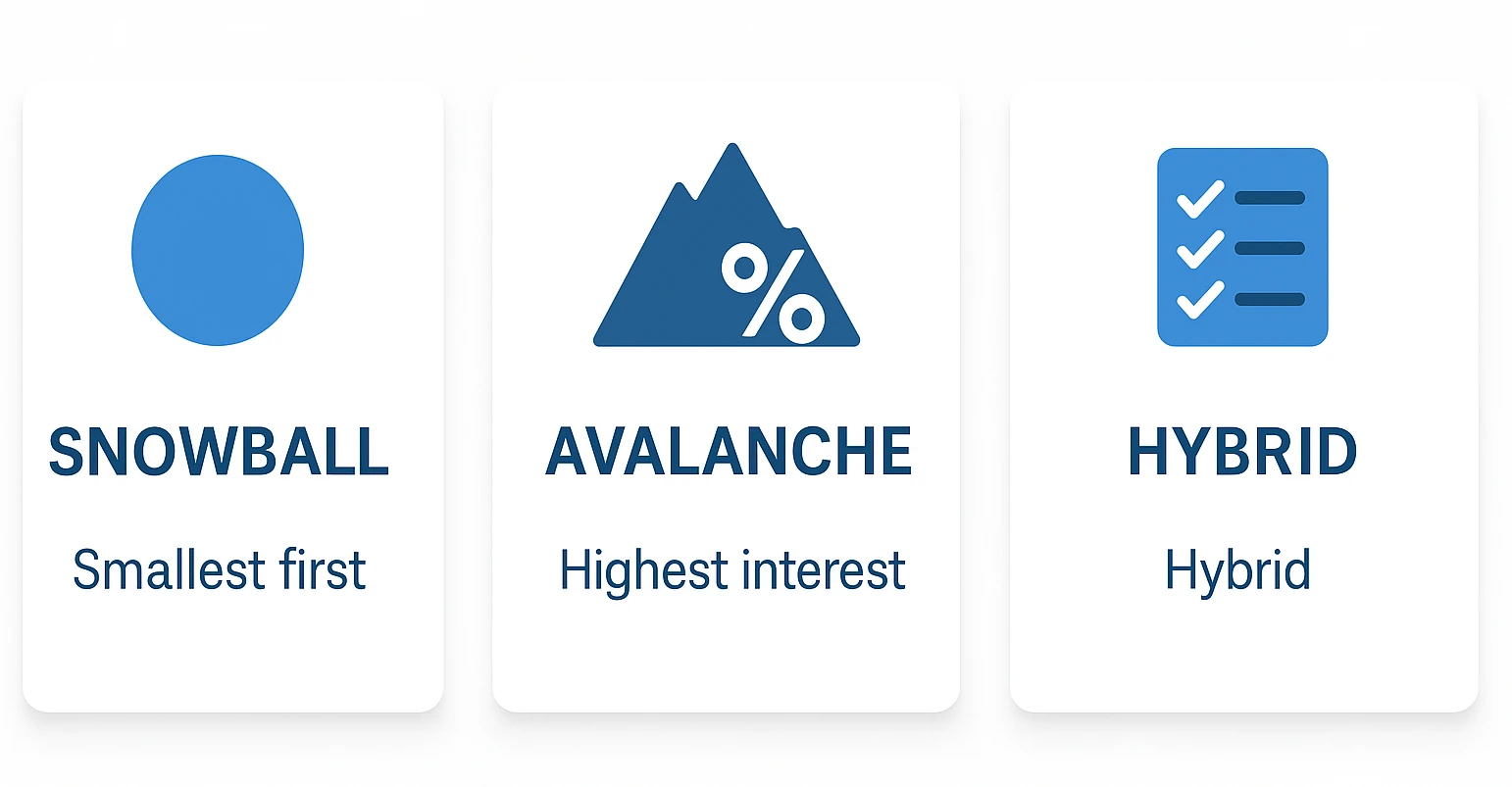
Snowball, Avalanche, or Cash-Flow First?
A payoff method decides where the next extra dollar goes. It cannot create money that is not in the budget, so separate the targeting rule from the work of creating monthly margin.
| Approach | Priority | How it works | Trade-off | Stories above |
|---|---|---|---|---|
| Snowball | Early wins | Target the smallest balance first while keeping other required payments current | May cost more interest than highest-rate-first | Brian; Zach and Katie |
| Avalanche | Interest savings | Target the highest APR first while keeping other required payments current | The first visible payoff can take longer | Alyssa |
| Cash-flow first | Create room to pay | Stabilize bills and change major spending or income before accelerating a target | May delay aggressive payoff while the budget is rebuilt | Lydia; Sarah |
The Consumer Financial Protection Bureau describes both smallest-balance-first and highest-interest-rate-first repayment strategies. The right targeting rule is the one you can execute with the cash flow you actually have.
The stories above show why the payment amount matters as much as the method. Once you have a rule and a realistic monthly number, use the estimator below to model your own timeline instead of borrowing someone else’s.
Debt-Free Date Estimator
Use your total balance, average APR, and monthly payoff budget to estimate a debt-free date. Add an extra monthly amount to see how much time and interest it could save.
Planning estimate only. It assumes one average APR and a fixed monthly payment; it does not model fees, promotional-rate changes, changing minimums, or separate balances.
Once you have a target, use our simple free debt payoff tracker to keep the plan visible.
With a rough timeline in mind, the FAQs below cover the method, motivation, and risk questions that often come next.
Frequently Asked Questions
Build Your Own Debt Payoff Plan
The pattern across these real debt-free stories is not speed. Progress accelerated when a vague goal became a rule: cut this cost, work these extra hours, move to this cheaper housing, target this balance, or protect this much cash before sending the rest to debt.
Start with your own numbers. List balances, APRs, required payments, and due dates; choose a targeting rule; then set a monthly amount your cash flow can support. If spending is the part you need to organize first, use our zero-based budget spreadsheet.
Next steps:
- Name the outcome: Write down what lower debt payments would make possible in your life.
- List the numbers: Balance, APR, required payment, and due date for every debt.
- Find the lever: Decide whether your biggest opportunity is a targeting rule, a major expense, more income, or formal repayment help.
- Set the payment: Choose an amount you can repeat without relying on a perfect month.
- Review and adjust: Track the current target and change the timeline when circumstances change.
A plan you can repeat beats a dramatic plan you abandon.

This content is educational and not financial advice. Your situation is unique—consider speaking with a qualified professional before making borrowing, payoff, or budgeting decisions.

