

Value investing strategies and fundamental analysis work together as a decision process: is this a business worth owning, is the price reasonable, and what evidence would prove the thesis wrong? For a FIRE investor, add one more guardrail: one bad stock thesis should never be able to derail the broader plan.
This guide shows how to screen valuation and business quality, verify the story in company filings, estimate value as a range and set position limits. The scorecard below helps you spot what still needs research. If you’re still getting comfortable with stocks and index funds, start with our beginner’s guide to investing for the diversified-investing foundation, then return here when you want a second-layer framework for researching individual companies.
This post contains affiliate links. If you use one of these links, we may earn a commission or referral fee at no extra cost to you. As an Amazon Associate I earn from qualifying purchases. Learn more.
Table of Contents
- Key Takeaways
- How Value Investing Fits a FIRE Plan
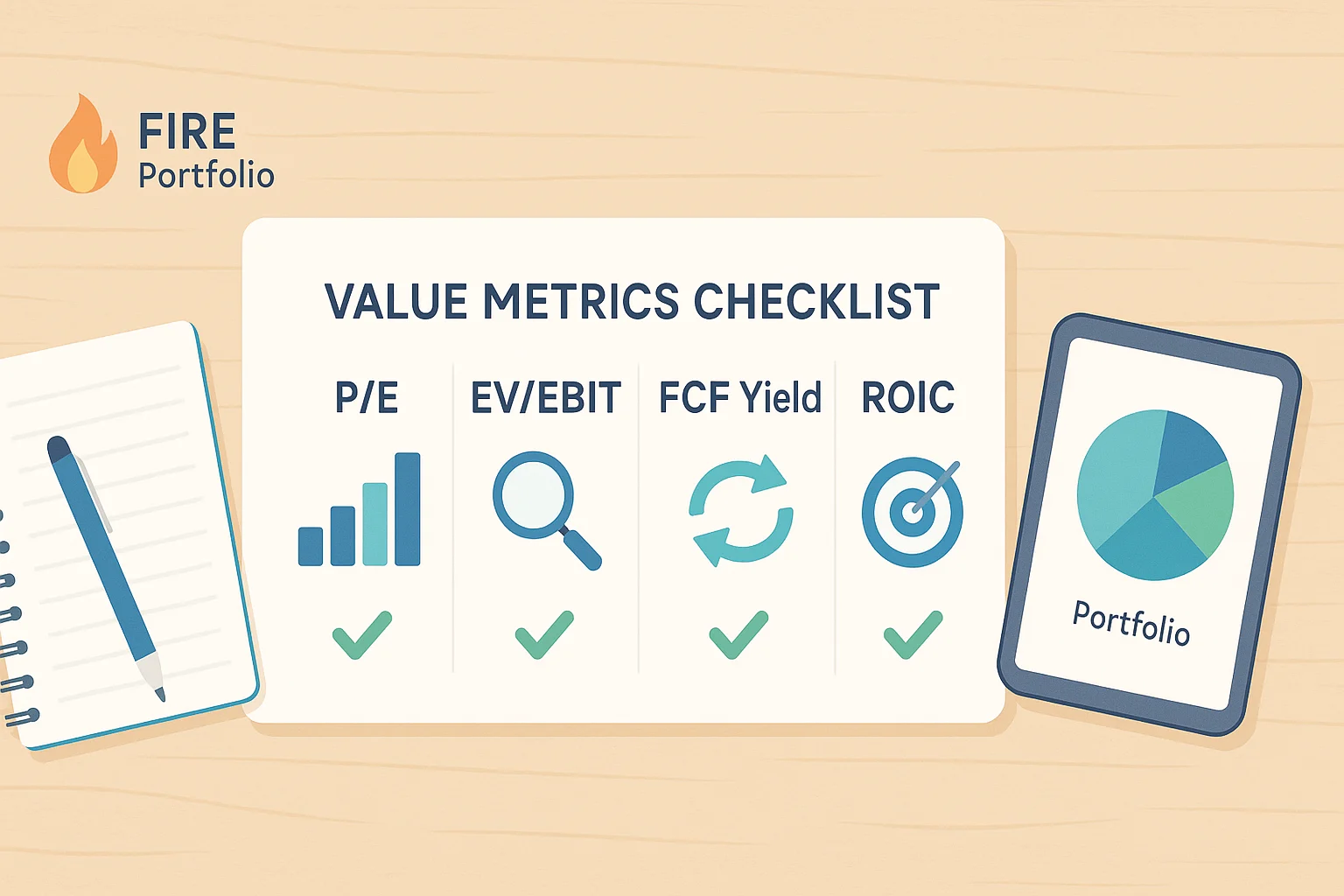
- Key Metrics for Fundamental Analysis
- Value Investing Screening Scorecard
- How to Do Fundamental Analysis: A Value Investing Workflow
- Avoiding Common Value Investing Pitfalls
- Integrating Value Picks with Your FIRE Portfolio
- Make Sure the Stock Pick Fits the Bigger Plan
- Worked Example: Keep Stock Picking in Its Lane
- Research Tools: Screen, Then Verify
- The Hard Part: Sticking to Your Process
- Frequently Asked Questions
- Your Next Step: Build One Thesis
Key Takeaways
- Value investing and fundamental analysis give you a repeatable way to separate business quality from the price you are being asked to pay; neither guarantees outperformance.
- Margin of safety and economic moats are different checks: one addresses valuation uncertainty; the other asks how durable the business’s competitive advantages may be. Neither removes investment risk.
- Compare valuation metrics in context. P/E, free cash flow yield and EV/EBIT are more useful against close peers and the company’s own history than as universal cutoffs.
- Before calling a stock a bargain, investigate why it looks cheap through its filings, competitive position, management incentives and capital allocation.
- Keep individual stocks inside a diversified FIRE plan. Before buying, write down what would invalidate the thesis and cap the position so one mistake cannot derail the plan.
How Value Investing Fits a FIRE Plan
Why the Time Horizon Fits
Value investing and FIRE can fit together because both reward long time horizons, patience and rules that reduce reactive decisions. That does not mean individual stocks are required for FIRE, or that value stocks will outperform on your timeline. If you choose to own individual companies, the practical benefit is having a process you can write down and revisit instead of reacting to every headline.
If you’re still designing your overall path to financial independence, our guide to financial independence and retiring early can help you map out your target number and timeline before you dive deep into stock selection.
Core Principles to Carry Into Stock Research
Margin of Safety: You aim to buy below a conservative estimate of intrinsic value so your decision has room for forecasting error. If your estimate were $100 per share, for example, you might require a meaningfully lower price before buying. The estimate can still be wrong, so a margin of safety is a decision buffer—not a guarantee.
Economic Moats: A common value-investing shorthand for durable competitive advantages. Examples can include brand strength, network effects, high switching costs and structural cost advantages.
Know What You Own: A focused research list can make it easier to follow a business closely, but familiarity is not the same as diversification. Keep the number and size of individual positions subordinate to the diversification your overall FIRE plan requires.
Write your FIRE goal in one sentence before you analyze a stock. It gives every later “buy,” “wait” or “pass” decision a clearer destination.
Before you analyze a stock, make sure the rest of your money plan can support the risk. Jump to the free Money Reset to see income, spending, debts, and goals together.
Key Metrics for Fundamental Analysis
Valuation Ratios: Put Price in Context
Valuation ratios help you understand what you’re paying for a dollar of earnings, cash flow or assets. They’re not magic by themselves, but they keep you from overpaying for a good story.
Imagine comparing two companies after a long day at work: one has a flashy story and a sky-high multiple, the other quietly produces steady profits at a much lower valuation. These ratios help you notice the difference before hype or fear take over.
| Metric | Formula | What It Reveals | How to Use It |
|---|---|---|---|
| P/E Ratio | Price ÷ Earnings per Share | How much you pay for $1 of earnings | Compare with the company’s own history and close peers |
| Earnings Yield | Earnings per Share ÷ Price | Earnings as a percentage of the share price | Compare with peers and check whether earnings are durable |
| EV/EBIT | Enterprise Value ÷ EBIT | Operating valuation that accounts for debt and cash | Compare within similar industries and capital structures |
| Free Cash Flow Yield | Free Cash Flow ÷ Market Cap | Cash generation relative to price | Compare with peers and the company’s own cash-flow history |
There is no universal “good” range for these ratios. Sector norms, a company’s own history, interest rates, growth expectations and accounting quality all change what a multiple means, so compare like with like. Investor.gov’s P/E ratio guide likewise frames P/E as a comparison with a company’s past or with other companies, rather than as a stand-alone buy signal.
Quality Indicators: Business Strength and Balance-Sheet Risk
Return on Invested Capital (ROIC): Measures how efficiently a company turns invested capital into operating profit. Treat it as a comparison metric: look at the company’s own history, close peers and whether returns stay comfortably above its cost of capital rather than assuming one percentage is “good” everywhere.
Debt-to-Equity Ratio: High leverage can magnify both gains and losses, but a useful debt level varies by industry. Read the ratio alongside interest costs, cash flow, maturities and peer balance sheets instead of relying on one universal cutoff.
Revenue Growth Consistency: A stable growth pattern can make a business easier to analyze, but growth by itself does not prove quality. Check whether revenue growth converts into durable margins, cash flow and returns on capital rather than targeting a fixed growth band.
Pick one company you already follow and look up its P/E, free cash flow yield and ROIC. Then compare each number with the company’s history and a few genuinely similar peers rather than deciding whether the stock is “cheap” from one ratio.
Now that you’ve seen what these metrics are trying to tell you, use this quick screen to organize what you know about one company before moving into the deeper research workflow.
Value Investing Screening Scorecard
Choose the description that best matches the company, using close peers and recent filings as context. Pick “Not sure yet” instead of guessing—this is a rough screening aid, not an intrinsic-value estimate or a buy/sell signal.
0 of 4 metrics selected
Choose one option per metric. If you have not researched one yet, use “Not sure yet” rather than forcing a score.
The payoff is a screening snapshot and a list of what to investigate next—not a valuation or investment recommendation.
How to Do Fundamental Analysis: A Value Investing Workflow
Step 1: Screening for Candidates
Start with basic filters to shrink the universe, not to declare winners. A useful screen should surface questions for research rather than hide sector differences behind one universal cutoff.
Financial Health Screen:
- Look for a business that can explain weak years and has a credible path to positive earnings or cash generation.
- Compare leverage, interest costs and debt maturities with close peers and the stability of the company’s cash flow.
- Check liquidity using measures that actually fit the industry; one ratio will not work equally well for banks, retailers and software firms.
Valuation Screen:
- Compare P/E, EV/EBIT or other relevant multiples with the company’s own history and close peers.
- Use free cash flow yield or earnings yield only after checking whether the underlying cash flow or earnings are durable.
- Investigate why a discount exists. A low multiple can signal opportunity, deterioration or both.
Quality Screen:
- Compare returns on capital and margins with peers and the company’s own history.
- Check whether revenue growth translates into cash flow and per-share value rather than growth for its own sake.
- Review share dilution, acquisitions, buybacks and reinvestment as part of the capital-allocation story.
Step 2: Read the Business and Financial Statements
Once the screen leaves you with a manageable shortlist, move from quick filters into full fundamental analysis: read the business, financial statements and risks before you refine valuation.
Read the 10-K filing: For U.S. public companies, the 10-K gives you a detailed view of the business, material risks and annual operating and financial results. Investor.gov’s guide to reading 10-K and 10-Q filings is a useful checklist before you rely on a screener summary.
Read the financial statements as one connected story rather than three isolated tables:
- Income statement: track revenue, margins and earnings over time.
- Balance sheet: check cash, debt and the obligations that can limit flexibility.
- Cash-flow statement: check how reported earnings translate into cash and how much cash the business uses for investment and financing.
- Notes and MD&A: look for accounting details, unusual changes and management’s explanation of what drove the results.
Assess the Competitive Position: Can competitors easily copy this model? Does the company have pricing power or meaningful switching costs?
Evaluate Management: Compare what leaders say with what they do. Review incentives, dilution, acquisitions, debt decisions, buybacks, dividends and reinvestment to see whether capital allocation has created value per share over time.
Step 3: Estimate Intrinsic Value as a Range
Comparable Company Analysis: Compare your candidate’s valuation, growth, margins and balance sheet with several close peers. A lower multiple is only interesting when the businesses are similar enough that the comparison means something and you understand why the discount exists.
DCF-Lite with Conservative Assumptions: Build a range rather than chasing one “correct” intrinsic-value number. Test several cash-flow, terminal-value and discount-rate assumptions, and pay attention to sensitivity: if a small input change flips the conclusion, the valuation is telling you to be cautious, not precise.
Treat valuation as a range of plausible outcomes. The model is useful when it shows which assumptions matter most and whether your thesis survives a more pessimistic scenario; it is not a guarantee of future returns.
Step 4: Position Sizing and Risk Management
Decide the role and maximum risk of individual stocks before you buy them. Size each position so an ordinary thesis failure cannot threaten your FIRE timeline, diversify across companies and industries, and use broad funds when you do not want to build diversification one security at a time. Higher conviction is not a substitute for diversification.

Avoiding Common Value Investing Pitfalls
The Value Trap Danger
Not every cheap stock is a bargain. Value traps look inexpensive but face permanent challenges such as dying industries, bloated cost structures or major technological disruption.
Maybe you’ve seen a stock chart that’s fallen 60% and felt tempted to call it a bargain. Before you click buy, ask whether the underlying business is still healthy or if something fundamental has broken.
Leverage and Yield-Chasing Risks
Chasing unusually high dividend yields or heavily indebted companies can backfire fast. Dividends can be reduced, and high leverage can turn an ordinary business setback into a severe loss for equity holders.
Behavioral Mistakes
Impatience, overconfidence and anchoring on past prices are common enemies. Commit to a written plan and position-size limits before emotions get involved.
Integrating Value Picks with Your FIRE Portfolio
The Core-Satellite Approach
One way to separate portfolio construction from stock picking is a “core-satellite” structure: broad, low-cost funds form the diversified core, while a smaller satellite holds individual ideas. The satellite may outperform or underperform; its job is to contain stock-selection risk rather than make extra return part of the FIRE plan.
To understand how that core might support long-term withdrawals, review our 4% rule for financial independence. Treat it as a historical planning guideline with assumptions and trade-offs, not as a promise that one withdrawal rate will fit every retirement horizon or portfolio.
Tax-Efficient Implementation
Asset location can change your after-tax result, but there is no one account map that fits every investor or jurisdiction. In the U.S., taxable accounts can allow capital losses to offset gains in some circumstances, while wash-sale rules can disallow a loss when substantially identical securities are repurchased too soon. For a deeper planning framework, see our asset location strategy guide, and check the current IRS Publication 550 before making a tax-loss decision.
If Roth accounts are new to you, our beginner’s guide to Roth IRAs covers the basics. For U.S. federal tax rules, remember that Roth IRA qualified distributions are tax-free only when the applicable requirements are met; the IRS Roth IRA guidance is the current authority.
When the Tax Rules Depend on Your Accounts
If the decision depends on taxable versus retirement-account placement, wash-sale rules, or your own retirement setup, a finance expert can help you work through the trade-offs before you act.
Rebalancing and Dollar-Cost Averaging
Simple systems beat complicated reactions. You can review your allocation on a calendar schedule—such as every six or twelve months—or rebalance when an asset class moves beyond a range you set in advance. Regular investing on a fixed schedule is dollar-cost averaging; it keeps contributions consistent through market ups and downs rather than asking you to predict the next move.
If your plan includes a cash allocation, define its purpose and target size in advance rather than treating it as an open-ended market-timing fund. Rebalancing with new contributions can also move money toward underweight assets without requiring you to guess when a sell-off has bottomed.
Choose a rebalance rule you can actually follow—calendar-based or threshold-based—and write it down before the next volatile week. Investor.gov’s asset-allocation and rebalancing guide explains both approaches and notes that taxes and transaction costs can matter.
Optional Complexity: Keep It Separate
Options overlays and other tactical strategies are separate decisions from whether a business is attractive at a given price. You do not need them to perform fundamental analysis, and extra complexity can make it harder to see whether the company thesis itself is sound. If you use options, understand the mechanics and risks first; FINRA’s options guide is a useful starting point.
By now a stock pick has a role in the plan, not the whole plan. Before you size the position, make sure the rest of your money is accounted for too.
Make Sure the Stock Pick Fits the Bigger Plan
See income, spending, up to 8 debts, and up to 8 goals together on the SNAPSHOT sheet before you decide how much room individual stocks should have in the plan.
Confirm to get the workbook and frugal money tips. Unsubscribe anytime.
Something went wrong. Please check your email address and try again.
Worked Example: Keep Stock Picking in Its Lane
Imagine a FIRE investor who wants to reserve a limited part of the portfolio for individual companies. Before choosing any company, they decide that broad diversified funds remain the core of the plan and that the stock-picking allocation can underperform without threatening the larger goal. For each candidate, they run a screen, read the filings, compare close peers, write down the thesis and list the facts that would prove the thesis wrong.
Notice what this example does not assume: that stock picking beats an index fund. The value of the process is that one bad idea cannot quietly become the FIRE plan. If you want to see how much your own timeline depends on future contributions and compounding, plug your numbers into our Coast FIRE calculator.
Research Tools: Screen, Then Verify
Screeners such as FINVIZ or Morningstar can help you narrow a large universe quickly, but a screener is a filter—not due diligence. Save a short watchlist, then return to filings, peer comparisons and the written thesis before you treat any result as investable.
Use research tools and paper trading in one platform
Explore MooMoo’s investing tools
In Canada? Explore MooMoo Canada .
For a fuller look at fit and trade-offs before opening an account, read our MooMoo review.
The Hard Part: Sticking to Your Process
The emotional challenge is not simply “buy when headlines are scary.” A falling price can be a bargain, a warning or both. Ask whether the business facts changed enough to invalidate your thesis.
Keep a short written checklist for what would make you buy, wait, add, trim or exit. On volatile days, review those facts before the share price; the goal is to make the next decision from evidence rather than from the mood of the market.
The Intelligent Investor, 3rd Ed. expands on valuation, margin of safety, investor behavior, and long-term decision-making. Use it to deepen the framework—not as a shortcut to deciding which stock to buy.
Frequently Asked Questions
Your Next Step: Build One Thesis
Start with one company you already understand. Use the screening scorecard to mark what you know and what still needs verification. Then read the 10-K, compare close peers, estimate value as a range and write two short lines: Why I might own it: the business-and-price case in plain English. What would prove me wrong: the evidence that would break the thesis. If you cannot explain both, you do not need to own the stock yet.
For FIRE, that restraint is part of the strategy. Keep individual-stock decisions understandable, revisitable and small enough that being wrong does not break the diversified plan carrying the larger goal.
This guide to value investing and fundamental analysis is for general education and entertainment only and isn’t personalized investment, tax or financial advice. Your situation, risk tolerance and local tax rules may be very different, so consider speaking with a qualified financial professional before making big money decisions. Investing always involves risk, and individual results will vary.

