

These health sharing ministries reviews compare Medi-Share, Christian Healthcare Ministries (CHM), and Liberty HealthShare using current program materials and regulator guidance. The focus is the costs, member responsibility, pre-existing-condition rules, eligibility limits, and risks that can change the decision before Medicare.
Health sharing can look attractive in early retirement because the monthly contribution may be lower than an unsubsidized insurance premium. The trade-off is certainty: health care sharing ministries are not insurance, payment of medical bills is not legally guaranteed, and ACA consumer protections do not apply in the same way. If health coverage is one piece of a bigger early-retirement plan, our financial independence & retiring early guide covers the rest of that picture.
Table of Contents
- Key Takeaways
- What Are Health Sharing Ministries?
- Health Sharing Fit Check
- Medi-Share vs. CHM vs. Liberty: Quick Comparison
- Health Sharing Ministries Reviews: Medi-Share, CHM, and Liberty
- Pros of Health Sharing for Retirees
- Cons and Risks to Watch For
- Health Sharing vs. Other Pre-Medicare Options
- Key Considerations Before Joining
- Put Your Money on One Screen Before You Compare Coverage
- Frequently Asked Questions
- Conclusion: When Health Sharing May Fit Before Medicare
Key Takeaways Before You Compare
- Start With the Core Trade-off: The NAIC warns that HCSMs are not insurance and cannot guarantee payment of claims, so a lower monthly contribution comes with less contractual certainty.
- Compare More Than the Monthly Share: Check the AHP, AUA, qualifying amount, co-share, and categories that are not shareable before deciding what a lower monthly contribution really means.
- Check Eligibility Before Price: Faith or lifestyle standards and pre-existing-condition rules vary by program and may narrow your realistic choices.
- Know Which Protections Do Not Apply: CMS says services covered by HCSM plans are not subject to No Surprises Act billing protections. If predictable coverage matters more than the lowest monthly cost, compare regulated insurance first.
What Are Health Sharing Ministries?
Health care sharing ministries are organizations whose members voluntarily share qualifying medical expenses under written program guidelines. Many are faith-based nonprofits, but eligibility and lifestyle rules vary by organization. Unlike an insurance policy, membership does not create the same legal obligation to pay a covered claim.
How They Operate
- Join: Apply under the program’s current membership and eligibility rules.
- Contribute: Pay a monthly share or contribution.
- Meet Your Member Responsibility: Programs use different terms—Medi-Share has an Annual Household Portion (AHP), Liberty uses an Annual Unshared Amount (AUA), and CHM uses qualifying amounts.
- Submit or Route Bills: Follow the ministry’s current provider and bill-submission process.
- Sharing Decision: Medical expenses that meet the written guidelines may be eligible for sharing.
Differences from Insurance
The core difference is legal and practical, not just terminology. NAIC consumer guidance says HCSMs are not insurance, do not have to provide ACA consumer protections, cannot guarantee claim payment, and generally are not supervised by state insurance regulators. CMS also notes that services covered by HCSM plans are not subject to No Surprises Act billing protections.
Once you understand that health sharing is not insurance, the next question is whether its trade-offs fit your own care needs and tolerance for uncertainty.
Health Sharing Fit Check
Answer four quick questions to see what deserves your next comparison. This is a screening tool, not an eligibility or coverage decision.
Medi-Share vs. CHM vs. Liberty: Quick Comparison
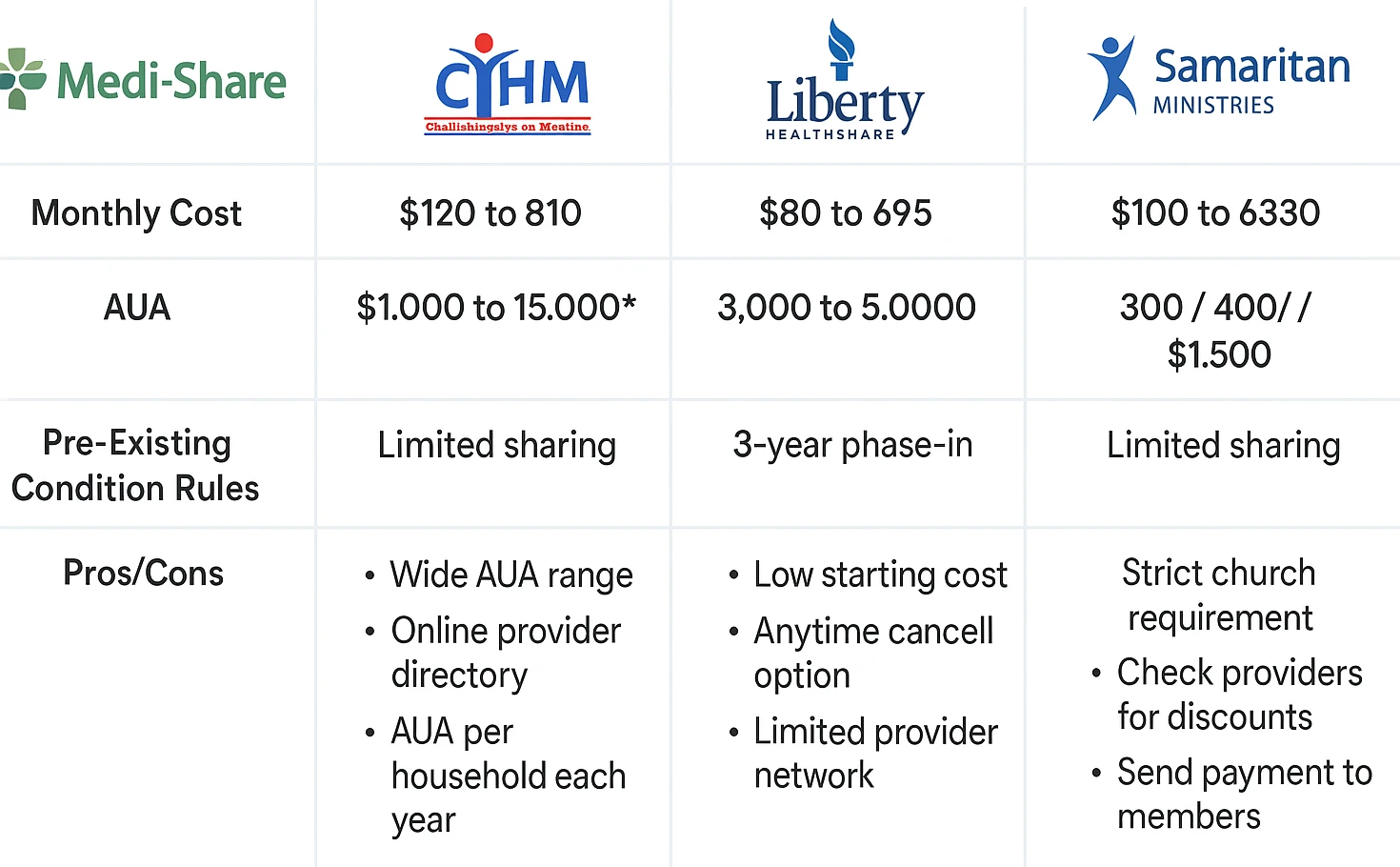
If the fit check still leaves health sharing on your list, the appeal is usually a lower monthly sticker price or a values-based sharing community. That is not an apples-to-apples replacement for insurance: the written sharing rules, member responsibility, and protections are different.
Marketplace premiums cannot be reduced to one national retiree number. HealthCare.gov says premiums vary with factors including age, location, tobacco use, and whether coverage is individual or family. Premium tax credits depend on household size and estimated income. Compare your actual Marketplace price and total out-of-pocket exposure against a ministry’s current contribution and sharing rules rather than assuming one route is always cheaper.
A lower monthly contribution only helps if the member responsibility and sharing rules fit your needs. Use this table as a fast screen, then read the detailed program notes below.
Facts checked August 2026: Figures below come from official program pages. Recheck before joining because contributions and guidelines can change.
| Program | Current monthly contribution | Member responsibility | Pre-existing-condition approach | Eligibility note |
|---|---|---|---|---|
| Medi-Share | Varies by household size and oldest applicant’s age | AHP: $3,000 / $6,000 / $9,000 / $12,000 per household per year | Current summary lists phased annual sharing after 36 and 60 months | Christian ministry; current membership guidelines apply |
| CHM Gold / Silver / Bronze | $299 / $169 / $115 per unit per month | Per-incident qualifying amount: $1,250 / $3,000 / $6,000 (CHM’s personal-responsibility rules may apply differently than a flat per-incident charge — verify current terms) | Gold has scheduled sharing during the first 3 years; Silver/Bronze use CHM Give for maintained pre-existing conditions | Christian ministry; current guidelines apply |
| Liberty Essential / Connect / Unite | $221 / $281 / $362 for a single member age 50–64 | AUA: $4,000 / $1,000 / $1,000; co-share 20% / 10% / none listed | Most programs: year 1 not shareable; up to $50,000 total in years 2–3; limitations may lift starting month 37 | Christian standards and lifestyle requirements |
Health Sharing Ministries Reviews: Medi-Share, CHM, and Liberty
The quick table gives you the structure. Use the details below to see which eligibility rules, member-responsibility amounts, and pre-existing-condition limits are most likely to change your decision.
Medi-Share (Christian Care Ministry)
- Eligibility: Medi-Share is a Christian health care sharing ministry; review its current membership guidelines before applying.
- Costs: The current share calculator bases monthly shares on household size and the age of the oldest applicant, so one age-60 price is not reliable. Current AHP choices are $3,000, $6,000, $9,000, or $12,000 per household per year.
- Pre-existing: Medi-Share’s current sharing summary lists up to $100,000 per member per year after 36 consecutive months and up to $500,000 per member per year after 60 months, subject to its guidelines.
- Provider process: The current summary lists a large provider network, in-network PPO discounts, and provider bill submission.
- Decision fit: More plausible if its Christian membership requirements fit and you can carry the chosen AHP; less attractive if you need near-term sharing for a pre-existing condition.
Christian Healthcare Ministries (CHM)
- Eligibility: CHM is a Christian health care sharing ministry; current guidelines govern membership and shareable expenses.
- 2026 costs: CHM lists Gold at $299 per unit per month, Silver at $169, and Bronze at $115. Current per-incident qualifying amounts are $1,250 for Gold, $3,000 for Silver, and $6,000 for Bronze; CHM’s personal-responsibility structure may apply differently than a flat per-incident charge, so verify the current terms before assuming you would owe that amount on every incident.
- Pre-existing: For maintained pre-existing conditions, CHM’s current Gold schedule allows up to $15,000 in year one, $25,000 cumulative through year two, and $50,000 cumulative through year three; after the third year the condition is no longer considered pre-existing. Silver and Bronze use a different CHM Give process for these expenses.
- Decision fit: Easier to compare if fixed per-unit contributions and qualifying amounts suit your budgeting; pre-existing needs and the standard illness cap/CHM Plus choice deserve extra scrutiny.
Liberty HealthShare
- Eligibility: Liberty’s current eligibility page requires Christian standards, shared beliefs, and lifestyle commitments.
- 2026 costs: For a single member age 50–64, Liberty currently lists Essential at $221/month, Connect at $281, and Unite at $362. Their AUAs are $4,000, $1,000, and $1,000 respectively; Essential also has a 20% co-share and Connect a 10% co-share.
- Pre-existing: Liberty’s current guidance says most programs do not share pre-existing-condition expenses in year one, allow up to $50,000 total in years two and three, and may remove the pre-existing limitation starting in month 37 of continuous membership.
- Provider process: Liberty offers optional PHCS network access; members may go outside the network, but the program warns that balance-billing risk rises and balance bills are not shareable.
- Decision fit: Worth comparing if its Christian standards fit and you want explicit AUA/co-share choices; the first-three-year pre-existing rules are a major filter.
Other Plans to Explore
- Samaritan Ministries: Another established member-to-member sharing option; verify its current membership and sharing guidelines before comparing it with the three programs above.
- Sedera: A medical cost-sharing option used by individuals and groups; verify the latest Member Guidelines directly because program terms can change.
- Zion HealthShare: Zion’s current membership page says it accepts people regardless of faith, bases contributions on factors including age, household and IUA, and does not require a provider network.
How to Read Health Share Plan Reviews Without Overweighting One Story
Medical cost sharing reviews are useful for spotting recurring friction, but one positive or negative story cannot tell you how a program will handle your medical need. Give more weight to detailed accounts that identify the program, the type of bill, the relevant written guideline, and what happened after the member submitted or appealed the expense.
- Large medical bills: Was the expense actually shareable under the written guideline, and what happened after submission?
- Pre-existing disputes: Does the complaint match the program’s published lookback or phase-in rule?
- Provider billing: Was the problem about network pricing, balance billing, self-pay handling, or the sharing decision itself?
- Service patterns: Repeated detailed reports are more informative than one extreme, context-free rating.
Use those patterns as questions to investigate, then cross-check them against the current guidelines and regulator notices before treating a review as a reason to join or avoid a ministry.
Pros of Health Sharing for Retirees
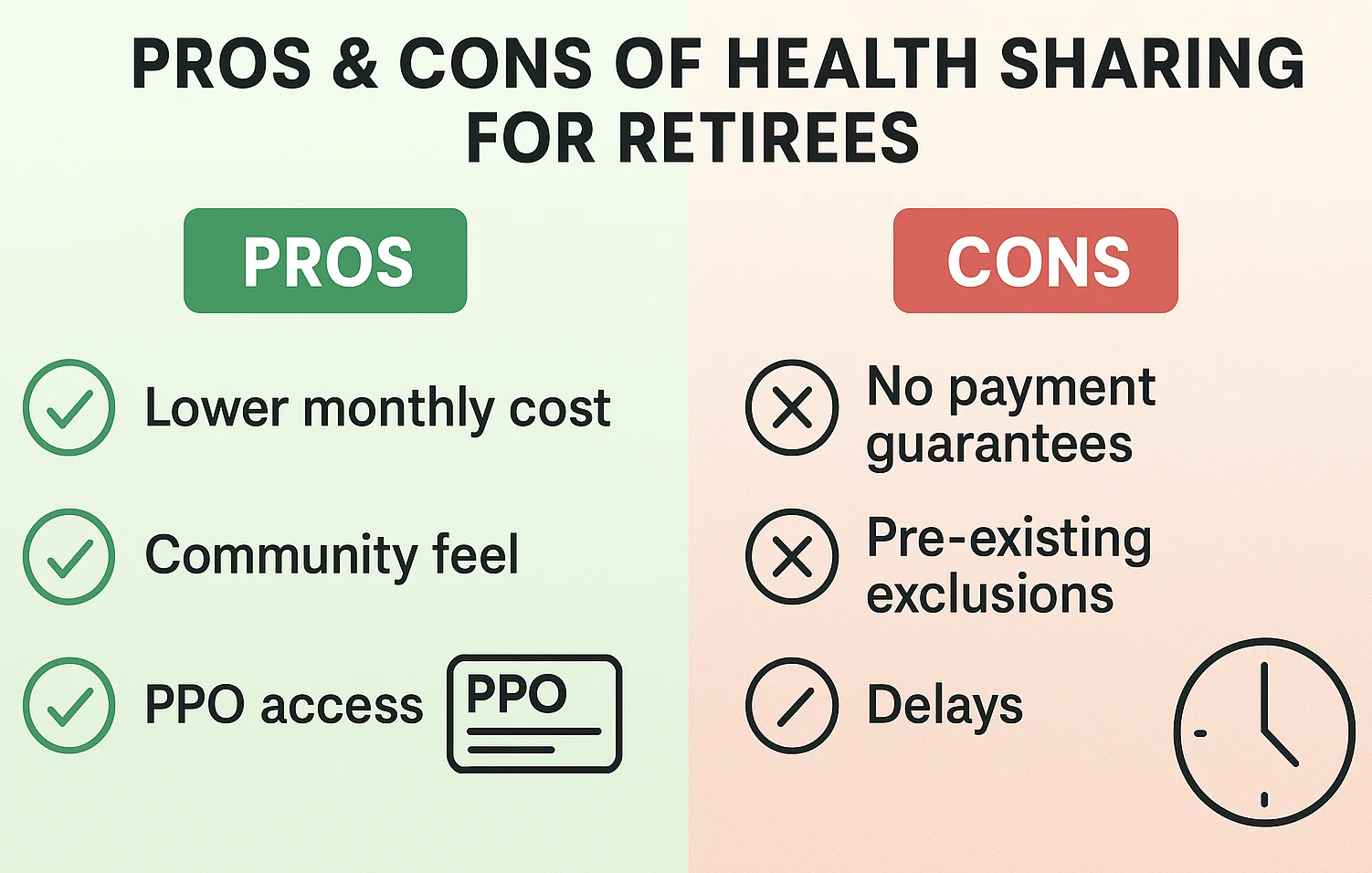
- Potentially Lower Monthly Contribution: Some households may see a lower monthly share than their unsubsidized insurance premium, but the total-risk comparison is different.
- Values-Based Community: Faith-based encouragement and mutual aid are meaningful to some members.
- Provider Flexibility: Some programs use broad networks or allow members to choose providers outside a required network.
- Choice of Member Responsibility: Some programs let members trade a higher AHP, AUA, or qualifying amount for a different monthly contribution.
Cons and Risks to Watch For
- No Contractual Payment Guarantee: Sharing is voluntary rather than an insurance obligation.
- No ACA Consumer-Protection Package: HCSMs do not have to provide the same protections for pre-existing conditions or out-of-pocket limits.
- Pre-existing Limits: The main programs use materially different waiting periods, phase-ins, caps, or special sharing processes.
- Billing Exposure: CMS says services covered by HCSM plans are not protected by the No Surprises Act’s billing protections.
- Eligibility and Lifestyle Rules: Some ministries require specific faith commitments or lifestyle standards.
Health Sharing vs. Other Pre-Medicare Options
If you are comparing ACA alternatives before Medicare, price regulated coverage with your actual ZIP code, household, and estimated income first. Marketplace premiums vary by factors such as age, location, tobacco use, and family enrollment, while premium tax credits depend on household size and estimated income. Depending on eligibility, Catastrophic Marketplace coverage may also be worth comparing — for most people age 30 and older, enrolling in a Catastrophic plan generally requires a hardship or affordability exemption rather than being an open metal-level choice, so confirm your eligibility before counting on it. If predictable contractual coverage matters more than the lowest monthly outlay, compare our early retirement health insurance options before choosing a non-insurance arrangement.
Key Considerations Before Joining
Before joining, read the current sharing guidelines—not only the marketing page. Compare the exact AHP, AUA, qualifying amount, co-share, pre-existing-condition rules, prescription and routine-care treatment, provider process, balance-billing exposure, and your ability to self-pay costs that are not shareable or are still under review.
Enrollment Process
Enrollment steps and start dates differ by ministry. Verify the current application, faith or lifestyle verification, health-history requirements, effective date, and any waiting or phase-in rules with the program you are considering. Do not cancel existing coverage until you understand when the new arrangement begins and which expenses it can share.
Practical Cost-Control Steps
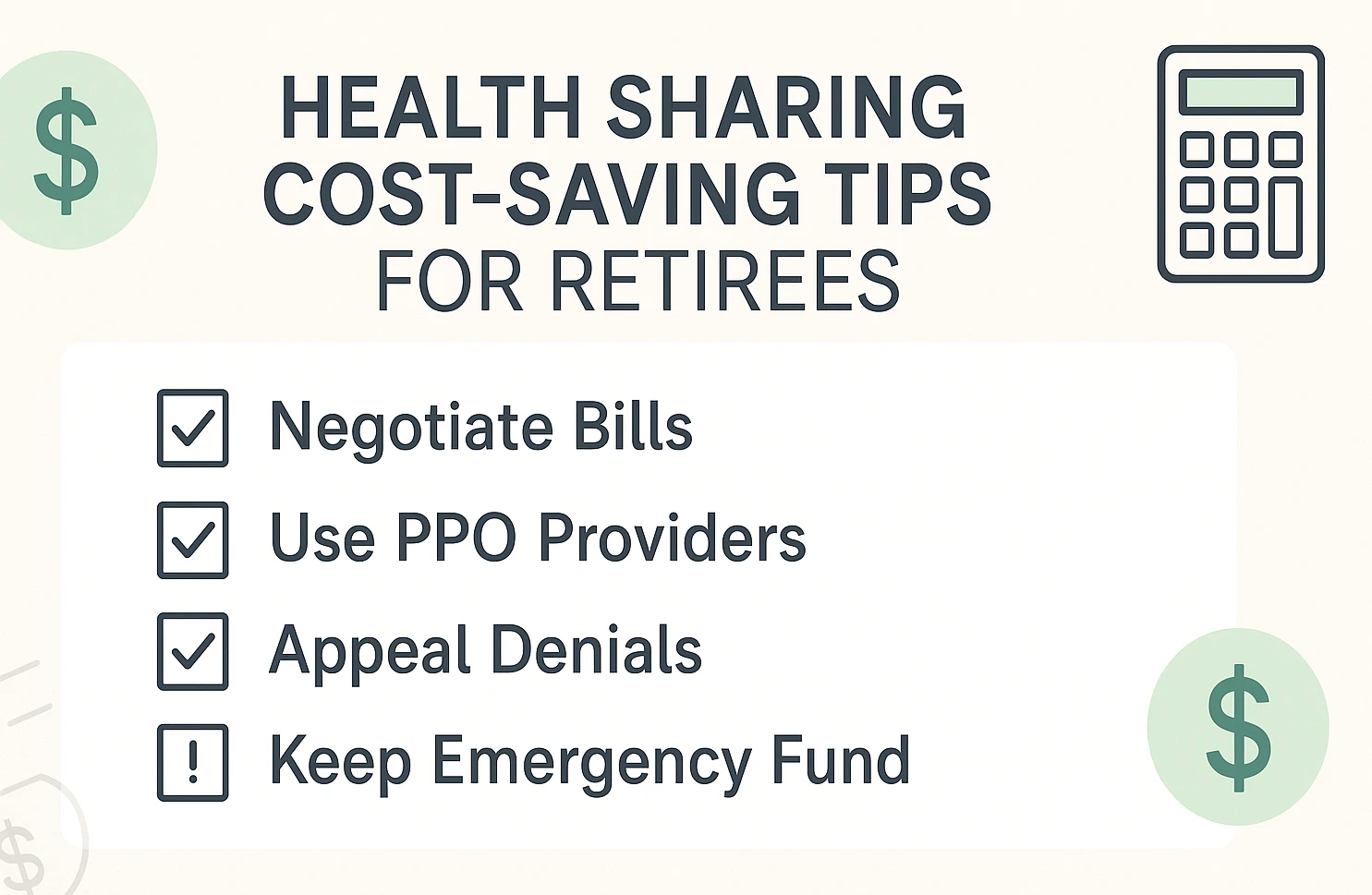
- Ask About Self-Pay Pricing: Before non-emergency care, ask the provider whether a cash or self-pay price is available.
- Use Official Cost Tools: If the ministry offers a provider network, fair-price tool, or bill-negotiation process, check it before scheduling care.
- Keep Documentation: Save itemized bills, explanations, and correspondence in case a sharing request needs clarification or appeal.
If those trade-offs make you wonder how much financial uncertainty your household can absorb, put your income, spending, debts, and goals on one screen before you compare the next coverage option.
Put Your Money on One Screen Before You Compare Coverage
Track income, spending, up to 8 debts, and up to 8 goals; the SNAPSHOT sheet totals everything automatically so you can see how much medical-cost uncertainty your budget can absorb.
Confirm to get the workbook and frugal money tips. Unsubscribe anytime.
Something went wrong. Please check your email address and try again.
Frequently Asked Questions
Conclusion: When Health Sharing May Fit Before Medicare
The decision is less about finding the lowest monthly share and more about deciding which risks you can accept. Before joining, compare the current guidelines for member responsibility, pre-existing conditions, provider handling, and bills that may not be shareable. If that uncertainty could strain your retirement budget, compare regulated insurance alongside the ministries rather than comparing ministries only with one another.
This article is general educational information, not insurance, legal, tax, medical, or financial advice. Health-sharing guidelines, Marketplace eligibility, prices, and HSA rules can change; verify current terms with the program and official government sources before changing coverage or making HSA contributions.

