

Imagine you and a friend both invest $500,000 in the same mix of funds and earn the same returns for 20 years. Yet your friend ends up with six figures more after tax. The difference isn’t a secret stock tip — it’s a simple asset location strategy that parks each investment in the account where it’s taxed least, so more of your growth actually stays yours. Over a couple of decades, that kind of tax-aware placement can easily mean tens of thousands of extra after-tax dollars, without changing what you own or how much risk you take. If you’re still building your foundation, our beginner’s guide to investing shows you how to set up the core portfolio this strategy builds on.
While asset allocation gets most of the attention in investment planning, this kind of tax-smart account placement can be equally powerful for building long-term wealth. This overlooked technique involves understanding how different account types are taxed, then deliberately placing specific investments where they’ll face the least tax drag. For DIY investors and FIRE enthusiasts who already invest consistently, optimizing asset location represents one of the most impactful ways to boost after-tax returns without taking additional risk.
Asset Location Focus Planner
Pick your situation to see where each account should focus.
Choose your tax bracket, main account, and time horizon to see a focus.
This post contains affiliate links. If you use these links, we may earn a commission at no extra cost to you. Learn more.
Open a Tax-Smart Brokerage
MooMoo offers commission-free stock and ETF trading plus helpful research tools, giving you a clean home for the taxable and Roth pieces of your asset location plan.
In Canada? → MooMoo Canada
Table of Contents
- Key Takeaways
- Understanding the Tax Landscape Across Account Types
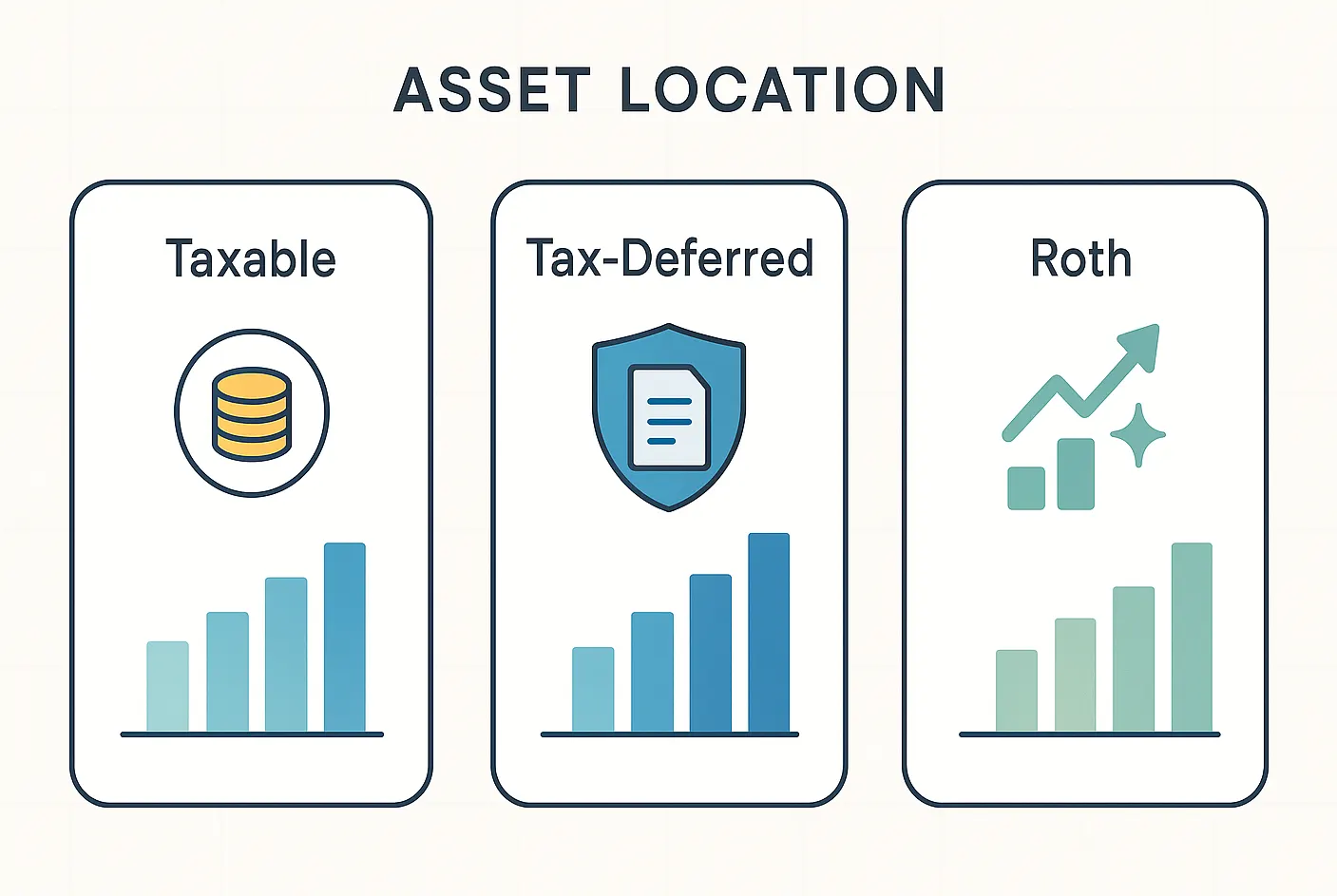
- Quick Asset Location Cheat Sheet: What Goes Where
- Implementation Examples: Applying Asset Location in Real Portfolios
- Advanced Considerations and Exceptions
- Rebalancing and Tax-Loss Harvesting Integration
- Monitoring and Adjusting Your Strategy
- Common Mistakes to Avoid
- Frequently Asked Questions
- Conclusion
Key Takeaways
- Asset location strategy means placing your different investments in the most tax-efficient account types so you can shrink your overall tax bill.
- Taxable accounts work best for broad-market equity index funds, municipal bonds (for high earners), and investments eligible for tax-loss harvesting.
- Tax-deferred accounts (traditional 401k/IRA) should hold ordinary-income generators like taxable bond funds, REITs, and high-turnover strategies.
- Roth accounts are ideal for highest-growth potential assets because, when the rules are met, qualified withdrawals of growth can be tax-free.
- Implementation requires maintaining your target asset allocation across all accounts while strategically placing specific holdings for maximum tax efficiency.
Quick action: If you’re skim-reading, pick the bullet that sounds most like your situation and focus on that section of the guide first.

Understanding the Tax Landscape Across Account Types
Taxable Brokerage Accounts: The Tax Drag Reality
Taxable brokerage accounts offer maximum flexibility but come with ongoing tax consequences. Every dividend payment, capital gains distribution, and realized gain from selling investments creates a taxable event. This “tax drag” can reduce annual returns by 1–2% or more, depending on the investments held. If you’ve ever opened a year-end statement and wondered why your tax bill jumped even though you “didn’t touch” your investments, that’s tax drag at work.
If you need a refresher on how each account type works, our retirement accounts and taxes guide walks through 401(k)s, IRAs, and Roth accounts in more detail.
Tax drag hits hardest with:
- High-yield dividend stocks and funds
- Actively managed funds with frequent trading
- Taxable bond funds generating ordinary income
- REITs and other pass-through entities
However, taxable accounts also provide unique advantages like access to tax-loss harvesting, preferential tax rates on qualified dividends and long-term capital gains, and the ability to pass assets to heirs with a stepped-up cost basis. Optimizing where each investment lives across your different accounts can be as impactful as chasing higher returns, often with less stress and risk. As a quick first step, circle or highlight any high-yield bond or REIT funds in your taxable account and note them as potential candidates to move into a tax-advantaged account over time.
Tax-Deferred Accounts: The Ordinary Income Conversion
Traditional 401(k)s and IRAs allow investments to grow tax-free until withdrawal, when everything gets taxed as ordinary income regardless of the original source. This means a long-term capital gain that would face a 15% tax rate in a taxable account gets converted to ordinary income potentially taxed at 24% or higher.
The trade-off creates opportunities:
- Investments generating ordinary income anyway (like bonds) lose nothing from this conversion.
- High-turnover strategies avoid ongoing tax drag during accumulation.
- Tax deferral can span decades, allowing compound growth on money that would otherwise go to taxes.
Roth Accounts: The Tax-Free Growth Engine
Roth IRAs and 401(k)s represent the holy grail of tax efficiency – when you follow the rules, future qualified withdrawals of growth can be tax-free. This makes them perfect homes for investments with the highest growth potential, especially those that might generate significant taxable events in other account types.
If you’re new to Roth accounts, our beginner’s guide to Roth IRAs explains how contributions, withdrawals, and tax-free growth work.
Roth accounts shine brightest for:
- Small-cap and emerging market funds with high growth potential
- Individual stocks expected to appreciate significantly
- Alternative investments with complex tax treatment
- Any investment you plan to hold for decades
Tax Efficiency Tiers at a Glance
Another way to think about placement is by how “tax hungry” each asset type is. Highly inefficient assets throw off a lot of taxable income every year, while efficient ones let you control when taxes show up.
| Tax Efficiency | Asset Types | Taxable Event Frequency | Typical Tax Treatment |
|---|---|---|---|
| Highly Inefficient | REITs, taxable bonds, high-turnover funds | Frequent, often yearly | Mostly ordinary income at your top rate |
| Moderately Inefficient | High-dividend stocks, some mutual funds | Regular dividends and distributions | Mix of ordinary income and capital gains |
| Highly Efficient | Municipal bonds, index ETFs, growth stocks | Infrequent or controllable | Tax-exempt interest or long-term capital gains |
Small next step: Jot down which account types you already have today — taxable, traditional, Roth, HSA, or 529 — so the rest of this guide maps cleanly onto your real-life setup.
Quick Asset Location Strategy Cheat Sheet: What Goes Where
Use this quick cheat sheet as you rebalance: Broad U.S. and international index funds usually fit best in taxable accounts, taxable bond funds and REITs often work better in traditional 401(k)s and IRAs, and your highest-growth bets (small-cap, emerging markets, or concentrated stock positions) belong in Roth accounts so every dollar of future growth can be withdrawn tax-free. If you’re early in your career, start by getting your new contributions aligned with this map; if you’re closer to retirement, focus on gradually shifting existing positions toward it whenever you rebalance. On a quiet weekend afternoon, you might simply log into each account and nudge things toward this map one transfer or new contribution at a time. Pick one account today and label each holding as “best for taxable,” “better in traditional,” or “better in Roth” — no trades yet, just tags.
| Account type | Best suited for | Why it fits |
|---|---|---|
| Taxable brokerage | Broad U.S. and international index funds, some municipal bonds | Tax-efficient holdings that benefit from lower capital gains rates and tax-loss harvesting. |
| Traditional 401(k)/IRA | Taxable bond funds, REITs, high-turnover strategies | Shelters ordinary income and frequent trades from current taxes while you’re working. |
| Roth IRA/401(k) | Highest-growth assets like small-cap, emerging markets, concentrated stock bets | Aim for long-term tax-free growth on aggressive holdings you can leave untouched for decades. |
Tier 1: Taxable Account Priorities
🏆 Broad-Market Equity Index Funds
Large, diversified index funds tracking the S&P 500 or total stock market earn the top spot in taxable accounts. These funds typically generate qualified dividends (taxed at preferential rates) and maintain low turnover, minimizing capital gains distributions. Their tax efficiency makes the tax drag manageable while preserving access to tax-loss harvesting opportunities.
Example: A total stock market index fund with a 1.8% dividend yield and 3% annual turnover creates minimal tax drag while maintaining maximum flexibility.
🏆 Municipal Bonds (For High Earners)
Investors in the 24% tax bracket or higher often benefit from municipal bonds, whose interest payments escape federal taxation. High-quality muni bond funds can provide after-tax yields superior to taxable bonds for these investors.
🏆 International Developed Market Funds
Foreign tax credits from international funds can only be claimed when held in taxable accounts, providing a small but meaningful tax benefit that disappears in retirement accounts.
Tier 2: Tax-Deferred Account Priorities
🎯 Taxable Bond Funds
Bond funds generating ordinary income face no penalty from the ordinary income conversion in traditional retirement accounts. Meanwhile, they avoid the annual tax drag that would occur in taxable accounts.
🎯 REITs and Real Estate Funds
Real Estate Investment Trusts typically generate high dividend yields taxed as ordinary income, making them natural fits for tax-deferred accounts. The tax shelter allows investors to capture the full yield without annual tax consequences.
🎯 High-Turnover and Factor Funds
Actively managed funds, factor-based strategies, and funds with high turnover generate frequent taxable events. Placing them in tax-deferred accounts eliminates this tax drag during the accumulation phase.
Tier 3: Roth Account Priorities
🚀 Highest Growth Potential Assets
Since qualified Roth withdrawals can be tax-free when the rules are met, these accounts should usually house investments with the greatest long-term appreciation potential. Small-cap funds, emerging market stocks, and individual growth stocks all make excellent Roth candidates.
🚀 Alternative Investments
Investments with complex tax treatment – like commodities, certain ETFs, or alternative strategies – work well in Roth accounts where tax complexity disappears.
🚀 Concentrated Positions
Individual stocks or sector-specific investments with significant upside potential can generate massive tax-free gains when held in Roth accounts.
Implementation Examples: Applying Your Asset Location Strategy in Real Portfolios
The Coordination Challenge
Many investors worry that optimizing asset location requires abandoning their carefully planned asset allocation. The simplest way to think about this is to view all accounts as one integrated portfolio while strategically placing specific holdings. Maybe you have a 401(k) at work, an old IRA, and a taxable brokerage account that all feel disconnected — asset location pulls them into one simple picture.
Step-by-Step Implementation:
- Calculate your target allocation across all accounts combined.
- Identify which specific funds/investments you’ll use to achieve each asset class exposure.
- Place each holding in its most tax-efficient account type.
- Adjust position sizes across accounts to maintain your overall target allocation.
Real-World Example
Sarah has $300,000 total invested with a target allocation of 70% stocks, 20% bonds, and 10% REITs:
- Taxable account ($150,000): 100% total stock market index fund
- Traditional 401k ($100,000): 50% bond fund, 50% REIT fund
- Roth IRA ($50,000): 100% small-cap fund
Her overall allocation: 70% stocks (50% large/mid-cap + 20% small-cap), 20% bonds, 10% REITs – exactly her target, but optimally located for tax efficiency.
Small next step: Sketch a simple version of Sarah’s layout using your own account balances, then write the stock, bond, and REIT percentage each account currently carries — no need to make changes yet.
Talk Through Your Tax Questions
If your asset location plan feels messy or your tax situation is unusual, JustAnswer lets you chat with verified finance pros for quick, on-demand guidance.
In Canada? → JustAnswer Canada
Advanced Considerations and Exceptions
The Qualified Dividend Advantage
Not all dividends receive preferential tax treatment. Qualified dividends from most U.S. corporations and qualified foreign corporations face capital gains tax rates (0%, 15%, or 20% depending on income). Non-qualified dividends face ordinary income rates. For formal definitions and current thresholds, see the IRS guidance on qualified dividends.
This distinction matters for asset location:
- Funds generating mostly qualified dividends work well in taxable accounts.
- Funds with significant non-qualified dividends (like REITs) belong in tax-deferred accounts.
Foreign Tax Credit Considerations
International funds often pay foreign taxes on behalf of shareholders, creating foreign tax credits. These credits can only be claimed when holding the funds in taxable accounts – they’re lost in retirement accounts.
For diversified international index funds, this benefit typically outweighs the tax drag from dividends, making taxable accounts the preferred location. If you hold an international index fund in a taxable account and spot a small “foreign tax paid” line at tax time, that’s exactly the kind of credit this strategy is trying to put to work for you.
Extra Tax Layers in Taxable Accounts
Short-term capital gains (for investments held one year or less) are taxed at your ordinary income rate, while long-term gains usually get lower rates. That difference is why holding periods matter so much when you decide what to buy and sell in a taxable account.
Higher-income investors may also owe the 3.8% Net Investment Income Tax (NIIT) on top of their regular tax when income passes certain thresholds. If you’re in that group, modeling this extra layer can make “tax drag” from the wrong asset in the wrong account even more expensive over time.
Factor Fund Placement Strategy
Factor-based funds (value, momentum, quality, etc.) present a placement dilemma. They often have higher turnover than broad market funds but may still generate mostly qualified dividends and long-term capital gains.
Consider these factors:
- Turnover rate: Higher turnover favors tax-deferred placement.
- Expected returns: Higher expected returns favor Roth placement.
- Dividend characteristics: Qualified dividends favor taxable placement.
- Tracking error: Higher tracking error creates more tax-loss harvesting opportunities in taxable accounts.
Required Minimum Distributions and Future Tax Rates
For investors approaching their 70s, required minimum distributions (RMDs) from traditional retirement accounts can unexpectedly push taxable income higher. Coordinating your asset location with planned Roth conversions and RMD timing may help keep future tax brackets steadier and reduce the odds of being forced to sell tax-inefficient assets at the wrong time.
Where Do HSAs and 529 Plans Fit?
Health Savings Accounts (HSAs) are often the most tax-advantaged accounts you’ll ever use: contributions can be pretax or deductible, growth is tax-free, and withdrawals for qualified medical expenses are tax-free. Because of that “triple tax benefit,” many investors treat the HSA like a super-charged Roth and hold long-term growth assets there. 529 college savings plans are more specialized and usually best reserved for education-bound money, where you might choose a balanced stock and bond mix that aligns with your timeline for tuition payments.
When to Break the Rules
Low Tax Bracket Investors
Investors in the 10% or 12% tax brackets face 0% rates on qualified dividends and long-term capital gains. For these investors, the tax drag in taxable accounts nearly disappears, making asset location less critical.
Employer Plan Limitations
Many 401(k) plans offer limited investment options, forcing compromises in optimal asset location. In these cases, use the available options that best fit each account type, even if they’re not perfect matches.
Municipal vs. Taxable Bond Decision
The break-even tax rate for municipal bonds varies by specific bonds and market conditions. Calculate the taxable equivalent yield to determine whether munis make sense for your situation:
Taxable Equivalent Yield = Municipal Yield ÷ (1 – Tax Rate)
Small next step: Choose one “advanced” topic from this section — NIIT, RMDs, or muni vs. taxable bonds — and jot down a question to bring to your next conversation with a tax professional.
Rebalancing, Tax-Loss Harvesting, and Taxable Account Investing
Contribution-Based Rebalancing in Taxable Account Investing
Rather than selling investments to rebalance, direct new contributions to underweight asset classes in their optimal account types. This approach keeps your taxable account investing on track, maintains your target allocation, and helps you avoid unnecessary taxable events.
Tax-Loss Harvesting Coordination
Tax-loss harvesting – selling investments at a loss to offset gains – only works in taxable accounts. When harvesting losses, be mindful of wash sale rules that prohibit buying substantially identical securities within 30 days.
Wash sale considerations for asset location:
- Don’t hold the same fund in taxable and retirement accounts if you plan to harvest losses.
- Use different index providers (e.g., Vanguard in taxable, Fidelity in 401k) to avoid wash sale issues.
- Consider broader or narrower index funds as substitutes during wash sale periods.
Managing Capital Gains Distributions
Even tax-efficient index funds occasionally make capital gains distributions, typically in December. These distributions create taxable events regardless of whether you reinvest them.
Strategies to minimize impact:
- Check distribution estimates before making large purchases late in the year.
- Consider holding funds with recent large distributions in tax-deferred accounts temporarily.
- Use ETFs instead of mutual funds when possible, as they typically avoid distributions.
If you’ve ever bought a fund in December only to get hit with a surprise capital gains distribution a few days later, you know how frustrating this can feel. A quick calendar check before big purchases can spare you that headache. In my own planning checklists, I’ve found that keeping a simple one-page map of “what goes where” near my desk makes it much easier to rebalance without second-guessing every trade.
Monitoring and Adjusting Your Strategy
Annual Review Process
Your asset location strategy needs an occasional check-in to stay effective:
🔍 Review annually:
- Changes in tax brackets affecting municipal bond attractiveness.
- New investment options in employer plans.
- Shifts in fund characteristics (turnover, dividend yield).
- Rebalancing needs across account types.
📊 Track key metrics:
- Overall asset allocation across all accounts.
- Tax drag in taxable accounts.
- Contribution room in tax-advantaged accounts.
- Opportunities for Roth conversions.
If you’re exploring conversions as part of early retirement planning, our Roth conversion ladder guide walks through how staged conversions can complement your asset location choices.
Many readers tell me they tie this check-in to filing their taxes or scheduling a yearly “money date.” Blocking even an hour on the calendar makes it much more likely you’ll take one or two practical steps instead of postponing them for another year.
Life Stage Adjustments
Early Career: Maximize Roth contributions and place highest-growth assets there.
Peak Earnings: Focus on tax-deferred savings and municipal bonds.
Pre-Retirement: Begin shifting toward more tax-efficient taxable account holdings.
Retirement: Coordinate withdrawals across account types for optimal tax management.
If you’re also wondering how much you can safely spend each year, our simple guide to the 4% rule pairs well with this account-by-account planning.
Small next step: Put a 30-minute “asset location review” on your calendar for the same week you normally file your taxes or do your yearly money check-in.
Common Mistakes to Avoid
The Perfection Trap
Don’t let the pursuit of perfect asset location prevent good investing. A simple, consistently implemented strategy beats a complex approach that gets abandoned.
Ignoring Investment Minimums
Many funds require minimum investments that may exceed your target allocation to specific account types. Start with available options and optimize over time as balances grow.
Overcomplicating with Too Many Funds
More funds don’t necessarily mean better asset location. A focused approach with 3–5 well-chosen funds often works better than trying to optimize 15+ holdings across multiple accounts. If you’re juggling a dozen overlapping funds across three different platforms, it’s completely normal to feel overwhelmed — simplifying the lineup is often the quickest relief.
Forgetting About Fees
Account maintenance fees, transaction costs, and expense ratios can outweigh tax benefits. Always consider total costs when implementing asset location strategies.
Small next step: Pick one potential mistake from this list and check your own accounts this week to see if it’s quietly showing up.
Frequently Asked Questions
Conclusion
Thoughtful asset placement across your taxable, traditional, and Roth accounts is one of the most powerful yet underused ways to improve your after-tax returns. By putting broad-market index funds and municipal bonds in taxable accounts, ordinary-income generators in tax-deferred accounts, and your highest-growth assets in Roth accounts, you give every dollar a more tax-efficient home. For example, a $500,000 portfolio that gradually shifts bond funds out of taxable and into a traditional 401(k) while keeping broad stock index funds in taxable may see tens of thousands of dollars more after tax over a couple of decades — without changing the underlying risk level.
Next steps to implement your asset location strategy in your own accounts:
- Audit your current holdings across all account types.
- Identify obvious mismatches (like bond funds in Roth accounts).
- Plan gradual transitions using new contributions and rebalancing opportunities.
- Set up annual reviews to maintain optimal placement as your situation evolves.
Remember, the right approach is the one you can implement consistently over decades. Start simple, stay disciplined, and let the power of tax-efficient placement compound your wealth over time.
This asset location strategy guide is general education, not personalized tax, investment, or legal advice. Your situation, goals, and tax profile are unique, so individual results will vary. Tax laws change over time, and examples here may not reflect the latest rules for your country or state. Before making significant moves, consider talking with a qualified tax professional or financial planner who can review your specific details.

