

A good CD ladder plan starts with dates, not rates. Decide when you may need each portion of the money, then spread the deposit across CDs that mature around those dates. That is the core of a CD ladder plan: scheduled access without putting the whole balance into one term. Keep emergency cash and money you may need sooner outside the ladder.
If you’re deciding how CDs fit into a broader plan for safe savings and investing, our beginner’s guide to investing covers the bigger picture. Here, you’ll build the ladder itself: choose a maturity schedule, split the deposit, compare the terms that fit those dates, check insurance coverage, and decide what happens when each rung matures.
This post contains affiliate links. If you use one of these links, we may earn a commission at no extra cost to you. Learn more.
Table of Contents
- Key Takeaways
- CD Ladder Calculator: Build a Starting Schedule
- How a CD Ladder Works
- See What Cash Should Stay Outside the Ladder
- How to Build a CD Ladder Plan
- Compare APYs, Penalties, and Short-Term Alternatives
- Comparing CD Types and Structures
- Managing FDIC and NCUA Coverage
- Optional CD Ladder Variations
- Common CD Ladder Mistakes to Avoid
- Hypothetical CD Ladder Examples
- Frequently Asked Questions
- 3 Final Checks Before You Open the First CD
Key Takeaways
- Stagger the maturity dates. A CD ladder spreads deposits across multiple CDs so portions of your safe savings become available on a schedule instead of all at once.
- Choose dates before rates. Pick rung lengths around when you may need the money, then compare the actual APYs and early-withdrawal terms for those maturities.
- Check insurance by institution and ownership category. Include your other deposits at the same bank or credit union when applying the $250,000 standard limit.
- Reassess at maturity. Compare the offers and your cash needs again instead of building the ladder around an interest-rate forecast.
- Match rungs to real expenses. Property taxes, insurance premiums, tuition, travel, or a planned purchase can all give a maturity date a specific job.
If you already know how much cash can stay outside your emergency fund, the planner below turns three choices—amount, maturity spacing, and number of rungs—into a concrete starting schedule.
CD Ladder Calculator: Build a Starting Schedule
Enter the amount available for CDs, then choose maturity spacing and a rung count. The calculator builds an equal-split starting schedule; it does not forecast APYs or future rates.
Keep emergency and near-term cash outside the ladder.
Choose spacing and rung count to build the schedule
The result will show an equal amount per rung and the starting maturity interval for each CD.
How a CD Ladder Works
If CDs are new to you: think of them as time deposits. You choose a term, and the institution pays interest under the account terms; taking money out before maturity may trigger the CD’s disclosed early-withdrawal rules.
What Is a CD Ladder?
A CD ladder plan is a strategy where you buy several certificates of deposit with different maturity dates, creating a “ladder” of CDs that come due at regular, predictable times. Instead of putting all funds into a single CD, you divide your money across several CDs with staggered terms.
If you’ve ever hesitated to open a longer-term CD because you were afraid of “what if I need the money,” this structure can feel like a relief by giving you regular, scheduled access to part of your savings.
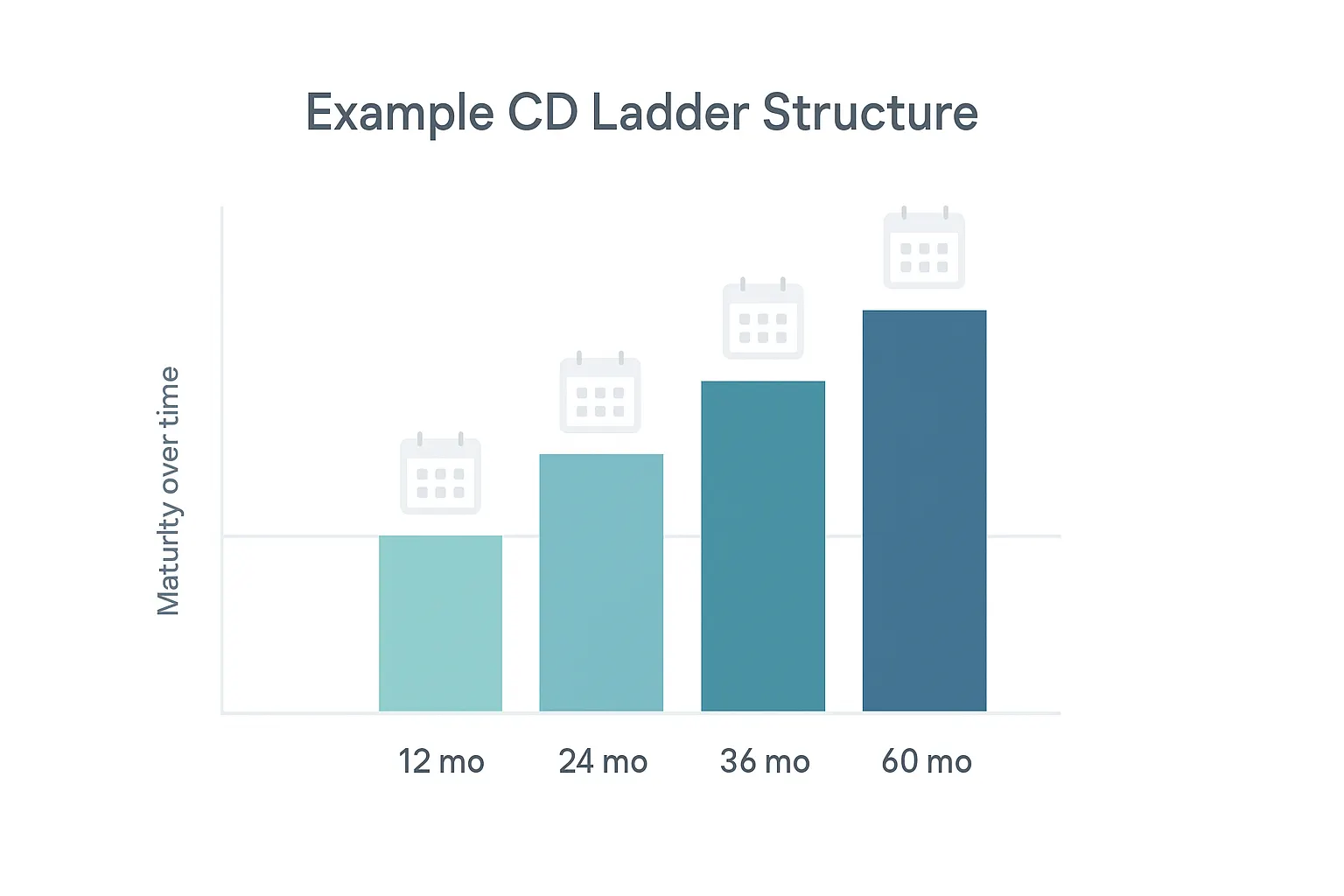
What a Ladder Changes vs. One CD
Traditional CD investing creates a trade-off between access and how long you commit the money. CD rates do not always increase with the term, so a ladder is most useful as a scheduling tool rather than a promise of a higher yield. A well-constructed ladder can provide:
- Scheduled access as individual rungs mature, reducing the need to break a CD early
- A way to compare and lock different APYs instead of committing everything on one date
- Less dependence on a single purchase date or maturity date
- Predictable maturity points for budgeting and planning
For example, putting $50,000 into one 3-year CD keeps the full principal committed until that CD matures unless you use the institution’s early-withdrawal option. Splitting the same $50,000 into five $10,000 rungs with different maturity dates creates smaller scheduled access points; the actual interest depends on the APY of each CD.
CD Ladder Pros and Cons: When It Fits—and When It Doesn’t
| Decision | A ladder can fit when… | Keep more money liquid when… |
|---|---|---|
| Timing | You have approximate dates when portions of the money can come due | You may need most of the money at any time or on very short notice |
| Access | You can leave each rung alone until its scheduled maturity | An early withdrawal is likely rather than exceptional |
| Goal | You value fixed terms and scheduled maturity dates | Your main priority is immediate access rather than a maturity schedule |
| Management | You are willing to track several maturity, grace-period, and renewal dates | You want one account with minimal maintenance |
A ladder is not automatically better than a savings account, Treasury bill, or single CD. Its advantage is the schedule it creates; the better choice still depends on the actual terms and when you need the money.
If you’re still deciding whether this cash is truly available for a ladder, check the rest of your money picture before you lock it up.
See What Cash Should Stay Outside the Ladder
Use the SNAPSHOT to see income, spending, up to 8 debts, and up to 8 goals together before you decide how much cash can stay locked in CDs.
Confirm to get the workbook and frugal money tips. Unsubscribe anytime.
Something went wrong. Please check your email address and try again.
How to Build a CD Ladder Plan
Build the ladder in this order: protect liquidity, choose the maturity schedule, split the deposit, compare the CDs that fit, record each rung, and revisit the plan at maturity.
1. Decide What Stays Outside the Ladder
Start with liquidity, not the amount you hope to earn. The ladder should contain only money you can leave until its scheduled maturity date.
- Keep emergency cash and near-term spending money liquid
- List known expenses and the dates you expect to pay them
- Check how much you already hold at the same bank or credit union before relying on deposit-insurance limits
The amount left after those checks is the amount you can reasonably consider for the ladder.
2. Choose Maturity Spacing and the Number of Rungs
Your access rhythm determines the ladder shape. These are planning patterns, not rate recommendations:
| Access rhythm | Example starting rungs | What it changes |
|---|---|---|
| Every 3 months | 3, 6, 9, 12 months | More frequent scheduled access and more maturity dates to manage |
| Every 6 months | 6, 12, 18, 24 months | A middle ground between access frequency and account count |
| Every 12 months | 1, 2, 3, 4, 5 years | An annual maturity schedule with a longer starting horizon |
Use shorter spacing when access matters more. Use a longer final rung only when you can leave that money untouched and the actual APY and terms justify the commitment.
3. Decide How to Split the Deposit
Equal weighting is the simplest starting point because every rung has the same principal. For a $60,000 five-rung ladder, that would be $12,000 per rung.
- Equal split: simplest to track and easiest to reproduce when a rung matures.
- Front-loaded split: put more principal in the earlier rungs when near-term access matters more.
- Back-loaded split: put more principal in later rungs only when the longer maturities fit your timeline and their actual terms justify the extra lock-up.
Unequal weights change how much cash becomes available at each maturity, so tie the larger rungs to a real need rather than to a rate forecast.
4. Compare the CDs That Fit Those Dates
Once the schedule is clear, compare products that actually match it. For each candidate CD, write down:
- APY and how interest is paid
- Minimum deposit and any balance tiers
- Early-withdrawal rules
- Renewal terms and the grace period after maturity
- FDIC or NCUA coverage for your institution and ownership category
- Call features and secondary-market rules when you are considering a brokered CD
Compare banks, federally insured credit unions, online institutions, and brokered CDs by the terms that matter to your schedule instead of assuming one institution type always pays more.
5. Open the Rungs and Record the Rules
- Open the CDs whose maturity dates and terms fit the schedule you chose
- Save the institution, principal, APY, maturity date, grace period, renewal setting, and early-access rule for each rung
- Set a reminder before each maturity so an automatic renewal does not make the decision for you
6. Decide What Happens at Maturity
Each maturity is a fresh decision point. You can:
- Withdraw the funds for a planned expense or a new cash need
- Hold the funds liquid when the next use is close or uncertain
- Reinvest in another CD whose maturity date and current terms still fit the plan
Review the ladder at each maturity and whenever your expected expenses change. That keeps the schedule tied to your life instead of to the assumptions you made when you first opened the CDs.

Compare APYs, Penalties, and Short-Term Alternatives
Understanding True Costs
An early withdrawal can reduce or even erase part of the interest you expected to earn, so the penalty belongs in the comparison before you open a CD—not after you need the cash.
Penalty Terms Vary: Banks and credit unions must disclose their early-withdrawal terms, but there is no universal penalty schedule. A penalty may be expressed as a fixed amount or as a number of days, weeks, or months of interest, so read the specific account disclosure before opening the CD. The CFPB’s Truth in Savings disclosure guidance shows why the exact product terms matter.
Break-Even Analysis: Compare the dollars you would give up under that specific penalty with the interest you expect to earn and with the return available from a liquid alternative. For any CD you are seriously considering, write down the exact early-withdrawal rule before deciding that its APY compensates for the reduced access.
When Treasury Bills Make Sense
Treasury bills are a separate short-term alternative worth comparing with CDs. TreasuryDirect currently issues regular bills from 4 to 52 weeks; you can hold a bill to maturity or sell it before maturity. Compare the current yield, maturity, tax treatment, and access mechanics rather than assuming either a CD or T-bill pays more.
T-Bill Characteristics:
- Regular maturities range from 4 to 52 weeks
- You can sell before maturity, but the sale price can differ from what you paid
- Interest is subject to federal income tax but exempt from state and local income taxes
- Backed by the full faith and credit of the U.S. government rather than FDIC deposit insurance
Direct Bank CD Characteristics:
- Eligible deposits can receive FDIC or NCUA protection within the applicable coverage limits
- Early access may be available under the CD’s disclosed penalty terms
- Automatic renewal may be offered, but the renewal rate and grace period should be checked each time
- Holding to maturity avoids the secondary-market price question that applies when selling a marketable Treasury or brokered CD early
For official bill terms and tax treatment, see TreasuryDirect’s Treasury bills guide. For U.S. federal tax purposes, the IRS treats interest from CDs as taxable interest and Treasury interest as federally taxable but exempt from state and local income taxes.
Comparing CD Types and Structures
Bank CDs vs. Brokered CDs
| Feature | Bank CDs | Brokered CDs |
|---|---|---|
| Rate Shopping | Limited to institution’s rates | Access to national market rates |
| Minimum Deposits | Varies by institution and product | Varies by brokerage and offering |
| Early Access | May require an early-withdrawal penalty under the CD’s terms | Generally requires a secondary-market sale; price and market availability can vary |
| FDIC Coverage | Counts with your other deposits in the same ownership category at the issuing bank | Depends on the issuing bank, ownership category, and proper broker recordkeeping |
| Convenience | Direct relationship | Single brokerage account |
Brokered CDs can be more complex than CDs bought directly from a bank. The SEC advises checking the issuing bank, insurance coverage, maturity date, call features, fees, and secondary-market terms before buying; see its brokered CD investor bulletin.
If you like having everything in one login, a brokerage can make shopping across issuers convenient; if you prefer a direct bank relationship and a simpler early-withdrawal process, a bank CD may be easier to manage.
Callable vs. Non-Callable CDs
Callable CDs give the issuer the right, after any stated call-protection period, to redeem the CD before its scheduled maturity. If a CD is called, you receive the principal and accrued interest through the call date, but you may have to reinvest sooner than expected.
Non-callable CDs remove that issuer call feature, which can make scheduled ladder maturities easier to plan. You still need to verify the exact maturity date, interest-payment method, and any early-access terms before buying.
Planning note: If predictable maturity dates are the main reason you are building a ladder, check the call provisions before treating a brokered CD as a fixed rung.
Managing FDIC and NCUA Coverage
Understanding Insurance Limits
The FDIC standard deposit insurance amount is $250,000 per depositor, per FDIC-insured bank, per ownership category. NCUA share insurance uses a similar $250,000 framework for federally insured credit unions. The important detail is that coverage is based on your combined deposits in the same ownership category at the same institution—not on each CD separately. Confirm bank coverage on the FDIC’s deposit insurance page and credit-union coverage on the NCUA’s share insurance page.
One Institution:
- Add together CDs and other insured deposits you hold in the same ownership category
- Do not assume each CD receives a separate $250,000 limit
- Different ownership categories can qualify for separate coverage when their requirements are met
Multiple Institutions:
- Coverage limits apply separately at each FDIC-insured bank or federally insured credit union
- Verify that each institution is federally insured before relying on that protection
- Keep records of balances and ownership categories across institutions
- Use the official insurance estimators when balances or account structures become complex
Joint Account and Beneficiary Strategies
Joint Accounts:
- At an FDIC-insured bank, each co-owner’s combined interests in qualifying joint accounts at that bank are insured up to $250,000
- A qualifying two-owner joint account can therefore have up to $500,000 of coverage when the owners’ other joint balances do not use part of those limits
- NCUA joint-account coverage is also calculated per owner at each federally insured credit union, subject to the agency’s requirements
Trust and Beneficiary Accounts:
- Trust-account coverage can exceed the single-account limit, but the calculation depends on eligible beneficiaries and account requirements
- Under current FDIC trust rules, each owner can receive up to $250,000 per eligible beneficiary, capped at $1.25 million per owner at one insured bank when five or more beneficiaries are named
- NCUA also provides beneficiary-based coverage for qualifying trust accounts, subject to its own requirements
Coverage check: Add up your deposits by institution and ownership category before relying on the headline insurance limit. If the setup is complex, use the official FDIC or NCUA coverage tools rather than estimating from the number of CDs alone.
When Deposit Insurance Gets Complicated
Start with the official FDIC or NCUA coverage tools. If you still have a situation-specific question about multiple institutions, ownership categories, or how the ladder fits your cash plan, a finance expert can help you work through it before you move money.
Ask a finance expert about your CD ladder
Optional CD Ladder Variations
Partial Ladders for Emergency Funds
Savings-account rates vary, and moving emergency money into CDs adds access constraints. A partial ladder can make sense only for the portion of your emergency fund that you are comfortable leaving until scheduled maturity dates.
Quarterly Emergency Ladder Example:
- Keep the amount you may need immediately in a liquid savings account
- Split only the less-immediate portion across 3, 6, 9, and 12-month CDs
- Reassess each rung as it matures instead of assuming the CD will out-yield savings
- Compare the actual APY and penalty terms before moving emergency cash
Expense-Synchronized Ladders
Align CD maturities with known future expenses:
Annual Expense Planning:
- Property-tax installments (timing varies by location)
- Insurance premiums (annual or semi-annual)
- Holiday and vacation spending
- Home maintenance and repairs
Example Structure:
- March maturity: Spring property taxes
- June maturity: Summer vacation funding
- September maturity: Fall property taxes
- December maturity: Holiday expenses
Common CD Ladder Mistakes to Avoid
Mistake #1: Shopping Only One Institution
Building the whole ladder from one institution’s menu can leave better-fitting terms elsewhere unchecked. Better move: compare APY, minimum deposit, early-withdrawal terms, renewal rules, and insurance coverage for the maturities you actually need.
Mistake #2: Trying to Predict the Rate Cycle
A rate forecast is a weak foundation for the whole schedule. Better move: let your cash-needs timeline set the maturity range, compare the actual terms available now, and make the next reinvestment decision when each rung matures.
Mistake #3: Losing Track of the Rungs
Multiple CDs create multiple maturity, renewal, and grace-period dates. Better move: keep one simple record with the institution, principal, APY, maturity date, renewal instruction, and contact information for every rung.
Mistake #4: Treating the First Schedule as Permanent
Your spending dates can change even when the CDs do not. Better move: review the ladder at each maturity and adjust the next rung when the old schedule no longer matches the expense it was meant to cover.
Hypothetical CD Ladder Examples
Example 1: Retirement Maturity Ladder
Situation: A hypothetical 65-year-old retiree has $150,000 available for CDs and wants scheduled annual maturity dates alongside Social Security.
Illustrative structure:
- $30,000 each in 12, 24, 36, 48, and 60-month CDs
- After the ladder is established, one $30,000 principal rung reaches maturity each year
- At each maturity, the retiree can spend, hold, or reinvest that principal based on current needs
- If the principal is reinvested, spendable cash from the ladder is the interest actually paid—not the full matured principal
What varies:
- Interest income depends on the APY of each rung and the timing of interest payments
- Taxes can reduce the amount available to spend
- Inflation can reduce purchasing power even when principal is preserved
If you’re retiring soon and want more ideas beyond CDs, you may also like our retirement savings hacks after 60 guide, which focuses on stretching income without sacrificing your lifestyle.
Example 2: Home Purchase Ladder
Situation: A hypothetical couple has $75,000 earmarked for a home purchase within about three years.
Illustrative structure:
- $25,000 in 12, 24, and 36-month CDs creates annual—not quarterly—maturity dates
- Money that might be needed sooner stays in a liquid savings account rather than inside the ladder
- At each maturity, the couple can keep the funds liquid if the purchase date is getting closer
- The choice only makes sense when the current CD APYs and penalty terms fit the home-buying timeline
What varies:
- Interest earned depends on the actual APYs available when each CD is opened
- Insurance coverage depends on the couple’s other deposits, ownership category, and institution
- A home purchase that moves earlier than expected can make liquidity more valuable than a higher CD rate
Frequently Asked Questions
3 Final Checks Before You Open the First CD
Before you open the first rung, make sure the plan answers three questions:
- When does each portion of the money need to come back? Match maturities to real spending dates and keep near-term cash liquid.
- Do the actual CD terms justify the lock-up? Check APY, minimum deposit, early-withdrawal rules, renewal terms, and applicable FDIC or NCUA coverage.
- What will you do when a rung matures? Spend it, hold it liquid, or reinvest it based on your needs and the offers available then.
If you can point to the cash that stays liquid, the date each rung should mature, and the rule you’ll use at maturity, you have a workable CD ladder plan. The schedule—not a rate forecast—is what makes the ladder useful.
This CD ladder plan guide is for general educational purposes only and isn’t personalized financial advice. Everyone’s situation is different, so consider speaking with a qualified financial professional or advisor before making decisions about CDs or other financial products. Actual results, interest rates, and tax outcomes will vary over time.

